Streetwear Puff Print Durability Guide
Streetwear puff print durability describes whether a raised screen-print effect keeps its intended height, surface, adhesion and flexibility through handling and agreed garment care. Puff can collapse, crack, flake or distort when the ink system, deposit, artwork, fabric and heat process are not developed together. Buyers should approve a physical strike-off and documented test plan.
Quick Answer: Improve streetwear puff print durability by selecting a puff system compatible with the production fabric, controlling additive ratio or ready-to-print ink, mesh and stencil deposit, preventing premature expansion during flash, validating the full cure window, and testing the exact graphic for wash, light abrasion, stretch and appearance before bulk release.
What is streetwear puff print durability?
Puff printing uses an ink or additive that expands during heating to create a raised, dimensional surface. Durability is not only whether the print remains attached. It includes retained loft, consistent texture, resistance to flaking, acceptable flexibility and visual stability after the agreed care process. A print can be bonded yet fail because its raised effect collapses or becomes uneven.
The supplier’s product data is the starting point. ScreenPrinting.com’s official information for FN-INK Puff Additive explains that deposit thickness affects loft, excessive additive can reduce wash stability, premature activation can lead to collapse, and wash testing is required before production. Those settings belong to that product; another system may use a different formulation and cure window.
Why can streetwear puff print durability fail?
Puff performance depends on expansion within a sufficiently strong ink film. Too little deposit may give weak height; too much additive or poor mixing can reduce film integrity. If the flash activates the puff before the final cure, later heat may collapse it. If the ink never reaches its validated cure throughout the deposit, the surface may appear finished while the lower layer remains weak.
Fabric also matters. Cotton, blends and synthetics absorb or hold ink differently. A soft, brushed surface can interrupt contact. Highly stretchy areas place more strain on a thick raised film. Garment dyes and finishes may cause migration, ghosting or adhesion problems. Test the exact color and material rather than a generic white cotton panel.
| Failure | Possible process cause | Approval check | Buyer evidence |
|---|---|---|---|
| Low or uneven loft | Thin deposit, screen variation or uneven heat | Height and texture map | Signed strike-off |
| Collapsed glossy areas | Premature or excessive heat | Flash and dryer profile | Temperature record |
| Flaking after wash | Too much additive or incomplete cure | Controlled wash test | Retained washed sample |
| Cracking during stretch | Rigid deposit on high-strain zone | Limited extension trial | Artwork placement rule |
| Garment puckering | Large continuous expanding area | Artwork and mezzotint trial | Approved separation |
| Color shift | Substrate dye or incompatible ink system | Production-color strike-off | Fabric and ink identity |
How should ink be selected for streetwear puff print durability?
Choose between a ready-to-print puff base and a controlled additive system based on available colors, desired hand, substrate and shop capability. Record the product code, lot, mixing ratio and any permitted pigment or additive. Weigh components where the supplier specifies weight-based addition; visual scoops do not provide repeatability.
Avient’s Flexipuff Additive bulletin describes a flexible puff effect, mesh and stencil considerations, printing directly on fabric, and the need for end-product performance testing. Avient’s Sponge Puff bulletin describes a soft, more durable puff route for specified substrates. Use each source as a product-specific reference, not permission to mix settings across systems.
How should streetwear puff print durability be specified?
- Garment style, fabric composition, construction, weight, color and finish.
- Puff ink or additive product, batch and approved mix formula.
- Artwork version, print dimensions and placement.
- Minimum positive and negative detail and spacing rules.
- Mesh count, thread, tension and stencil build.
- Squeegee durometer, stroke, pressure and off-contact.
- Underbase, print order and flash limits.
- Final cure method and measured ink-film requirement.
- Approved loft, texture, color and garment puckering reference.
- Wash, abrasion, flex and appearance test plan.
A visual mock-up cannot specify height or texture. Include a physical signed sample and close-up photographs, then describe which variation is acceptable. Large puff fields, fine typography and halftone textures may need different construction rules.
How do mesh and stencil control puff height?
A lower mesh and thicker stencil can deposit more ink, which can create greater expansion. A higher mesh deposits less and may hold finer detail. The relationship is not linear because thread, tension, emulsion-over-mesh, ink viscosity, stroke and fabric influence the film. The product data sheet should define the usable range.
Approve the actual screen architecture. Record coating sequence and stencil measurement where available. If the print shop changes mesh because the original screen is unavailable, run a new strike-off. A small change in deposit can alter both height and durability.
How should artwork support streetwear puff print durability?
Expansion changes geometry. Very tight negative spaces can close, small counters can disappear, and sharp points may distort. Large solid areas can pull the shirt and produce puckering. Break broad fields into controlled texture, mezzotint or separate elements where the look allows. Keep raised ink away from seams, folds and high-friction edges unless specifically tested.
Use the screen print underbase guide when an underbase is required. Puff printed over another layer may expand differently from puff printed directly on fabric. Document choke, registration and flash so the layers do not create unexpected ridges.
How should flashing and curing be validated?
Flashing should gel the print enough for subsequent colors without fully activating the puff. ScreenPrinting.com’s technical article on flashing and curing puff explains that excessive flash can activate and later collapse the raised effect and that a conveyor dryer provides more consistent heating than a flash unit. Follow the chosen ink supplier’s current temperatures and dwell requirements.
- Warm and stabilize the line: Establish production conditions before approving the first sample.
- Measure the ink film: Use an appropriate probe or documented technique rather than reading only oven air.
- Map heat consistency: Check left, center and right positions and garment loading.
- Control flash: Gel without early expansion or glossy collapse.
- Run the full cure: Reach the validated film condition without exceeding the stable puff window.
- Cool before judging: Record height, surface and garment puckering after stabilization.
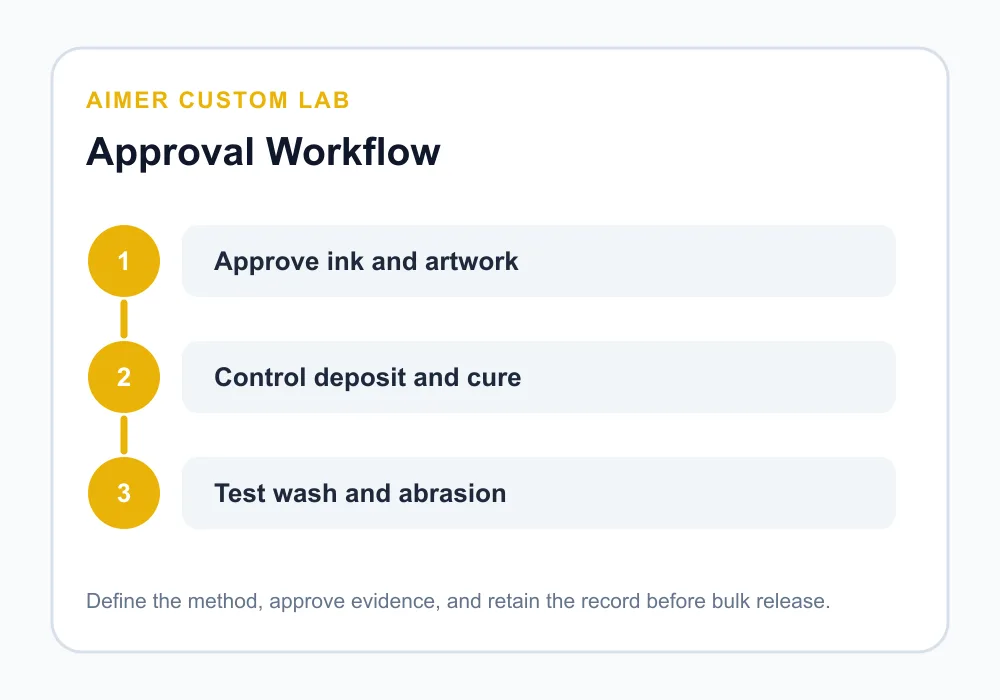
- Challenge the result: Complete wash and limited abrasion or flex testing before bulk.
- Retain settings: Link dryer, belt, temperature readings, ink and fabric lot to the approved piece.
How should streetwear puff print durability be tested?
Use the intended care instruction and an agreed number of cycles. Record water temperature, detergent, loading, drying and inspection timing. Compare loft and surface with an unwashed retained sample. Look for flaking, cracking, edge release, gloss change, color shift and garment distortion. A light abrasion check may help screen weakness, but the supplier notes that wash testing gives the more meaningful durability result.
If the design sits across the chest or another stretch zone, use a controlled extension trial within the intended garment use. Do not pull the sample arbitrarily until it fails. Define the direction and extension, then inspect the same points after recovery.
What should bulk quality control monitor?
- Ink product, mix ratio, lot and mixing record.
- Screen mesh, stencil and tension against approval.
- Garment fabric color, finish and lot.
- Flash behavior before later colors.
- Dryer profile and ink-film readings.
- Loft and texture at start, middle and end of run.
- Registration, garment puckering and edge detail.
- Retained-sample wash and abrasion observations.
Use the screen print curing guide to structure cure records. When loft changes, investigate deposit and heat before adding more additive. Uncontrolled formula changes can improve height temporarily while reducing film strength.
Frequently asked questions
Does more puff additive always create a better print?
No. Higher addition can increase expansion but may weaken wash stability or cause collapse. Follow product-specific limits and test.
Can puff ink be printed on polyester?
Some systems support selected synthetics, but compatibility, dye migration and cure temperature must be verified on the exact garment.
Why did the puff collapse in the dryer?
The ink may have activated during flash, exceeded its stable heat window or experienced uneven dwell. Check the complete heat profile.
Is a thicker stencil always more durable?
No. It increases deposit, but cure must reach the full film and the expanded layer must remain stable. Approve thickness and durability together.
Should puff prints be placed over seams?
Avoid it unless tested. Seams interrupt screen contact and create flex and abrasion zones that can distort the raised film.
What should a buyer retain for repeat orders?
Keep the signed garment, artwork and separation, ink formula, screen specification, heat record, wash result and fabric lot reference.
Conclusion: approve streetwear puff print durability with loft
Streetwear puff print durability comes from controlled deposit, compatible materials, a validated heat window and post-care evidence. Approve the physical texture and the process that created it, then monitor both through production. Contact Aimer Custom Lab with the artwork, garment fabric, color and desired puff character so a production-intent sample and test plan can be discussed.