Streetwear Carton Marking Guide
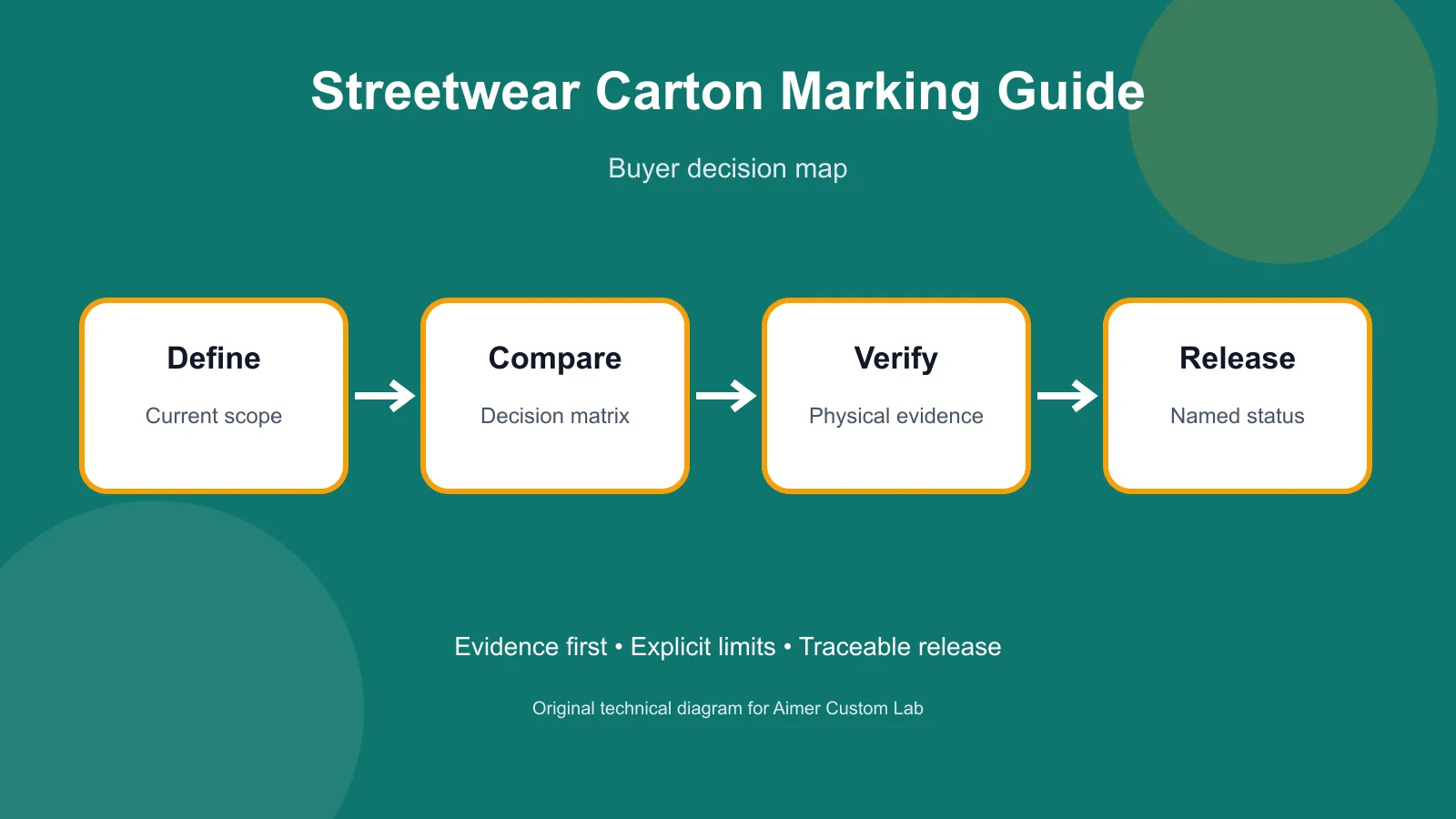
Quick Answer: Streetwear carton marking should identify the purchase order, brand, style, colour, size assortment, carton sequence, quantity and destination without forcing receivers to open every carton. Match visible marks and barcode data with the packing list, control label revisions and repeat verification whenever a carton is repacked.
A private-label shipment may contain several colours, size runs, hangtag versions and retail destinations. A generic mark such as mixed apparel can force the receiver to open every carton, while a copied carton number or wrong assortment can hide a shortage until allocation begins.
The control must stay linked to the current purchase order and approved revision. A clean-looking result is not sufficient when the represented product, size coverage or decision authority is unclear. Unknown values remain unknown; unavailable evidence is a coverage gap, not a pass.

What is streetwear carton marking?
Streetwear Carton Marking is the controlled human-readable and machine-readable information applied to a shipping carton so its contents and receiving destination can be identified. It supports a sourcing decision only when the represented order, method, revision and evidence boundary are explicit.
Key entities include purchase order, brand, style, colourway, size assortment, units per carton, carton sequence, destination, logistic unit identifier, barcode data, packing list, mark revision, repack status and release decision. Keeping these entities connected prevents an attractive image, isolated measurement or generic status from replacing the actual evidence needed for release.
Why does streetwear carton marking matter to private-label buyers?
It converts a subjective or fragmented check into a repeatable decision that can be reviewed by design, production, quality and receiving teams. The value is not the number of fields recorded; it is the ability to connect a current instruction to the physical goods and the final disposition.
Streetwear programs often combine multiple silhouettes, decoration methods, colours, sizes and packaging versions. The process should therefore identify what is represented, what remains outside coverage, which exceptions can be corrected and who can authorise the next step.
Which buyer decisions belong in the streetwear carton marking plan?
Translate the order into named decisions before asking an operator or inspector to act. The following matrix keeps convenience, visual similarity and obsolete files from becoming hidden acceptance rules.
| Decision | Evidence question | Required output |
|---|---|---|
| Order identity | Which PO, brand, style and colourway are inside? | Unambiguous order link |
| Assortment | Which sizes and quantities are packed in this carton? | Receiving-ready content statement |
| Sequence | Which carton is this within the full shipment? | Unique carton number and total |
| Destination | Which warehouse, store group or fulfilment route applies? | Controlled routing field |
| Barcode data | Which data element is encoded and who owns it? | Scannable logistics reference |
Commercial priorities can change timing or review depth, but they should not rewrite technical evidence. If a condition changes the represented product, document the approval and repeat the affected check against the updated revision.
Which source records define the evidence boundary?
Use current authoritative guidance for terminology, method and reporting context, then apply the buyer-approved specification to the actual order. The research sources used for this guide are listed below and linked again in the application record.
GS1 Logistic Label Guideline, ISO 15394 overview, SGS Pre-Shipment Inspection.
How should a buyer run the streetwear carton marking workflow?
Freeze inputs, perform a repeatable check, control exceptions and issue a named release decision. Record the responsible person, represented order, revision and dated outcome at every stage.
- Confirm buyer, carrier, destination and market-specific marking requirements.
- Freeze PO, brand, style, colour, component and retail-pack identifiers.
- Define the human-readable field list and the order in which fields appear.
- Assign carton sequence, total-carton logic and any logistic-unit identifier.
- Map each size assortment and inner-pack quantity to the packing list.
- Create one approved label artwork revision with readable contrast and dimensions.
- Print marks from controlled data rather than retyping each carton manually.
- Apply labels to the agreed carton faces without covering closures or warnings.
- Reconcile the mark with the physical contents and packing list before sealing.
- Control repacks and replacement labels, then record the final shipment release.
A changed input reopens the affected decision. Do not allow an earlier sample, inspection or label to remain the release basis when the physical product or instruction has changed.
What evidence should be retained?
The evidence package should allow another reviewer to understand exactly what was checked, what was not checked and why the final decision was made. Photographs support identity and findings, but they do not replace quantity, measurements, revision or method.
| Evidence block | Minimum identity | Buyer verification |
|---|---|---|
| Mark specification | field list, format, placement and revision | Is there one current approved template? |
| Packing data | PO, style, colour, size and quantity | Do printed values come from a controlled source? |
| Carton record | sequence, quantity, weight and dimensions | Can every carton be reconciled? |
| Readability check | human text, barcode and print condition | Can receiver systems use the label? |
| Repack log | reason, replacement mark and recheck | Does final evidence match final contents? |
How should results and exceptions be interpreted?
Interpret a result only inside the recorded scope and conditions. A local pass does not erase an uncovered size, changed input, unavailable document or unresolved exception.
| Finding | Meaning | Action |
|---|---|---|
| Within the approved boundary | The sampled condition meets the recorded basis | Retain evidence and continue the defined workflow |
| Outside the boundary | The represented units require disposition | Segregate, investigate and record authority |
| Required evidence unavailable | Coverage is incomplete | Pause the affected judgment and request the missing record |
| Goods changed after checking | Earlier evidence may no longer represent the lot | Repeat affected checks before release |
Which failure modes should the buyer prevent?
The most serious failure is a complete-looking record that represents the wrong product, revision or population.
- Using abbreviations that the receiver cannot interpret.
- Omitting colour or size assortment from mixed-style shipments.
- Repeating one carton number on different logistics units.
- Encoding barcode data that conflict with the printed text.
- Applying labels across seams, closures or damaged corrugated board.
- Handwriting uncontrolled corrections over the approved label.
- Repacking after inspection without issuing a controlled replacement mark.
- Treating a carrier label as a complete buyer content mark.
These failures are controlled through defined inputs, representative selection, explicit unknowns, revision discipline and named decision authority. More fields do not compensate for the wrong evidence boundary.
What belongs in the pre-release checklist?
Use a short checklist only after the detailed method and acceptance basis are agreed.
- Buyer and destination requirements current
- PO, style and colour identifiers match
- Size assortment and quantity explicit
- Carton sequence unique
- Packing list reconciled
- Destination field correct
- Barcode data defined and readable
- Placement durable and visible
- Repack changes controlled
- Final release status recorded
How did high-traffic and fast-growth peer learning improve this guide?
Peer learning was applied to information architecture, direct answers, internal-link context and entity clarity only. Competitor wording, branded artwork, prices, claims and product designs were not copied.
| Dimension | Research finding | Specific application | Public evidence marker |
|---|---|---|---|
| SEO | customink.com: Custom Ink separates product choice, personalization, size collection and ordering into clear buyer tasks with descriptive links. | Aligned the title, search intent, decision table and descriptive internal links around streetwear carton marking. | ACL-CARTON-SEO intent and decision matrix |
| AEO | uberprints.com: UberPrints answers common ordering questions immediately and follows them with a short step sequence. | Added a 40-70 word Quick Answer, question headings, direct first sentences, numbered steps and five practical FAQs. | ACL-CARTON-AEO answer-first workflow |
| GEO | customink.com and uberprints.com: The qualified peers connect concrete product, design, quantity and delivery entities instead of relying on broad quality language. | Defined purchase order, brand, style, colourway, size assortment, units per carton, carton sequence, destination, logistic unit identifier, barcode data, packing list, mark revision, repack status and release decision; linked claims to authorities and stated evidence limits. | ACL-CARTON-GEO entity and evidence boundary |
The high-traffic signal came from current July 2026 session evidence for Custom Ink. The fast-growth signal came from UberPrints’ latest three-month growth evidence. These traffic signals qualify the peers; they do not prove that every page element caused growth.
How were authority findings applied?
| Research source | Applied finding | Visible evidence |
|---|---|---|
| GS1 Logistic Label Guideline | Used terminology and record structure without treating the source as supplier certification or a universal pass rule. | definition and decision table |
| ISO 15394 overview | Applied inspection and traceability boundaries while keeping acceptance order-specific. | workflow and evidence table |
| SGS Pre-Shipment Inspection | Applied textile and shipment evidence context and required explicit limits. | interpretation and FAQs |
The answer-first boundary supports AEO. Stable entities, source links, decision conditions and explicit unknowns support GEO without promising inclusion in any AI-generated answer.
Frequently asked questions about streetwear carton marking
Should every size be printed on the carton?
When the carton contains a size assortment, the approved mark or linked packing record should make each size and quantity unambiguous..
Is a packing list enough without carton marks?
Not when receivers need carton-level identification. The list and the physical mark should reconcile rather than substitute for each other.
Can several cartons share one barcode?
Use the identification rules defined by the buyer and logistics system. A unique logistics-unit identifier should not be duplicated.
Where should a carton label be placed?
Follow the approved carton-face and carrier requirements, keeping the label readable and away from closures or likely abrasion..
What happens after a carton is repacked?
Replace affected identification through revision control and repeat the content, quantity and readability checks..
Conclusion: release only what the evidence represents
Streetwear Carton Marking is the controlled human-readable and machine-readable information applied to a shipping carton so its contents and receiving destination can be identified. A reliable process connects current inputs, representative physical evidence, exception control and named authority. The decision should make the next sourcing, production or shipment step easier without overstating what was checked.
Continue with private-label hoodie manufacturing, streetwear production capabilities, confirm packaging requirements. Share the represented style, intended market, active specification and required evidence so project-specific options can be confirmed rather than assumed.