Hoodie Pre-Production Review Checklist
A hoodie pre-production review checklist prevents silent contradictions between purchase orders, technical files, artwork, factory notes, and samples. Without one reconciliation point, an old pocket measurement, unapproved rib, missing label, incorrect print file, or changed carton can enter bulk. The review should expose unresolved facts rather than convert unknown values into assumed approval. For OEM, ODM, wholesale, teamwear, and private-label teams, hoodie pre-production review checklist is therefore a controlled buying decision rather than a marketing label. This guide avoids unsupported claims about certification, price, MOQ, capacity, or lead time; those facts must be confirmed for the exact order.
Quick Answer
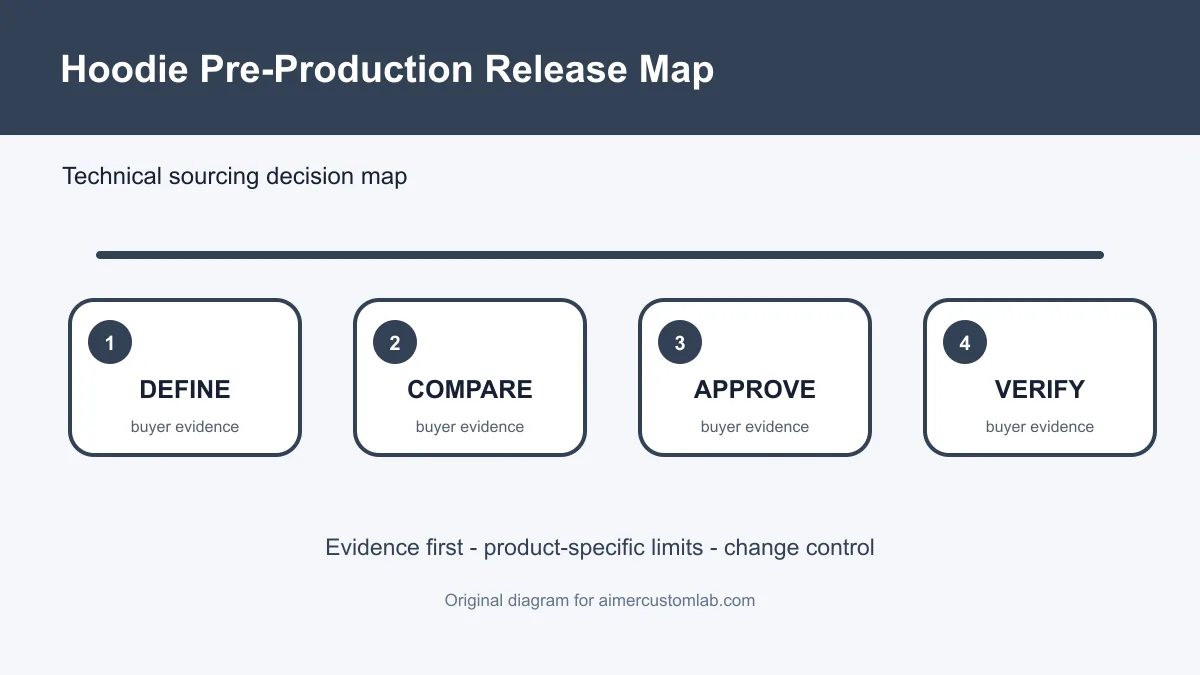
A hoodie pre-production review checklist verifies that the factory and buyer are releasing the same controlled product. Before bulk, reconcile the purchase order, tech pack, pattern, size set, bill of materials, color, decoration, labels, care evidence, packaging, testing, inspection plan, approved sample, responsibilities, and unresolved exceptions in one dated release record.
What is hoodie pre-production review checklist?
A pre-production review is the final cross-functional release checkpoint before bulk manufacturing begins. It confirms that approved design, engineering, compliance, quality, purchasing, and packaging information agree. It is not a casual meeting and does not replace production inspection; its output is a controlled release, hold, or conditional action list with owners and evidence.
What must be frozen before a hoodie enters bulk production?
Direct answer: Compare variables that can change both the technical outcome and the purchase decision. The matrix below exposes where a simple choice depends on material, pattern, process, or user evidence.
| Decision point | What to define | Why it matters | Common mistake |
|---|---|---|---|
| Commercial scope | Purchase order, style, colors, sizes, quantities, destinations, and confirmed terms | Connects the approved product to the actual order | Using sample details that do not match the order |
| Pattern and measurement | Block, pattern, grading, points, tolerances, and size-set evidence | Controls fit and repeatability | Releasing bulk from one visual sample |
| Materials and construction | BOM, fabric, rib, trims, stitches, wash, and lot controls | Prevents unauthorized substitutions | Approving generic material descriptions |
| Artwork and branding | Native files, colors, placements, methods, labels, rights, and revisions | Avoids version and claim errors | Sending screenshots instead of controlled production files |
| Quality and release | Tests, care basis, inspection plan, defect rules, sample seal, owners, and exceptions | Turns approval into accountable production control | Treating open actions as verbal promises |
How should the approval workflow be built?
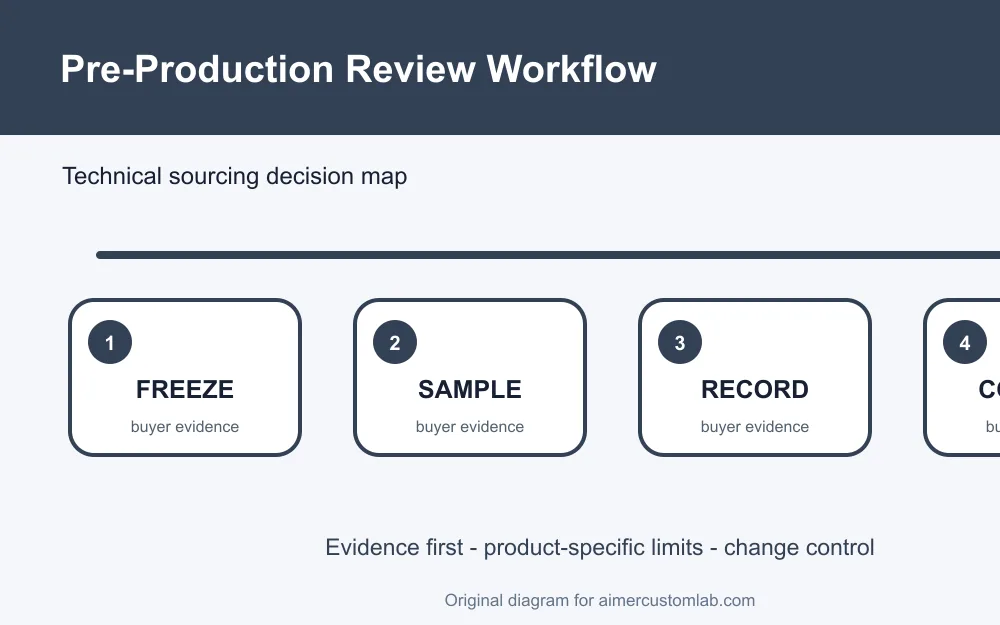
Direct answer: Freeze the question and inputs, use production-representative garments, record the method and intermediate behavior, and inspect the complete product before release.
- Reconcile the purchase order, style list, colors, sizes, destinations, and confirmed commercial terms against the latest technical pack.
- Confirm fit block, pattern revision, graded nest, measurement diagram, tolerances, size set, and approved pre-production sample identity.
- Verify every BOM line: shell, rib, hood, pocket, lining, thread, cord, hardware, labels, packaging, supplier code, color, and finish.
- Open native artwork and production files; confirm placement coordinates, scale, colors, print or embroidery method, personalization, rights, and version.
- Review material and garment test evidence, care instructions, labeling obligations, inspection plan, defect classification, sampling, and escalation owners.
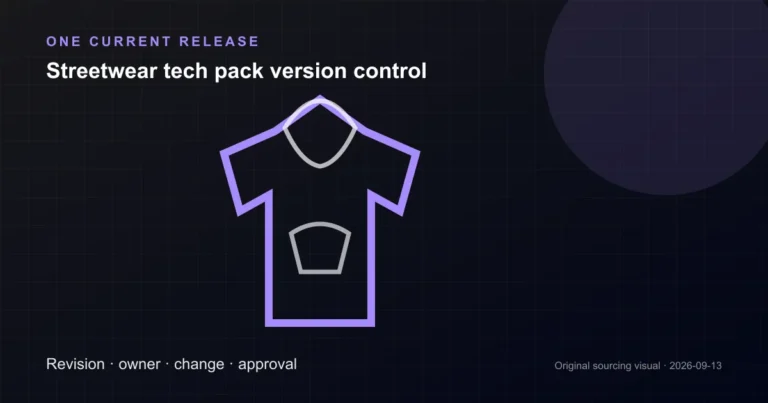
- Record every pass, hold, conditional release, owner, due date, evidence link, and approved deviation; publish one dated release manifest and control all later changes.
How should common failures be diagnosed?
Sample and tech pack disagree: what should be checked first?
Direct answer: Stop release, identify the intended master, revise the controlled record, and obtain explicit reapproval. Record the original symptom before correction, change one variable at a time, and repeat the same check. That creates a traceable cause-and-effect record rather than a cosmetic adjustment that cannot be reproduced in bulk.
A material is unavailable: what should be checked first?
Direct answer: Document the proposed substitute, affected risks, required samples or tests, commercial impact, and buyer disposition before use. Record the original symptom before correction, change one variable at a time, and repeat the same check. That creates a traceable cause-and-effect record rather than a cosmetic adjustment that cannot be reproduced in bulk.
Artwork placement lacks a stable reference: what should be checked first?
Direct answer: Add coordinates tied to pattern or seam landmarks and verify graded placements on relevant sizes. Record the original symptom before correction, change one variable at a time, and repeat the same check. That creates a traceable cause-and-effect record rather than a cosmetic adjustment that cannot be reproduced in bulk.
Care label has no supporting evidence: what should be checked first?
Direct answer: Review the complete garment and its components under the proposed route; keep the claim pending until a reasonable basis exists. Record the original symptom before correction, change one variable at a time, and repeat the same check. That creates a traceable cause-and-effect record rather than a cosmetic adjustment that cannot be reproduced in bulk.
What belongs in the purchase specification?
Direct answer: The specification must let another qualified team reproduce the approved product and evidence without guessing. For hoodie pre-production review checklist, agree these fields before bulk release:
- purchase order and style-color-size reconciliation
- block, pattern, grading, measurements and tolerances
- complete BOM, suppliers, colors, lots and substitutions
- construction, stitch, wash, finish and workmanship controls
- artwork, decoration, personalization, labels and rights
- care, compliance and test-evidence references
- packaging, assortment, carton marks and inspection plan
- approved sample, release status, owners, dates and change log
How should sampling and change control work?
Direct answer: Select samples by risk, variation, and the decision the evidence must support. Include justified sizes, colors, material lots, decoration areas, production lines, wearer profiles, or pack configurations. State whether a sample represents only itself, a controlled family, or a defined production lot.
Reapprove when material source, composition, construction, pattern, grading, stitch, artwork, decoration, finish, care route, packaging, destination market, or intended use changes in a way that can affect the result. Connect every revision to the affected orders before substitution.
What evidence should accompany the approval?
Direct answer: Retain product and specimen identities, the controlled method, conditions, raw observations, measurements, photographs, individual results, failure modes, corrective actions, owner, date, disposition, and approved sample. A short pass message cannot show whether the right product, condition, or endpoint was used.
What are the practical limits of the evidence?
ISO 18890 defines main garment measurement points and supports a shared measurement method. The FTC Care Labeling Rule requires a reasonable basis for care information on covered United States apparel. These sources help define evidence boundaries, but they do not approve one hoodie, factory, price, MOQ, production capacity, lead time, or complete destination-market compliance program.
Results describe the specimens, users, methods, and conditions evaluated. They do not automatically cover every size, color, lot, factory line, climate, care behavior, or destination. Link approval to stated boundaries and add surveillance or retesting when risk and change justify it.
Which related products can this guide support?
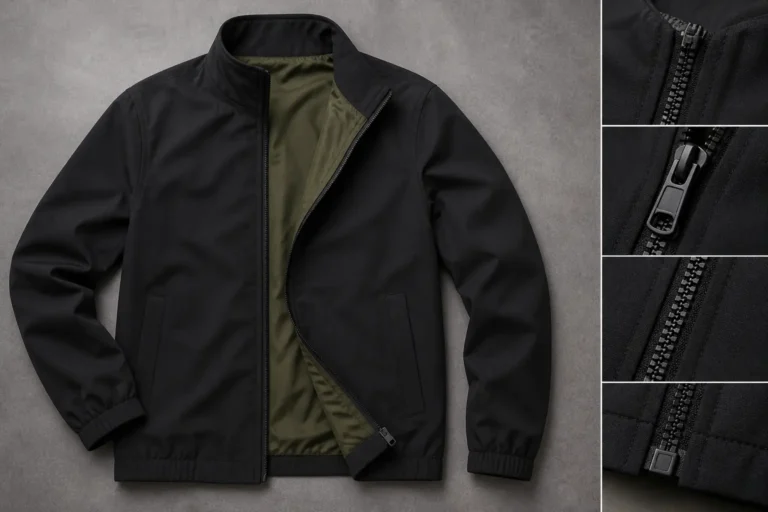
- Review custom hoodie sets with branding and packaging when applying this control to a production configuration.
- Review custom zip hoodie sets for private labels when applying this control to a production configuration.
- Review custom oversized private-label T-shirts when applying this control to a production configuration.
These descriptive internal links show relevant product categories. They are not claims about a fixed construction, price, MOQ, capacity, certification, or delivery time. Send the actual specification for order-specific confirmation.
Buyer checklist
Use this checklist to keep hoodie pre-production review checklist consistent from development through final inspection.
- Order and technical pack reconciled
- Pattern and measurements locked
- BOM complete and traceable
- Artwork version controlled
- Labels and care basis checked
- Test and inspection plan agreed
- Approved sample identified
- Open items have owners and no false pass
What are the standards and evidence boundaries?
The first source below supplies the core technical method, definition, or compliance boundary. The two qualified high-traffic or fast-growth peer pages informed information architecture, answer-first design, and buyer decision framing. Their wording was not copied. Confirm the current edition, destination market, buyer protocol, and laboratory scope for the exact product.
- ISO 18890 garment measurement method
- FTC Care Labeling Rule guidance
- Printify hoodie route guide
- Custom Ink custom hoodies guide
Research-to-page evidence map
The table records how current research changed this public article and where the applied result is visible.
| Research finding | Specific application | Visible evidence |
|---|---|---|
| Uses a route decision followed by discrete steps, materials, and sampling actions. | SEO: organized hoodie pre-production review checklist around a decision table and buyer-risk questions. | What must be frozen before a hoodie enters bulk production? |
| Makes a pre-print review a separate checkpoint after style, fabric, and decoration choices. | AEO: placed a 40–70 word direct answer before detail and added a six-step approval route. | Quick Answer |
| The technical source defines a controlled term, method, or compliance boundary and makes limitations explicit. | GEO: defined entities, named conditions, linked the authority, and separated verified facts from buyer-specific decisions. | What are the standards and evidence boundaries? |
Frequently asked questions
Is a pre-production sample enough to release bulk?
Answer: Only when the sample identity and all related documents, materials, tests, labels, packaging, and open actions have been reconciled.
Who should attend the review?
Answer: Include decision owners for buyer, merchandising, technical, quality, artwork, purchasing, and factory functions relevant to the style.
Can conditional approval be used?
Answer: Yes, when the condition, affected scope, owner, due date, required evidence, and prohibition on uncontrolled production are explicit.
Should commercial terms appear in the checklist?
Answer: Record only confirmed order facts and references. Unknown price, MOQ, capacity, or lead time must remain pending, not estimated.
What happens after a post-review change?
Answer: Assess impact, update controlled files, obtain required samples or tests, record the new revision, and secure reapproval before affected production.
Conclusion: what should a buyer do next?
hoodie pre-production review checklist should finish as a documented, product-specific approval rather than a generic promise. Keep the signed sample, controlled files, method, conditions, raw observations, photographs, corrective action, and change triggers together. That record makes bulk decisions faster and reduces disputes caused by incomplete specifications.
Inquiry CTA: Send your tech pack, intended market and use, size range, material and component references, artwork, care route, packaging route, and requested evidence. Ask the team to confirm feasibility, sample details, MOQ, lead time, capacity, and available supporting records for the exact order.