Streetwear Eyelet Specification Guide
Streetwear eyelet specification turns a small metal or molded opening into a controlled garment component. Eyelets may guide hoodie drawcords, ventilate a jacket panel or reinforce a decorative hole, but poor material, sizing or attachment can cut fabric, stain a wash, detach in use or create a sharp edge.
Quick Answer: What should a streetwear eyelet specification include?
Define the eyelet and washer as a matched set, name material, finish, inside diameter and flange dimensions, show the exact location, and state the required fabric reinforcement and setting method. Approve appearance, edge safety, pull resistance and wash compatibility on the actual layered garment before bulk production.

What is an eyelet in streetwear?
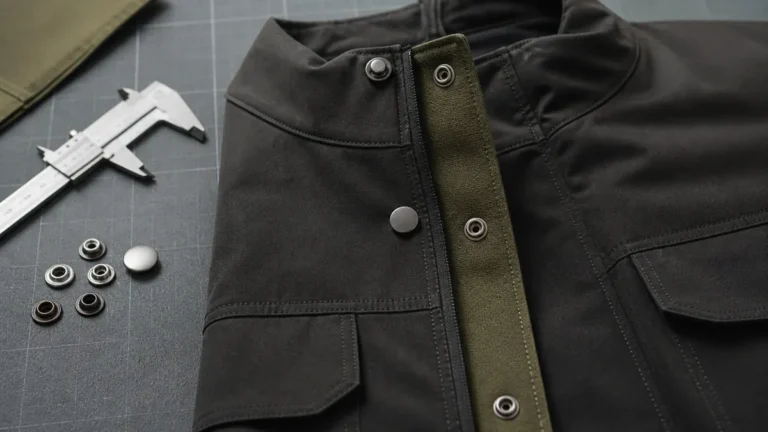
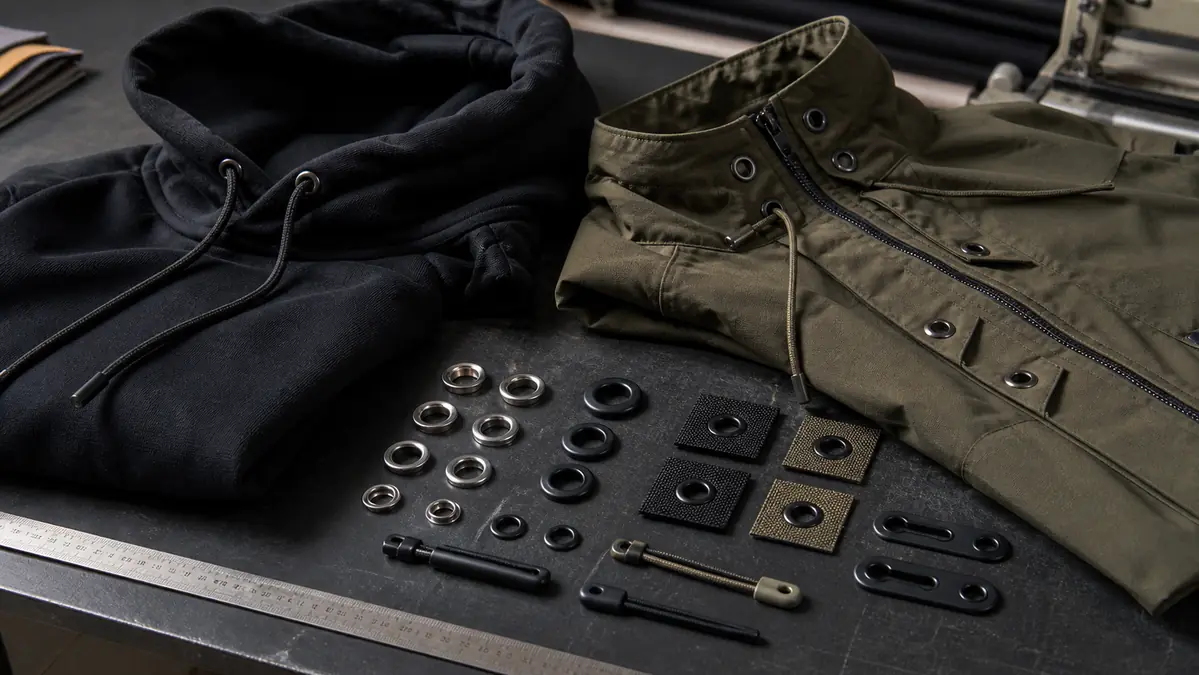
An eyelet is a ring-shaped component placed through a prepared hole. Many garment systems use a visible eyelet on the face and a washer on the reverse. During setting, the barrel is rolled, split or compressed to clamp the fabric layers. The finished opening may guide a cord, provide ventilation or serve as a visual detail.
A streetwear eyelet specification must distinguish an eyelet from a snap, rivet or sewn buttonhole. These products may look related but use different parts, tools and performance checks. The buyer should also identify whether “grommet” and “eyelet” are being used as supplier terms or as different size categories; the technical drawing should remove ambiguity.
Where are eyelets commonly used?
- Hood drawcord exits on hoodies and sweatshirts.
- Waist or hem drawcord exits on jackets, trousers and shorts.
- Underarm or back-yoke ventilation openings.
- Lace-up panels, adjustable tabs or decorative arrangements.
- Drainage points on pocket bags or specialized outerwear details.
Each location has a different load, layer stack and skin-contact risk. A ventilation eyelet may carry little direct pull but face wash chemicals and abrasion. A drawcord eyelet must tolerate repeated cord movement and localized pulling. Do not copy one location’s part and acceptance rule to all others.
How should eyelet material and finish be selected?
| Decision | Options to compare | Main risk | Buyer evidence |
|---|---|---|---|
| Base material | Brass, steel, aluminum or approved polymer system | Corrosion, deformation, weight or breakage | Supplier material declaration and finished-sample test |
| Surface finish | Plated, painted, oxidized or molded color | Chipping, shade variation, staining or restricted substances | Approved color standard and relevant compliance evidence |
| Washer type | Matched ring, toothed or supplier-specific backing | Uneven clamp, fabric cutting or part separation | Matched component code and section sample |
| Profile | Flat, raised, rolled or decorative flange | Snagging, discomfort or visual mismatch | Approved face and reverse appearance |
| Magnetic behavior | Depends on metal and finish | Unexpected product or packaging interaction | Material confirmation where relevant |
The finish must be evaluated after every planned garment process. Enzyme wash, pigment wash, stone effects, bleaching, heat and acidic conditions can change color or accelerate corrosion. Ask the hardware supplier whether the finish is suitable, then validate it on a representative garment rather than relying on a catalog image.
Which dimensions belong in a streetwear eyelet specification?
Record inside opening diameter, visible outside diameter, flange profile, barrel length and washer dimensions. Barrel length must accommodate the complete layer stack and still set correctly. An eyelet chosen only by visible diameter can be too short for a reinforced hoodie or too long for a single lightweight shell.
State location from stable pattern reference points, not from a variable seam edge after assembly. Mark whether dimensions refer to the hole center, inside edge or outside flange. For paired eyelets, define spacing and symmetry. Include permitted position and visual tolerances that reflect the garment’s scale.
How should the hole be prepared?
The hole method should suit the shell and reinforcement. Cutting too large leaves too little fabric under the flange; cutting too small can distort the panel or prevent correct rolling. A ragged hole can begin a tear. The approved punch should be maintained and matched to the eyelet system.
Knits and soft wovens often need a reinforcement patch or interlining. It must extend beyond the flange without showing through, and its stretch, shrinkage and wash behavior should match the shell. A streetwear fusible interlining guide can help teams evaluate heat-bonded support when it is appropriate, but the eyelet assembly still needs its own test.
How is the eyelet set without damaging fabric?
- Verify the parts. Confirm eyelet and washer codes, material, finish and barrel length.
- Stabilize the panel. Apply the approved reinforcement and allow it to cool or settle.
- Cut the hole. Use the sealed punch size and inspect the edge.
- Load face and washer. Keep orientation correct and avoid trapping folds.
- Set with matched tooling. Control alignment, pressure and stop position.
- Inspect both sides. Look for complete roll, cracks, burrs, tilt and fabric damage.
- Test the assembly. Apply the agreed pull, wash and functional checks.
Tooling must match the component geometry. A die from another brand or size may mark the face or roll the barrel unevenly. Operators should not compensate for a wrong tool by increasing pressure until the part appears flat.
What does a safe finished eyelet look like?
The face should be seated evenly without rocking, excessive indentation or chipped finish. The reverse should be fully formed and free from sharp edges, splits or exposed points. Fabric should remain smooth around the flange. The opening must be clear enough for the specified cord without scraping its cover.
Run a fingertip and approved snag check on both sides, considering whether the component contacts skin. Visual inspection should include angled light. Tiny cracks can hide under normal overhead lighting and grow during laundering.
How should attachment strength be tested?
The method must reflect the product and applicable buyer requirement. Measure the force or controlled functional loading needed to separate the eyelet, washer or surrounding fabric, and record the failure mode. A result is incomplete if it says only “passed” without showing whether hardware detached, fabric tore or reinforcement delaminated.
YKK’s published fastening-product quality methods illustrate why dimensions, finish and attachment behavior require defined tests, although buyers must select procedures applicable to their exact eyelet and garment. A practical wear simulation can supplement laboratory measurement by cycling the real drawcord through the opening and checking abrasion.
How do garment wash and care affect the result?
Hardware can react with detergent, bleach, enzymes, moisture and other metal parts. Test the final color, wash recipe and drying method. Check staining on adjacent light fabric, coating loss, corrosion, washer movement and sharpness. If the garment will be sold with a care instruction, the approval sequence should reproduce that instruction.
For cord exits, inspect both hardware and cord after care. Our streetwear hoodie drawcord guide covers cord diameter, tips and routing; the cord and opening must be approved as one functional pair.
What should happen during sampling?
Start with a material board and component codes, then create section samples using the actual shell and reinforcement. Compare at least the intended color and any high-risk light or washed colors. After appearance approval, test pull behavior, cord abrasion, wash compatibility and wearer comfort.
Build the selected assembly into the full pre-production garment. The streetwear clothing sampling process explains how component approval fits into the larger sequence. Seal the successful part, washer, punch, die, pressure setting, location and sample.
How should a streetwear eyelet specification control bulk quality?
- Keep eyelet and washer lots identified and paired.
- Approve the first pieces after every tooling, color or operator change.
- Check location, symmetry, face seating, reverse roll and fabric distortion.
- Use a go/no-go or dimension gauge where the supplier recommends it.
- Perform scheduled attachment tests using the agreed sampling plan.
- Recheck after wash when the finish or garment process creates risk.
- Segregate cracked, tilted, sharp or loose assemblies; do not repair by hammering.
What belongs in a streetwear eyelet specification?
- Supplier and matched eyelet/washer component codes.
- Base material, finish, color standard and required compliance documents.
- Inside and outside diameters, profile and barrel length.
- Location, spacing, orientation and tolerances on the technical drawing.
- Shell layer stack, support patch and hole preparation.
- Approved punch, die, machine and setting controls.
- Visual, sharp-edge, functional, pull and care acceptance rules.
- Sealed sample and bulk sampling frequency.
Frequently Asked Questions
Does every eyelet need a washer?
Not every system uses the same backing, but parts must follow the supplier’s matched design. Do not omit or substitute a washer without validation.
Can the eyelet be set before garment washing?
It may be, but finish and attachment must tolerate the exact wash. Some programs choose a different sequence. Test the intended production route.
Is a larger flange always safer?
No. It can distribute load, but it may show through, distort the panel or change hand. Balance geometry with shell and reinforcement.
How large should the fabric hole be?
Use the component supplier’s tooling guidance and validate it on the actual layer stack. An arbitrary hole size risks cutting or poor clamping.
Can a pull test alone approve an eyelet?
No. Pull resistance does not cover sharp edges, corrosion, coating loss, cord abrasion, wash staining or placement accuracy.
Should branded hardware be used in samples?
Only if authorized and intended for production. Unapproved marks or logos should not appear in product development imagery or bulk goods.
Conclusion: Specify the complete eyelet assembly
Reliable streetwear eyelet specification covers component identity, geometry, washer, fabric support, tooling, setting, safety, wash and bulk control. The YKK Eyelet Washer product reference demonstrates the importance of treating eyelet and washer as a system, while the final selection still requires garment-specific approval.
Developing hoodies, jackets or trousers with eyelet details? Contact Aimer Custom Lab with the drawing, shell, reinforcement, wash process and cord details. We can align the sampling checklist before bulk approval.