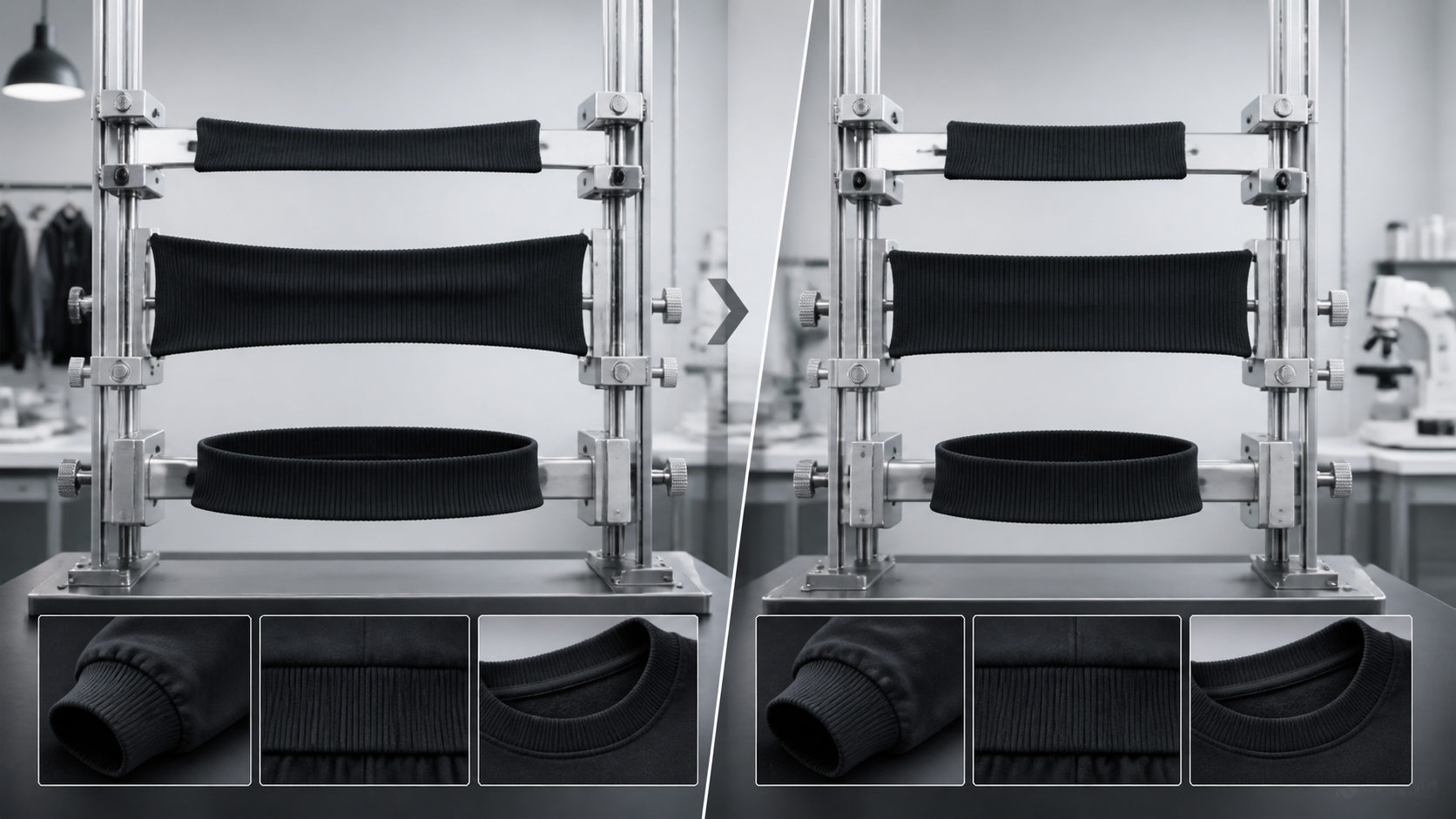
Streetwear Rib Recovery Test: Buyer Guide
A streetwear rib recovery test turns a broad quality claim into evidence that buyers can compare before bulk approval. For private-label streetwear, the result matters because necklines, cuffs, and waistbands can bag, wave, or lose shape after extension and washing. A useful plan records the specimen, equipment, conditioning, settings, result units, failure observations, and the person who approved the decision. This guide explains how to build that plan without inventing a universal pass number.
Quick Answer: Run the streetwear rib recovery test on representative production fabric, trims, prints, or finished garments, follow one declared method, keep every test condition consistent, and judge results against a written product-specific requirement. Do not compare values produced with different equipment, specimen geometry, pressure, clamping, laundering, or conditioning.
streetwear rib recovery test: Purpose and Buyer Decisions
The purpose is not simply to generate a high number. It is to understand whether growth and recovery after controlled extension and relaxation remains suitable for the intended jersey, panel location, decoration, size range, and use environment. Oversized T-shirts, hoodies, tracksuits, jackets, and heavily decorated panels can present different risks. Buyers should decide which constructions are critical before sampling begins.
A test request should connect to a purchasing decision: approve the sample, request a construction change, repeat after washing, increase production inspection, or reject a nonconforming lot. When no decision rule exists, a laboratory report can look precise while remaining commercially useless. The specification should name who reviews the report and what happens when a result is close to the agreed limit.
Choose and Document the Test Method
ASTM D2594 covers stretch properties of knitted fabrics under specified tension, while ASTM D4964 addresses tension and elongation of elastic fabrics. Extension level, hold time, relaxation, cycles, specimen geometry, and laundering must be declared. See ASTM D2594 and ASTM D4964.
Official standards describe apparatus and procedures, but they do not create one pass value for every streetwear garment. Buyer and supplier must agree on the applicable edition, specimen count, conditioning, settings, calculation, rounding, and reporting format. If an internal method is used, attach the work instruction so another laboratory can reproduce it.
Method variables that must stay controlled
- Fabric lot, colour, panel position, direction, size, and decoration state.
- Conditioning atmosphere, prewashing, drying, and relaxation time.
- Machine type, calibration status, fixture, test area, speed or pressure.
- Number of specimens, invalid-test rule, averaging, and reporting units.
- Failure location, photographs, operator, date, and sample identification.
Build a Representative Sampling Plan
Start with the bill of materials and garment map. Identify the main body, contrast panels, mesh zones, collars, cuffs, reinforced areas, and printed or embroidered sections. Select specimens from locations that represent real production, not only the strongest uninterrupted fabric. Include colourways or finishes that could behave differently.
Sampling should cover development, pre-production, and risk-based bulk checks. Development tests help compare constructions. A pre-production test confirms the approved fabric, machinery, and decoration combination. Bulk testing verifies that production stayed within the approved window. Preserve a sealed reference sample and link every report to a purchase order, batch, and revision.
Rib Recovery Comparison Table
| Control point | Record | Buyer question |
|---|---|---|
| Specimen identity | Lot, colour, direction, panel | Does it represent bulk goods? |
| Conditioning | Atmosphere, wash state, relaxation | Can results be repeated? |
| Equipment | Method, fixture, calibration | Are values comparable? |
| Settings | extension percentage, hold time, relaxation | Were agreed variables used? |
| Result | growth, recovery percentage, residual deformation | What does the number mean? |
| Observation | bagging, edge curl, seam distortion | What improvement is needed? |
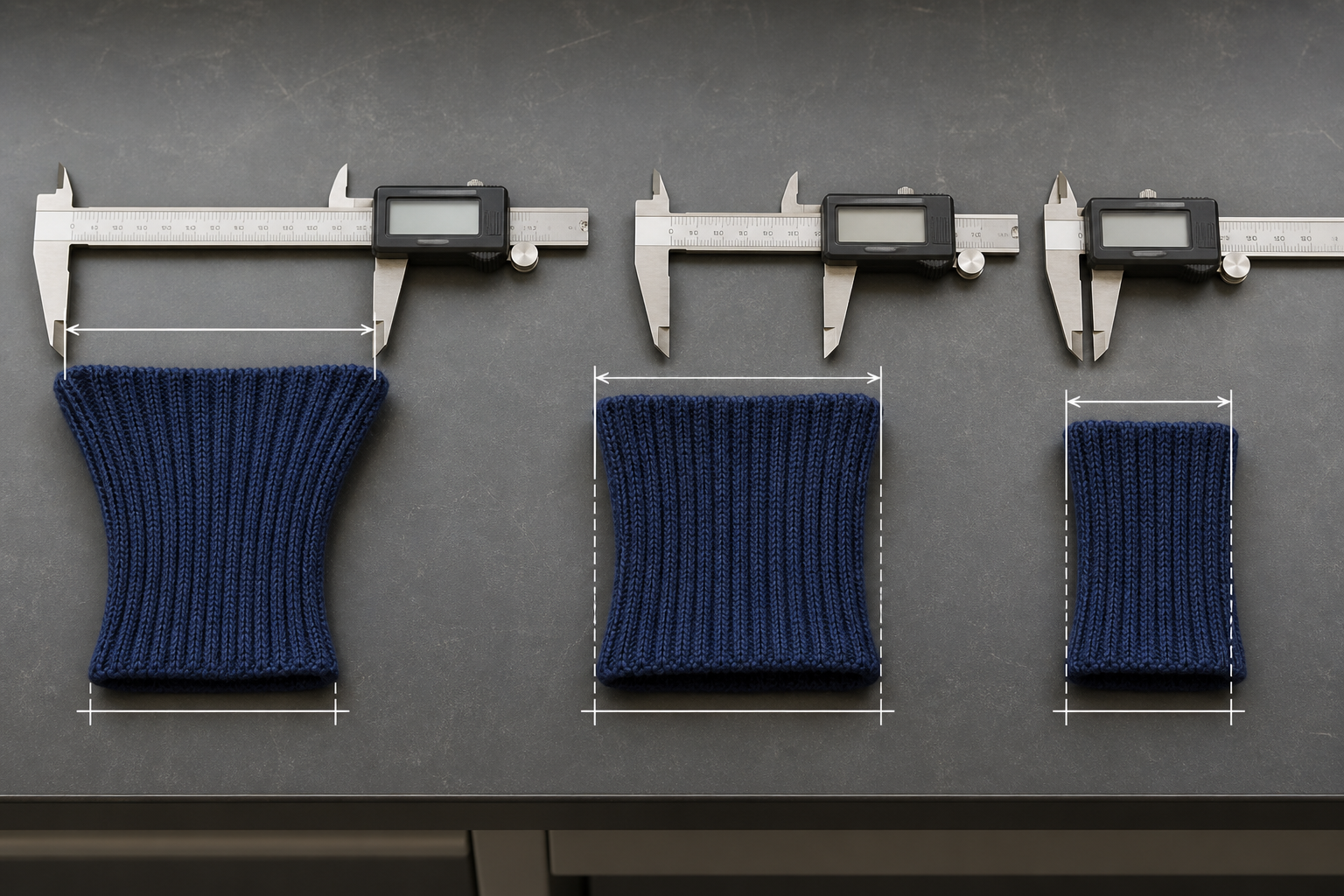
Interpret Results Without False Precision
Averages alone can hide a weak specimen. Review every result, the range, variation, and failure location. Compare only like-for-like data produced with the same method and settings. A result may be technically high yet commercially unsuitable if failure occurs suddenly, distorts a decorated panel, or creates an uncomfortable garment.
The streetwear rib recovery test should be read with related evidence such as fabric weight, dimensional stability, colourfastness, seam performance, snagging, print adhesion, and wear trials. No single test predicts every field condition. Use laboratory data to reduce uncertainty, then confirm appearance, hand feel, fit, and mobility on an approved garment sample.
From Sample Approval to Bulk Quality Control
Create an approval record that links the report to the exact material and construction revision. The record should show accepted settings, raw data, photos, comments, and sign-off. If fabric, finish, supplier, yarn, gauge, decoration, or panel design changes, review whether retesting is required.
During bulk production, use risk-based verification. Check incoming fabric identity, cutting direction, machine settings, and workmanship before selecting finished pieces. Investigate trends rather than waiting for a complete failure. Corrective action may include material replacement, process adjustment, panel redesign, additional reinforcement, operator training, or a new approval sample.
Common Buyer Mistakes
One mistake is asking for “the standard test” without naming the method or settings. Another is accepting a single best specimen. Buyers also create confusion when they compare reports from incompatible procedures, omit conditioning, or fail to state whether washed and unwashed values are required. A certificate without sample traceability cannot prove that the tested material matches bulk goods.
Do not copy a competitor’s limit without confirming the product, method, and end use. Avoid treating a minimum as a design target with no safety margin. Finally, do not let a passing laboratory number replace garment inspection. The report supports a decision; it does not replace review of fit, construction, decoration, and workmanship.
streetwear rib recovery test Approval Checklist
- Define end use and critical panels.
- Name the method and current edition.
- Confirm specimen count, directions, and wash state.
- Record equipment, calibration, settings, and units.
- Review raw results, variation, photos, and failure modes.
- Set a product-specific approval rule and escalation path.
- Link the approved report to the bulk order and revision.
FAQ
Is one result enough?
No. Multiple representative specimens show variation and reduce the risk of approving an unusually strong or weak piece.
Can two standards be compared directly?
Not automatically. Different apparatus, test areas, loading systems, and reporting rules can produce different values. Keep the method constant or validate a correlation study.
Does the standard provide a universal pass value?
Usually no. The buyer and supplier need a product-specific requirement based on method, end use, construction, and risk.
Should testing be repeated after washing?
When laundering can change the fabric, finish, decoration, or geometry, include a declared wash and drying sequence and compare results under identical conditions.
What should a supplier report contain?
Sample identity, method edition, conditioning, equipment, settings, raw results, calculations, failure observations, photos, operator, date, and approval status.
Conclusion
A reliable streetwear rib recovery test combines representative specimens, one controlled method, complete reporting, and a decision rule tied to the actual garment. Review the test with the wider quality plan instead of treating one number as a guarantee. For a project-specific testing discussion, review our streetwear sampling process, explore products, and contact Aimer Custom Lab. Confirm final methods and limits for the specific order.
Streetwear Rib Recovery Test Reporting
Identify rib construction, fibre content, width, attachment seam, extension level, hold time, cycles, relaxation, wash state, and measurement locations. Compare collar, cuff, and waistband functions separately. A neckline may need appearance stability, while a cuff must recover after repeated hand passage. Record wave, curl, tunnelling, and seam damage alongside residual growth.