Streetwear Lab Dip Approval Guide
Quick Answer: Streetwear lab dip approval confirms whether a laboratory dyeing on the intended substrate is an acceptable colour direction before bulk dyeing. Buyers should identify the physical and digital standard, material, recipe, finish, lighting, instrument settings, visual assessment, tolerance rule, approver and bulk applicability, then retain the approved dip as a controlled reference rather than a colour guarantee.
A colour name or screen image is not enough to control garment dyeing. Fibre, yarn, construction, finish and viewing light can change appearance. Streetwear lab dip approval creates a reproducible decision before the mill commits bulk material, while preserving the difference between an approved development sample and actual bulk shade evidence.
The lab dip supports one material and process direction. It does not certify fastness, guarantee that every bulk lot will match, or transfer automatically to another fibre, finish or colour system.
What is streetwear lab dip approval?
Streetwear lab dip approval is the documented visual and, when specified, instrumental acceptance of a small laboratory dyeing against an identified colour standard. The decision should record substrate, formulation or recipe reference, finish, option number, light sources, instrument geometry and settings, measured data, visual comments, status and authority.
Key entities include the colour name and code, Pantone or custom physical standard, spectral file, substrate, dye class, lab-dip option, light source, illuminant, observer, instrument profile, Delta E rule, metamerism observation, approved reference and bulk shade band.
Why does streetwear lab dip approval matter before bulk production?
Lab-dip control makes colour communication physical, measurable and traceable before bulk exposure grows. It helps multiple mills or teams aim at the same target, identifies metamerism or substrate limitations, and creates a stable reference for later bulk comparison.
Pantone recommends both visual and digital evaluation for textile standards and notes that material and lighting systems differ. AATCC lists separate instrumental and visual colour evaluation procedures, so one number should not replace a complete decision.
Which buyer decisions belong in the control?
Approve the colour direction, process scope and evaluation conditions together. A decision table prevents a visually acceptable sample or convenient average from hiding an unresolved material, size, colour or production risk.
| Decision | Evidence question | Output |
|---|---|---|
| Target | Which current physical and digital standard is authoritative? | Controlled colour reference |
| Substrate | Does fibre, construction and finish represent production? | Applicability boundary |
| Viewing | Which light sources and booth conditions apply? | Repeatable visual evaluation |
| Instrument | Which geometry, illuminant, observer and tolerance rule apply? | Comparable measurement |
| Option | Which lab dip is approved and with what comments? | Named development decision |
| Bulk | How will first bulk and shade variation be assessed? | Release plan |
An approval such as closest or acceptable with comments must identify the exact option and conditions. Never approve a colour from an uncalibrated screen image alone.
Which standards and source records set the evidence boundary?
Use Pantone material-specific colour guidance and AATCC visual and instrumental procedures to define evaluation conditions. Pantone recommends D65 visual evaluation for textiles, official spectral data and spectrophotometer measurement, while warning that formulations still require testing. AATCC lists EP6 for instrumental colour measurement and EP9 for visual colour difference. Pantone light-booth guidance explains why multiple lights reveal metamerism.
Review Pantones polyester and nylon evaluation guidance, the AATCC standards index and Pantone light-booth guidance.
The sources explain methods, entities or decision principles. They do not certify this supplier, establish a universal pass value, or replace a buyer-approved specification for the actual order.
How should buyers run the streetwear lab dip approval workflow?
Freeze the target and substrate, evaluate each coded option under controlled conditions and issue a scoped decision. Identify the style, colour, size range, material, order revision, responsible person and dated outcome at every step.
- Confirm the active colour name, code, physical standard and spectral data file.
- Identify fibre, yarn, construction, weight, pre-treatment and intended finish.
- Request coded lab-dip options with recipe references rather than informal colour names.
- Condition the standard and samples using the agreed procedure.
- Evaluate visually in the approved light booth and secondary light source.
- Measure with the agreed instrument profile, geometry, illuminant and observer.
- Record numerical difference, hue direction, depth, chroma and visual observations.
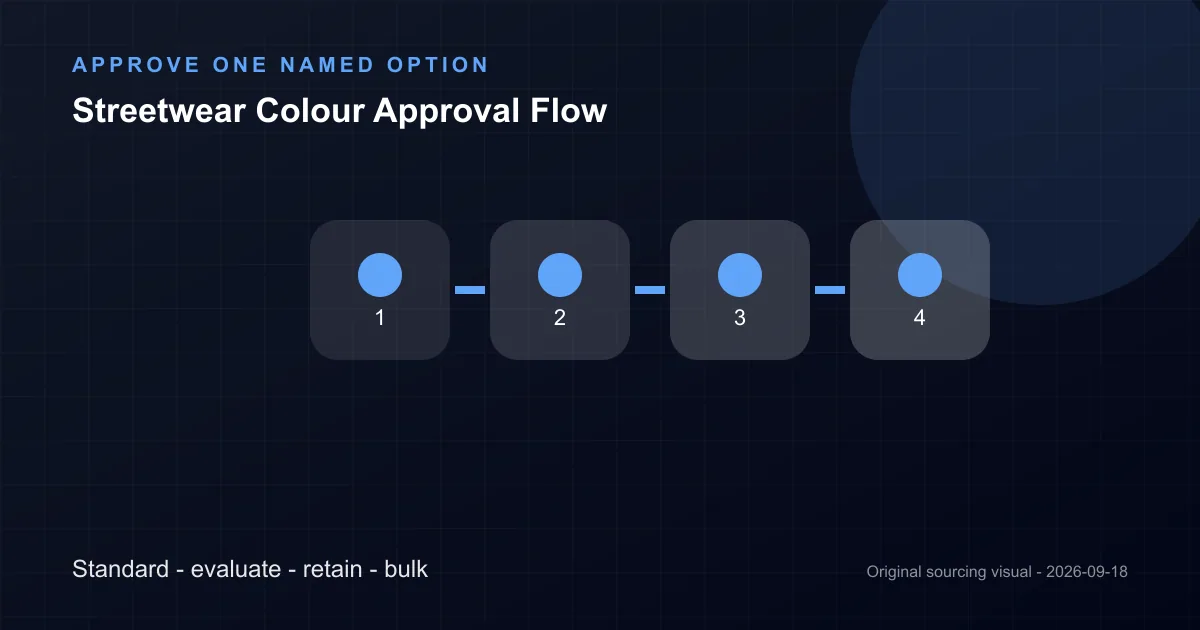
- Approve, comment, reject or request a new round for one named option.
- Retain the approved physical dip and digital record with a stable ID.
- Compare first bulk, shade bands and later lots under the same stated conditions.
If substrate, dye class, finish or supplier changes, review applicability and reopen the affected colour approval rather than transferring the old result by assumption.
What evidence should be retained?
The approval package should let another evaluator reproduce the comparison and identify the exact sample. Evidence should be readable, connected to the represented product and explicit about what was not checked.
| Evidence block | Minimum identity | Buyer verification |
|---|---|---|
| Target | Standard code, physical reference, spectral file and age | Is the target current? |
| Substrate | Fibre, construction, weight, treatment and finish | Does it represent production? |
| Evaluation | Light sources, booth, instrument and settings | Can conditions be repeated? |
| Option | Code, recipe reference, measured data, photos and comments | Which sample was judged? |
| Decision | Status, approver, date, bulk limits and reopening trigger | What does approval permit? |
Photos are useful for communication but should not replace controlled viewing and measurement because camera, display and ambient light alter appearance.
How should results and exceptions be interpreted?
Treat visual and instrumental findings as complementary evidence within the agreed rule. A small numerical difference can remain visually unacceptable, and a pleasing visual match under one light may separate under another. Record both the data and the decision.
| Finding | Meaning | Required action |
|---|---|---|
| Visual and instrumental results meet the agreed rule | The option supports the named colour direction | Approve for first-bulk comparison |
| Match changes under another light | Metamerism risk is visible | Adjust formulation or scope |
| Option matches but substrate differs | Applicability is uncertain | Repeat on production substrate |
| Bulk falls outside the approved boundary | Lab approval does not cover the result | Hold and assess bulk |
A concession for one bulk lot does not create a new master automatically. Name whether it is a one-time acceptance or a revised standard.
What failure modes should the buyer prevent?
The main risk is confusing colour communication with a universal promise of bulk consistency.
- Using a screen image as the master.
- Specifying the wrong Pantone system for a textile.
- Evaluating under uncontrolled room light.
- Omitting instrument geometry or profile.
- Approving an unidentified option.
- Ignoring substrate and finish differences.
- Treating lab approval as fastness proof.
- Replacing the standard without version control.
Keep the approved physical reference protected from light, contamination and handling damage, and connect it to its digital identity.
What belongs in the pre-release checklist?
Before approval, verify the standard, substrate, options, viewing conditions, instrumental settings, comments, authority and bulk plan.
- Colour target and system are explicit.
- Physical and digital references align.
- Production substrate is represented.
- Options have stable identifiers.
- D65 and required secondary lights are used.
- Instrument settings are recorded.
- Visual and numerical findings are both visible.
- Decision and approver are named.
- Bulk shade-band rules are written.
- Changes trigger scoped reapproval.
Retain rejected rounds and comments so the mill understands direction and later reviewers can see why the approved option was selected.
How did high-traffic and fast-growth peer learning improve this guide?
Peer learning was used only for information architecture and buyer usability. No competitor wording, branded artwork, commercial claim or product design was copied.
| Dimension | Peer-page finding | Specific application | Public evidence marker |
|---|---|---|---|
| SEO | HUF separates fabric quality, fit and construction into clear evidence blocks. | Separated target, substrate, viewing, instrument and bulk decisions for the lab-dip intent. | ACL-LABDIP-SEO colour decision blocks |
| AEO | SCRT uses concise material statements before supporting detail. | Placed a standalone definition and buyer action before the longer evaluation workflow. | ACL-LABDIP-AEO answer-first approval rule |
| GEO | Qualified peers name concrete materials and construction rather than vague quality. | Defined colour entities, evaluation settings and limits with Pantone and AATCC sources. | ACL-LABDIP-GEO colour evidence entities |
The page translates high-performing product-page clarity into an original sourcing control without copying brand claims or imagery.
How were authority findings applied?
| Research finding | Original application | Visible evidence |
|---|---|---|
| Pantone requires material-appropriate standards and controlled light | Added target-system and D65 checks | Decision and workflow |
| Pantone combines visual and spectral evaluation | Kept visual and instrumental evidence together | Evidence and interpretation tables |
| AATCC separates EP6 and EP9 | Avoided treating one number as the full decision | Why-limit and FAQs |
| Peer pages show concise proof before purchase action | Placed key evidence blocks before the CTA | Structure and conclusion |
Short direct answers support AEO. Defined colour entities, conditions and authority links support GEO without promising a perfect bulk match.
Frequently asked questions about streetwear lab dip approval
Is a Pantone code enough to approve a lab dip?
No. Identify the correct colour system, physical standard, spectral data when used, substrate and evaluation conditions.
Should lab dips be checked only under D65?
D65 is a common textile reference, but secondary lights may be required. Use the buyer-approved viewing plan to assess metamerism and end use.
Does a low Delta E automatically pass?
Not necessarily. Apply the agreed numerical rule together with visual assessment and product context.
Can an approved cotton dip be used for polyester?
Do not assume it can. Fibre and dye chemistry affect appearance and reproduction, so review applicability.
Does lab-dip approval prove colourfastness?
No. Fastness requires separate methods on represented material and process conditions.
Conclusion: approve a controlled colour direction
Streetwear lab dip approval is reliable when the target, substrate, viewing conditions, instrumental settings, named option and bulk boundary remain connected. Preserve the approved reference and reopen the decision after material or process changes.
Connect colour approval to the wash and dimensional stability guide, production evidence file guide and golden PP sample checklist. Contact the sourcing team with the style, intended market, active specification and required evidence so project-specific options can be confirmed.