Streetwear Cut Panel Bundle Traceability Guide
streetwear cut panel bundle traceability is a product-control decision for OEM, ODM, wholesale and private-label buyers. When bundles lose lot, shade, size, or marker identity, panels can mix, defects spread, and recuts can use the wrong color or revision. A ticket that disappears before sewing cannot support containment. This guide makes no unsupported claim about price, MOQ, capacity, delivery, certification, licensing or factory qualification; confirm those facts for the exact order.
Quick Answer
Streetwear cut panel bundle traceability should connect each bundle to order and style, material and shade lot, roll, lay, marker revision, color, size, panel identity, quantity, cut sequence, station, issue and return times, damage, recut, and reconciliation. The identifier must remain readable through sewing and support containment without exposing unnecessary personal or sensitive data.

What is streetwear cut panel bundle traceability?
Streetwear cut panel bundle traceability links material and cutting decisions to grouped garment panels moving through production. It identifies the traceable object, critical events, locations, quantities, status, and evidence needed for containment or investigation.
The definition keeps teams focused on the complete product entity instead of one isolated swatch, artwork file or machine setting. Each approval should identify the represented style, size range, material, construction, revision, sample and evidence boundary.
Cut Panel Bundle Traceability Decision Table
Direct answer: Compare the variables that can change both the visible outcome and the sourcing decision. The matrix converts a subjective discussion into named inputs, evidence and failure risks.
| Decision point | What to define | Why it matters | Common mistake |
|---|---|---|---|
| Object | Order, style, color, size, lay, bundle, panel group, and quantity | ID must match the physical unit | One ID for a whole day |
| Source links | Material lot, roll, shade group, marker, pattern, and sequence | Problems must trace to inputs | Recording style only |
| Events | Created, issued, received, split, combined, damaged, recut, returned, and closed | State changes locate errors | Tracking cutting only |
| Identifier | Ticket or barcode, readability, duplicate prevention, and replacement | The link must survive handling | Rewriting from memory |
| Reconciliation | Planned, cut, issued, sewn, rejected, recut, remaining, and disposition | Balance reveals missing panels | Closing exceptions |
How should streetwear cut panel bundle traceability be approved step by step?
Direct answer: Freeze the question and inputs, use production-representative garments and components, record the method and intermediate behavior, inspect the finished product, and connect approval to a controlled revision.
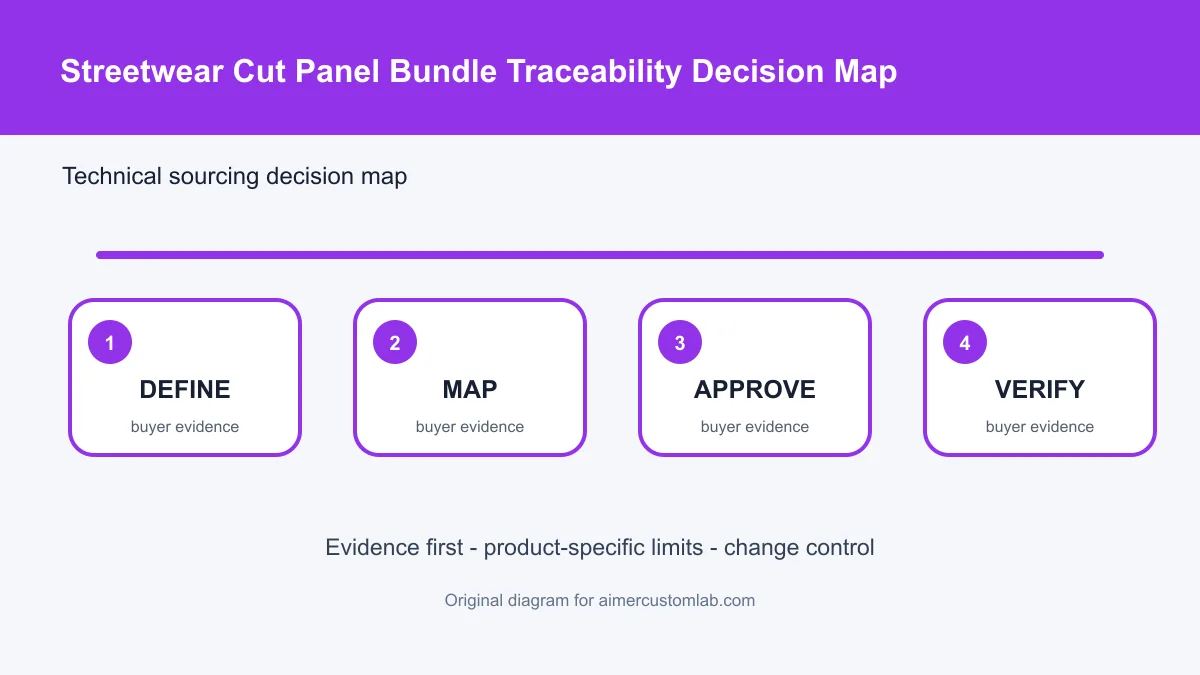
- Define purpose, containment time, owner, traceable object, and upstream and downstream links.
- Release order, style, color, size, lot, roll, lay, marker, pattern, panel, quantity, and bundle fields.
- Create identifiers at cutting and verify uniqueness, readability, orientation, and attachment.
- Record each event, split, merge, damage, return, and recut without overwriting history.
- Reconcile quantities and shade or lot links at released stations and isolate exceptions.
- Run a backward and forward mock trace, protect unnecessary personal data, and retain evidence.
When a result is uncertain, preserve the specimen and repeat the affected check rather than silently choosing the most convenient value. Variation can reveal a material, cutting, sewing, application or handling problem that will become larger in bulk.
How should common failures be diagnosed?
A ticket detaches during sewing: what should be checked first?
Direct answer: Stop the bundle, preserve location and contents, and restore identity only through approved evidence. Preserve the original symptom, product identity and settings before correction. Change one controlled variable at a time and repeat the same inspection so the final disposition remains traceable.
Panels from shade groups mix: what should be checked first?
Direct answer: Contain linked bundles and garments, trace rolls and events, and release a controlled disposition. Preserve the original symptom, product identity and settings before correction. Change one controlled variable at a time and repeat the same inspection so the final disposition remains traceable.
A recut has no link to shortage: what should be checked first?
Direct answer: Create a linked event with reason, lot, panel, quantity, authorization, and receipt. Preserve the original symptom, product identity and settings before correction. Change one controlled variable at a time and repeat the same inspection so the final disposition remains traceable.
What belongs in the purchase specification?
Direct answer: The specification must let another qualified person reproduce the approved product without guessing. For streetwear cut panel bundle traceability, include the following fields and link each one to the current sample or record.
- purpose and owner
- order, style, color, size, and bundle IDs
- lot, roll, lay, marker, and pattern links
- panel, quantity, and sequence
- events and stations
- readability and replacement controls
- damage, return, and recut history
- reconciliation and mock trace
How should sampling cover size and production risk?
Direct answer: Choose samples by variation and consequence, not convenience. Include justified small, middle and large sizes, risk colors, material lots, pattern changes, decoration geometries or wearer configurations that can change the decision. State whether each result covers one specimen, a controlled family or a defined production lot.
A middle-size showroom sample may hide the highest-risk geometry. A smaller pattern can compress clearances, while a larger size can change visual proportion, seam length or material load. Record why each selected sample represents the claimed range.
How should bulk inspection and change control work?
Direct answer: Convert the approved target into measurable checkpoints, inspection timing, sample selection, defect language, disposition and escalation. Preserve the sealed sample or approved visual standard and train inspectors on the same landmarks and terminology used during development.
Reapprove material source, composition, construction, pattern, grading, dimensions, placement, label, artwork, application, pressing, care route, packaging or destination changes that can affect the result. Identify affected orders and segregate work completed under earlier revisions.
What evidence should accompany the approval?
Direct answer: Retain product and specimen identities, source files, revisions, conditions, raw observations, measurements, photographs, individual results, failure modes, corrective actions, owner, date, disposition and approved sample. A short pass message cannot prove that the right product, method or endpoint was used.
The evidence record should distinguish measured facts, visual observations, responsible decisions and open points. Unknown information remains unknown until supported; it must not be converted into a zero, assumed tolerance or universal commercial promise.
What are the evidence boundaries?
Bundle traceability should be designed around product risk and critical tracking events, not around collecting every possible field. Bundle traceability should be designed around product risk and critical tracking events, not around collecting every possible field. The GS1 Global Traceability Standard supplies a framework for traceability systems, and ISO 2859-1:2026 supplies attribute-sampling procedures; neither prescribes one label, barcode, retention period, or sewing-floor workflow for every order.
Results apply to the specimens, methods and conditions evaluated. They do not automatically cover every size, color, lot, factory line, climate, wearer, care behavior or destination. Confirm current rules, intellectual-property permissions and laboratory scope with the responsible authority.
Which related products can this guide support?
- Review custom hoodie sets with branding and packaging when applying this control to an order-specific sourcing brief.
- Review custom zip hoodie sets for private labels when applying this control to an order-specific sourcing brief.
- Review private-label streetwear capabilities when applying this control to an order-specific sourcing brief.
These descriptive internal links show relevant sourcing categories only. They do not assert a fixed construction, price, MOQ, capacity, certification or delivery time. Send the actual specification for order-specific confirmation.
Buyer checklist
Use this checklist to keep streetwear cut panel bundle traceability aligned from development through final inspection.
- Purpose defined
- Source links complete
- ID unique
- Ticket survives
- Events recorded
- Recuts linked
- Quantities reconciled
- Mock trace retained
Which sources informed this guide?
The following current peer and authority pages informed the information architecture, terminology and evidence boundaries. Their wording was not copied, and their commercial claims were not transferred to either target site.
Research-to-page evidence map
This table records how qualified high-traffic or fast-growth peer learning changed the public article and where each application is visible.
| Research finding | Specific application | Visible evidence |
|---|---|---|
| Printify organizes cut-and-sew guidance around named garment panels and seam constraints. | SEO: organized streetwear cut panel bundle traceability around a procurement decision matrix, failure diagnosis and descriptive cluster links. | Cut Panel Bundle Traceability Decision Table |
| Printful uses named zones, common mistakes, and direct recommendations for answer-first buyer decisions. | AEO: placed a 40–70 word answer first and converted a buyer question into a direct, scannable response. | Does every panel need a barcode? |
| The peer page connects a named garment entity with visible use context and decision constraints. | GEO: defined the product entity, named evidence limits and separated externally verified context from order-specific approval. | Bundle traceability should be designed around product risk and critical tracking events, not around collecting every possible field. |
Frequently asked questions
Does every panel need a barcode?
Answer: Not necessarily. Choose identifier granularity from risk, containment, process, and data needs.
Can a bundle be split?
Answer: Yes, if child quantity and destination remain linked to origin and status.
How are recuts controlled?
Answer: Record trigger, authorization, lot, panel, quantity, issue, receipt, and reconciliation.
What should a mock trace prove?
Answer: It should trace identified units backward and relevant affected units forward within scope.
What requires reapproval?
Answer: Identifiers, ticket materials, fields, system links, station events, or reconciliation rules.
Conclusion: what should a buyer do next?
streetwear cut panel bundle traceability should finish as a documented, product-specific approval rather than a generic promise. Keep the controlled inputs, measured target, representative sample, method, raw observations, photographs, corrective action and change triggers together. This record makes repeat orders faster and reduces disputes caused by incomplete specifications.
Inquiry CTA: Send your tech pack, intended market and use, size range, pattern or garment reference, material and component details, artwork or label files, care route and requested evidence. Ask the team to confirm feasibility, sample details, MOQ, lead time, capacity and available supporting records for the exact order.