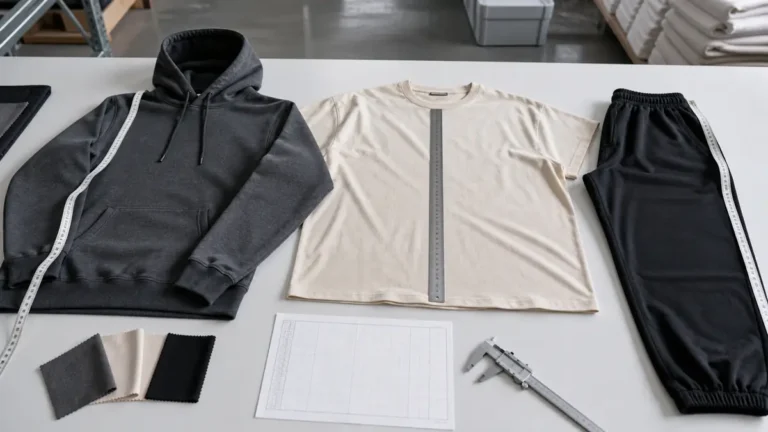
Streetwear Label Attachment Pull Test Guide
streetwear label attachment pull test helps sourcing teams turn a visual or technical request into evidence that a supplier, laboratory and buyer can reproduce. This guide focuses on search intent from product developers, teamwear buyers and private-label managers who need a practical approval route. It does not promise a fixed price, MOQ, capacity, lead time, certification or universal pass limit; confirm commercial and compliance details for the exact order.
Quick Answer
A streetwear label attachment pull test evaluates how an attached woven, printed, leather-like, rubber, or transfer label behaves under a defined load or extension. Buyers should specify the label, base fabric, attachment, pull direction, grip, rate, conditioning, endpoint, and failure mode, then retain the specimen-level evidence.
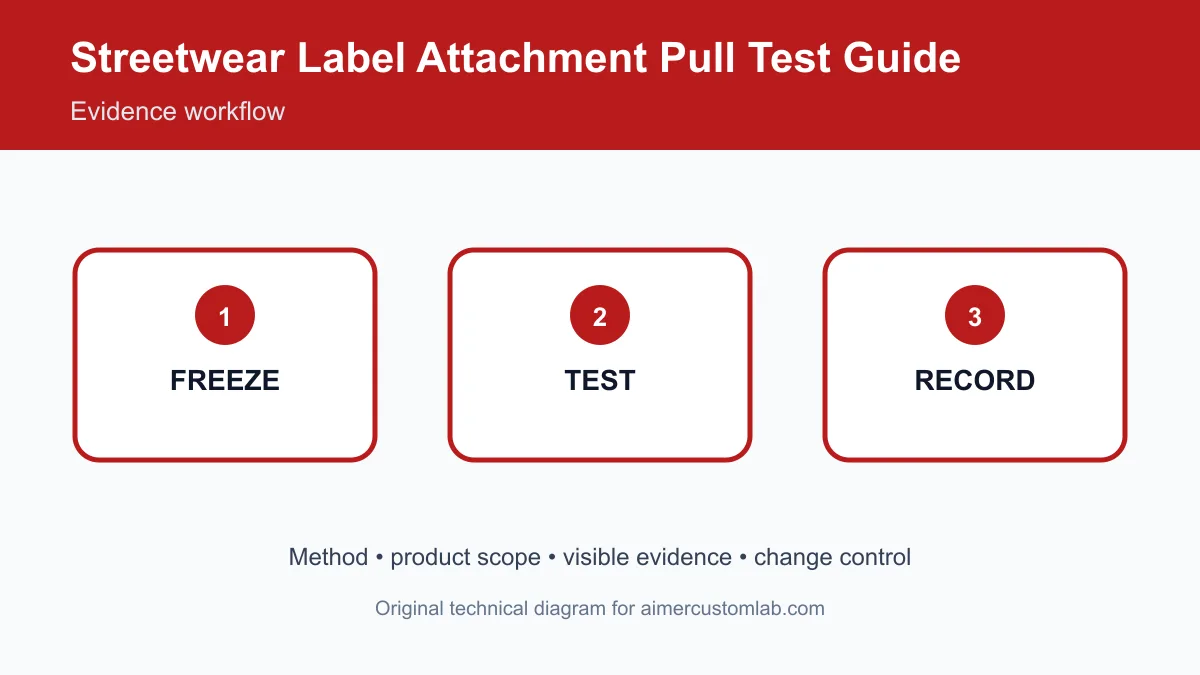
What is streetwear label attachment pull test?
Label attachment performance is the resistance of the complete label-to-garment system to detachment, seam failure, tearing, delamination or unacceptable distortion. It is not a property of the label alone. Corner geometry, stitch line, backing, adhesive, fabric structure, placement and nearby seams all affect the outcome.
The definition matters because related tests or constructions may answer different questions. Define the complete product entity and intended use first. Then select evidence that represents the actual material, component, assembly, wearer and care route.
How should private-label attachment methods be compared?
Direct answer: Compare variables that can change both the technical result and the buying decision. The matrix below converts the topic into reviewable trade-offs rather than a generic supplier promise.
| Decision point | What to define | Why it matters | Common mistake |
|---|---|---|---|
| Label construction | Woven, printed, patch, transfer or molded component | Different edges and backings create different loads | Treating every branding element as a sewn label |
| Attachment | Perimeter stitch, corner stitch, bonding, heat transfer or hybrid | Failure modes and repair options differ | Specifying appearance without seam details |
| Pull direction | Define peel, shear or direct tension and grip location | Direction can reverse the result | Reporting one unlabeled force value |
| Base garment | State fabric, weight, stretch, placement and seam proximity | The garment may tear before the label releases | Testing the label on a rigid substitute |
Copy the approved values into the tech pack, quality manual and purchase order attachments. A controlled specification keeps development, laboratory and production teams aligned on the same specimen and endpoint.
How should the approval trial be built?
Direct answer: Freeze inputs, use production-representative assemblies, document the method, observe intermediate behavior and inspect the complete product after the trial.
- Identify the exact label code, dimensions, backing, edge finish, placement and wearer-contact surface.
- Freeze the garment fabric, panel construction, stitch or bonding process, thread, needle and production settings.
- Choose a test configuration that reflects the likely service load and document direction, grip, rate, conditioning and endpoint.
- Use production-representative assemblies and record whether failure occurs in label, thread, seam, adhesive or base fabric.
- Repeat after the intended care route when water, heat or detergent can change the attachment.
- Approve the method, acceptance rule, photographs, specimen results and process controls; retest meaningful changes.
Repeat questionable results instead of discarding them. Variation can reveal a material, cutting, sewing, bonding or handling problem that will become larger in bulk. Record every deviation and explain why the final decision remains valid.
How should common failures be diagnosed?
| Observed failure | Likely control gap | Corrective direction |
|---|---|---|
| Corner lifts first | Load concentrates at an unsupported geometry or stitch turn | Round, reinforce or redesign the corner and retest |
| Base fabric tears | Attachment is locally stronger than the lightweight panel | Redistribute load or add justified reinforcement |
| Bond peels after washing | Adhesive, heat, pressure or material compatibility is unstable | Validate the complete bonding window and care route |
| Results vary by operator | Stitch placement, backtack or handling is uncontrolled | Use guides, approved samples and in-line inspection |
Corrective action should target the failure mechanism. Increasing reinforcement, tension, heat or stitch density without diagnosis can move the failure into the base fabric, change hand feel or create a new care problem.
What belongs in the purchase specification?
Direct answer: The specification should let another qualified team reproduce the approved construction and evidence without guessing.
- label code, construction, dimensions and approved artwork
- garment fabric, weight, stretch, placement and reinforcement
- attachment method, seam or bonding parameters and equipment
- conditioning, pull direction, grip, rate, endpoint and acceptance rule
- care preconditioning and visual or tactile acceptance
- sample plan, failure classification, evidence record and retest triggers
Use conditional wording for unverified commercial details. Ask the factory to confirm feasibility, sample details, MOQ, capacity and lead time for the actual material and order rather than treating a content guide as a quotation.
How should sampling and change control work?
Direct answer: Build the sample plan around risk, variation and the decisions the result will support. Include justified sizes, colors, material lots and production lines instead of calling one convenient sample representative of every possible order.
Start with development evidence, then repeat a controlled confirmation on production-representative material. When a failure appears, quarantine the affected scope, identify the mechanism, implement a documented correction and retest the corrected construction. Do not average a clear failure into several passing specimens or substitute an unrelated supplier declaration.
Changes to material source, composition, weight, finish, artwork coverage, pattern, component, stitch, adhesive, machine setting, care route or destination market may invalidate the approval. The buyer and supplier should agree which changes trigger notification and whether they require document review, partial verification or full retesting.
What evidence makes the result useful for a buyer?
Direct answer: A useful record connects the exact specimen to the method, raw observations, acceptance decision and production disposition. A simple “pass” message cannot show whether the correct material, condition, direction or endpoint was used.
Record product code, color, size, lot, component revisions, conditioning, equipment identification, calibration status where relevant, operator, date, environmental conditions, specimen count, method edition, deviations and individual results. Add photographs before, during and after the evaluation. Keep the approved master beside the report so later inspectors can distinguish acceptable variation from a new failure.
If a laboratory report is used, confirm that the report describes the tested item and that the laboratory’s scope is appropriate. If an internal factory check is used, state that clearly. Neither route should be presented as certification unless a valid certification program actually applies.
What are the practical limits of the evidence?
ASTM D1683/D1683M evaluates sewn-seam failure in woven fabrics and identifies seam-engineering variables such as thread size, seam type, stitch type and stitch density. It is not automatically the correct method for every knit, adhesive or transfer label, so select or adapt a qualified protocol for the actual assembly.
Test results describe the specimens and conditions evaluated. They do not automatically cover every color, size, lot, line, supplier or end-use scenario. Link approval to stated boundaries, then add risk-based surveillance when change or production variation justifies it.
Which related products can this guide support?
These descriptive internal links show relevant product categories. They are not claims about a fixed construction, price, MOQ, certification, capacity or delivery time. Send the actual specification for confirmation.
Buyer checklist
- Confirm search intent, product entity, wearer, use and destination market.
- Freeze the bill of materials, pattern, construction and artwork revisions.
- Name the method, edition, conditioning and any documented deviation.
- Use production-representative samples and justify coverage across variants.
- Record individual results, failure modes, photographs and corrective action.
- Link the approved sample and evidence to production inspection.
- Retest after relevant change and keep superseded revisions traceable.
What are the standards and evidence boundaries?
The authoritative source supplies a method or compliance boundary; the peer pages informed information architecture and answer design. Their wording was not copied. Confirm the current standard edition, market rule and laboratory scope for the exact product.
- ASTM D1683/D1683M: Failure in Sewn Seams of Woven Fabrics
- printify.com topic guide
- www.customink.com topic guide
Research-to-page evidence map
The table records how current research changed this public article and where the applied result is visible.
| Research finding | Specific application | Visible evidence |
|---|---|---|
| printify.com uses a clearly scoped guide title and buyer-oriented selection structure. | Used an intent-specific title and the comparison section “How should private-label attachment methods be compared?”. | How should private-label attachment methods be compared? |
| www.customink.com organizes practical care or product guidance as an answer followed by steps. | Added a 40–70 word answer-first summary and a numbered approval workflow. | Quick Answer |
| ASTM D1683/D1683M: Failure in Sewn Seams of Woven Fabrics defines an authoritative method or compliance boundary. | Separated the entity definition, applicable scope and evidence limits from supplier claims. | What are the standards and evidence boundaries? |
Frequently asked questions
Can one approved sample represent every color and size?
Answer: Not automatically. Fiber, dye, trim, print coverage, pattern geometry and operator settings may change the result. Define justified families, then test or verify the highest-risk variants.
Should a buyer copy a competitor or laboratory limit?
Answer: No. Use standards to define reproducible methods, then set acceptance criteria from the intended market, end use, risk assessment and approved product. Record the edition and any deviation.
When should the check be repeated?
Answer: Repeat after relevant material, supplier, pattern, construction, machine-setting or care-process changes, and at a risk-based production interval. A signed sample does not cover an uncontrolled change.
What evidence should accompany a pass?
Answer: Keep specimen identity, conditioning, equipment or fixture, method, observations, measurements, photographs, operator, date, disposition and corrective action together.
Does this guide confirm certification or legal compliance?
Answer: No. It is a sourcing and quality-planning guide. The buyer and supplier must confirm the applicable market rules, laboratory scope, standard edition and product-specific requirements.
Conclusion: what should a buyer do next?
streetwear label attachment pull test should finish as a documented, product-specific approval rather than a generic promise. Keep the signed sample, method, conditions, raw observations, photographs, corrective action and change triggers together. That record makes bulk decisions faster and reduces arguments caused by incomplete specifications.
Inquiry CTA: Send your tech pack, destination market, wearer and use, size range, material and component references, artwork, care route and requested test method. Ask the team to confirm feasibility, sample details, MOQ, lead time and available supporting evidence for the exact order.