Streetwear Packaging Artwork Approval Guide
Quick Answer: Streetwear packaging artwork approval is the controlled release of a specific label, hangtag, polybag, insert or carton-mark file for a defined SKU, market and pack level. Buyers should verify the supplier dieline, copy, barcode data, safe areas, print layers and proof scope, then compare a representative physical pack before bulk printing.
A packaging PDF can look polished while carrying an old size, wrong barcode, unapproved claim or obsolete market wording. The same product may also use several assets with different dimensions and print processes. A controlled artwork approval record keeps each asset, revision, pack level and decision scope visible before an error is multiplied across an order.
What is streetwear packaging artwork approval?
Streetwear packaging artwork approval is permission to use one named artwork revision for a stated packaging component, SKU set, destination and production purpose. The record identifies the supplier-issued dieline, native source file, locked viewing proof, language, copy owner, barcode data owner, colour references, special print layers, approver, date, required next evidence and superseded file.
Artwork approval does not by itself certify barcode quality, legal compliance, colour accuracy, material performance or finished-pack function. Those conclusions require the relevant owner and evidence. This guide does not invent mandatory wording or symbols for markets that have not been verified.
Why does streetwear packaging artwork approval matter before bulk production?
The release prevents “final-final” files, placeholder data and screen-only proofs from reaching bulk printing. Packaging preflight sources consistently separate structure or dieline, artwork content, variable data, barcode identity, colour and finishing. GS1 specifications also make the packaging level and data carrier important: the barcode must identify the intended trade item or logistics unit, not merely look scannable in the PDF.
A design proof can confirm copy and layout but cannot prove the finished substrate, coating, fold, seal, hole, adhesive, print registration or barcode quality. State exactly what the proof approves and what remains conditional.
Which fields belong in the approval record?
Review each asset as a controlled component with its own source, owner and physical evidence. The comparison below separates the decision, its evidence and the action that follows.
| Approval field | Buyer decision | Evidence before release |
|---|---|---|
| Pack identity | Which unit, inner pack or carton does the asset describe? | SKU and pack-level mapping |
| Dieline | Is the current supplier structure used at the correct scale? | Dieline ID, dimensions and revision |
| Fixed copy | Who approved names, claims, instructions and market text? | Master-copy comparison and owner |
| Variable data | Who supplies size, colour, lot, date or order fields? | Field map, format and sample values |
| Barcode | What identifier and packaging level are encoded? | Data source, quiet area and verification plan |
| Physical proof | What production characteristics were actually checked? | Representative sample, photos and scoped decision |
Keep the construction baseline, artwork baseline and production release as separate decisions. A copy edit should not silently approve a new bag dimension, and a structural mock-up should not approve an unverified barcode.
Which sources define the evidence boundary?
Use packaging-proof workflow guidance, printer preflight controls and GS1 identification rules together. ProofScene recommends panel-by-panel review against the approved source copy and a single recorded approval. J-Origin separates version, variable data, barcode ownership, legal copy and physical sample scope. GS1 General Specifications provide the identification and data-carrier framework that should be checked for the actual packaging level.
Review ProofScene artwork approval guidance, J-Origin packaging preflight guidance and the GS1 General Specifications. Confirm destination-market wording with authorised specialists.
How should buyers run the streetwear packaging artwork approval workflow?
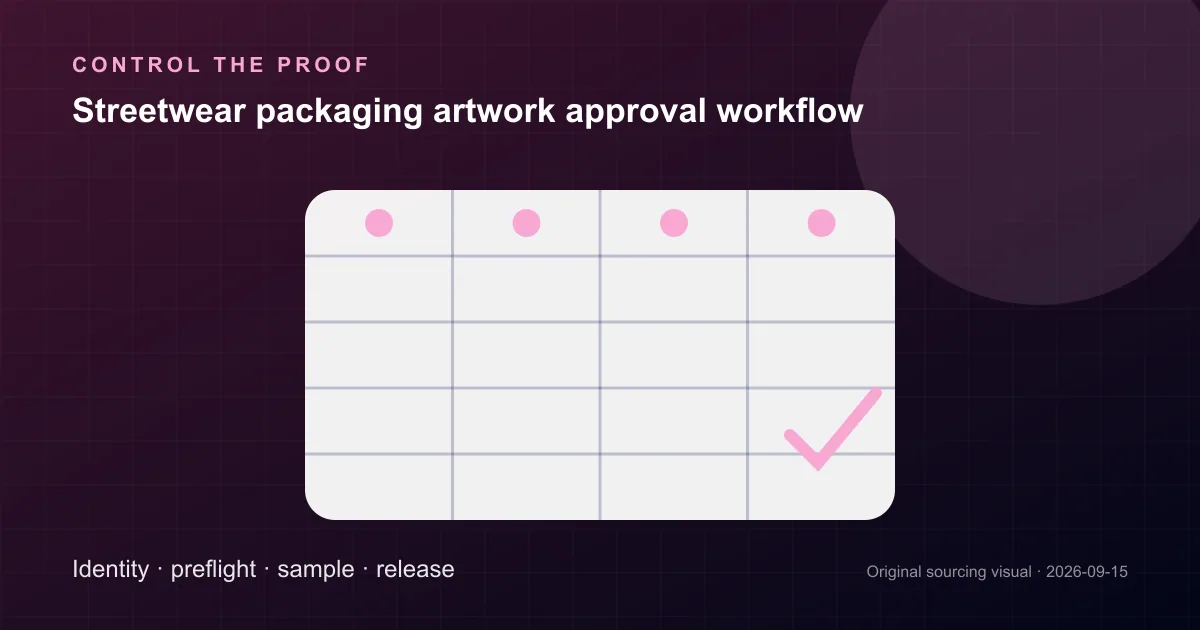
Freeze the product and pack identity, control the dieline and copy, verify data ownership and approve the physical result in stages. Every step should create a dated record tied to the style, variant, active revision, reviewer and decision.
- Identify the finished SKU, destination market and packaging level.
- Confirm component material, dimensions and current supplier dieline.
- Assign a unique asset ID, revision and intended downstream purpose.
- Compare every fixed word and claim with the approved master copy.
- Map each variable field to its owner, source and format.
- Confirm barcode identifier ownership, pack level and verification method.
- Preflight scale, safe area, bleed, fonts, links, colour space and special layers.
- Issue one locked viewing proof for consolidated comments and approval.
- Inspect a representative physical pack for fold, placement, print and usability.
- Release the named revision, notify recipients and withdraw superseded files.
Reopen approval when the SKU, size or colour mapping, market, wording, barcode, dieline, material, finish, printer or pack configuration changes in a way that can affect the evidence.
How should a buyer interpret the result?
An approval is valid only for the fields, asset revision and proof state listed in the release record. Use scoped statuses such as content approved, structure approved, barcode data confirmed, physical sample approved or released for bulk. A single unqualified “approved” hides which questions remain open.
| Finding | Meaning | Buyer action |
|---|---|---|
| Dieline, content, data and physical proof agree | The named asset supports release | Approve the linked revision |
| Copy is approved but barcode owner is unconfirmed | Identity evidence remains open | Hold the barcode-bearing asset |
| PDF is correct but folded sample hides information | Physical layout fails | Revise placement or structure |
| SKU, market or pack level changes | Earlier mapping may be invalid | Reopen affected approvals |
A phone scan is a useful check but not the same as confirming encoded data and standards-based symbol quality. Record the verification method required by the retailer, logistics program or project.
What common failure modes should be prevented?
The largest risk is approving appearance without proving that the artwork describes the correct product and packaging level.
- Using a redrawn or obsolete dieline.
- Approving copy from memory instead of a master source.
- Leaving placeholder size, barcode or market text.
- Encoding an identifier for the wrong pack level.
- Allowing a hole, fold or sticker to cover essential data.
- Relying on a screen for printed colour.
- Combining comments from different proof revisions.
- Keeping superseded files in the production folder.
A staged streetwear packaging artwork approval record makes ownership, limitations and next evidence explicit before print release.
What belongs in the release checklist?
The final package should let another reviewer connect the physical pack to the exact approved file and data sources.
- SKU and pack level confirmed.
- Supplier dieline and dimensions identified.
- Native file and locked proof agree.
- Fixed copy has an authorised source.
- Variable fields have owners.
- Barcode identity and method are documented.
- Safe area, bleed and print layers checked.
- Physical sample scope is stated.
- Approver and date recorded.
- Superseded assets withdrawn.
Retain the approval with the private-label packaging brief, barcode record and purchase-order reference. Each owns a different decision and together they create traceability.
How were research findings applied to this guide?
The source facts were converted into an original procurement control. No competitor wording, protected artwork, branded product image or unsupported commercial claim was reused.
| Research finding | Specific change | Visible evidence |
|---|---|---|
| Proof workflow guidance recommends panel-by-panel review and one consolidated decision | Added a locked proof and single approval trail | Workflow steps eight and ten |
| Preflight guidance separates fixed copy from variable data | Added source and owner fields for each class | Approval table |
| GS1 makes identity and packaging level explicit | Added pack-level mapping and verification method | Definition, barcode row and FAQ |
| Peer learning requested evidence-based CTA and trust controls | Added scoped approval states and change triggers | Interpretation and checklist |
The concise answer and question headings support AEO. Clear entities, owner fields, standards references and explicit limits support GEO without claiming universal compliance.
Frequently asked questions about streetwear packaging artwork approval
Can a PDF proof approve the finished package?
Not by itself. It can approve specified artwork content, while the physical pack still needs the agreed material, fold, placement and print checks.
Who owns barcode data?
The authorised identifier owner must supply or confirm it. Do not invent a GTIN or copy a code from another size or packaging level.
Should every packaging component share one artwork file?
No. A hangtag, polybag, insert and carton mark can share product data but need their own controlled asset records.
Is a phone scan enough?
No. It does not prove that the correct item is encoded or that symbol quality meets the required standard.
When must approval be reopened?
After a relevant product, market, wording, barcode, structure, material, printer or finish change. Record the affected assets and repeat only the checks whose evidence may have changed.
Conclusion: release one named packaging version
Streetwear packaging artwork approval is strongest when the product, pack level, dieline, source copy, variable data, barcode identity, print layers and physical sample are linked to one controlled revision. Scoped decisions and clear change triggers prevent a visually attractive proof from becoming unsupported bulk-print approval.
Connect the asset to the private-label streetwear packaging guide, the streetwear barcode verification guide and the apparel retail label zone guide. Contact the sourcing team with the product type, intended market, active revision and required evidence so project-specific options can be confirmed.