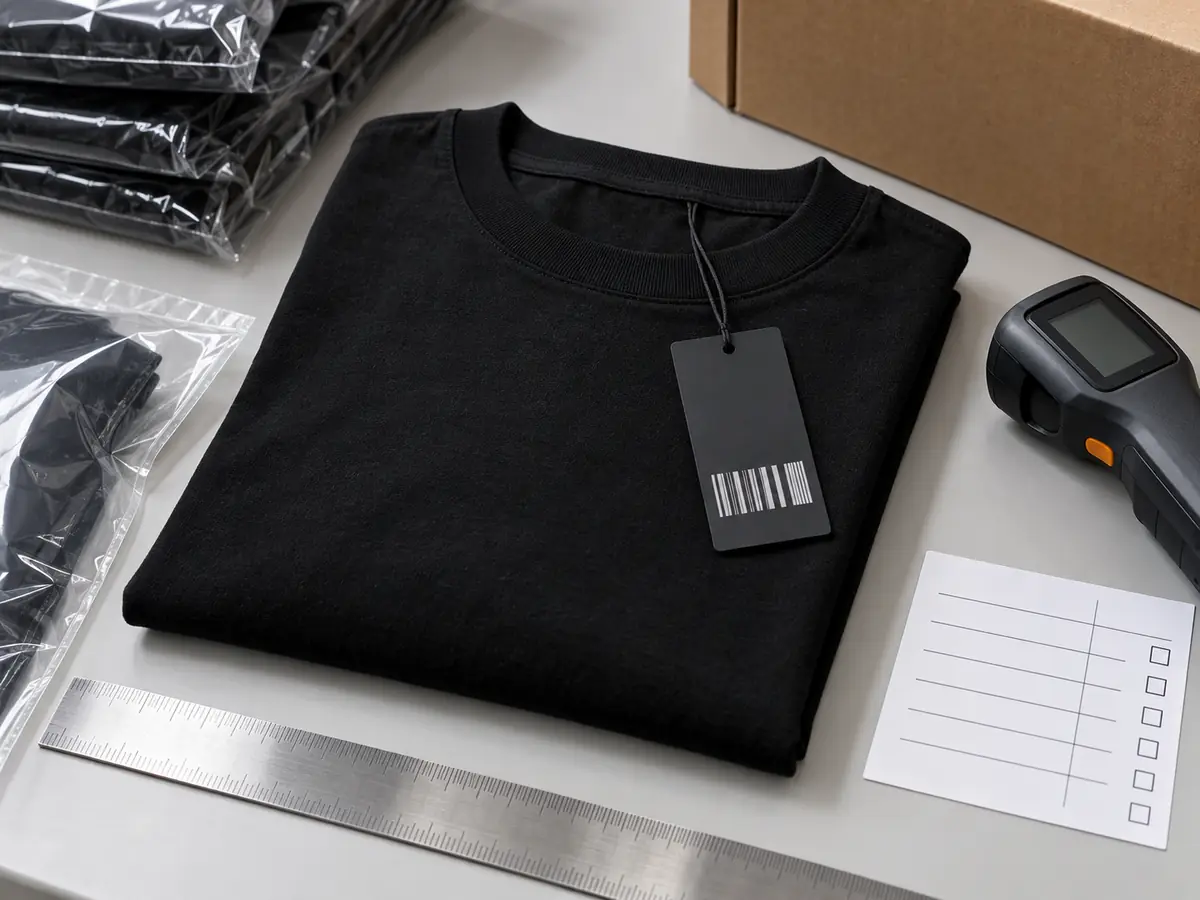
Streetwear Barcode Verification Guide
Quick Answer: Streetwear barcode verification checks both the printed symbol and the integrity of the encoded identification data. Private-label buyers should verify the correct GTIN for each orderable variant, barcode type, dimensions, contrast and quiet zones, then assess representative production labels in their finished packaging position and retain a report linked to artwork, printer, substrate and lot.
A barcode that scans once on a phone can still fail at a warehouse or retail checkout, and a perfectly printed symbol can still encode the wrong item. Streetwear adds variant complexity: style, colour, size, bundle and packaging level may each affect identification. A streetwear barcode verification plan connects item-master data with label production and finished-pack application so a brand can release evidence rather than a screenshot of a successful scan.
What does streetwear barcode verification mean?
Streetwear barcode verification is a controlled assessment of barcode symbol quality and the correctness of the data encoded for a specific trade item. The record identifies the GTIN or other GS1 key, barcode symbology, artwork revision, substrate, print process, size, colour, placement, packaging level, verifier, standard settings, grade or findings and production lot. Data validation and symbol-quality measurement are separate gates.
A scanner read is not the same as standards-based verification. A design-file grade also may not represent production ink spread, label coating, sewing distortion, curvature or final packaging. The applicable barcode, magnification, location and data rules depend on the sales channel and GS1 specifications; confirm them before artwork release.
Why does streetwear barcode verification matter to buyers?
It matters because identification errors can route inventory, orders and invoices to the wrong apparel variant. GS1 defines a trade item as something that may be priced, ordered or invoiced. In streetwear, a black medium hoodie and a black large hoodie are different orderable products even when their design is visually identical. Verification protects both machine readability and the link between that symbol and the correct master data.
This guide does not allocate GTINs and does not claim that every sales channel uses the same carrier. The brand owner should work with its GS1 Member Organization, retailer, marketplace and verification service. Use the latest GS1 General Specifications because implementation guidance notes that specifications are updated.
What should buyers compare before approval?
Treat data, artwork, print and application as four connected controls. The table turns a broad topic into fields that can be checked against the real purchase order.
| Verification layer | Question | Evidence |
|---|---|---|
| Item master | Does the GTIN identify the correct style, colour, size and pack? | Approved variant record and assignment owner |
| Encoded data | Does the symbol contain the intended data and check digit? | Decoder output matched to the master record |
| Symbol quality | Does the printed symbol meet the selected verification parameters? | Verifier report and diagnostic findings |
| Physical placement | Is the label flat, visible and protected in its real position? | Finished-pack sample and placement photo |
| Production control | Does bulk output remain consistent after printer or substrate change? | Lot checks, retained samples and change log |
Do not average different variants or label locations into one conclusion. If a barcode is verified before lamination, sewing, folding or packing, record that limitation and verify the finished condition when those processes can affect readability.
Which standards and sources support this guide?
Use GS1 identification and verification guidance together with the latest channel-specific specifications. GS1’s verification guidelines describe consistent services for testing barcode quality and encoded-data integrity. The 1D implementation guideline says overall barcode and data quality is more than print quality and lays out receipt, data, verification, additional tests and reporting steps. GS1’s GTIN page explains that GTIN uniquely identifies trade items.
Review the GS1 barcode verification guidelines, the GS1 1D implementation guideline, the GS1 GTIN overview and the current GS1 General Specifications access page.
What belongs in the technical brief?
- Brand owner and GS1 Company Prefix responsibility.
- Style, colour, size, pack and orderable-unit master data.
- GTIN and check-digit record.
- Barcode symbology, dimensions and artwork revision.
- Printer, ink, substrate, finish and supplier.
- Label position, orientation and finished packaging state.
- Verifier settings, report and acceptance route.
- Bulk sampling, retained labels and change triggers.
How should the streetwear barcode verification workflow run?
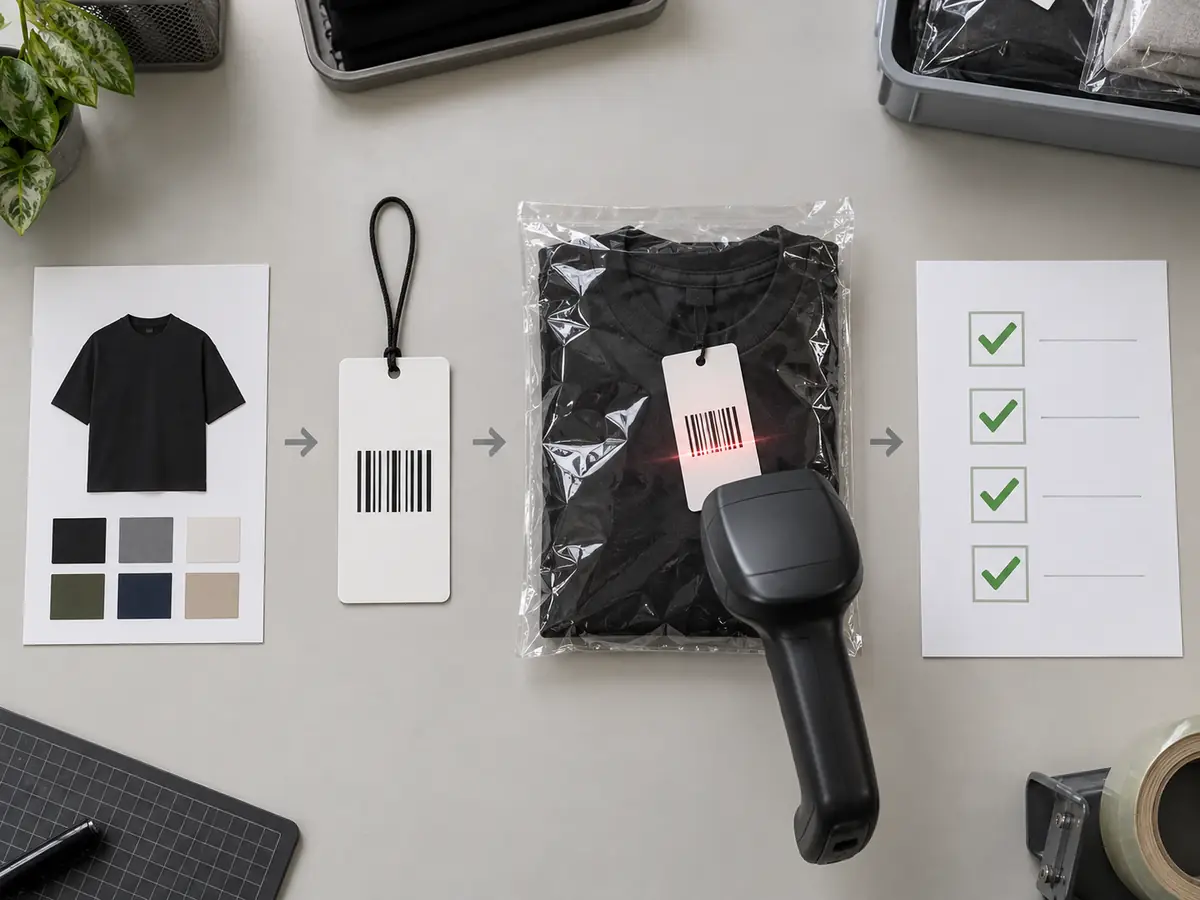
Approve identification first, then artwork, production symbol quality and finished application. Each step should leave a dated record tied to the style, component, version and decision owner.
- Freeze the orderable product hierarchy and variant master data.
- Confirm who allocates and controls each GTIN.
- Match every style-colour-size-pack record to the intended encoded data.
- Generate controlled barcode artwork using the selected symbology and current specifications.
- Approve dimensions, quiet zones, contrast, human-readable information and placement.
- Print representative labels on the actual production substrate and equipment.
- Verify encoded data and symbol quality with an appropriate verifier.
- Apply the label to the finished garment or packaging and review physical effects.
- Retain the report, sample, artwork, printer settings and production lot link.
- Repeat after a relevant GTIN, artwork, printer, ink, substrate, finish or placement change.
A status of “approved” should mean that the evidence was reviewed against a stated requirement. It should not mean only that a file was uploaded or that a sample looked acceptable. If a relevant input changes, reopen the affected decision instead of silently extending old evidence.
How should the evidence be interpreted?
A complete approval needs both correct data and acceptable symbol quality in the intended use state. Good print quality cannot correct a GTIN assigned to the wrong size. Correct data cannot compensate for a symbol damaged by glossy coating, low contrast, folding or stitching. Diagnostic information should be used to correct the process, not just to produce a pass/fail badge.
| Finding | Meaning | Buyer action |
|---|---|---|
| Data and production symbol both match requirements | Identification and readability are supported | Approve the stated variant and lot |
| Symbol scans but encoded GTIN is wrong | Identification failure remains | Hold and correct data/artwork |
| Artwork passes but finished label fails | Application process changes the result | Correct placement or production |
| Printer, substrate or packaging changes | Earlier verification may be stale | Reverify affected output |
Do not promise retail acceptance from an informal scan. Retailer, marketplace and logistics requirements may add rules beyond this guide. The report supports the exact symbol, data, settings, substrate and physical state tested.
What mistakes weaken the decision?
The biggest mistake is treating one successful scan as proof of both correct data and production quality.
- Assigning one GTIN to distinct orderable variants.
- Encoding a correct-format number for the wrong product.
- Verifying only a PDF artwork file.
- Ignoring quiet zones, contrast or substrate.
- Placing the label across a fold, seam or curve.
- Losing the report-to-lot link.
- Skipping recheck after printer or packaging change.
These errors separate the test, design file or identification record from the product actually ordered. A controlled streetwear barcode verification reconnects the evidence, product scope, version, condition, decision rule and named approver.
What belongs in the buyer approval checklist?
Another reviewer should be able to trace the barcode from master data to the finished pack.
- Orderable variant uniquely defined.
- GTIN owner and allocation record visible.
- Encoded data matched to master data.
- Artwork revision controlled.
- Production substrate and printer tested.
- Finished position reviewed.
- Verification report retained.
- Lot sampling plan active.
- Changes trigger re-verification.
Keep this checklist with the tech pack, laboratory request, artwork pack or item-master record. Mark unknown fields as pending and assign an owner. Conditional wording is more accurate than an unsupported promise about performance, compliance, durability or market acceptance.
How were current research findings applied?
This article converts current source scope and competitor structure into an original buyer workflow; it does not copy commercial promises, prices, images or protected design material.
| Research finding | Specific application | Visible evidence |
|---|---|---|
| GS1 verification covers symbol quality and encoded-data integrity | The article creates two independent release gates | Definition and decision table |
| GS1’s 1D workflow records sample receipt, data, verification and report | The workflow preserves sample-to-report traceability | Steps six to nine |
| GTIN uniquely identifies trade items | Style, colour, size and pack are resolved before artwork | Item-master row and FAQ |
| Yesterday’s learning called for finished-pack verification | Placement and post-application checks are mandatory | Comparison table and checklist |
The sources support definitions, scope and limitations. Procurement recommendations are identified as practical controls, not universal legal or technical requirements. This separation gives answer engines concise responses, gives generative systems attributable context and keeps the page useful to a human sourcing team.
Frequently asked questions about streetwear barcode verification
Is scanning with a phone enough?
No. A casual scan does not replace controlled data validation and standards-based symbol verification.
Should every size have a different GTIN?
Distinct orderable variants generally need unique identification. Confirm the exact allocation with current GS1 rules and your sales channel.
Can barcode artwork be verified before printing?
It can be reviewed, but it is incomplete. Production ink, substrate, finishing, sewing and placement can change the result.
What should be retained?
Keep the report and the production context. Retain artwork, decoded data, verifier settings, label sample, printer/substrate details, placement and lot.
When is re-verification needed?
After relevant change. GTIN, data, artwork, printer, ink, substrate, coating, size or placement changes can affect approval.
Conclusion: verify the identity and the printed carrier
Streetwear barcode verification is strongest when the GTIN record, encoded data, production symbol, physical placement and retained report describe the same orderable variant. That combined control reduces avoidable inventory errors without treating an informal scan as a universal acceptance guarantee.
Link identification evidence to the supplier declaration validity guide, align label production with the capabilities page, and confirm the orderable product scope on the products page. Contact the sourcing team with the style, construction, market and decision requirement so the available facts can be confirmed for your project.