Streetwear Care Label Evidence Guide
Quick Answer: Streetwear care label evidence is the reliable product-specific basis for the washing or dry-cleaning route, drying, bleaching, ironing and warnings placed on a garment. Brand buyers should test or otherwise substantiate the finished garment—including prints, trims, zippers, linings and mixed materials—then confirm destination-market wording and symbols instead of copying a generic instruction from the base fabric.
An oversized T-shirt, hoodie, tracksuit or jacket may combine a body fabric with rib, lining, screen print, embroidery, heat transfer, zipper, drawcord and label. The safest instruction for the fabric may still damage another component or cause colour transfer across the finished garment. A streetwear care label evidence file connects the final instruction to the complete approved construction and makes every warning traceable.
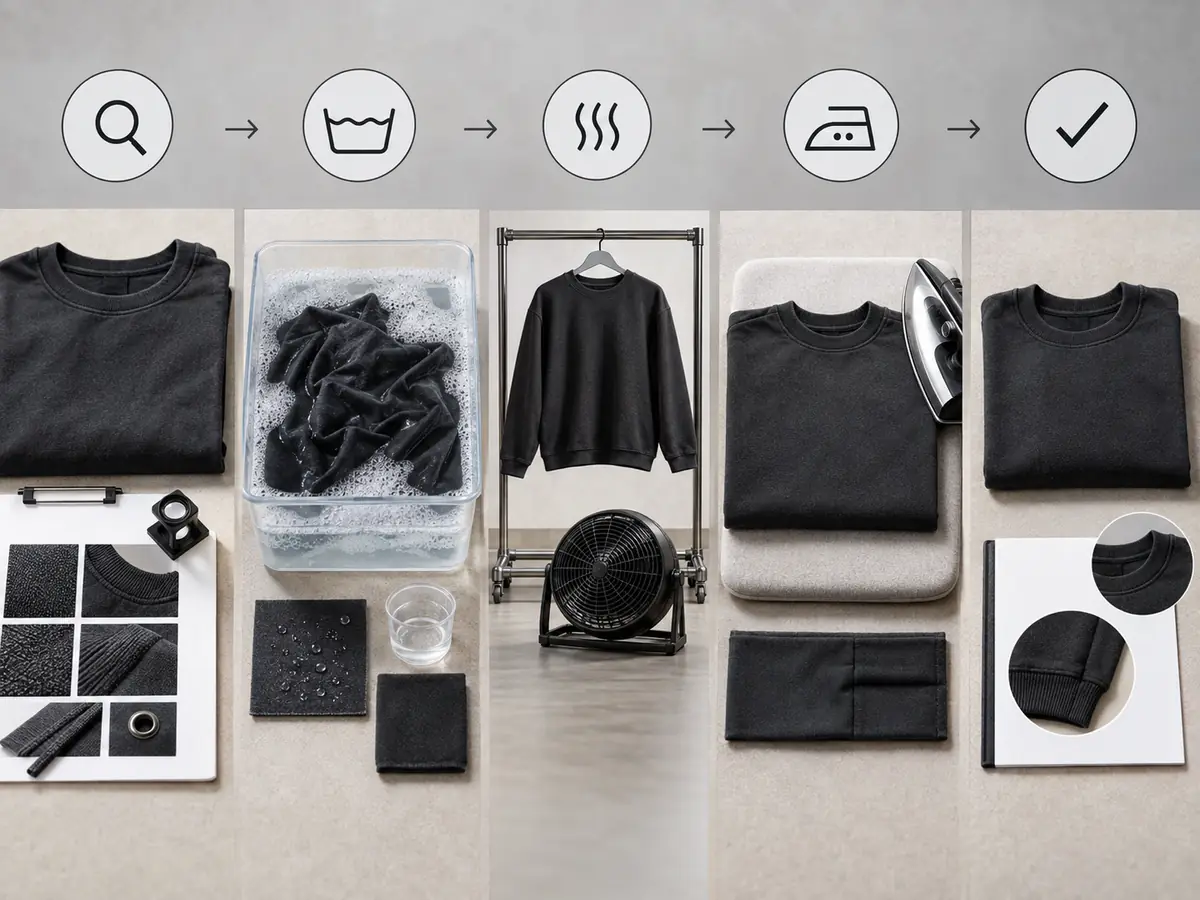
What does streetwear care label evidence mean?
Streetwear care label evidence is reliable information supporting the regular-care instruction and warnings for the finished textile product. It can include appropriately designed tests, controlled experience, current technical literature, component data and whole-garment validation, depending on the applicable rule and risk. The record identifies style, material and decoration versions, sample state, care route, observations, approver and market.
A fibre supplier recommendation is not automatically sufficient for a decorated garment. A successful test on separate components may also miss bleeding, transfer damage, differential shrinkage or hardware interaction when the garment is cleaned as a whole. Legal wording and approved care symbols vary by destination market and must be checked independently.
Why does streetwear care label evidence matter to buyers?
It matters because omissions can have a meaning and consumers can reasonably use damaging procedures unless warned. The FTC’s U.S. guidance explains that care instructions need a reasonable basis and that washing, drying, ironing, bleaching and warnings must be considered. It also states that component evidence must be joined with reliable whole-garment evidence. This is especially relevant to private-label streetwear with multiple decoration and trim suppliers.
This guide uses the FTC rule as a U.S. example and ISO 3758 as an international symbol framework. It does not claim that one system applies worldwide. The brand owner or importer should confirm current market scope, language, symbol, permanence and placement requirements with qualified advisers.
What should buyers compare before approval?
Map every care element to the component or interaction that could be harmed. The table turns a broad topic into fields that can be checked against the real purchase order.
| Care element | Evidence question | Whole-garment risk |
|---|---|---|
| Washing or dry-cleaning | Which regular route is supported? | Bleeding, distortion, finish or adhesive damage |
| Drying | Which method and heat exposure are safe? | Shrinkage, print cracking, delamination or hardware heat |
| Bleaching | What regular bleach condition is supported or prohibited? | Colour loss, fibre or decoration damage |
| Ironing | Is ironing needed and where can heat cause harm? | Melt, gloss, transfer or embroidery distortion |
| Warnings | Which reasonably expected action needs explicit restriction? | Damage to the item or other items cleaned with it |
Silence can imply that a procedure is allowed under some rules. Therefore every omitted temperature, bleach or warning field should be reviewed deliberately. Keep the final wording aligned with the evidence and market rather than adding generic warnings that have no documented basis.
Which standards and sources support this guide?
Use current destination-market rules and a recognized care-symbol framework, supported by finished-product evidence. The FTC Clothes Captioning guidance explains reasonable basis, whole-garment interactions and five washing-instruction elements for covered U.S. products. The FTC rule text provides the legal detail. ISO 3758:2023 establishes graphic care symbols that indicate the most severe treatments that do not cause irreversible damage and includes national and regional context.
Review the FTC Clothes Captioning guidance, the FTC Care Labeling Rule text and the ISO 3758:2023 overview. Confirm current requirements for each destination market.
What belongs in the technical brief?
- Brand owner/importer, destination market and product category.
- Style, colourway, size and approved-sample identity.
- Body, rib, lining, trim, hardware and decoration versions.
- Proposed washing or dry-cleaning route.
- Drying, bleach, ironing and warning decisions.
- Evidence source and finished-garment interaction review.
- Label wording, symbols, language, placement and permanence route.
- Approver, review date and change-triggered retesting.
How should the streetwear care label evidence workflow run?
Start with the complete construction, identify foreseeable care risks, build evidence and only then write the label. Each step should leave a dated record tied to the style, component, version and decision owner.
- Confirm destination markets and the party responsible for the final label.
- Freeze the finished BOM, decoration, trim and approved sample.
- Map how washing, drying, bleach, ironing and dry-cleaning could affect each component.
- Choose reliable evidence proportionate to the garment and claimed instruction.
- Validate interactions on a representative finished garment or justified equivalent.
- Compare the observations with the proposed instruction and warnings.
- Translate the approved decision into the correct market wording and symbol system.
- Check visibility, attachment, permanence and packaging/hang-tag duplication where applicable.
- Retain the evidence file and tested sample with the production lot.
- Reopen the decision after a relevant material, print, trim, supplier or market change.
A status of “approved” should mean that the evidence was reviewed against a stated requirement. It should not mean only that a file was uploaded or that a sample looked acceptable. If a relevant input changes, reopen the affected decision instead of silently extending old evidence.
How should the evidence be interpreted?
The strongest instruction is the least restrictive route that is fully supported for the finished garment and market. A component can pass alone and fail through interaction. Conversely, a conservative warning should not be added automatically without understanding the rule and evidence. The review should record why each instruction, temperature, symbol and warning is present or absent.
| Finding | Meaning | Buyer action |
|---|---|---|
| Whole garment supports the complete proposed instruction | Evidence matches the frozen construction | Approve for the stated market |
| Only base-fabric data is available | Decoration and interaction risks remain | Test or substantiate the finished garment |
| Instruction omits a field with regulatory meaning | Consumer interpretation may exceed evidence | Clarify wording or warning |
| Print, trim or market changes | Earlier evidence or symbols may be stale | Reassess affected scope |
Do not describe this page as legal advice and do not apply U.S. instructions globally. Do not say that a garment is “care proof.” Evidence supports the specific finished construction, procedure and market reviewed, subject to the limits recorded.
What mistakes weaken the decision?
The most serious mistake is copying a generic care label before the finished garment is validated.
- Using body-fabric instructions for a decorated garment.
- Ignoring colour transfer between panels.
- Omitting drying or bleach review.
- Allowing ironing over heat-sensitive decoration without warning review.
- Using symbols from the wrong market system.
- Changing trims or adhesive without reassessment.
- Keeping no reasonable-basis evidence file.
These errors separate the test, design file or identification record from the product actually ordered. A controlled streetwear care label evidence reconnects the evidence, product scope, version, condition, decision rule and named approver.
What belongs in the buyer approval checklist?
The label, approved sample and evidence file must describe the same product.
- Destination market confirmed.
- Complete BOM and decoration frozen.
- Whole-garment interactions reviewed.
- Washing/dry-cleaning route supported.
- Drying, bleach and ironing considered.
- Warnings justified and visible.
- Symbols and language checked.
- Attachment and permanence verified.
- Evidence owner and change triggers assigned.
Keep this checklist with the tech pack, laboratory request, artwork pack or item-master record. Mark unknown fields as pending and assign an owner. Conditional wording is more accurate than an unsupported promise about performance, compliance, durability or market acceptance.
How were current research findings applied?
This article converts current source scope and competitor structure into an original buyer workflow; it does not copy commercial promises, prices, images or protected design material.
| Research finding | Specific application | Visible evidence |
|---|---|---|
| FTC requires a reasonable basis for care information | Every label element is linked to a named evidence source | Definition, brief and checklist |
| FTC explains component results need whole-garment support | The workflow validates interactions on the frozen garment | Steps three to six |
| FTC identifies washing, drying, ironing, bleaching and warnings | The article uses these as the core comparison dimensions | Five-row table |
| ISO 3758:2023 defines a care-symbol system and treatment severity | Symbol selection is separated from the test evidence and market decision | Authority and interpretation sections |
The sources support definitions, scope and limitations. Procurement recommendations are identified as practical controls, not universal legal or technical requirements. This separation gives answer engines concise responses, gives generative systems attributable context and keeps the page useful to a human sourcing team.
Frequently asked questions about streetwear care label evidence
Can a fabric supplier care instruction be copied to the garment?
Not automatically. Prints, linings, rib, hardware and interactions can require different evidence or warnings.
Must the whole garment be tested?
Whole-garment support is important. The exact evidence route depends on the rule and risk, but component data alone may miss damaging interactions.
Can ISO care symbols be used in every market?
Do not assume that. Check the current destination-market rules, approved symbol system, language and placement.
What should trigger reassessment?
Any relevant change. Fabric, dye, print, adhesive, trim, hardware, supplier, care route or destination market can alter the basis.
Is a more restrictive label always safer?
Not necessarily. The instruction should be accurate, complete and supported rather than automatically over-restrictive.
Conclusion: write the label after validating the garment
Streetwear care label evidence turns a generic instruction into a traceable product decision. By freezing the construction, reviewing every care element, validating finished-garment interactions and checking market rules, a private-label buyer can publish clearer instructions without implying universal legal coverage.
Connect care evidence to the streetwear sampling process, review manufacturing options on the capabilities page, and retain component scope using the supplier declaration validity guide. Contact the sourcing team with the style, construction, market and decision requirement so the available facts can be confirmed for your project.