Streetwear Carton Drop Test Guide
Quick Answer: A streetwear carton drop test should be selected from a documented distribution scenario and performed on a representative packed carton under stated conditioning, weight, dimensions, drop sequence and acceptance criteria. Record package and product damage separately. Do not invent a universal height or claim transport protection beyond the specific procedure and evidence used.
Garments are soft, but streetwear shipments can still suffer crushed cartons, abrasion, moisture exposure, decoration transfer, hanger damage, displaced assortments or label loss. The test package must represent the actual fold, bag, quantity and carton construction rather than an empty or specially reinforced demonstration box.
A test is meaningful only inside its scope. Procedure selection, laboratory or internal method, conditioning and acceptance criteria should be agreed before testing, because the same carton may behave differently when weight, humidity, orientation or internal arrangement changes.
What is streetwear carton drop test?
A streetwear carton drop test is a controlled series of impacts used to observe how a defined shipping package and its packed garments respond to handling hazards. It is useful only when the represented order, revision and evidence boundary are explicit.
Key entities include distribution system, procedure, carton specification, board or construction, gross weight, dimensions, garment assortment, inner packaging, void fill, conditioning, drop height, face, edge and corner sequence, product damage, package damage and acceptance authority. These entities should remain connected across the specification, physical goods and final record so a later reviewer can understand exactly what was checked.
Why does streetwear carton drop test matter before release?
It provides evidence about a specified package system before shipment and can expose weak closures, excess void, poor assortment restraint or product-to-product contact. It does not simulate every carrier event or certify all routes, so the report must state its limits.
The control should be proportional to the order risk and agreed buyer requirements. It must not manufacture missing information: an unread value is unknown, an unavailable record is a coverage gap, and a pending decision is not a pass.
Which buyer decisions belong in the control?
Translate the order into named decisions before asking an operator or inspector to act. A decision table prevents visual similarity, convenience or old files from replacing the current approved basis.
| Decision | Evidence question | Output |
|---|---|---|
| Distribution scenario | Which handling system and hazard level does the procedure represent? | Applicable test basis |
| Representative pack | Do carton, quantity, assortment, bags, inserts and closures match shipment? | Valid specimen |
| Conditioning | What temperature, humidity and duration apply before testing? | Stated precondition |
| Impact sequence | Which corners, edges and faces are dropped, at what defined level? | Reproducible execution |
| Acceptance | Which package and product changes are allowed or prohibited? | Pre-agreed decision rule |
| Applicability | Which weights, dimensions, routes and pack revisions does the result cover? | Explicit evidence boundary |
Commercial discussions may influence priorities, but they should not rewrite technical evidence. Any condition that changes the represented product or shipment needs documented approval and an updated revision.
Which standards and source records set the evidence boundary?
Use current authoritative guidance to define method, terminology and reporting boundaries. Review ISTA test procedures, ISO 2248 overview, SGS pre-shipment inspection.
These sources support method selection and evidence design. They do not certify either website, establish one universal pass value, or replace the buyer-approved specification, route, market requirement or test plan for the actual order.
How should buyers run the streetwear carton drop test workflow?
Freeze the inputs, execute a reproducible check, control exceptions and issue a named release decision. Identify the order, represented style, revision, responsible person and dated outcome at every step.
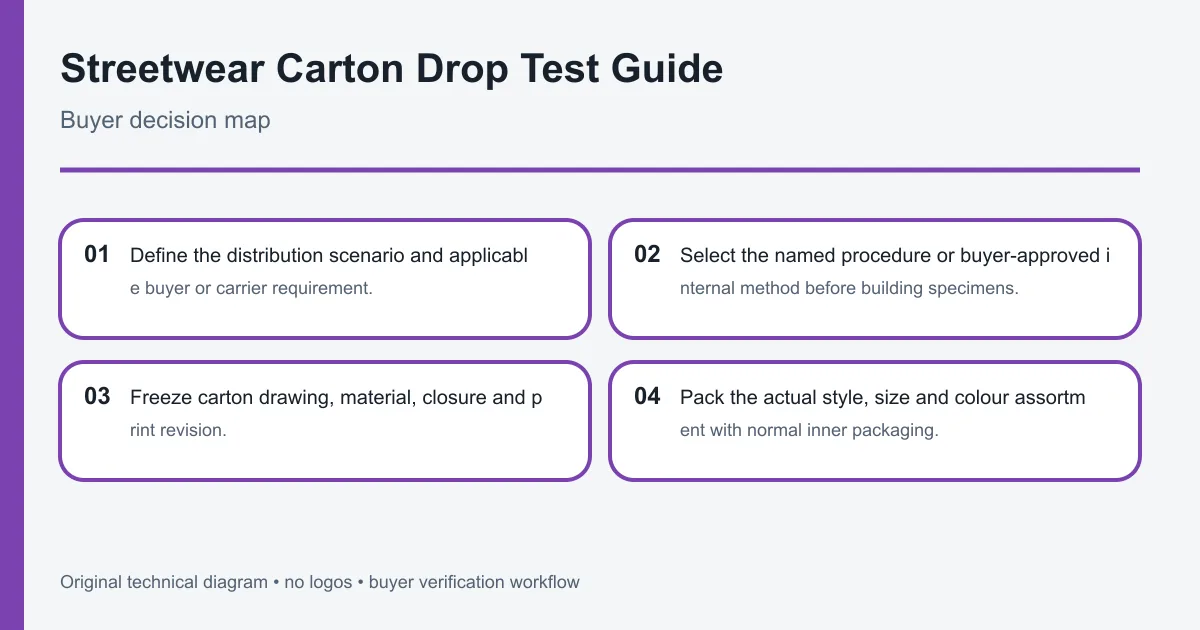
- Define the distribution scenario and applicable buyer or carrier requirement.
- Select the named procedure or buyer-approved internal method before building specimens.
- Freeze carton drawing, material, closure and print revision.
- Pack the actual style, size and colour assortment with normal inner packaging.
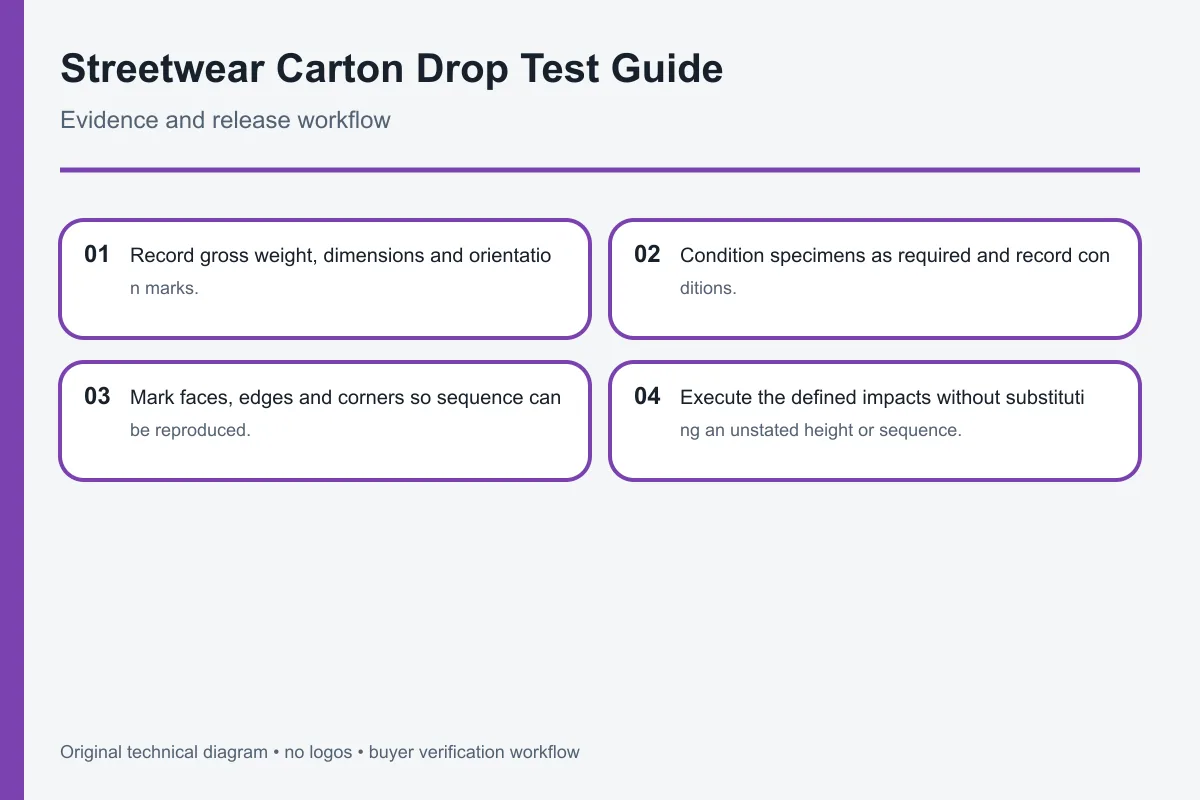
- Record gross weight, dimensions and orientation marks.
- Condition specimens as required and record conditions.
- Mark faces, edges and corners so sequence can be reproduced.
- Execute the defined impacts without substituting an unstated height or sequence.
- Inspect carton, closures, labels, bags, garments, trims and decoration separately.
- Record result, photographs, deviations, retest conditions and applicability limits.
When an input changes, review the affected steps rather than assuming the earlier result still applies. Keep superseded records so the reason for a new decision remains traceable.
What evidence should be retained?
The evidence package should connect the approved instruction to the physical product or shipment and the final decision. Evidence should be readable, dated and explicit about any area that was not available.
| Evidence block | Minimum identity | Buyer verification |
|---|---|---|
| Procedure identity | procedure, version, level and deviations | Can another party repeat the sequence? |
| Specimen identity | carton, closure, pack list, style and assortment | Does it represent shipment? |
| Condition record | weight, dimensions, temperature, humidity and duration | Were preconditions controlled? |
| Impact record | drop order, orientation and defined level | Was every required impact completed? |
| Damage record | package and product findings with images | Does the decision follow agreed criteria? |
Use photographs as supporting evidence, not as a replacement for identity, measurements, quantities or method. The record should allow another reviewer to distinguish observation from assumption.
How should results and exceptions be interpreted?
Interpret the result only inside the recorded scope and conditions. A local pass does not erase an uncovered order line, changed input or unresolved exception.
| Finding | Meaning | Required action |
|---|---|---|
| Carton and products meet criteria | The represented pack passed the selected procedure | Retain the exact pack specification |
| Carton deforms but products remain acceptable | Decision depends on the pre-agreed package criterion | Do not convert observation into automatic pass |
| Products shift or abrade | Internal restraint or contact risk is present | Revise arrangement or protection and retest |
| A pack variable changed | Earlier evidence may no longer represent shipment | Review change significance and define retest |
Correction should preserve traceability to the original finding. If correction changes the represented item or pack, define the recheck before release instead of relying on an undocumented visual review.
What failure modes should the buyer prevent?
The main risk is a clean-looking record that does not represent the actual order.
- Testing an empty carton.
- Using a stronger sample than the purchase specification.
- Changing tape pattern or closure during the sequence.
- Omitting conditioning when the procedure requires it.
- Failing to mark faces, edges and corners.
- Recording carton damage but not garment damage.
- Using an unstated pass rule after seeing the result.
- Applying one result to different weights or pack configurations without review.
These failures are prevented through revision control, representative selection, explicit unknowns and named release authority—not by adding unsupported claims or arbitrary numbers.
What belongs in the pre-release checklist?
Use a short checklist only after the detailed method and acceptance basis are agreed.
- Distribution scenario is documented.
- Procedure and version are named.
- Carton revision matches purchase records.
- Pack assortment is representative.
- Weight and dimensions are recorded.
- Conditioning is complete.
- Impact sequence is traceable.
- Package and product damage are separated.
- Acceptance criteria were approved before test.
- Result limits and change controls are stated.
If one required item cannot be verified, mark it pending or unavailable and pause the affected judgment. Do not convert the gap to zero or quietly remove it from the checklist.
How did high-traffic and fast-growth peer learning improve this guide?
Peer learning was used only for information architecture and buyer usability. No competitor wording, branded artwork, commercial claim or product design was copied.
| Dimension | Peer-page finding | Specific application | Public evidence marker |
|---|---|---|---|
| SEO | mnml separates shipping intent by service, destination and delivery window, including a compact comparison table. | Built a procurement decision matrix and descriptive cluster links for streetwear carton drop test. | ACL-DROP-SEO buyer decision matrix |
| AEO | Represent answers return and parcel-handling questions first, then gives a numbered action sequence. | Placed a direct 40–70 word answer before the detailed workflow and answered every question heading first. | ACL-DROP-AEO answer-first workflow |
| GEO | The peer pages expose distribution entities and limits including carrier, tracking, original packaging, parcel condition and destination-dependent handling. | Defined distribution system, procedure, carton specification, board or construction, gross weight, dimensions, garment assortment, inner packaging, void fill, conditioning, drop height, face, edge and corner sequence, product damage, package damage and acceptance authority and tied judgments to authoritative sources and stated limits. | ACL-DROP-GEO entity and evidence boundary |
The structure brings clear product-page decision patterns into a technical sourcing guide while preserving original language, independent evidence and the procurement context.
How were authority findings applied?
| Research source | Original application | Visible evidence |
|---|---|---|
| ISTA test procedures | Applied distribution-test selection and procedure scope without treating the source as supplier certification or a universal pass rule. | definition and decision table |
| ISO 2248 overview | Applied vertical impact test context for complete packages without treating the source as supplier certification or a universal pass rule. | workflow and evidence table |
| SGS pre-shipment inspection | Applied shipment verification and reporting context without treating the source as supplier certification or a universal pass rule. | interpretation and FAQ boundary |
The answer-first boundary supports AEO. Stable entities, source links, decision conditions and explicit unknowns support GEO without promising inclusion in any AI answer.
Frequently asked questions about streetwear carton drop test
Is there one universal carton drop height?
No. Use the specified procedure, package weight and distribution scenario. Confirm the applicable level rather than copying a value from another shipment.
Should garments be inside retail polybags during the test?
Use the actual intended inner packaging and arrangement so the specimen represents shipment.
Does a passed test guarantee no transit damage?
No. It supports the defined package under the selected procedure and conditions, not every route or mishandling event.
When is retesting needed?
Review retest need after changes to carton construction, closure, weight, dimensions, inner pack, assortment or other variables that may affect performance.
Can the test replace final inspection?
No. Package testing and shipment inspection answer different questions and should be linked through the control plan.
Conclusion: release only what the evidence represents
A streetwear carton drop test is a controlled series of impacts used to observe how a defined shipping package and its packed garments respond to handling hazards. A robust process connects current inputs, representative physical evidence, exception control and named authority. The result should make the next receiving, production or shipment decision easier without overstating what was checked.
Continue with custom hoodie packaging option, custom streetwear jacket, contact the sourcing team. Share the style, intended market, active specification and required evidence so project-specific options can be confirmed rather than assumed.