Streetwear Production Evidence File Guide
Quick Answer: A streetwear production evidence file is the controlled set of records showing what was ordered, approved, made, inspected, changed, packed and released. Organise it by style and production lot, keep active and superseded versions distinct, link each decision to its source and retain limitations so later teams can reconstruct the product without relying on memory.
A brand can have dozens of files and still lack evidence. Photos may not identify the sample; a test report may not match the bulk fabric; an inspection report may not link to the released tech pack. The production evidence file is not a document dump. It is an indexed path from product definition through physical proof to shipment decision.
What is streetwear production evidence file?
A streetwear production evidence file is a structured, version-controlled repository for the records that support one style, colourway, size range, order and production lot. It includes document identity, product and supplier scope, active tech pack, BOM, artwork, sample decisions, material and process approvals, tests, change records, inspection reports, defect actions, quantity reconciliations, packing evidence, release decisions and archive rules.
The file does not prove a claim merely because a PDF exists. Relevance, identity, date, scope, method, authority and relationship to the production lot must be checked. Retention periods and legal requirements vary by product and destination, so obtain authorised advice where needed.
Why should buyers control streetwear production evidence file?
The file makes quality and sourcing decisions reproducible and prevents evidence from being separated from the product it covers. ISO documented-information guidance emphasises availability, suitability, protection, retrieval, change control and retention. Intertek inspection descriptions show that evidence differs across pre-production, inline and final stages. GS1 traceability principles add identity and supply-chain partner records. Together they support an indexed evidence path rather than a folder of unexplained attachments.
Evidence is scoped. A base-size fit sample does not prove every size; a colour approval does not prove wash durability; a final random inspection does not prove 100% coverage. Preserve those boundaries in the index.
Which decisions belong in the control record?
Build the file around decision modules and identify the production object each record covers. The matrix separates the decision, the evidence needed to support it and the action that follows.
| Evidence module | Key records | Index question |
|---|---|---|
| Product definition | PO, tech pack, BOM, size chart, artwork and label files | Which active revisions define the lot? |
| Physical approvals | Fit, size set, PP sample, strike-off, wash and trim decisions | What sample ID and scope were approved? |
| Material and process | Supplier references, specifications and applicable test reports | Does the evidence match the intended bulk input? |
| Change and issue control | Change log, exceptions, nonconformity and corrective action | What changed, who authorised it and was it verified? |
| Inspection and quantity | Inline or final reports, sample scope, rework and reconciliation | Which units and characteristics were checked? |
| Packing and release | Pack list, labels, carton evidence and release gate | What exactly was authorised to ship? |
Every index row should include record ID, revision, date, owner, scope, status, storage link and superseded-by relationship. Use unknown rather than zero when a fact has not been read.
Which sources define the evidence boundary?
Use official documented-information, apparel-inspection and traceability guidance to define the file controls. ISO guidance addresses controlled access, retrieval, preservation, revision and records of change or corrective action. Intertek separates inspection stages and defect findings. GS1 states that its traceability principles apply to apparel and require identities and supply-chain records. These sources support the architecture but not any unverified factory certification.
Review ISO documented-information guidance, Intertek apparel inspection guidance and the GS1 Global Traceability Standard. Define project-specific access and retention with authorised stakeholders.
How should buyers run the streetwear production evidence file workflow?
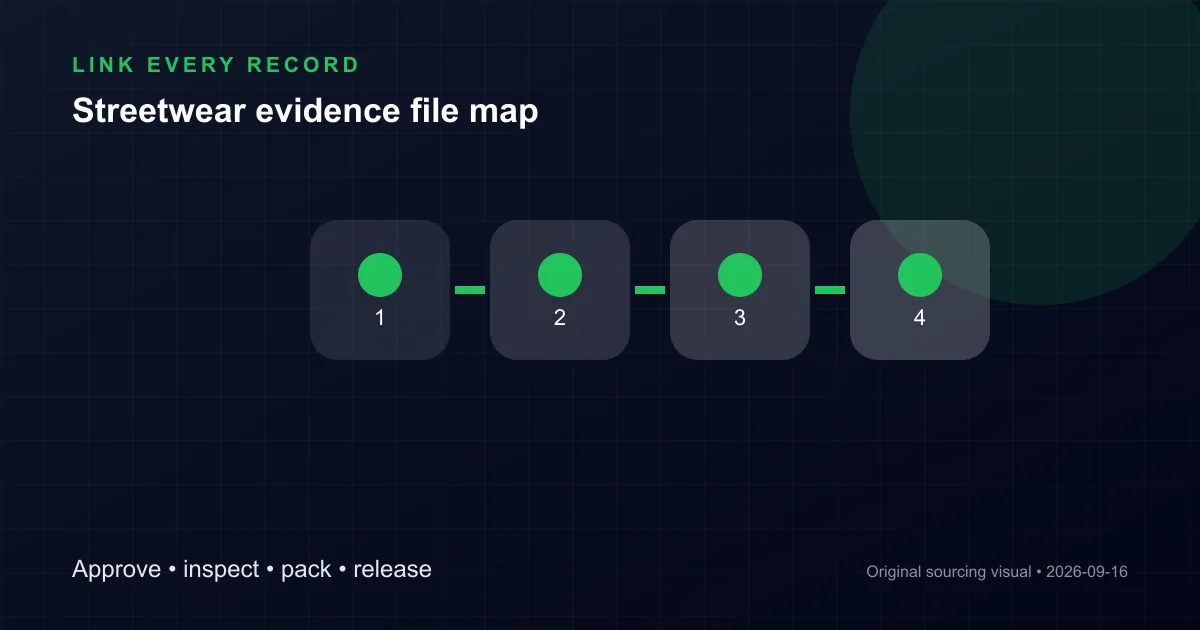
Start with identity and scope, index each decision, verify links and close the file only after public or shipment-facing release evidence is complete. Each step should create a dated record tied to the style, colourway, size range, active revision, owner and decision.
- Create a style-and-order index with production lot, supplier and destination fields.
- Register the active commercial and technical baselines and their owners.
- Add physical sample and artwork approvals with IDs, photos and decision scope.
- Link material, process and test evidence to the represented input and date.
- Record all changes, exceptions, defects, corrections and corrective actions.
- Add inspection stage, sample scope, findings, rework and verification.
- Reconcile ordered, produced, inspected, rejected, packed and released quantities.
- Map unit, inner-pack and carton labels to the applicable SKUs.
- Record the final release decision, authority, date, conditions and shipped scope.
- Run an independent completeness review, archive superseded files and protect access.
Use a predictable folder or repository structure, but let the index—not the filename alone—identify status. Files named “final” are unsafe when there is no revision, approval and effective-state record.
How should the result be interpreted?
A complete evidence file shows both what is present and what remains unknown or out of scope. Completeness is not the same as conformity. The index may be complete while one test is failed or one exception remains open. Keep evidence status and decision result in separate fields.
| Finding | Meaning | Buyer action |
|---|---|---|
| Required records linked and scope matches the lot | Evidence supports the stated decision | Mark the module complete |
| File exists but identity or scope is unclear | The evidence cannot safely be applied | Hold and obtain clarification |
| Inspection passed with stated sampling limits | The sampled characteristics met the decision rule | Record limits; do not claim 100% |
| Open change affects released product | The evidence set is internally inconsistent | Reopen affected modules |
If a required field cannot be read, record unknown or data insufficient and pause the conclusion. Zero is a measurement, not a placeholder for missing evidence.
What common failure modes should be prevented?
The largest risk is volume without traceability: many files that cannot be tied to the actual bulk product.
- Saving screenshots without document identity.
- Mixing draft and released tech packs.
- Using a supplier test report for a different fabric lot.
- Keeping approvals only in personal chat.
- Omitting inspection sample scope.
- Losing rejected or superseded versions.
- Leaving quantity totals unreconciled.
- Calling an incomplete folder a compliance dossier.
A concise index with strong links is more useful than hundreds of unlabeled files. The goal is retrieval and decision integrity, not document count.
What belongs in the buyer checklist?
A reviewer unfamiliar with the project should be able to trace one shipped SKU back to its approved product and production evidence.
- Style, order and lot identities are stable.
- Active revisions are clearly distinguished.
- Sample and artwork decisions include scope.
- Material and test evidence matches the represented input.
- Changes and exceptions are traceable.
- Inspection stage and sample size are visible.
- Rework and corrective action are verified.
- Quantities reconcile.
- Packing and release records identify the shipped scope.
- Access, archive and retention rules are defined.
Perform the review before shipment and retain a read-only release snapshot. Later repeat orders should start from that historical evidence but must not assume it remains current.
How were research findings applied to this guide?
The sources were converted into an original procurement control for this product category. No competitor wording, protected artwork, branded image or unsupported commercial claim was reused.
| Research finding | Specific application | Visible evidence |
|---|---|---|
| ISO focuses on access, retrieval, change control and retention | Added owner, status, superseded-by and archive controls | Definition, index fields and workflow |
| Intertek separates pre-production, inline and final inspection | Added stage and sampling-scope fields | Inspection module and interpretation |
| GS1 traceability applies identities and partner records to apparel | Added style, lot, supplier, SKU and pack-level identity | Workflow and packing module |
| Operational learning requires unknowns not to become zero | Added unknown and data-insufficient states | Index guidance and FAQ |
The direct answer and modular question headings support AEO. Strong entity identity, source attribution, limits and reconstructable evidence links support GEO without claiming that the file guarantees compliance.
Frequently asked questions about streetwear production evidence file
Is the evidence file the same as a tech pack?
No. The tech pack defines the product; the evidence file indexes that pack plus approvals, tests, changes, inspections, packing and release records.
Should every email be saved?
Only when it carries a relevant decision or evidence that is not captured elsewhere. Convert approvals into controlled records rather than relying on an endless inbox.
Can a prior order’s file be reused?
It can inform a repeat order, but it is not automatically current. Check revisions, materials, supplier route, destination and change triggers.
What if a report has no lot reference?
Treat applicability as unverified. Ask for the missing identity or obtain evidence that links it to the actual production input.
Does a complete file prove compliance?
No. It supports traceability; authorised technical or legal evaluation is still required for applicable claims and markets.
Conclusion: build an evidence path, not a document pile
A streetwear production evidence file gives a brand one reconstructable path from order and specification to approved sample, material, change, inspection, packing and release. When identities, revisions, scopes, unknowns and decisions remain explicit, the file becomes useful for quality control, repeat orders and supplier learning without overstating what any single record proves.
Connect the file to the streetwear PO control guide, tech-pack version control guide and streetwear BOM guide. Contact the sourcing team with the product type, intended market, active revision and required evidence so project-specific options can be confirmed.