Streetwear Bill of Materials Guide for Brand Buyers
Quick Answer: A streetwear bill of materials lists every fabric, rib, lining, thread, closure, hardware, decoration, label and packaging item required for one garment style. Record a stable component code, specification, colour, placement, unit or consumption, supplier status and approval reference, then control changes by colourway and revision before sampling or bulk production.
A streetwear bill of materials, or BOM, is where a visual design becomes a list that a manufacturer can source and check. Oversized T-shirts, heavy hoodies, tracksuits and jackets use different combinations of body fabric, rib, lining, hardware, decoration and branding. Omitting a “small” component can change hand feel, function, cost or retail presentation.
Use the BOM with the streetwear sampling approval guide and the relevant garments in Aimer Custom Lab’s custom menswear range. Product-specific minimums, availability, prices and lead times must be confirmed for the actual enquiry.
What is a streetwear bill of materials?
It is a controlled, row-by-row record of the physical inputs needed to make and pack a defined style. A useful BOM removes material assumptions during quotation, sourcing and production while connecting each component to approved evidence.
The Alignes apparel BOM guide identifies fabrics, trims, labels, hardware, artwork applications, thread and packaging as separate groups. That structure is especially useful for streetwear because visible trims and packaging often form part of the brand identity.
Which component groups should a streetwear BOM include?
| Group | Examples | Key specification | Approval evidence |
|---|---|---|---|
| Body materials | Jersey, fleece, French terry, woven shell | Reference, composition, construction, weight, finish | Swatch, test and garment sample |
| Secondary materials | Rib, lining, interlining, pocketing | Placement, stretch, colour and compatibility | Trim card and sample |
| Closures/hardware | Zipper, snap, eyelet, drawcord end | Size, material, finish, function | Physical approval and test |
| Decoration | Screen print, puff print, embroidery, patch | Artwork, process, size, position, colour | Strike-off or decorated sample |
| Labels | Main, size, care, origin, content | Artwork, data, fold, placement, variant | Label proof and first piece |
| Packaging | Hangtag, bag, tissue, sticker, carton | Material, dimensions, data and pack ratio | Pack-out sample |
What fields belong on every component row?
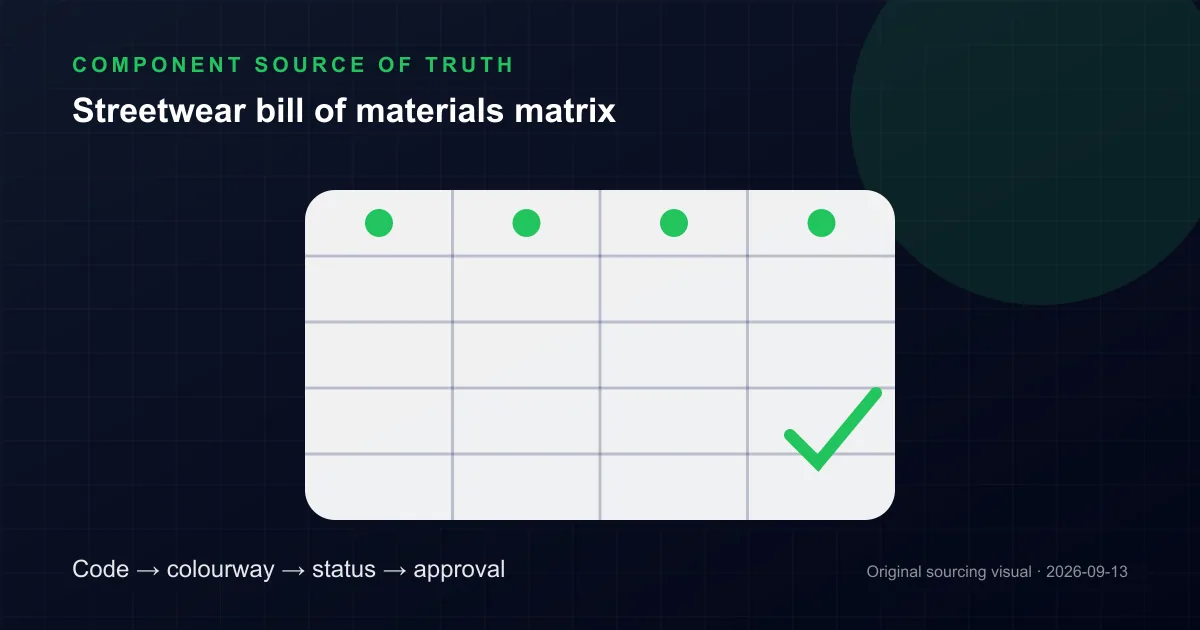
Use a stable ID, description, category, supplier reference, material or finish, colour, placement, applicable colourway and size, unit of measure, planned consumption or quantity, status, owner and approval reference. Add an image only as a visual aid.
Separate facts from assumptions. “Confirmed” means evidence exists. “Proposed” identifies a candidate. “TBD” requires an owner and decision date. A blank cell is unsafe because users cannot distinguish not applicable from forgotten.
How does a hoodie BOM differ from a T-shirt BOM?
A basic tee can require body jersey, neck rib, shoulder tape, sewing thread, artwork, labels and packaging. A hoodie may add hood lining, drawcord, eyelets, rib cuffs and hem, pocket reinforcement, zipper or snaps, and multiple artwork applications. Each added interface creates compatibility questions.
For heavyweight garments, record fabric construction and finish rather than relying on GSM alone. Weight does not prove fibre, density, surface, shrinkage or hand feel. Link the selected fabric to a swatch and approved sample.
How are colourways and variants controlled?
Give every colourway a stable code and map the body, rib, thread, print, hardware and label colours. If a black hoodie uses tonal embroidery but a cream hoodie uses contrast embroidery, those are distinct BOM applications even when the artwork shape is identical.
Use size applicability fields for components that change by size, such as labels or consumption. Verify every style-colour-size combination against the variant table used for hangtags, barcodes and packing.
How should labels be represented?
List the physical label construction separately from its controlled data. Main labels, size labels, care labels and hangtags can have different suppliers, materials and artwork variants. State fold, dimensions, print or weave method, placement and attachment.
For U.S. sales, the FTC textile labelling guide explains core fibre, origin and responsible-business disclosures. The brand or importer must confirm destination requirements; the manufacturer should not invent percentages, origin or legal identity.
What is the difference between quote and production status?
| Stage | Permitted BOM status | Control |
|---|---|---|
| Early quote | Confirmed plus named assumptions | Assumptions visible and priced separately |
| Sample request | Sample-approved or proposed with scope | Substitutes identified on sample |
| Bulk release | Bulk-approved rows only | Open conditions formally closed |
| Reorder | Revalidated approved revision | Availability, condition and data checked again |
How should substitutions be reviewed?
A proposed substitute should name the original, new component, reason and affected styles. Compare the properties that matter: appearance, dimensions, composition, weight, stretch, recovery, strength, wash behaviour, colour, print compatibility, function and destination requirements.
Specify whether evidence needs a swatch, trim sample, decorated panel, wash test, fit sample or laboratory result. Do not silently overwrite the old row. Issue a new revision and retain the approved change record.
What is the BOM release workflow?
- Confirm one style, silhouette, size range and market scope.
- Walk through flats and samples to identify every component.
- Create one row per distinct material or supplied item.
- Map colourways, sizes, placements and artwork references.
- Set confirmed, proposed, TBD or rejected status.
- Link approvals and required tests to active rows.
- Reconcile the BOM with construction, labels and packaging.
- Lock the release revision and obtain supplier acknowledgment.
How can the BOM support quality control?
Inspectors can use the approved component ID and reference at incoming, first-piece and final stages. Record supplier lot, colourway and disposition so a failed zipper or label can be traced to affected units. The BOM should point to the relevant dimensions, appearance standard or test record without trying to duplicate every procedure.
At final inspection, reconcile the garment and its packaging with active BOM rows. A correct hoodie with an obsolete hangtag is still the wrong retail unit. For reorders, compare available stock with the current revision before releasing leftover fabrics, trims or labels.
Streetwear BOM buyer checklist
- Stable style, component and colourway identifiers
- Body, rib, lining and reinforcement separated
- Thread, closures, hardware and decoration included
- Main, size, care and origin labels listed
- Hangtags, bags, stickers and cartons included
- Placements and applicable variants explicit
- Unknown fields have owners and stop conditions
- Approval references link to physical evidence
- Substitution and obsolete-component history retained
For handover, export one readable BOM with the same revision shown on the tech pack and sample approval. Ask the supplier to acknowledge open items, substitutions and buyer-supplied components before sourcing begins. This makes the streetwear bill of materials a shared production reference rather than a private design worksheet, and it gives quality teams a stable record for inspection and reorders.
Frequently asked questions
Is the BOM only for costing?
No. It supports costing, but it is also used for sourcing, sampling, inspection, production and reorders.
Should fabric consumption be exact before the first sample?
Early values may be estimates if clearly labelled. Confirm the measurement method, marker or production basis before commercial commitment.
Can one BOM cover a whole collection?
A shared component library can help, but each style and colourway needs clear applicability. Do not hide style-specific differences in a generic list.
Does a supplier reference prove equivalence?
No. Approve the relevant specification, physical sample and tests. Similar item names can mask different performance.
When should a BOM revision change?
Change it whenever an authorised production input or instruction changes. Record reason, affected rows and required reapproval.
How should leftover trims be used on a reorder?
Verify revision, quantity, condition, colour, performance and destination data before reuse. Old stock is not automatically current stock.
Conclusion: make the garment buildable without guessing
A streetwear bill of materials turns design intent into controlled sourcing data. List every component, map colourways and variants, show status, link physical approvals and manage substitutions through revision control. Brands can send the garment range, tech pack, material direction, decoration and market scope through the Aimer Custom Lab contact page to confirm order-specific development and production requirements.