Streetwear Applique Patch Attachment Guide
Heavy chenille, embroidered twill, woven badges and printed patches load the garment differently. A rigid patch on stretch jersey can pucker or limit movement, while heat can glaze synthetic fabric or damage a coating. Tight stitching may perforate lightweight material, but sparse stitching can let edges lift and snag. For sourcing teams, streetwear applique patch attachment is therefore an approval decision that must connect the sample, written specification, production controls and final inspection.
This guide is written for OEM, ODM, wholesale and private-label buyers. It converts the topic into observable evidence, separates material behavior from assembly effects, and avoids unsupported claims about prices, certifications, MOQ, capacity or lead time. Those commercial details must be confirmed for the actual inquiry.
Quick Answer
Streetwear applique patch attachment can use perimeter stitching, satin or zigzag stitching, heat-activated backing, bonding, hook-and-loop, or a combined method. Buyers should match the attachment to patch construction, garment fabric, stretch, placement, care route, safety needs, and repair expectations, then approve edges, distortion, strength, appearance, and post-care performance on production materials.
What is streetwear applique patch attachment?
An applique or patch is a separately prepared textile element attached to a garment surface. The attachment system includes the patch base and border, backing or adhesive, placement aid, stitch type, thread, needle, stabilizer, heat and pressure where used, and the garment substrate. A decorative look does not prove durable attachment.
The definition matters because neighboring tests or constructions may answer different questions. State the entity and scope first, then choose evidence that represents the actual garment, component, packaging or decoration system.
What should buyers compare for streetwear applique patch attachment?
Direct answer: Compare the variables that can change both the result and the buying decision. The matrix below turns streetwear applique patch attachment into a reviewable set of trade-offs.
| Decision point | What to define | Why it matters | Common mistake |
|---|---|---|---|
| Attachment | Sew-on, heat-applied, bonded, hook-and-loop or combined | Durability, removability and equipment | Selecting by speed alone |
| Patch build | Embroidered, woven, chenille, printed or layered applique | Weight, border and flexibility | Ignoring border behavior |
| Garment base | Jersey, fleece, woven shell, coated or padded fabric | Stretch, heat sensitivity and support | Using one press recipe on every substrate |
| Placement | Chest, sleeve, back, pocket or seam crossing | Movement, curvature and inside comfort | Approving on a flat scrap only |
| Care route | Home wash, dry clean or specialist care | Adhesive, thread and color stability | Claiming durability without care exposure |
Use the table during development and copy the chosen conditions into the tech pack or quality manual. That prevents a later pass from being based on a different specimen, setup or endpoint.
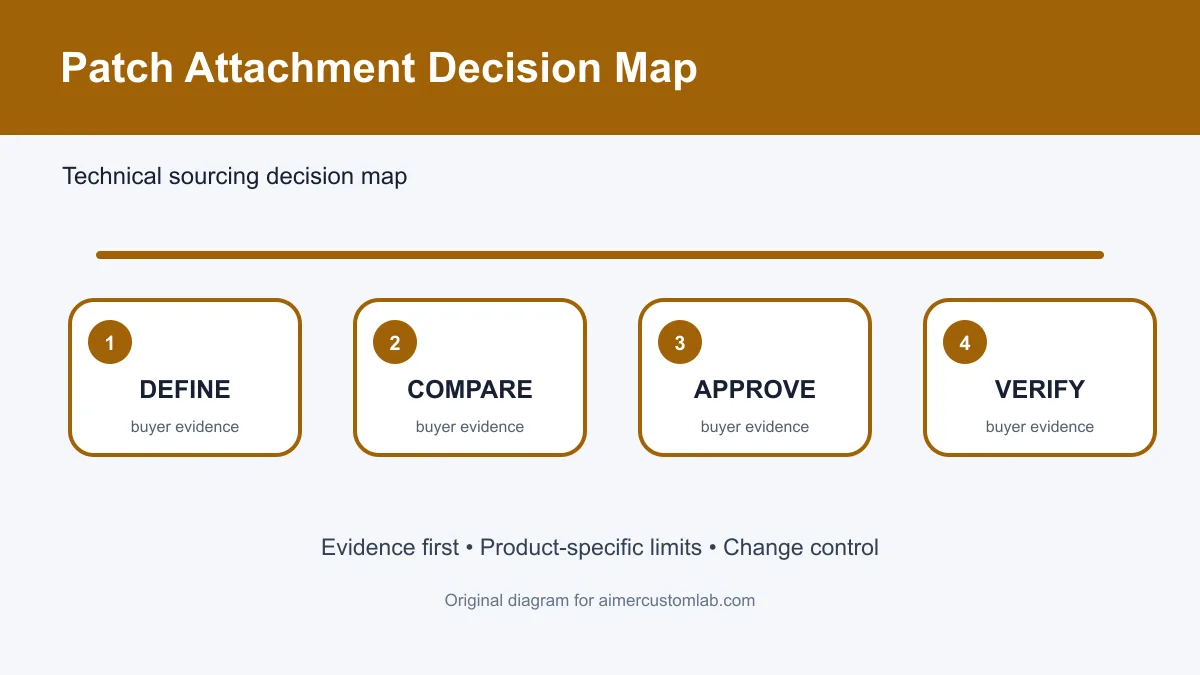
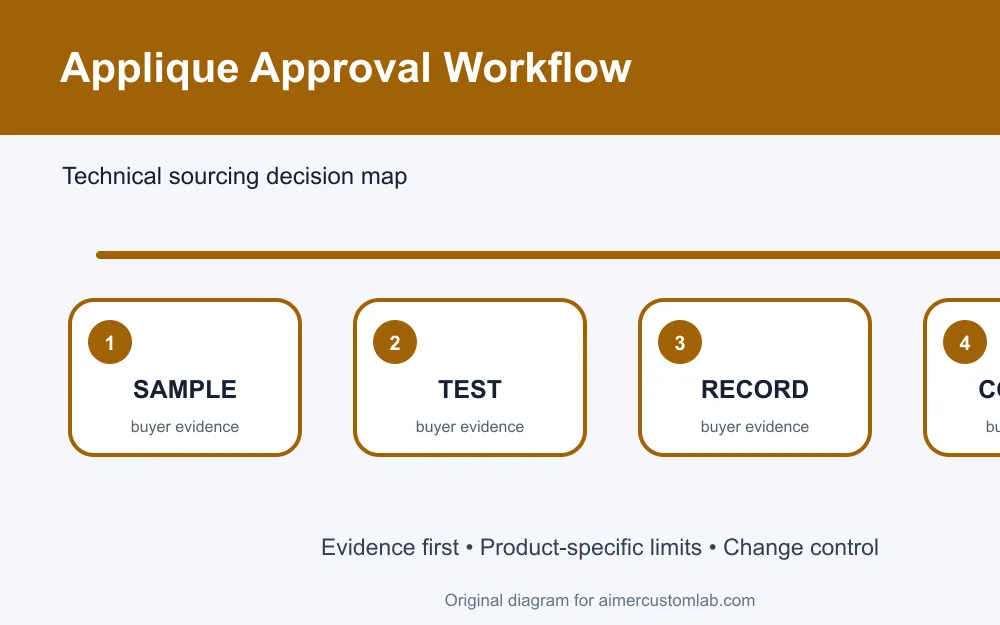
How should a factory build the approval trial?
Direct answer: Freeze the inputs, use production-representative materials, document the method, observe intermediate behavior and inspect the complete product after the trial.
- Identify patch dimensions, mass, stiffness, border, backing, artwork orientation and intended location on each size.
- Confirm garment composition, construction, finish, stretch, heat sensitivity and nearby seams or pockets.
- Select an attachment method and create a production-material trial with correct stabilizer, thread, needle, heat, pressure and dwell records.
- Inspect placement tolerance, puckering, edge coverage, strike-through, shine, adhesive bleed, inside roughness and artwork alignment.
- Apply the agreed care and flex sequence, then examine edge lift, cracking, delamination, stitch damage, color transfer and garment distortion.
- Retain the approved patch and garment sample, document repair or rework limits, and require reapproval after any material or process change.
Do not let a successful single specimen erase variation. If the risk is material, repeat across justified specimens and investigate inconsistent results before release. Record deviations rather than averaging away a clear failure mode.
How should common failures be diagnosed?
Edge lift: what should be checked first?
Direct answer: Check border shape, adhesive coverage, press uniformity, curved placement and whether perimeter stitching is required. Record the original symptom before correction, change one variable at a time, and repeat the same check. That creates a traceable cause-and-effect record instead of a cosmetic rework that cannot be reproduced in bulk.
Base fabric puckers: what should be checked first?
Direct answer: Review patch stiffness, stabilizer, stitch density, thread tension and differential shrinkage. Record the original symptom before correction, change one variable at a time, and repeat the same check. That creates a traceable cause-and-effect record instead of a cosmetic rework that cannot be reproduced in bulk.
Heat mark or shine: what should be checked first?
Direct answer: Reduce unsupported assumptions: verify garment heat sensitivity, platen contact, protective sheets, pressure and dwell. Record the original symptom before correction, change one variable at a time, and repeat the same check. That creates a traceable cause-and-effect record instead of a cosmetic rework that cannot be reproduced in bulk.
Patch rotates in bulk: what should be checked first?
Direct answer: Add placement templates, orientation marks and first-piece checks; do not rely on visual centering alone. Record the original symptom before correction, change one variable at a time, and repeat the same check. That creates a traceable cause-and-effect record instead of a cosmetic rework that cannot be reproduced in bulk.
What belongs in the purchase specification?
A usable purchase specification should identify the product state, test or inspection method, sampling plan, acceptance rule and evidence owner. For streetwear applique patch attachment, the following fields should be agreed before the purchase order is released:
- patch type, dimensions, mass and border
- backing, adhesive and supplier code
- garment material and placement coordinates
- stitch class, density, thread, needle and stabilizer
- press temperature, pressure and dwell where applicable
- placement tolerance and visual defects
- care, flex and attachment evaluation
- safety, labeling, rework and change-control rules
Numeric limits must come from an applicable buyer standard, a current published method, a qualified laboratory recommendation or a jointly approved development trial. A machine setting, cycle count or visual grade without the rest of the method is not portable evidence. If any value cannot be verified, mark it for confirmation instead of presenting an estimate.
What are the practical limits of the evidence?
Brother guidance shows that applique construction benefits from stabilizer and that editing after the applique setting can create misalignment. Printify recommends checking patch edges, backing adhesion and wash performance on samples. These are useful process insights, not universal specifications. Attachment strength, heat settings and safety rules must be confirmed for the target garment and market.
Laboratory results describe the specimens and conditions tested. They do not automatically prove every color, size, lot, factory line or end-use scenario. Link the approval to stated boundaries, then add surveillance or retesting when risk and change justify it.
How should sampling and change control work?
Direct answer: Sample the construction that carries the highest practical risk, not only the easiest middle-size unit. Include relevant material lots, colorways, sizes, decoration areas and pack configurations. Define whether observations are destructive, how tested units are identified, and what happens when results disagree. A retained control and repeatable photo setup make later comparisons more defensible.
Change control is part of streetwear applique patch attachment. Reapprove when material, construction, pattern, process, care route, packaging or intended market changes in a way that can affect the result. Link the change to affected orders before substitution.
What evidence should accompany the bulk shipment?
Direct answer: Retain the signed sample, specification revision, material or component references, conditioning record, equipment identification, raw observations, photographs, corrective actions and final disposition. The report should distinguish measured facts from interpretation and name unresolved limitations.
Which related products can this guide support?
- Review custom zip hoodie sets when applying this control to a production configuration.
- Review custom oversized streetwear T-shirts when applying this control to a production configuration.
These internal links show relevant product categories. They are not claims about a fixed construction, price, MOQ, capacity, certification or delivery time. Send the actual specification for confirmation.
Buyer checklist
Use this checklist to keep streetwear applique patch attachment consistent from development through final inspection.
- Patch build recorded
- Garment substrate verified
- Placement template approved
- Attachment variables documented
- Inside comfort inspected
- Care and flex sample reviewed
- Edge and distortion criteria defined
- Change control active
What are the standards and evidence boundaries?
Use the sources below as current research inputs and confirm the applicable edition, market and buyer protocol before testing or production. The first source supplies the core method or engineering boundary; the two high-traffic or fast-growth peer pages were used for information architecture and answer design, not copied wording.
- Brother applique operation guidance
- Printify custom patch guide
- Custom Ink sweatshirt decoration methods
- ASTM D6193 stitches and seams practice
Research-to-page evidence map
The table records how research changed this public article and where the result can be found.
| Research finding | Specific application | Visible evidence |
|---|---|---|
| Uses clear patch definitions, a step sequence and sample-focused quality checks. | SEO: organized streetwear applique patch attachment around a buyer comparison and risk-led headings. | What should buyers compare for streetwear applique patch attachment? |
| Compares decoration methods and explains limits before the FAQ. | AEO: placed a 40–70 word direct answer before detailed explanation and added a numbered approval route. | Quick Answer |
| The authoritative source defines a controlled method or scope and makes test limitations explicit. | GEO: defined the entity, named decision variables and stated where product-specific limits require buyer or laboratory confirmation. | What are the standards and evidence boundaries? |
Frequently asked questions
Is iron-on backing permanent?
Answer: Not universally. Adhesive, substrate, heat application and care determine performance; sewing may be needed for the intended use.
Can a patch be placed over a seam?
Answer: It is possible, but uneven thickness can reduce contact, distort stitching and affect appearance; approve a full construction sample.
Should stretch fabric be stabilized?
Answer: Often it needs controlled support, but stabilizer type and extent must preserve comfort, drape and recovery.
How can patch placement stay consistent across sizes?
Answer: Use graded coordinates or templates tied to stable pattern references and verify first pieces by size group.
When is hook-and-loop appropriate?
Answer: When removal or interchangeability is intended and both sides, edge comfort, strength and care behavior are approved.
Conclusion: what should a buyer do next?
streetwear applique patch attachment should finish as a documented, product-specific approval rather than a generic promise. Keep the signed sample, method, conditions, raw observations, photographs, corrective action and change triggers together. That record makes bulk decisions faster and reduces arguments caused by incomplete specifications.
Inquiry CTA: Send your tech pack, intended market and use, size range, material and component references, artwork, care route, packaging route and requested test method. Ask the team to confirm feasibility, sample details, MOQ, lead time and supporting evidence for your exact order.