Private Label Streetwear Packaging Guide
Private label streetwear packaging should protect the garment, identify every SKU, support warehouse receiving, and present the brand consistently without adding unnecessary bulk. Packaging development includes care labels, hangtags, size stickers, barcodes, individual protection, carton assortments, and destination-market information. This guide gives brand buyers a complete approval workflow while avoiding unsupported claims about legal compliance or environmental performance.
Quick Answer
A reliable private label streetwear packaging system starts with verified garment and destination data, one approved label-and-hangtag artwork set, scan-tested barcodes, a fold and individual-pack standard, a written carton matrix, and a sealed master pack. Confirm legal wording with qualified guidance for each sales market and make sustainability statements only when evidence supports them.
Why Private Label Streetwear Packaging Matters
Streetwear buyers often focus on graphics and fabric, then leave packaging until the final production week. That creates avoidable errors: old logo files, incorrect fiber information, missing sizes, duplicate barcodes, oversized bags, mixed carton assortments, and garments folded across raised prints. Packaging should be developed alongside the sample because it interacts with product measurements, decoration, wash, logistics, and retail systems.
The right system depends on the route to customer. Direct-to-consumer brands may need a unit barcode and clean unboxing presentation. Wholesale orders may need retailer-specific tickets and carton labels. A launch sample set may prioritize style identification and low quantities. Do not copy a packaging list from another brand without checking the actual channel.
Private Label Streetwear Packaging: Component Map
| Component | Purpose | Approval evidence |
|---|---|---|
| Main and size labels | Brand identity and quick size recognition | Artwork, dimensions, material, color, and placement sample |
| Care and fiber label | Product identity, origin, fiber, and care information as required | Destination-market review and sewn sample |
| Hangtag | Brand story, style data, price, barcode, or product information | Printed proof, hole position, attachment method, and scan test |
| Size sticker | Identifies a folded unit without opening | Size format, color, location, and adhesion trial |
| Individual bag or wrap | Protects against dust, moisture, and abrasion | Dimensions, closure, ventilation, print, and warning review |
| Master carton | Protects units and organizes receiving | Packed-carton trial, assortment, label, dimensions, and weight |
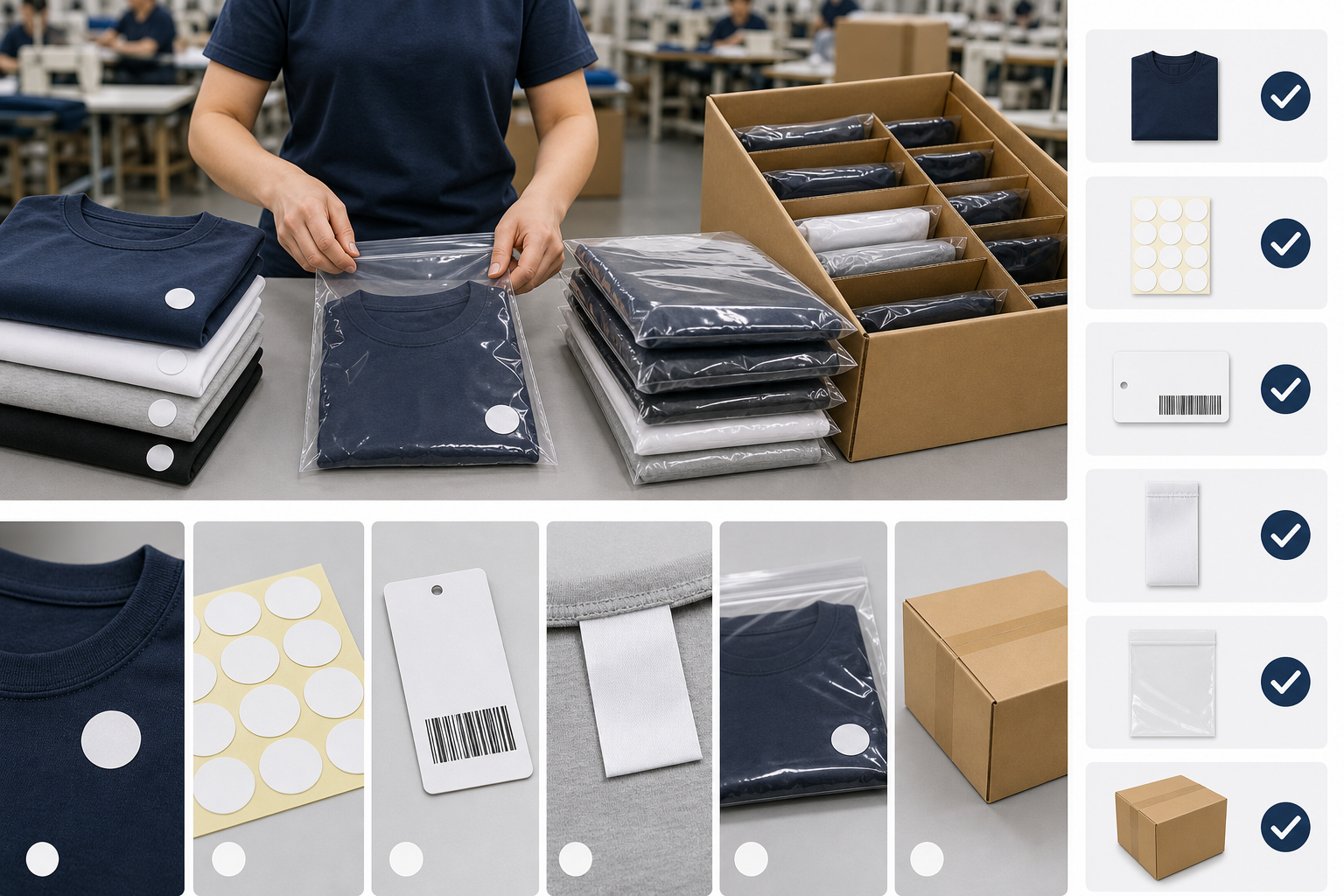
A complete pack approval covers garment labels, barcode data, individual protection, carton assortment, and receiving information.
Private Label Streetwear Packaging Labels
A garment label set can include a main brand label, size label, care label, fiber-content information, country of origin, responsible company details, and traceability code. The required combination varies by country, product, material, and sales route. For products sold in the United States, the Federal Trade Commission publishes textile and care-labeling guidance. Other markets use different rules, so brands should seek qualified local confirmation.
Information must match the actual product. If the approved hoodie changes from one cotton-polyester blend to another, the label artwork must be reviewed. Care instructions should account for garment dye, pigment effects, embroidery, heat transfers, zippers, rib, and other components. Legibility after the intended wash is as important as the initial print quality.
Private Label Streetwear Packaging Hangtags
Separate fixed and variable data
Brand story, logo, and general care advice may remain fixed, while style code, color, size, price, barcode, and retailer data vary. Design the file so variable fields can be updated without moving the approved layout. Use a controlled data sheet and one owner for final values.
Approve physical construction
Specify tag dimensions, paper or other material, thickness, finish, print sides, hole position, corner shape, and attachment method. A very heavy tag can distort a lightweight tee; a rough cord can catch on brushed fleece. Place the tag where it will not puncture the main fabric or damage a decoration.
Confirm claims
Do not print recycled, biodegradable, organic, compostable, or carbon claims unless the brand has suitable evidence and wording for the market. Packaging appearance does not prove an environmental claim. Keep supporting records with the approved artwork.
Private Label Streetwear Packaging Barcodes
A barcode is useful only when the encoded data matches the human-readable information and the receiving system. Define the barcode symbology, item number, check digit, size, quiet zone, color contrast, print position, and destination system. Generate codes from the brand’s authorized number source rather than inventing them in artwork.
Scan a printed proof and a production tag with the equipment used by the warehouse or retailer. Test curved, glossy, dark, and textured surfaces because they can reduce readability. Never reuse one code across multiple sizes or colors when the inventory system expects a unique SKU.
Private Label Streetwear Packaging Fold and Protection
Set a repeatable fold that shows the desired logo or front panel, fits the selected bag, and avoids hard creases across puff print, embroidery, applique, or heavy seams. Approve folded dimensions for each product type. Oversized tees, hoodies, jackets, and tracksuits should not be forced into one bag size if that creates compression or wasted space.
Individual protection should match transport and storage risk. Specify bag material or approved alternative, thickness if relevant, dimensions, closure, ventilation, print, sticker location, and any required warnings. Ensure garments are fully dry and conditioned before packing, especially after garment wash or dyeing.
Private Label Streetwear Packaging Carton Planning
Decide whether cartons are solid-SKU, mixed-size, mixed-color, store-specific, or order-specific. A carton matrix should show style, color, size ratio, unit count, carton number, and total cartons. Mixed cartons can reduce partial cases but increase receiving complexity. Choose the method that matches the warehouse.
Run a packed-carton trial. Confirm that the carton closes without crushing the garments, survives reasonable handling, and does not contain excessive empty space. Agree any weight limit with the logistics and receiving teams. Labels should remain legible after tape is applied and should not be placed across opening seams.
Private Label Streetwear Packaging Approval Checklist
- All logos and brand colors use the current approved files.
- Style, color, size, fiber, origin, and care data match the garment.
- Destination-market label requirements have been reviewed.
- Hangtag dimensions, finish, hole, cord, and attachment point are approved.
- Every barcode matches the correct SKU and passes a scan test.
- Fold protects prints, embroidery, zippers, and washed surfaces.
- Individual pack dimensions and size-sticker position are defined.
- Carton assortment, numbering, shipping mark, and totals reconcile with the purchase order.
- A full master pack is photographed, dated, and retained.
- Claims have evidence and no unapproved retailer information remains.
Private Label Streetwear Packaging Quality Control
- Inspect the garment first: packaging must not hide stains, damage, wrong measurements, or decoration defects.
- Verify variable data: compare labels, tag, sticker, and barcode with the SKU sheet.
- Check pack appearance: confirm fold, cleanliness, orientation, closure, and warning print.
- Count the assortment: reconcile each size and color before sealing.
- Audit cartons: reopen random cases from early, middle, and late packing.
- Record shipment data: retain carton dimensions, weights, quantities, labels, and photos.
Common Private Label Streetwear Packaging Failures
Wrong label version
Several near-identical artwork files circulate by email. Use one named approval folder, lock version numbers, and mark old files obsolete.
Barcode does not scan
The code may be undersized, stretched, low contrast, poorly printed, or incorrectly encoded. Test the physical production piece before the entire order is tagged.
Packaging damages the finish
A tight fold, adhesive sticker, rough insert, or damp garment can mark pigment dye, flock, puff print, or brushed surfaces. Test the complete pack after storage and handling.
Carton totals do not match
Overall quantity can appear correct while size ratios are wrong. Control by SKU, carton, and purchase-order matrix rather than one grand total.
Frequently Asked Questions
Does every product need a branded bag?
No. The decision depends on channel, protection needs, cost, and brand strategy. A plain, correctly labeled protective pack may work better for some wholesale orders.
Can one care label be used for all styles?
Only when fiber, origin, care, responsible-party, and destination requirements genuinely match. Style-specific decoration or wash may require different care instructions.
When should packaging be sampled?
Before bulk tags, labels, bags, and cartons are ordered. Approve the physical garment pack after the final wash and decoration sequence.
How can a small brand avoid packaging errors?
Use a compact SKU data sheet, one artwork owner, physical proofs, barcode scans, and a signed master pack. Complexity should grow only when the sales channel needs it.
What should be sent to a manufacturer?
Provide logo files, label and hangtag artwork, SKU list, barcode source, fold reference, bag specification, carton matrix, destination markets, and required retailer instructions.
Conclusion: Build a Traceable Packaging System
Private label streetwear packaging works best when every physical component connects to verified product data and a receiving requirement. A sealed master pack, scan-tested barcode, clear carton matrix, and documented label review protect both brand presentation and operational accuracy.
Explore our private-label production capabilities and custom oversized T-shirt option. For an order-specific packaging checklist, contact us with your SKU and destination details. For U.S. background, review the FTC textile labeling guide.