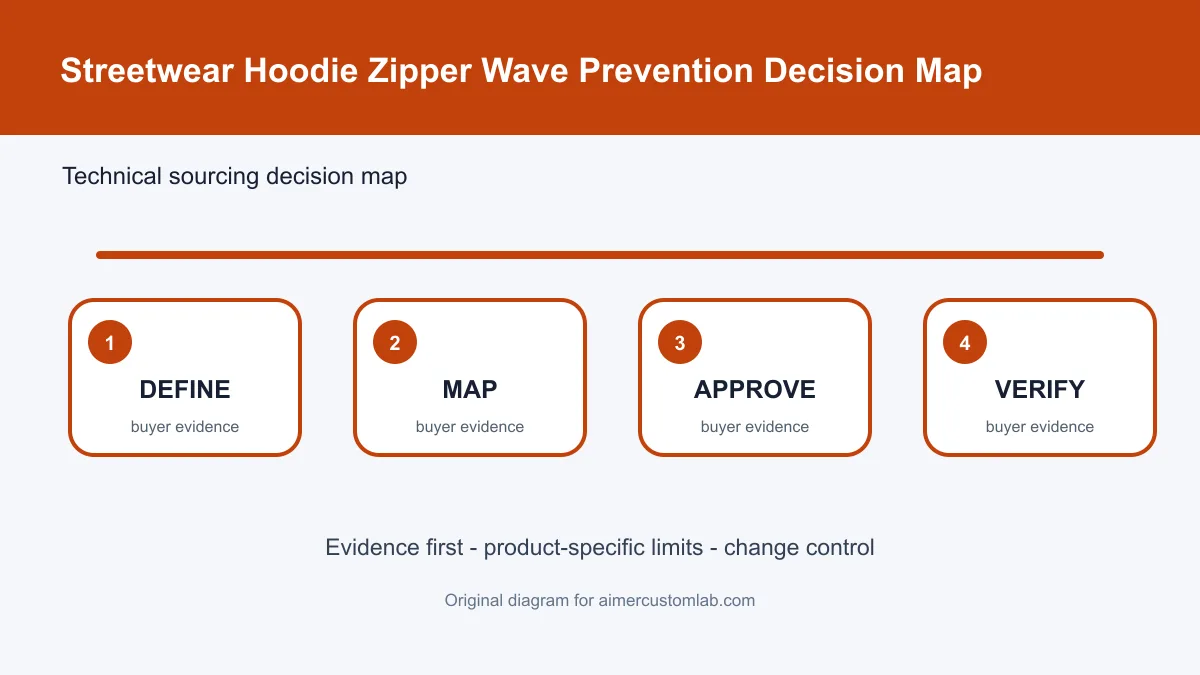
Streetwear Hoodie Zipper Wave Prevention Guide
Heavy fleece may relax after cutting while zipper tape remains dimensionally stable, or a soft knit may be stretched during attachment. Pressing can temporarily flatten the edge but change loft, shade, adhesive, or zipper components. A supplier must prove the result on the exact hoodie construction and size range instead of solving the symptom by pulling or steaming each garment differently. For OEM, ODM, wholesale, teamwear and private-label buyers, streetwear hoodie zipper wave is a product-control decision, not a marketing label. This guide makes no unsupported claim about price, MOQ, capacity, lead time, certification, licensing or factory qualification; those facts require confirmation for the exact order.
Quick Answer
Streetwear hoodie zipper wave is best prevented by treating the zipper, front panels, facing, stabilizer, seam, feed, and pressing route as one system. Match component length and dimensional behavior, sew without stretching either ply, and inspect the closed and open hoodie after full relaxation and care. Approval should include flatness, symmetry, hem level, slider function, comfort, and reproducible measurements.
What is streetwear hoodie zipper wave?
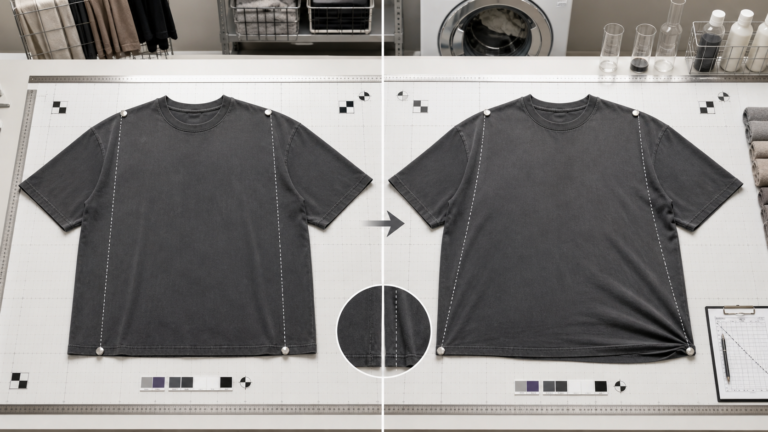
Streetwear hoodie zipper wave is repeated rippling or buckling along the installed front zipper. It can arise when the zipper tape and knit front edge have different length, extension, recovery, shrinkage, or feeding behavior. Seam tension, stitch density, presser pressure, stabilizer, facing, heat, and operator handling can lock those differences into the garment.
Which controls prevent streetwear hoodie zipper wave?
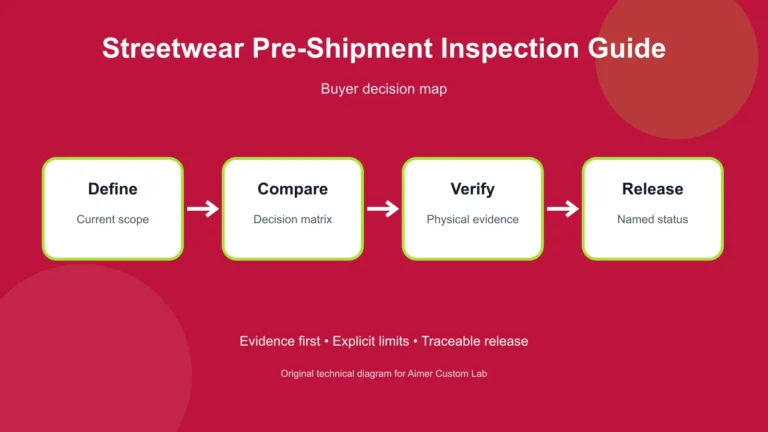
Direct answer: Compare the variables that can change both the visible outcome and the sourcing decision. The matrix below converts a subjective discussion into named inputs, evidence and common failure risks.
| Decision point | What to define | Why it matters | Common mistake |
|---|---|---|---|
| Shell and front edge | Fiber, knit, weight, stretch, recovery, finish, grain and cut length | The front edge must be stable before attachment | Handling unsupported panels |
| Zipper system | Type, gauge, tape, teeth, slider, length, shrinkage and lot | Zipper behavior must match the garment route | Selecting only by tooth color |
| Support structure | Facing, placket, stabilizer, tape, width and placement | Support can control extension or create stiffness | Adding support without testing hand feel |
| Sewing and pressing | Notches, feed, pressure, tension, density, foot, heat and handling | Unequal feed or heat can lock in waves | Stretching the shell to fit |
| Approval evidence | Open and closed views, hem level, symmetry, operation, care and retained sample | Function and appearance must both pass | Inspecting only on a hanger |
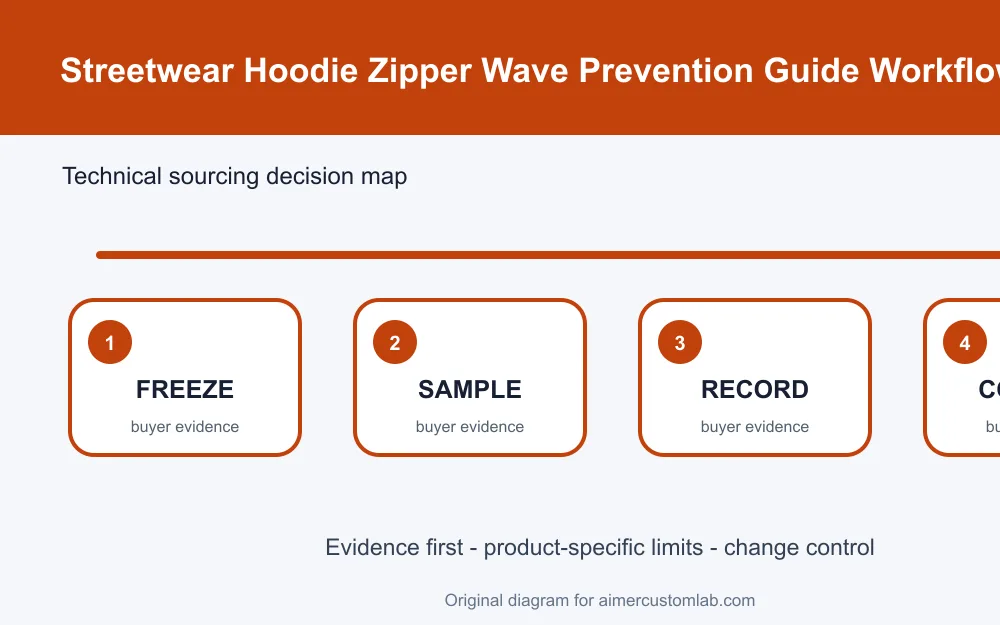
How should buyers build the approval workflow?
Direct answer: Freeze the question and inputs, use production-representative garments and files, record the method and intermediate behavior, inspect the finished product, and connect approval to a controlled revision.
- Freeze the shell, rib, lining, facing, zipper specification, pattern, notches, seam allowance and care route.
- Condition components, verify cut front-edge and zipper lengths, and record any intended ease or engineered differential.
- Prepare matched trials with defined support options while keeping stitch, operator and machine variables controlled.
- Sew from named landmarks without stretching the zipper or shell and record feed, pressure, tension, density and speed.
- Allow the hoodie to cool and relax before checking open and closed fronts, hem level, symmetry, slider function and ridge formation.
- Run the stated care route, condition again, and compare dimensional change and visible waves across representative sizes.
- Retain the approved recipe, measurements, images, passed and failed samples, disposition and reapproval triggers.
How should common failures be diagnosed?
The front looks flat when open but waves when zipped: what should be checked first?
Direct answer: Compare left and right lengths, closure alignment, tape behavior, seam balance and hem level under the closed condition. Preserve the original symptom, product identity and settings before correction. Change one controlled variable at a time and repeat the same inspection, because a cosmetic adjustment without a traceable cause cannot support reliable bulk production.
Waves appear after washing: what should be checked first?
Direct answer: Measure shell, support, thread and zipper dimensional change separately before altering attachment tension. Preserve the original symptom, product identity and settings before correction. Change one controlled variable at a time and repeat the same inspection, because a cosmetic adjustment without a traceable cause cannot support reliable bulk production.
One side is longer at the hem: what should be checked first?
Direct answer: Audit panel length, zipper placement, notches, feeding direction and operator handling rather than trimming the finished hem. Preserve the original symptom, product identity and settings before correction. Change one controlled variable at a time and repeat the same inspection, because a cosmetic adjustment without a traceable cause cannot support reliable bulk production.
What belongs in the purchase specification?
Direct answer: The specification must let another qualified person reproduce the approved product without guessing. For streetwear hoodie zipper wave, include the following controlled fields and link each field to the relevant sample or record.
- exact garment, panel, material, finish, color and lot identity
- approved pattern, artwork, machine and process revisions
- equipment, needle, thread, support and operator-visible settings
- conditioning, sample size, test sequence and observation timing
- measured landmarks, photographs, raw observations and defect language
- representative size, color, lot and risk-location coverage
- approved sample, failed sample, disposition and escalation owner
- substitution, maintenance and process changes that trigger reapproval
How should sampling cover size and production risk?
Direct answer: Choose samples by variation and consequence, not convenience. Include justified small, middle and large sizes, risk colors, artwork geometries, placements, material lots or wearer configurations that can change the decision. State whether each result covers only one specimen, a controlled family or a defined production lot.
How should bulk inspection and change control work?
Direct answer: Convert the approved target into measurable checkpoints, inspection timing, sample selection, defect language, disposition and escalation. Preserve the sealed sample or approved visual standard and train inspectors on the same landmarks and terminology used during development.
What evidence should accompany the approval?
Direct answer: Retain product and specimen identities, source files, revisions, conditions, raw observations, measurements, photographs, individual results, failure modes, corrective actions, owner, date, disposition and approved sample.
What are the evidence boundaries?
Coats identifies thread tension, fabric structure, unequal ply feeding, and differential dimensional change as common pucker causes. Printful demonstrates an answer-first comparison structure, while The Couture Club product page names fit, fabric, decoration, construction and care entities close to the purchase decision. These sources support systematic diagnosis but do not set one universal zipper differential, support type, pressing temperature, or wave tolerance for every hoodie.
Results apply to the specimens, files, methods and conditions evaluated. They do not automatically cover every size, color, lot, factory line, climate, wearer, competition, care behavior or destination. Confirm current external rules and intellectual-property permissions with the responsible authority for the exact market and use.
Which related products can this guide support?
- Review custom hoodie sets with branding and packaging when applying this control to a specific sourcing brief.
- Review custom zip hoodie sets for private labels when applying this control to a specific sourcing brief.
- Review custom oversized private-label T-shirts when applying this control to a specific sourcing brief.
These descriptive internal links show relevant product categories only. They do not assert a fixed construction, price, MOQ, capacity, certification or delivery time. Send the actual specification for order-specific confirmation.
Buyer checklist
Use this checklist to keep streetwear hoodie zipper wave aligned from development through final inspection.
- Exact product and materials frozen
- Current instructions and revisions attached
- Representative risk samples selected
- Machine and process conditions recorded
- Initial condition photographed and measured
- Failure modes separated by evidence
- Corrective trials change one variable at a time
- Approved reference and reapproval triggers retained
Which sources informed this guide?
The following current peer and authority pages informed the information architecture, entity definitions and decision boundaries. Their wording was not copied, and commercial or product claims were not transferred to this supplier.
- Printful decoration comparison
- The Couture Club oversized hoodie page
- Coats seam puckering technical bulletin
Research-to-page evidence map
This table shows how qualified high-traffic or fast-growth peer learning changed the public article and where the result is visible.
| Research finding | Specific application | Visible evidence |
|---|---|---|
| The comparison page defines options before expanding into process and use cases, which supports answer-first sourcing content. | SEO: organized streetwear hoodie zipper wave around a buyer decision matrix and explicit failure risks. | |
| AEO: placed a direct 40–70 word answer before detail and followed it with a controlled approval route. | Quick Answer | |
| Peer content names product entities, use cases and constraints instead of treating decoration as one generic choice. | GEO: defined the core entity, named conditions and limits, cited current sources, and separated verified facts from order-specific decisions. | What are the evidence boundaries? |
Frequently asked questions
Is zipper wave always caused by a zipper that is too long?
Answer: No. Fabric stretch, feeding, seam tension, support and post-care shrinkage can create similar waves.
Can steam pressing permanently fix the problem?
Answer: Not necessarily. Pressing may mask the symptom or alter the materials; retest after full relaxation and care.
Should the zipper or shell be stretched during attachment?
Answer: Only if an approved engineering method specifies a controlled differential and evidence proves the result.
Why inspect the hoodie both open and closed?
Answer: Closing changes length, load and symmetry and can reveal defects hidden in the open state.
What changes require reapproval?
Answer: Reapprove shell, lot, zipper, facing, stabilizer, pattern, length, needle, thread, feed, pressure, pressing or care changes.
Conclusion: what should a buyer do next?
streetwear hoodie zipper wave should finish as a documented, product-specific approval rather than a generic promise. Keep the controlled files, measured target, representative sample, method, raw observations, photographs, corrective action and change triggers together. That record makes repeat orders faster and reduces disputes caused by incomplete specifications.
Inquiry CTA: Send your tech pack, intended market and use, size range, pattern or garment reference, material and component details, artwork or roster, care route, packaging route and requested evidence. Ask the team to confirm feasibility, sample details, MOQ, lead time, capacity and available supporting records for the exact order.