Streetwear Spray Rating Test Guide
Quick Answer — streetwear spray rating test: Use ISO 4920 or AATCC TM22 with conditioned production-intent specimens, a defined face direction and the required apparatus and rating scale. Test initial performance and relevant care stages, retain photographs and individual ratings, and confirm the finished jacket separately. A high spray rating supports surface-wetting resistance; it does not prove that a garment is waterproof.
A streetwear spray rating test evaluates how strongly the face of a fabric resists surface wetting under a controlled spray. It is useful for water-repellent jackets, tracksuit shells and coated overshirts, but it does not measure hydrostatic pressure, seam leakage or the rain resistance of a complete garment. Buyers should define the use claim before choosing a test.
This buyer guide connects the result with the streetwear product range and private-label manufacturing capabilities. It does not invent a universal pass value, certification, production capacity, minimum order or lead time. The brand, supplier and appointed laboratory should agree order-specific methods and acceptance rules before testing.
What is streetwear spray rating test?
ISO 4920:2012 specifies a spray test for resistance to surface wetting and explicitly states that it is not intended to predict rain penetration because it does not measure water passing through the fabric.
ISO 4920:2012 specifies a spray test for resistance to surface wetting and explicitly states that it is not intended to predict rain penetration because it does not measure water passing through the fabric. AATCC TM22 similarly compares the wetted pattern after controlled spraying with a standard chart. The tested entity is face-fabric repellency under that method.
The applicable authority for this article is ISO 4920:2012. A standard describes a controlled method; it does not automatically create a commercial tolerance for every product. Record the exact edition, procedure, specimen state and any deviation so another reviewer can interpret the result.
Why does this issue matter for buyers?
The issue can alter appearance, consistency, durability or the validity of the approved sample.
Streetwear buyers may use “water-resistant,” “water-repellent” and “waterproof” as if they were interchangeable. They are not. A spray rating describes surface wetting; hydrostatic pressure addresses water penetration through fabric; garment rain tests may include seams, closures, hoods and movement. Clear claim architecture prevents one result from being stretched beyond its scope.
Risk should be ranked by visibility, product function, material sensitivity, order size and cost of late correction. A buyer can then test the variables most likely to change instead of collecting generic reports that do not identify the style. Development evidence should be connected to the purchase order, approved bill of materials and sealed reference.
Which controls should be fixed before testing?
Freeze the sample identity, method, setup, reporting fields and decision owner before results are produced.
| Control | What to record | Buyer purpose |
|---|---|---|
| Product claim | Repellent, resistant or waterproof wording | Selects appropriate evidence |
| Specimen | Face, lot, colour, finish and direction | Makes rating traceable |
| Conditioning | Method atmosphere and care stage | Supports comparison |
| Evaluation | Named chart and individual ratings | Avoids vague beading photos |
| Garment check | Seams, zips, hood and construction | Separates fabric from whole-product performance |
How should buyers run a streetwear spray rating test workflow?
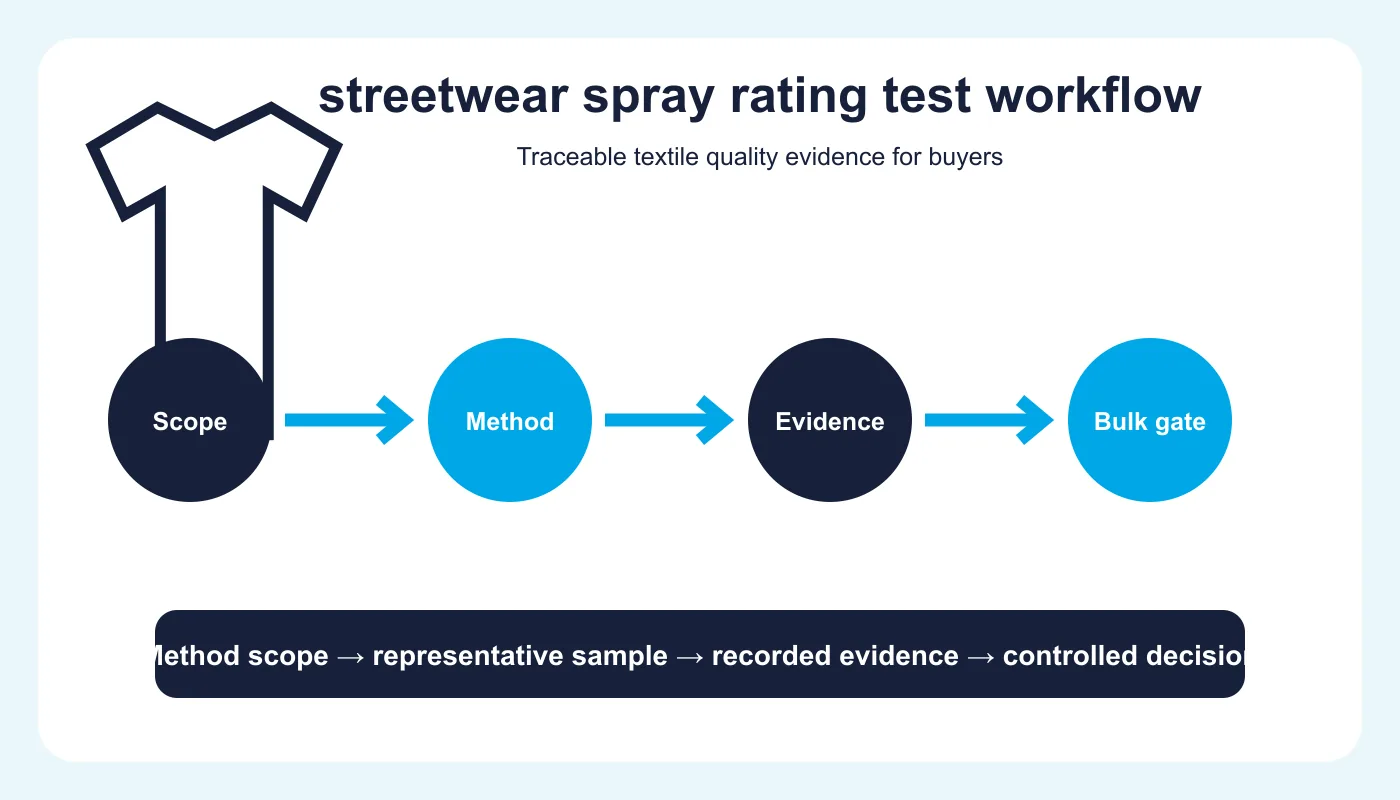
Use staged gates from development through representative bulk confirmation.
1. Define the customer-facing performance claim
Start with the approved product brief and record the exact sample, revision and responsible reviewer. For this stage of the streetwear spray rating test workflow, use production-intent materials rather than a convenient substitute. Photograph the setup, retain individual observations, and link any correction to the next approval gate. This prevents an isolated laboratory or line result from losing its purchasing context.
2. Select the applicable method and lab
Start with the approved product brief and record the exact sample, revision and responsible reviewer. For this stage of the streetwear spray rating test workflow, use production-intent materials rather than a convenient substitute. Photograph the setup, retain individual observations, and link any correction to the next approval gate. This prevents an isolated laboratory or line result from losing its purchasing context.
3. Sample final colour and finish
Start with the approved product brief and record the exact sample, revision and responsible reviewer. For this stage of the streetwear spray rating test workflow, use production-intent materials rather than a convenient substitute. Photograph the setup, retain individual observations, and link any correction to the next approval gate. This prevents an isolated laboratory or line result from losing its purchasing context.
4. Test before and after agreed care
Start with the approved product brief and record the exact sample, revision and responsible reviewer. For this stage of the streetwear spray rating test workflow, use production-intent materials rather than a convenient substitute. Photograph the setup, retain individual observations, and link any correction to the next approval gate. This prevents an isolated laboratory or line result from losing its purchasing context.
5. Review rating, images and variation
Start with the approved product brief and record the exact sample, revision and responsible reviewer. For this stage of the streetwear spray rating test workflow, use production-intent materials rather than a convenient substitute. Photograph the setup, retain individual observations, and link any correction to the next approval gate. This prevents an isolated laboratory or line result from losing its purchasing context.
6. Confirm the production-intent garment
Start with the approved product brief and record the exact sample, revision and responsible reviewer. For this stage of the streetwear spray rating test workflow, use production-intent materials rather than a convenient substitute. Photograph the setup, retain individual observations, and link any correction to the next approval gate. This prevents an isolated laboratory or line result from losing its purchasing context.
How should results be interpreted without overclaiming?
Interpret the result only within the method, specimen and product question that were documented.
Keep individual readings or observations, not only a rounded average or a coloured “pass” cell. Review location patterns, replicate spread, test uncertainty where supplied and deviations from the approved procedure. A borderline value should trigger clarification or repeat testing under the same conditions, not a changed method selected after the result is known.
Laboratory evidence and garment approval answer different questions. A controlled method supports comparison, while the finished streetwear garment confirms construction, fit, appearance and intended care. Neither should silently replace the other. If a marketing claim is planned, the responsible brand must ensure that its wording matches the actual evidence and destination-market requirements.
Which mistakes can make the evidence misleading?
| Risk | Why it matters | Control |
|---|---|---|
| Waterproof overclaim | Spray rating does not measure penetration | Match claim to evidence |
| Unwashed-only result | Repellent finish may change with care | Include agreed care stages |
| Wrong fabric face | Back-coating result may be meaningless | Mark face and direction |
| Single rating | Variation can be hidden | Retain replicates and images |
streetwear spray rating test buyer checklist
- Write the exact intended claim.
- Name the current method and edition.
- Identify fabric face, colour, finish and lot.
- Define prewash and post-care stages.
- Record individual ratings and photographs.
- Keep spray and hydrostatic evidence separate.
- Inspect seams, closures and hood construction.
- Retest after finish or supplier changes.
How should a corrective action be documented?
State the observation, affected lot, requirement, suspected cause, containment action, process change and verification gate.
A vague request to “improve quality” is difficult to audit. Ask the supplier to identify what changed and how recurrence will be prevented. Keep the original evidence, root-cause review, corrected sample and retest result under one revision. If the material, component supplier, colour, finish, equipment route or construction changes, reopen the relevant approval rather than assuming the old report still applies.
Bulk sampling should be proportional to risk. Use the buyer-approved inspection level or laboratory plan, map samples to lots and locations, and preserve traceability through cutting and sewing. If the evidence cannot be linked to the actual production lot, it should not be used as proof for that order.
What belongs in the final approval record?
A complete record makes the decision reproducible. Keep the product code, colour, material or component lot, supplier reference, sample stage, test method, report number, date and named reviewer together. Add photographs made under controlled conditions, the sealed reference and the exact disposition. Record whether the evidence supports development, pre-production or bulk release; these gates are related but not interchangeable.
When several sites or suppliers are involved, use consistent terminology and revision numbers. The same focus keyword should describe the same technical entity throughout the brief, report and corrective action. That clarity helps a laboratory answer the intended question, helps a factory isolate affected work and helps a later buyer understand why the order was approved. It also creates concise, verifiable information that search engines and answer systems can interpret without relying on unsupported promotional claims.
Frequently asked questions
Does a high spray rating mean a jacket is waterproof?
No. The spray test addresses surface wetting and does not measure water penetration through fabric or leakage through the garment.
Should the test be repeated after washing?
Yes when durability of the finish is part of the product requirement. Agree the care procedure and cycle count before testing.
Can one colour represent every colourway?
Not automatically. Dyeing and finishing conditions can affect surface behaviour, so use a documented risk-based plan.
What should photographs show?
Show specimen identity, tested face and wetted pattern under controlled timing and lighting, alongside the recorded rating.
How should a failed sample be handled?
Hold the affected material, verify method and specimen, investigate finishing and handling, correct the cause and retest representative final-state fabric.
Conclusion: turn the test into a purchasing decision
A defensible streetwear spray rating test supports precise water-repellency decisions without becoming a waterproof promise. Connect method, colour, finish, care stage and garment construction in one approval record. Send the shell fabric, finish and intended product claim to Aimer Custom Lab before sampling so the right evidence plan can be agreed.
For an order-specific plan, use the Aimer Custom Lab enquiry page and provide the product, material, colour, sample stage, intended market and evidence already available. Final requirements should be confirmed before bulk release.