Hoodie Kangaroo Pocket Construction Guide
Quick answer: Reliable hoodie kangaroo pocket construction depends on pocket shape, placement, opening angle, fabric direction, edge finish, topstitching, corner reinforcement, and compatibility with the hoodie’s weight and shrinkage. Brand buyers should define every point in the tech pack, approve the pocket after wash testing, and inspect symmetry, sagging, puckering, stretch, and decoration clearance before bulk production.
The hoodie kangaroo pocket is one of the most recognisable streetwear details, yet it is also a frequent source of sampling disputes. A pocket can be technically attached and still look wrong: the openings may gape, the corners may pull, the pouch may sit too low, or the shape may distort after washing. On an oversized streetwear hoodie, small placement changes can alter the entire front proportion.
This guide gives private-label brands and wholesale buyers a practical method for specifying and approving the pocket. It focuses on construction choices, points of measure, reinforcement, decoration planning, sampling, and bulk inspection. For the wider development sequence, review our streetwear clothing sampling process.
What is a kangaroo pocket?
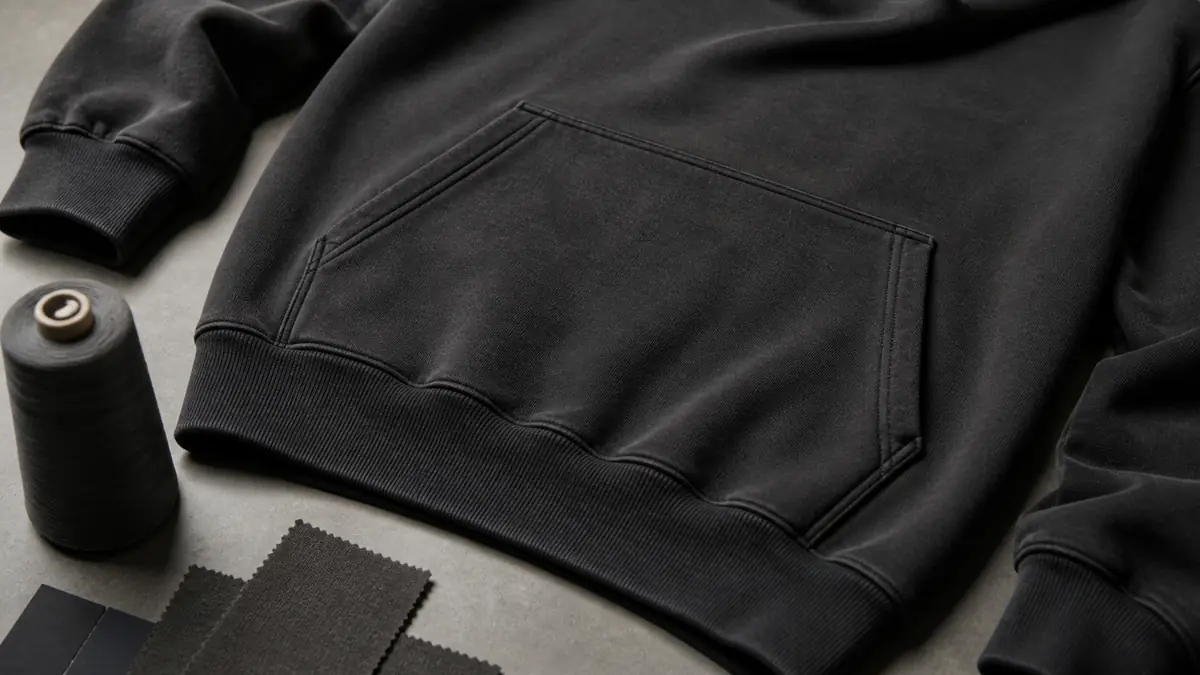
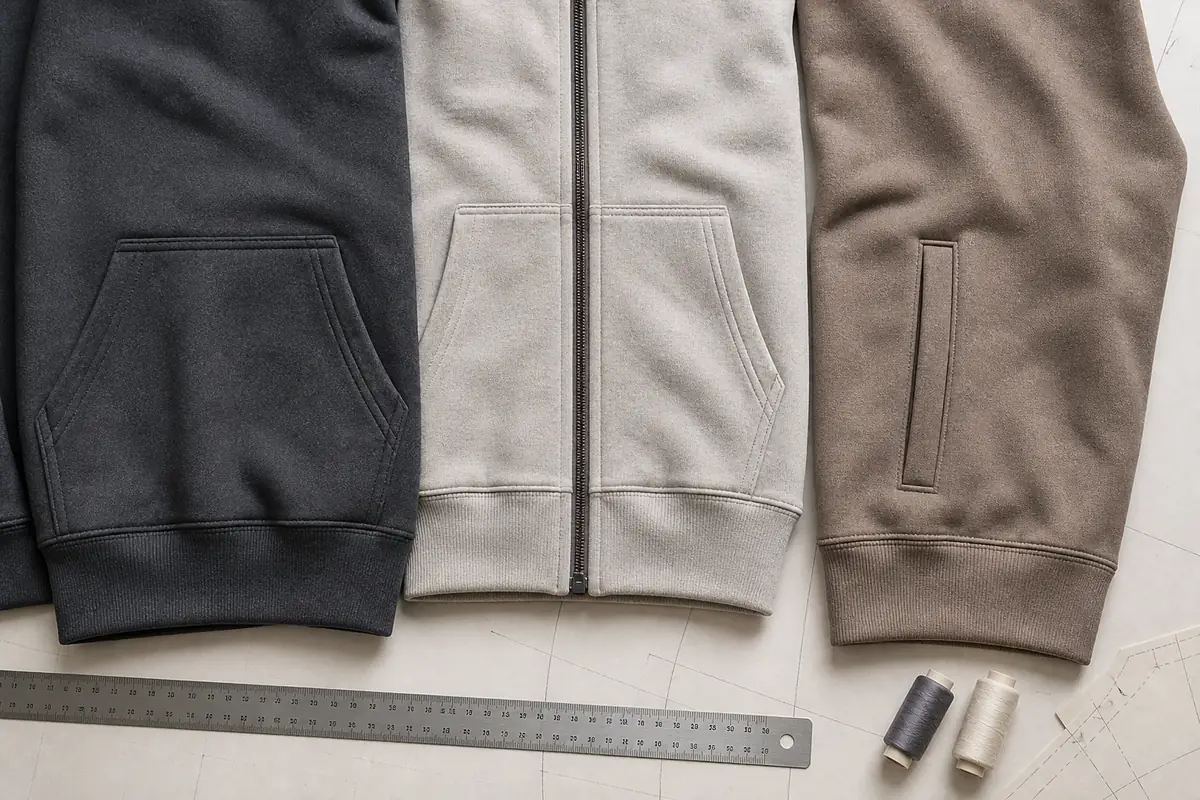
A kangaroo pocket is a patch pocket placed across the lower front of a pullover hoodie, usually with an opening on each side. The pocket is cut as a separate piece, its openings are finished, and the remaining edges are attached to the front body. A zip-up hoodie typically uses two split pockets because the centre-front zipper divides the garment.
Construction references such as Jiashun Clothing’s hoodie component guide describe the pocket as a front patch with angled hand openings and reinforced stress points. Hook and Eye’s hoodie tech-pack guide emphasises width, height, opening size, angle, topstitching, reinforcement, and position. These are useful comparison dimensions, but each brand still needs its own approved specification.
Which hoodie pocket options should brands compare?
| Pocket type | Visual effect | Best use | Main control points |
|---|---|---|---|
| Classic kangaroo patch | Familiar casual front | Pullover hoodies | Symmetry, opening stretch, corner stress |
| Split kangaroo pocket | Two balanced halves | Zip-up hoodies | Alignment to zipper, mirrored placement |
| Side-entry pocket | Cleaner front surface | Minimal or premium styles | Bag depth, seam bulk, access angle |
| Zipped pocket | Technical and secure | Travel or utility products | Zipper length, reinforcement, hardware comfort |
| Hidden internal pocket | Low visual impact | Phone or small-item storage | Bag support, access, garment balance |
The classic patch is not automatically the cheapest or simplest once heavy fabric, lining, special binding, contrast topstitching, or large graphics are added. Ask the supplier to quote the approved construction rather than a generic “kangaroo pocket.”
What measurements belong in the pocket tech pack?
Every hoodie kangaroo pocket measurement should use pattern landmarks that the sample room and final inspector can reproduce.
- Finished pocket width at top and bottom reference points
- Finished centre-front pocket height
- Opening length and opening angle
- Distance from pocket top to chest reference or neck point
- Distance from pocket bottom to waistband seam
- Distance from pocket sides to body side seams
- Topstitch distance from edge
- Corner reinforcement length and orientation
- Seam allowance and fold details
- Tolerance for placement, size, and symmetry
Include a front technical flat plus an enlarged pocket detail. The factory should not have to infer whether a line represents a fold, seam, stitch, binding, or decorative print. Use one measurement unit throughout the tech pack.
How should pocket placement be determined?
Placement should relate to the garment pattern, not to a marketing mockup. Record the reference points used by the pattern maker and quality team. On oversized and boxy fits, body length, chest width, and waistband height change the visual balance. Simply scaling a regular-fit pocket may create a pouch that looks too small or sits too low.
Test hand access on the intended wearer group. The opening should be accessible without forcing the shoulder or wrist into an unnatural position. Check the pocket while sitting as well as standing. Confirm that the waistband does not push the pocket upward and that carried items do not pull the pouch below the hem.
Which construction details affect durability?
Opening finish
The hand openings repeatedly stretch and rub. Options include turned-and-stitched edges, rib binding, self-fabric binding, or another approved finish. The opening should recover after extension and remain comfortable against the hand. Heavy bindings can create a stiff edge; weak finishes may flare.
Corner reinforcement
Pocket-mouth corners concentrate force. A bartack or another specified reinforcement can distribute load, but size, density, thread, and position must suit the fabric. White Cotton’s hoodie construction guide compares pocket types and other hoodie details, while multiple manufacturing references identify pocket openings as stress areas. Brands should verify reinforcement on the actual fabric rather than relying on a generic rule.
Topstitching
Topstitching controls the edge and creates a visible quality signal. Define single or double rows, spacing, thread colour, stitch appearance, and start-stop security. On heavyweight fleece, a narrow stitch margin may sink into the surface or look uneven.
Fabric direction
Pattern grain and knit direction affect stretch, drape, and shrinkage. The pocket should be cut according to the approved marker and pattern instructions. If body and pocket pieces relax differently after washing, the front may pucker.
Should the pocket be lined?
Lining can add warmth, structure, contrast, or surface protection, but it also increases weight and sewing operations. The lining and outer fabric need compatible shrinkage and stretch. A low-stretch lining can restrict the pocket opening even when the shell fabric stretches well.
For an unlined pocket, inspect the internal raw-edge treatment and thread ends. For a lined design, define how the layers are joined, whether seams are enclosed, and how the opening edge is stabilised.
How does decoration interact with the pocket?
Large front prints often compete with the pocket for space. Define decoration size and position from stable pattern landmarks. If printing or embroidery is applied to the pocket piece, approve it before assembly so the placement remains accurate. Heavy embroidery may distort the pouch or create an uncomfortable internal surface.
Keep critical artwork away from folds, bartacks, and topstitch lines unless overlap is intentional. Our streetwear logo placement guide provides a companion framework for converting a visual mockup into measurable factory instructions.
How should brands approve a kangaroo pocket sample?
Approve the hoodie kangaroo pocket on the nominated fabric and finished hoodie, because body shrinkage, waistband tension, and decoration can change its appearance.
- Compare to the tech pack: Verify pocket type, fabric, measurements, stitch rows, reinforcement, and position.
- Check symmetry: Fold or measure from centre front and confirm that both openings mirror each other.
- Wear-test access: Insert and remove both hands while standing, walking, and sitting.
- Load the pocket: Use realistic small items and observe sagging, corner stress, and garment balance.
- Extend the openings: Check recovery and any broken or skipped stitches.
- Wash the garment: Follow proposed care instructions, condition it, and remeasure placement and shape.
- Review decoration clearance: Confirm that prints and embroidery do not collide with construction.
Common pocket defects and likely causes
| Defect | What buyers see | Areas to investigate |
|---|---|---|
| Gaping opening | Opening edge stands away from body | Stretch, binding, shape, tension, placement |
| Puckered body | Ripples around attached pocket | Differential feed, shrinkage, stitching, handling |
| Corner tearing | Damage begins at opening end | Reinforcement, stitch density, fabric, load |
| Uneven placement | Pocket appears tilted or off-centre | Pattern marks, guides, operator alignment |
| Sagging pouch | Pocket hangs away from body | Size, fabric weight, lining, attachment |
| Twisting after wash | Pocket and body no longer lie flat | Grain direction, shrinkage, pressing |
Bulk quality-control checklist
Bulk inspectors should compare each selected hoodie kangaroo pocket with the sealed sample before assigning a defect classification.
- Pocket fabric and colour match approval
- Width, height, openings, and placement within tolerance
- Both sides visually symmetrical
- Topstitch rows straight and correctly spaced
- Reinforcement present at required points
- No skipped stitches, raw edges, or loose thread ends
- No puckering, twisting, stains, or press marks
- Decoration position remains within approved safe area
- Post-wash evidence available for the production construction
Frequently asked questions
How large should a hoodie kangaroo pocket be?
Size should be proportional to the approved body pattern and wearer group. Define width, height, opening, and placement measurements rather than copying a generic template.
Are bartacks always required?
Corner reinforcement is common, but the appropriate method depends on fabric, styling, load, and appearance. Approve the exact reinforcement on the sample.
Can a pocket use the same fabric as the hoodie body?
Yes, but cut direction, shrinkage, thickness, and stretch still need control. A lining or binding may introduce additional materials.
Why does a kangaroo pocket gape?
Possible contributors include opening shape, excessive stretch during sewing, unsuitable binding, poor recovery, incorrect placement, or heavy carried items.
Should printing be done before or after pocket attachment?
It depends on artwork and method. Printing a flat cut panel can improve access and registration, but the production sequence must be confirmed and tested.
How should pocket placement be graded?
Use size-specific rules tied to the garment’s points of measure. Do not assume that scaling every dimension by the same amount will preserve the intended look.
Conclusion: make the pocket measurable
A strong hoodie kangaroo pocket is the result of pattern proportion, controlled openings, suitable reinforcement, fabric compatibility, decoration planning, and measurable inspection. When these decisions appear clearly in the tech pack and sealed sample, brands reduce subjective feedback and improve repeat-order consistency. Treat the hoodie kangaroo pocket as a fit-and-construction component, not merely a decorative patch.
Developing a private-label hoodie? Use this guide with our hoodie rib and cuff specification guide, then contact Aimer Custom Lab through the website with your technical flats, fabric target, size range, quantity, artwork, and delivery window. Materials, MOQ, sample timing, and production schedule should be confirmed for the specific project.