Streetwear Embroidery Backing Guide for Brands
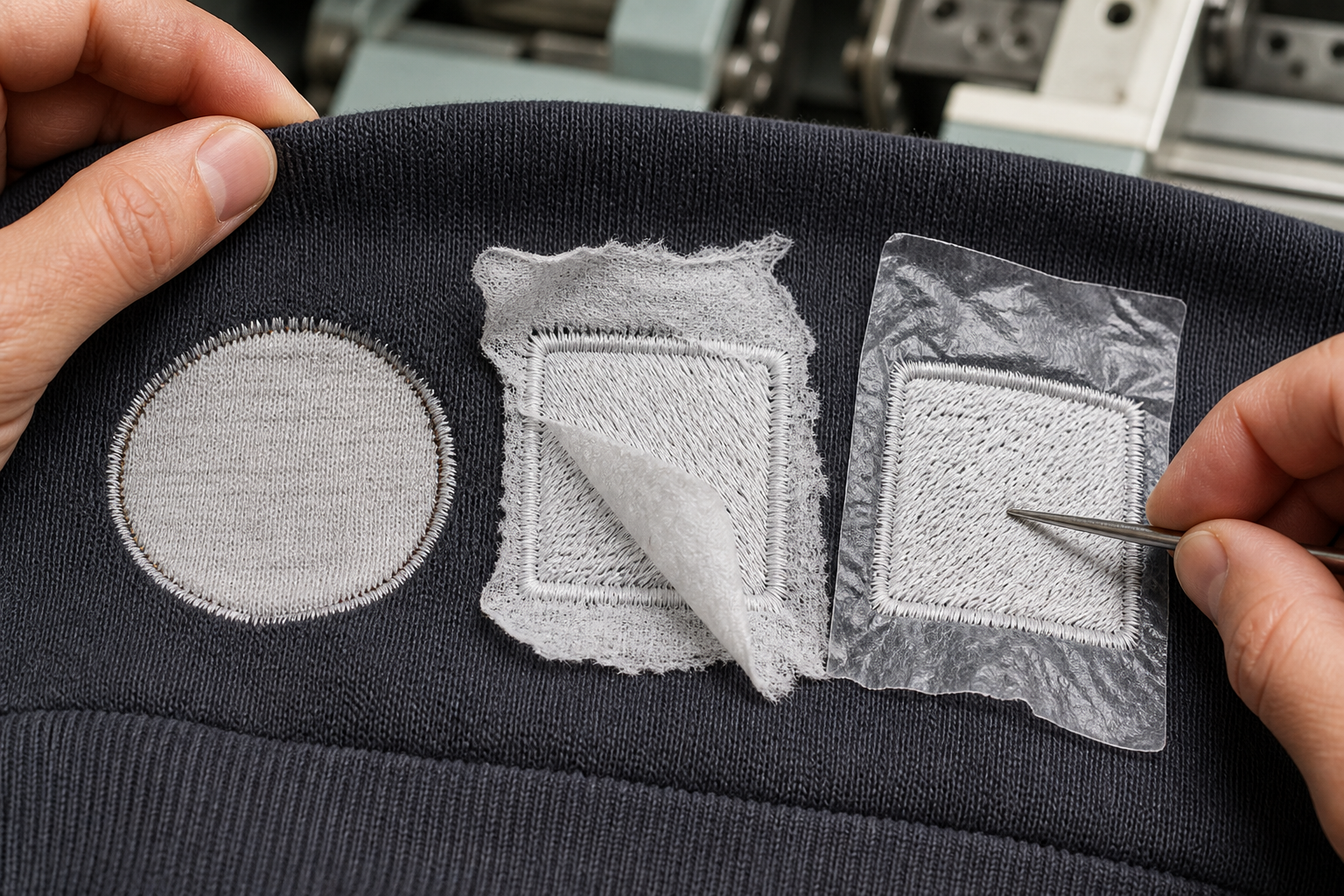
Streetwear embroidery backing supports the fabric while the machine builds stitches. It helps control distortion, puckering, sinking, and movement around a logo, but the wrong backing can feel stiff, show through a garment, or fail after trimming and washing. Private-label brands should approve backing together with the fabric, embroidery file, thread, placement, and finished garment.
Why Streetwear Embroidery Backing Is Part of the Design
Embroidery pulls thread repeatedly through the garment. A dense logo can compress, stretch, or gather a soft knit. Hoodies, oversized T-shirts, fleece, jersey, woven jackets, and caps do not react the same way. Backing creates temporary or permanent support so the fabric can resist needle and thread forces during sewing and later wear.
The backing decision also affects the customer experience. A large, stiff remnant behind a small chest logo may be secure but uncomfortable. An aggressively torn edge may leave a rough outline. A backing that is too light can allow puckering or detail loss. The objective is the least obtrusive system that still provides reliable support.
Main Streetwear Embroidery Backing Types
Madeira USA publishes a practical embroidery backing guide and product-specific information on cut-away backing. Use the current manufacturer instructions for the selected material rather than assuming all products in a category behave identically.
| Backing family | Typical behavior | Useful applications | Buyer concern |
|---|---|---|---|
| Cut-away | Remains behind the design after trimming | Stretch knits, dense designs, repeated wear | Hand, trim shape, visibility, comfort |
| Tear-away | Excess is removed by controlled tearing | More stable fabrics and suitable designs | Support loss, rough edges, garment damage |
| Wash-away | Selected material dissolves with water | Special constructions or appearance needs | Care method and remaining support |
| Heat-removable | Selected film is removed through controlled heat | Special open or delicate effects | Fabric heat sensitivity and residue |
| Fusible support | Temporarily or permanently adheres to fabric | Useful where shifting must be controlled | Bond, shine, stiffness, care response |
These categories are a starting point. Backing weight, fiber, softness, direction, perforation behavior, and supplier construction can change performance. Approve the exact reference used in sampling.
Streetwear Embroidery Backing for Knit Garments
Oversized T-shirts
Light jersey can stretch during hooping and sewing. A soft cut-away solution is often evaluated because permanent support may help the logo keep its shape, but the final choice depends on design density, fabric, and customer comfort. Avoid stretching the shirt in the hoop.
Hoodies and fleece
Fleece can be thicker and more stable than T-shirt jersey, yet the brushed or lofty surface may allow stitches to sink. Backing controls the base fabric while a water-soluble topping may be tested on the face to keep details visible. Topping and backing serve different purposes and should be specified separately.
Rib and elastic zones
Embroidery on cuffs, waist rib, or highly elastic panels can restrict stretch and produce uncomfortable stiffness. Test the complete zone under normal extension. Consider whether the placement should move to a more stable panel instead of forcing a dense logo onto rib.
Backing for Woven Streetwear Jackets
Woven shells may appear stable, but coated, padded, washed, lightweight, or slippery constructions can still shift or mark. Review the complete layer stack: shell, interlining, insulation, lining, pocket bag, and backing. A backing that works before lining assembly may create visible bulk after the jacket is closed.
For a chest or back logo, confirm whether embroidery is applied before or after lining insertion and how the inside is finished. A brand may choose to expose a clean embroidery back, cover it with lining, or add a comfort layer. The production sequence belongs in the tech pack.
Match Backing to Stitch Density and Design Size
Large filled logos place more stress on fabric than small open lettering. Underlay, stitch direction, sequence, pull compensation, thread, and machine tension also influence stability. Backing cannot rescue a poorly digitized file indefinitely.
| Design factor | Effect on support need | Approval question |
|---|---|---|
| High stitch count in a small area | Concentrates needle and thread forces | Does the fabric remain flat after hoop release? |
| Large filled area | Can pull edges inward | Are outline and dimensions stable? |
| Fine lettering | Needs controlled surface and registration | Are counters open and edges readable? |
| Multiple color registration | Requires fabric stability across sequences | Do color boundaries stay aligned? |
| Open, low-density artwork | May need less support | Can backing be reduced without distortion? |
Hooping, Adhesion, and Placement Control
Hooping should hold the garment securely without stretching or leaving lasting marks. Record the placement reference, hoop orientation, and method used during the approved sample. Adhesive sprays or fusible materials, when used, should be controlled to avoid residue, staining, or excessive stiffness.
- Mark garment centerlines and design boundaries.
- Keep the fabric relaxed during hooping.
- Support garment weight so it does not pull during sewing.
- Prevent seams, zippers, or pockets from lifting one side of the hoop.
- Use a tested needle and thread for the textile.
- Approve the logo position on representative sizes.
Placement tolerances should use stable garment landmarks. “Left chest” is not enough for bulk inspection; show distances from the center front, shoulder, armhole, pocket, or zipper as appropriate.
Trimming and Inside Finish
Cut-away material should be trimmed with a controlled border that preserves support without leaving an unnecessarily large patch. Tear-away should be removed in a way that does not pull stitches or damage fabric. Loose fragments, sharp corners, and untrimmed thread reduce perceived quality.
Madeira’s E-Zee backing guide illustrates the breadth of available support materials. Brands should therefore identify the exact backing reference instead of writing only “cut-away” or “tear-away.”
Comfort and Skin-Contact Review
Inside appearance matters on unlined garments. Wear the sample over the expected base layer and directly against skin where relevant. Check the backing edge, thread tails, knots, density, and any cover material. A soft backing can still irritate if trimmed poorly.
If a comfort cover is proposed, test its bond, stretch, wash durability, hand, and appearance. Do not add a cover automatically without confirming that it will remain secure through the intended care cycle.
Wash, Stretch, and Appearance Tests
- Photograph and measure the logo before washing.
- Follow the proposed care-label process.
- Condition the garment and inspect puckering, shrinkage, color, and registration.
- Check whether backing edges curl, fray, detach, or become visible.
- Stretch knit garments within normal wear and observe distortion.
- Repeat relevant cycles according to the agreed sampling plan.
Record the fabric, backing, layer count, topping, embroidery file version, thread, needle, and test conditions. If any part changes, repeat the checks that could be affected.
Bulk Quality Control Checklist
- Verify garment panel, size, and color before embroidery.
- Confirm the approved embroidery file and thread shades.
- Check backing type, orientation, and number of layers.
- Inspect hoop marks, distortion, and placement.
- Review registration, coverage, loose stitches, and thread damage.
- Inspect trimming and inside comfort.
- Compare dimensions with the approved logo sample.
- Separate embroidery defects from garment defects in records.
Use first-piece approval and recheck after a material, digitizing, hoop, needle, thread, machine, or operator change.
What to Include in the Embroidery Spec
Provide vector artwork, final dimensions, color references, stitch-file version, placement measurements, garment fabric, backing reference, layers, topping, hooping notes, trim boundary, inside finish, tolerance, and approved photos. Keep the sealed sample available to production and inspection teams.
For related development planning, see our streetwear manufacturing capabilities, sampling process, and garment wash guide.
Frequently Asked Questions
What streetwear embroidery backing works best for T-shirts?
There is no universal best choice. Test the exact jersey, design, density, placement, and care method. Soft permanent support may be evaluated for stretch knits, but comfort and appearance must be approved.
Is tear-away suitable for every hoodie?
No. Suitability depends on fabric stability, logo construction, wash needs, and the specific backing. Test the selected system.
Is topping the same as backing?
No. Backing supports from below; topping is placed on the face for selected textured or lofty surfaces. They can be used together when required.
Why does embroidery pucker after the hoop is removed?
Possible causes include fabric stretch, insufficient or mismatched support, dense digitizing, tension, hooping, or shrinkage. Diagnose the complete system.
Should backing be visible inside the garment?
Some backing remains by design, especially cut-away. Its trim, softness, color, and coverage should be clean and consistent with the approved sample.
Conclusion
Effective streetwear embroidery backing combines the right support material with sound digitizing, relaxed hooping, controlled trimming, comfort review, and wash testing. Approve the exact system on the production garment.
Developing branded hoodies, tees, or jackets? Contact Aimer Custom Lab with your artwork, garment reference, fabric, placement, and target use. The backing and embroidery construction can then be reviewed during sampling before bulk production.