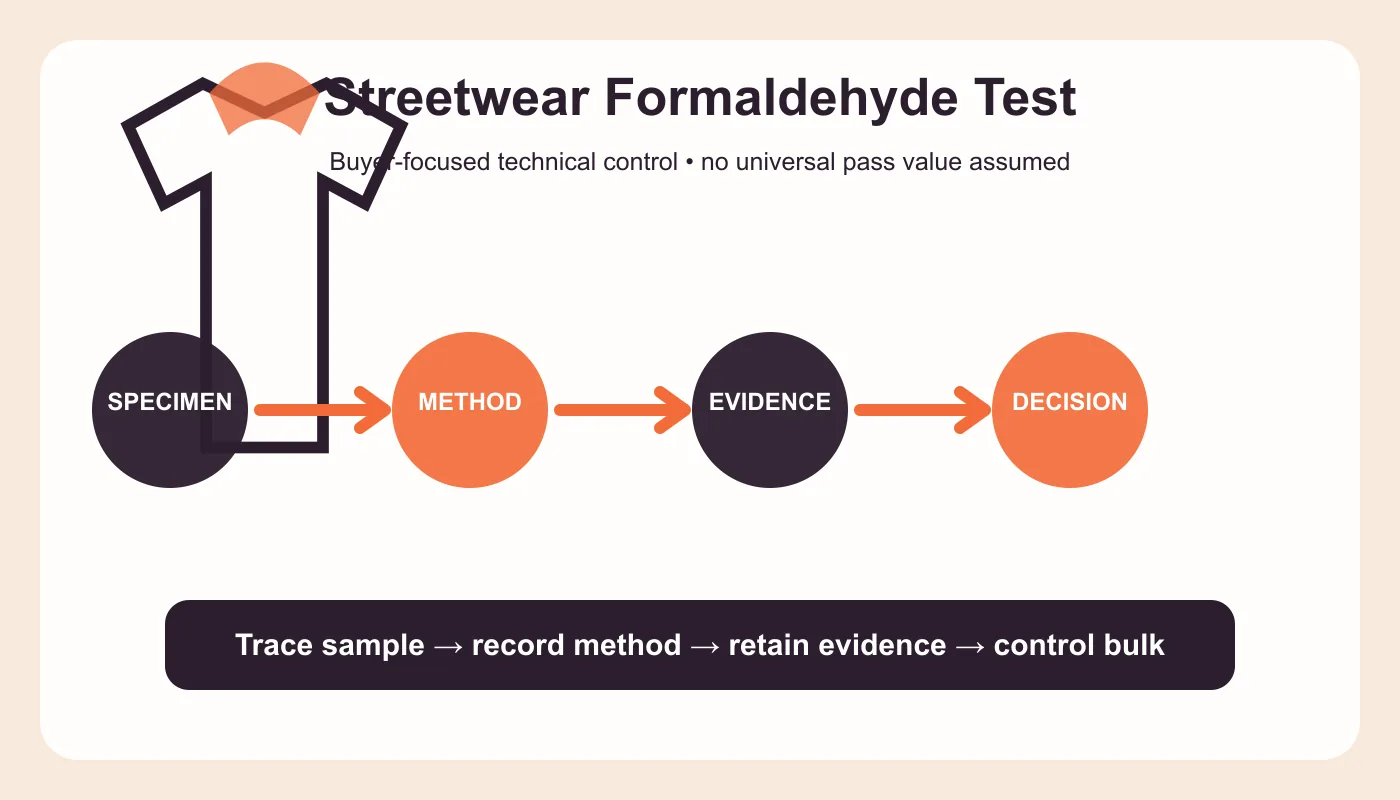
Streetwear Formaldehyde Test Guide
Quick Answer — streetwear formaldehyde test: Define the destination market and required method first. Test representative final-state fabrics, prints, labels and finishes with traceable sample IDs; report the procedure, detection or quantification information and individual results. Separate free and hydrolysed formaldehyde from formaldehyde released under accelerated conditions, because different methods answer different questions and should not be compared as identical numbers.
A streetwear formaldehyde test measures a defined form of formaldehyde in a textile under a specified analytical procedure. The result can support chemical quality control for hoodies, T-shirts, jackets, linings, labels and finished effects, but it is meaningful only when the specimen, method, reporting limit and market requirement are identified. Odour, touch and a supplier statement are not substitutes for testing.
This article gives private-label buyers a practical evidence workflow without claiming that Aimer Custom Lab holds an unverified certificate or that one limit applies worldwide. Review the site’s production capabilities and contact route, then confirm current legal and customer requirements with an appropriate laboratory.
What does a streetwear formaldehyde test measure?
It measures the formaldehyde fraction defined by the selected extraction or release method.
ISO 14184-1:2011 covers free and partly hydrolysed formaldehyde using water extraction and applies to textile samples in different forms. ISO also identifies a separate released-formaldehyde method in Part 2. AATCC TM112-2020 uses accelerated sealed-jar conditions for fabrics that evolve formaldehyde. The method name therefore belongs next to every result.
Where can formaldehyde-related risk enter a streetwear style?
Risk can relate to selected easy-care, resin, print, adhesive, coating or finishing systems and to contamination or storage interactions.
Do not assume that every textile uses the same chemistry. Start with a chemical input and component map. Include shell fabrics, ribs, pocketing, linings, labels, interlinings, transfer adhesives, print binders and packaging that contacts the garment. Garment washing may reduce, redistribute or reveal residues, so the tested state must match what is sold.
Why must the buyer define the market before testing?
Requirements and reporting conventions can differ by jurisdiction, customer programme, wearer age and product use.
A method is not a legal threshold. The responsible brand should confirm the current rule, test basis, product scope, sampling frequency and laboratory expectations for each destination. Avoid repeating an online limit without its source and date. If the requirement is unclear, keep the style on hold and request qualified compliance guidance rather than declaring the material compliant.
How do common formaldehyde methods differ?
Use the method that matches the buyer’s requirement and do not merge unlike results.
| Method family | Question answered | Specimen note | Buyer warning |
|---|---|---|---|
| Water extraction | Free and partly hydrolysed amount under the method | Final textile state | Not the same as release |
| Sealed-jar release | Amount evolved under accelerated conditions | Fabric suited to method scope | Do not compare directly with extraction |
| Component screening | Where a risk may originate | Shell, print, label, adhesive | One shell result may not cover all |
| Finished-garment confirmation | Delivered style evidence | After all processing | Requires traceable production state |
| Bulk monitoring | Lot consistency | Risk-based lots and colours | Needs pre-agreed action rule |
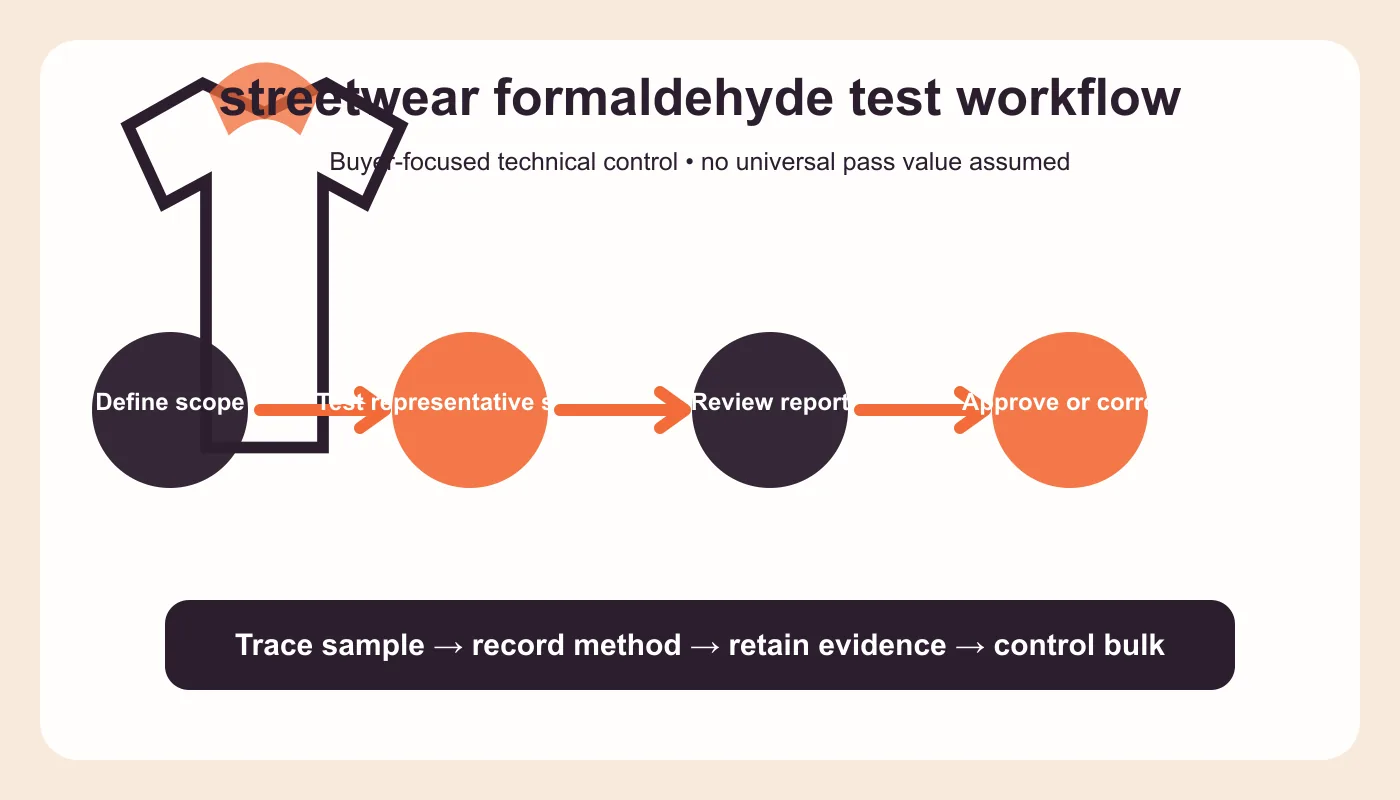
How should buyers run a streetwear formaldehyde test workflow?
Use a staged workflow that connects development evidence to bulk decisions.
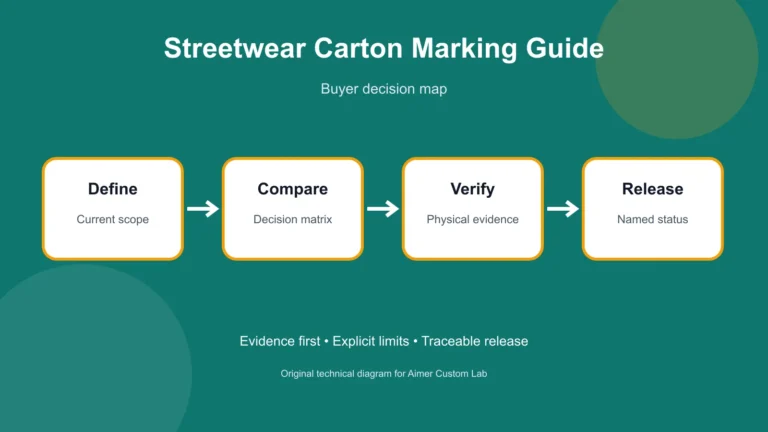
1. Confirm scope and requirement
Document country, customer programme, wearer group, method, reporting unit and decision authority.
2. Map chemical inputs and components
Ask suppliers for current declarations while recognizing that documentation and testing serve different purposes.
3. Select final-state specimens
Cover risk colours, finishes, prints, labels and lots with sealed and photographed identification.
4. Use a competent analytical laboratory
Request method, sample preparation, result, reporting limit information and any deviation.
5. Trace a nonconformance
Hold the affected lot and review chemistry, dosing, curing, rinsing, storage and component sources.
6. Revalidate after change
Test the corrected final-state material with the same required method and update the approved specification.
Which problems can make the result misleading?
Most misleading reports omit context rather than numbers.
| Risk | Why it matters | Control |
|---|---|---|
| Method confusion | Extraction and release procedures describe different test conditions. | Name the exact method with the result. |
| Incomplete component map | Labels or adhesives may follow a different supply chain. | Screen the complete bill of materials. |
| Supplier statement only | A declaration may not represent the final lot. | Use risk-based verification. |
| Unsupported compliance claim | A result can be misapplied to another market or style. | Link approval to scope and date. |
streetwear formaldehyde test buyer checklist
- Identify destination market, wearer group and current requirement.
- State analytical method and edition.
- Map fabrics, finishes, prints, labels, adhesives and packaging contact.
- Test final production-intent specimens.
- Keep sample IDs, lot data, colour and process state.
- Retain reporting limit and laboratory information.
- Hold and investigate affected material before rework.
- Repeat verification after supplier, chemistry or process change.
How should buyers document evidence and manage change?
Keep a compact evidence pack that another reviewer can understand without relying on memory. Record the product reference, material or component code, colour, size, sample stage, supplier lot, test method and report date. Attach the approved specification, relevant photographs and the decision made. For streetwear formaldehyde test, that record is more useful than an isolated pass label because it shows exactly what was examined and which purchasing question the evidence answered.
A development sample does not automatically represent every future production lot. Fibre blend, yarn, knit or weave construction, finish, dye recipe, coating, trim supplier and processing route can change performance. Buyers should therefore define change-control triggers before ordering. A meaningful material substitution, new colour family, new finishing route, new component source or recurring complaint can justify a new risk review and, where appropriate, targeted retesting.
Use the result as one input to approval, not as a substitute for product judgement. Compare laboratory evidence with the approved sample, measurement report, workmanship inspection, wear or handling trial and intended care instructions. If the report does not clearly identify the specimen or method, return it for clarification. If a result is close to an agreed limit, discuss repeatability, conditioning and sampling with a competent laboratory rather than rounding the number into a convenient answer.
Supplier communication should remain specific and neutral. State the observation, cite the agreed requirement, identify the affected lot and request a corrective-action explanation with fresh evidence. Avoid vague instructions such as “improve quality.” A practical corrective plan names the suspected cause, containment action, process change, responsible owner, verification method and approval gate. This makes the streetwear formaldehyde test workflow auditable without pretending that one test predicts every use condition.
Finally, retain approved reports with purchase-order and material records for a period appropriate to the buyer’s market and internal policy. Link the evidence to the exact style and revision rather than storing it in an unlabelled folder. When the next order begins, reviewers can see what was previously approved, which variables changed and whether a new test is proportionate to the risk.
Frequently asked questions
Can smell replace a streetwear formaldehyde test?
No. Odour is not a quantitative or method-specific measurement.
Is a fabric certificate enough for a printed hoodie?
Not automatically. Printing, labels, adhesives and finishing can create a different final product state.
Are ISO 14184-1 and AATCC TM112 results interchangeable?
No. They use different principles and answer different questions. Follow the required method.
Can one test cover every order?
Use a risk-based plan that reflects lots, colours, finishes, suppliers and changes. A historic result may not represent new material.
What should a brand do when requirements conflict?
Use the requirement applicable to the actual destination and customer programme, obtain qualified advice and document the decision before release.
Conclusion: make the evidence usable
A defensible streetwear formaldehyde test programme starts with method scope, final-state specimens and destination-market requirements. It keeps component evidence, analytical reports and corrective actions linked instead of relying on smell or generic certificates. Brands can submit the complete style and material brief through the enquiry page so testing responsibilities are clarified before bulk approval.