Garment Measurement Tolerance Guide for Streetwear
Quick answer: A garment measurement tolerance is the permitted variation from a target point of measure, not an extra allowance to change the design. Streetwear brands should define every POM, measuring method, target, size grade, tolerance, sample condition, and decision rule before production, then use the same document for sample approval and bulk inspection.
A garment measurement tolerance dispute often begins with a simple sentence: “The garment is only one centimetre different.” Whether that difference is acceptable depends on the point, size, fabric, fit concept, approved tolerance, and measuring method. One centimetre at an oversized body length may have a different visual effect from one centimetre at a neck opening or pocket placement.
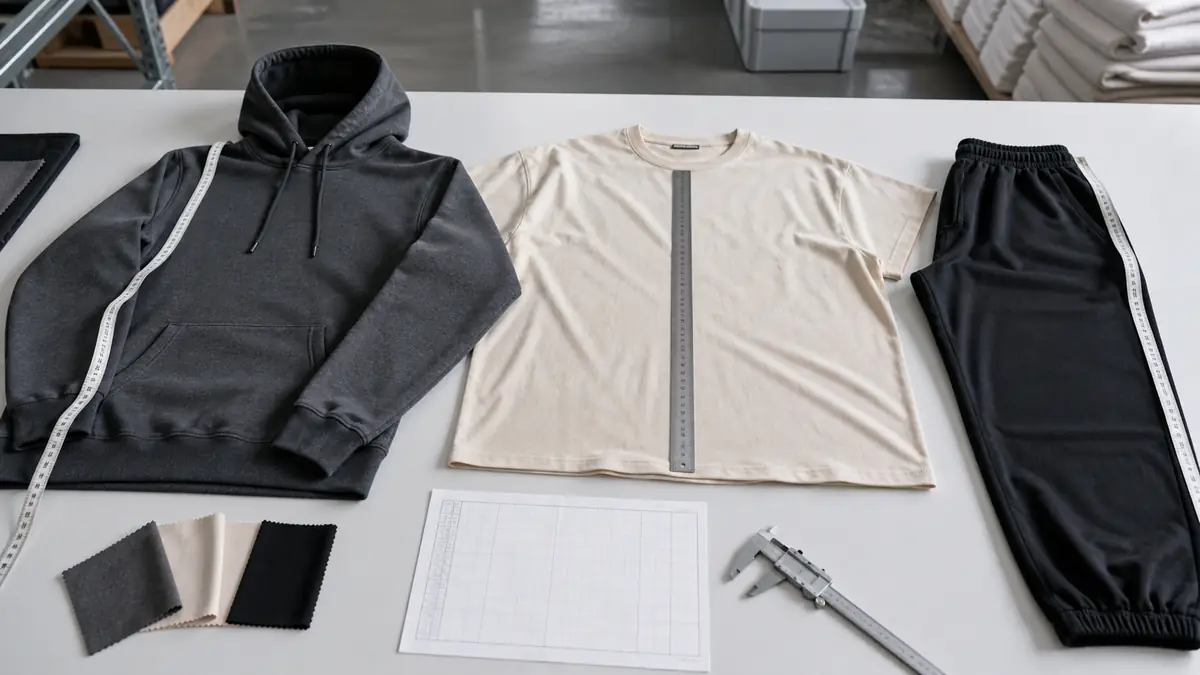
This guide helps private-label streetwear brands build practical measurement and tolerance specifications for tees, hoodies, joggers, and jackets. It covers points of measure, conditioning, grading, decision rules, sample comments, and bulk inspection. For the full development sequence, start with our streetwear clothing sampling process.
What is a garment measurement tolerance?
A target measurement is the intended value for a defined point of measure. Tolerance is the permitted positive and negative variation from that target under an agreed measuring condition. For example, a specification may state a target and a symmetrical tolerance, or it may use different plus and minus limits where the product requires it.
Tolerance does not replace accurate cutting and sewing. It recognises controlled production variation. The appropriate value depends on garment type, fabric behaviour, measurement length, construction, fit sensitivity, equipment, and commercial risk.
Why do streetwear brands need POM definitions?
Points of measure, or POMs, tell the sample room and quality team exactly where and how to measure. Skema3D’s POM guide explains that each point needs a standard name, method, target, and tolerance. Techpacker’s tech-pack guide likewise identifies measurement specifications as a core production document.
A label such as “chest” is not sufficient. Specify whether it is measured a fixed distance below the armhole, from edge to edge, with the garment flat and unstretched, and whether the result represents a half measurement. Add a diagram with arrows and landmarks.
Which POMs matter by garment type?
| Garment | Fit-critical POM examples | Construction POM examples |
|---|---|---|
| Oversized T-shirt | Chest, shoulder, body length, armhole, sleeve opening | Neck rib width, hem depth, print placement |
| Hoodie | Chest, shoulder, body length, sleeve, hood opening | Pocket position, rib height, drawcord exit spacing |
| Jogger | Waist relaxed/extended, hip, rise, inseam, thigh | Cuff height, pocket opening, drawcord length |
| Jacket | Chest, shoulder, across back, sleeve, body length | Zipper length, pocket position, cuff and hem details |
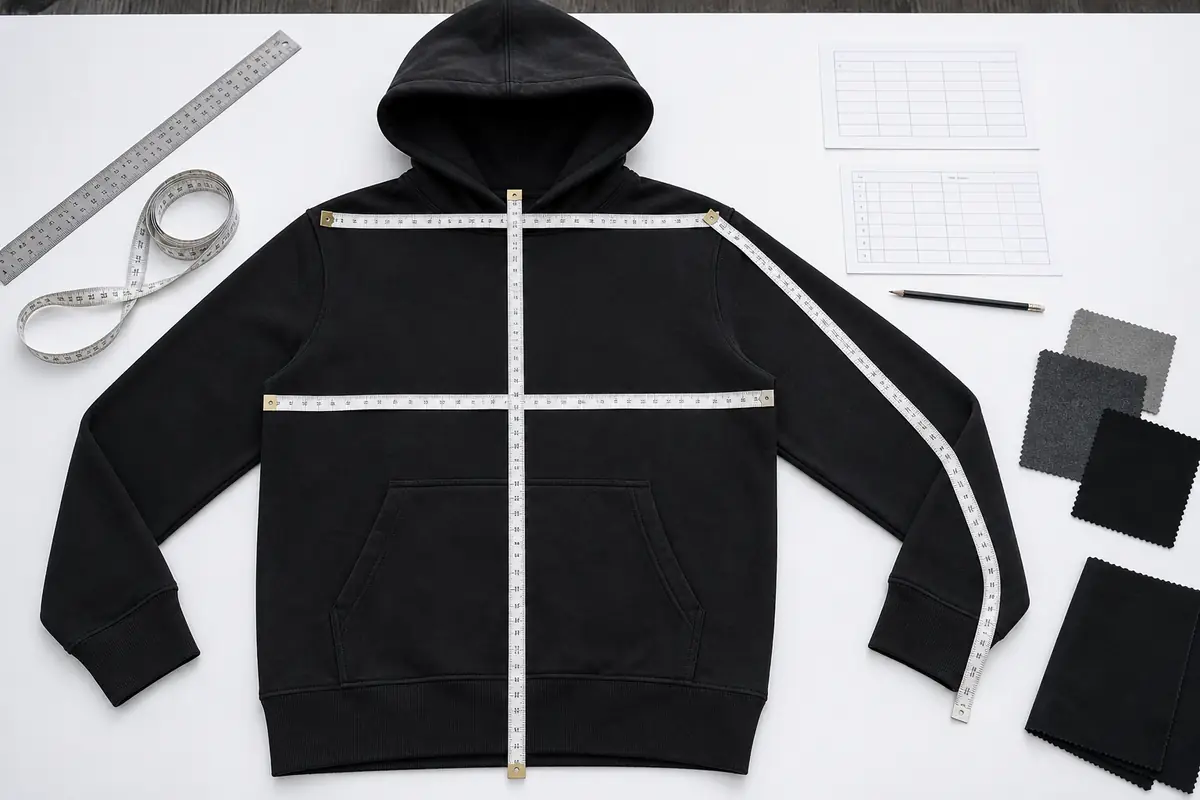
The complete list should describe the silhouette without creating unnecessary inspection burden. Complex products require more points than a basic tee, but every POM should have a clear purpose.
How should a garment be prepared for measurement?
Define the condition before measuring. The garment may need to rest flat, close all zippers and buttons, smooth wrinkles without stretching, align seams, and condition in a specified environment or for an agreed period. If one team measures immediately after pressing and another measures after relaxation, results may differ.
Also state whether measurements are pre-wash, post-wash, or both. Garment-washed streetwear requires especially clear control because washing and finishing can change dimensions and surface shape.
How should tolerances be selected?
Select each garment measurement tolerance according to function, fit sensitivity, material behaviour, process capability, and the buyer’s commercial risk.
Start from product function and risk rather than copying a universal chart. Fit-critical small openings may need tighter control than a long non-critical measurement. Stretch fabrics and wash processes may require realistic allowances, but wide tolerances should not be used to hide an unstable process.
Discuss capability with the supplier during development. Review actual sample and pilot data where available. Gibben’s streetwear tech-pack guide describes tolerances as an agreed band around a target; that agreement should happen before bulk cutting, not after an inspection failure.
Should tolerances be symmetrical?
Many specifications use the same plus and minus allowance, but asymmetrical tolerances can be appropriate when one direction creates more risk. For example, an opening that becomes too small may create a functional problem, while a slightly larger value may be less critical. Any asymmetry should be intentional, documented, and consistently applied.
How do grading and tolerance differ?
Grading is the planned change from one size to another. Tolerance is the allowed variation around each size target. They must not be combined. If a Medium chest target differs from Large by a grade increment, a Medium outside tolerance does not become a valid Large.
Review grade rules by fit family. Oversized, boxy, cropped, and regular products may need different increments to preserve silhouette. Our oversized tee measurement guide provides relevant POM context for width, shoulder, and length.
How should sample comments reference tolerances?
- Record the sample version, size, colour, and measurement condition.
- List target, actual result, and variance for every POM.
- Mark each point as pass, fail, or review using the approved tolerance.
- Describe the pattern or construction change required; do not only say “fix fit.”
- Attach consistent photographs and diagrams where visual balance matters.
- Issue one consolidated comment sheet with revision date and owner.
- Update the master spec after approval so obsolete values do not reach production.
How should bulk measurement inspection work?
The bulk team must apply the same garment measurement tolerance table used for the approved sample; informal factory allowances should not replace the signed revision.
Agree the sampling plan, size distribution, colour coverage, measuring tools, conditioning, and pass/fail rule before final inspection. Use calibrated tools and a flat, suitable surface. Inspectors should follow the same POM diagrams used by the sample room.
Do not average a small and large error to create a pass. Evaluate each selected garment and point according to the decision rule. If repeated results cluster near one tolerance limit, investigate process drift even if individual units technically pass.
Common measurement-control mistakes
| Mistake | Why it causes disputes | Better approach |
|---|---|---|
| No POM diagram | Teams use different landmarks | Add arrowed sketches and written method |
| Mixed units | Conversion and rounding errors | Use one master unit system |
| One tolerance for every point | Ignores fit and construction risk | Assign by POM and product need |
| Measuring stretched | Results depend on operator force | Define relaxed or extended method |
| Old spec in production | Factory follows obsolete values | Control version and approval status |
| Checking only base size | Grade problems remain hidden | Inspect representative sizes |
How do washing and finishing affect tolerances?
Garment dyeing, enzyme washing, stone effects, softening, steaming, and pressing can change measurements. Define whether the production target applies before or after the final finish. Approve dimensional-change expectations and use the same care or wash method for comparison.
Fabric shrinkage and garment construction interact. Rib, pocket, lining, zipper tape, and body fabric may change at different rates. Measure key POMs before and after testing to identify distortion, not only overall shrinkage.
Measurement tolerance checklist
Complete one garment measurement tolerance checklist for every active style and ensure that the revision number matches the purchase order and inspection file.
- Every POM has a unique name and diagram
- Target value and unit are unambiguous
- Positive and negative tolerance are shown
- Measuring condition and garment preparation are defined
- Pre-wash and post-wash status is clear
- Grade increments are separate from tolerance
- All sizes and colours use the current approved revision
- Inspector tools and surface are appropriate
- Sampling plan and decision rule are agreed
- Approved sample and comment history are retained
Frequently asked questions
Is there one standard tolerance for all clothing?
No. Appropriate tolerances depend on garment type, POM, material, construction, finish, fit sensitivity, production capability, and buyer requirements.
Does tolerance mean the factory can intentionally cut off target?
No. The target remains the intended value. Tolerance is an acceptance band for controlled variation, not a substitute for process accuracy.
Should every POM use the same tolerance?
Usually not. Small, functional, or fit-critical points may require different control from long or less sensitive measurements.
How should stretch waist measurements be recorded?
Define relaxed and extended methods separately, including the reference points and the force or procedure used for extension.
What happens when a sample is within tolerance but looks wrong?
Review whether the POM list, targets, and tolerance actually describe the intended silhouette. Visual approval and fit testing remain important.
When should the master measurement sheet be updated?
Update it after approved changes and before the next production stage. Use version control so only the signed current revision is active.
Conclusion: make acceptance rules clear before cutting
Garment measurement tolerance works only when the POM, method, target, condition, grade, and decision rule are equally clear. A disciplined garment measurement tolerance specification reduces subjective inspection, prevents obsolete values from reaching production, and helps a streetwear brand preserve its silhouette across sizes and repeat orders.
Preparing a production tech pack? Combine this guide with the streetwear sample approval workflow and contact Aimer Custom Lab through the website with your technical flats, measurement chart, fabric target, size range, finish, quantity, and delivery window. Confirm applicable tolerances, MOQ, sampling plan, and production timing for the specific style.