Streetwear Air Permeability Test Guide
Quick Answer: A streetwear air permeability test measures airflow through a defined fabric area under a specified pressure difference. Use one consistent method, face, conditioning, test area and unit when comparing samples. Treat airflow as distinct from moisture management or water-vapor resistance, and test printed or layered zones when they affect the claim.

Air permeability can help compare an open jersey knit, dense heavyweight fleece, mesh panel or coated shell, but the result depends strongly on construction and test conditions. A dependable streetwear air permeability test program compares like with like: the same method, test area, face, conditioning and garment layer. It then connects the number to a real use case instead of turning one laboratory result into a vague “breathable” promise.
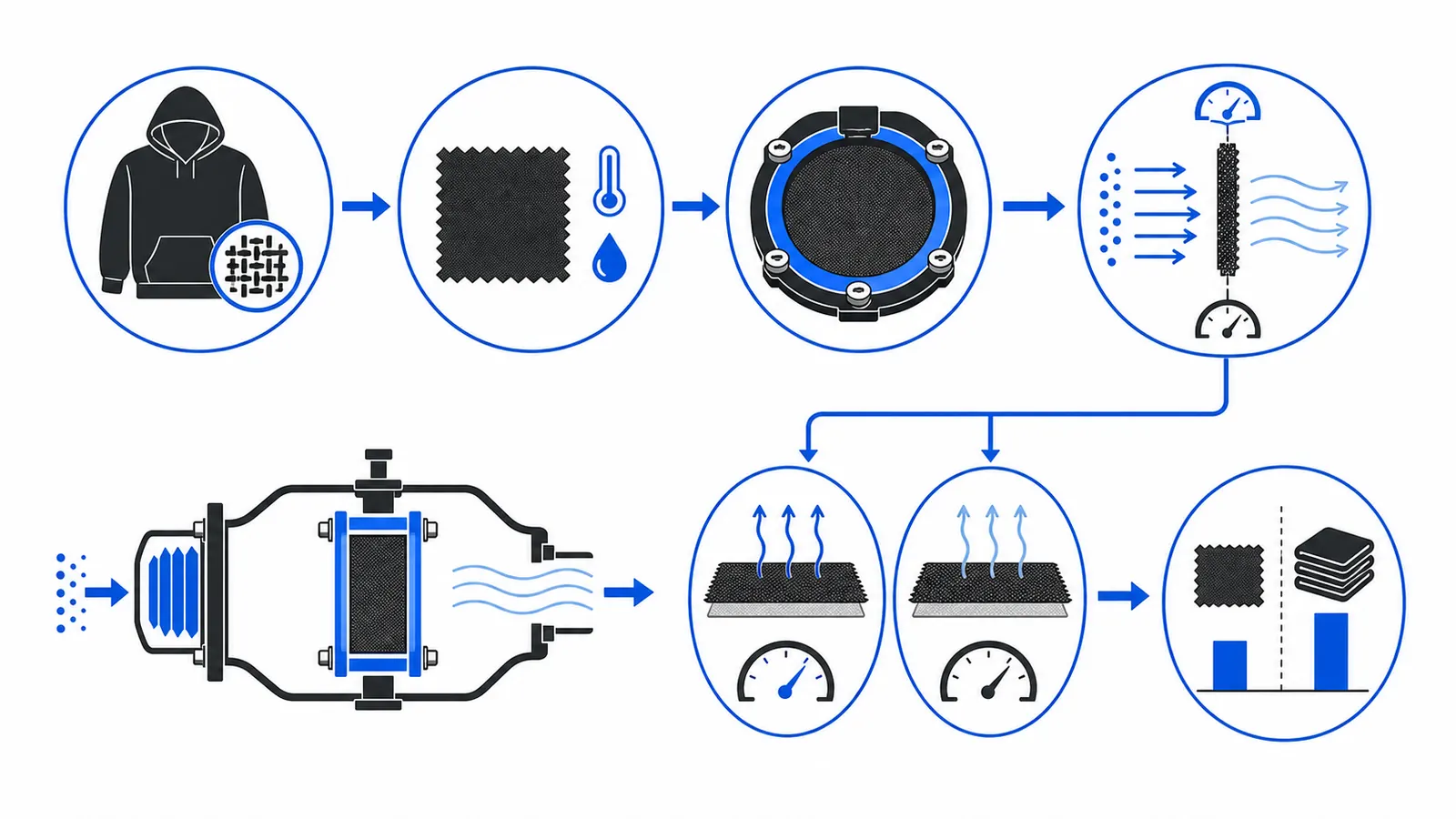
What is air permeability in streetwear fabric?
Air permeability is the rate at which air passes perpendicularly through a known textile area under a defined pressure difference. It is not the same as moisture-wicking, drying time, hydrostatic pressure or water-vapor resistance. These properties can influence comfort together, but they answer different questions and often require different instruments. Buyers should name the intended property in specifications and marketing copy.
ISO 9237 and ASTM D737 are commonly referenced methods for measuring fabric air permeability. Both require controlled conditions and specimen preparation. The method controls the laboratory procedure; the buyer still needs to decide which sample, direction, layer and result range are relevant to the product. A result from a loose fabric swatch should not be presented as a guaranteed whole-garment experience.
Why does a streetwear air permeability test matter?
Streetwear silhouettes range from oversized lightweight tees to dense hoodies and lined jackets. A number can support material comparison when the design team knows whether the goal is ventilation, wind resistance, structure or layering.
Large graphics, coatings, embroidery backing and fused layers can reduce local airflow. Testing only an unprinted swatch may therefore miss the zone that covers much of the finished garment.
The greatest value of a streetwear air permeability test is comparison. A brand can compare a development sample with an approved reference, check whether finishing changed the result, and confirm whether bulk remains inside a pre-agreed tolerance. Universal claims are less useful because knit structure, garment fit, climate, activity, laundering and layering change the wearer’s experience.
Which variables can change the result?
| Variable | Possible effect | Control for comparison |
|---|---|---|
| Knit or weave density | Open structures generally allow more airflow than compact structures | Compare the same construction and weight range |
| Pressure difference | A higher pressure can produce a higher measured flow | Use the same specified pressure |
| Fabric face and direction | Pile, brushing and anisotropic structure can affect flow | Record face and specimen orientation |
| Print, coating or lining | Layered areas can restrict airflow | Test the relevant finished zone |
| Conditioning and care | Moisture, finishing and laundering may change structure | Use the same conditioning and wash state |
Record the fabric face, specimen orientation and any finish or wash history. If a garment uses body fabric, rib, mesh, lining and print zones, one number cannot describe every region. Map the zones that influence the intended use and test the relevant construction.
Which streetwear air permeability test standard should a buyer specify?
ISO 9237:1995 specifies measurement of air permeability of fabrics and remains current after its 2023 confirmation. ASTM D737-18(2023) covers air permeability of textile fabrics and notes that results depend on factors such as pressure, construction and treatment.
See the official ISO 9237 page and the official ASTM D737 page. Do not compare values from different methods or conditions as if they were interchangeable. Test area, pressure or vapor conditions, units, calculation and sample preparation can differ. The purchase specification should cite the standard edition and laboratory conditions, while the report should state any deviation.
Recommended laboratory brief
- Style, fabric code, color, finish and whether the sample is fabric or a layered assembly.
- Standard and edition, specimen face, test area, conditioning and required units.
- Number of specimens, reporting of individual values and average, and variation rule.
- Reference sample or agreed performance range for the intended use case.
- Before/after wash or finishing condition when durability is part of the claim.
How should a streetwear air permeability test be planned?
- Define the use case. Decide whether the garment is a heavy lifestyle hoodie, a light oversized tee, a lined jacket or another construction.
- Select a reference. Use a proven sample or a range derived from wear and product testing rather than a borrowed competitor number.
- Lock test conditions. Put the method, face, area, conditioning, units and specimen count in the lab request.
- Sample representative zones. Include coatings, prints or layered areas when they materially affect the intended claim.
- Compare development and bulk. Look at averages and variation, not only the best specimen.
- Keep claims narrow. Describe what was measured, by which method and under which condition.
How should results guide fabric selection?
For a lightweight tee, the buyer may compare airflow against an approved seasonal reference while also checking opacity, recovery and shrinkage. For a heavyweight hoodie, lower airflow may be consistent with the intended dense hand and warmth, but it should be assessed with thermal and wear considerations.
For a jacket or coated panel, compare the uncoated fabric, finished material and critical seams or print zones when relevant. The result should guide trade-offs, not force every product toward the maximum airflow.
A numeric result is therefore one input in a balanced product decision. Combine it with fabric weight, dimensional stability, pilling, colorfastness, seam performance, handfeel and the garment’s intended silhouette. The best material is not the one with the most extreme single number; it is the one that meets the complete design and quality brief.
Method comparison for buyers
| Question | Useful evidence | What not to assume |
|---|---|---|
| Did finishing change performance? | Same fabric tested before and after the controlled finish | A different fabric is a valid baseline |
| Does bulk match approval? | Bulk specimens tested under the same conditions as the sealed reference | Supplier mill data represents every lot |
| Can the brand make a comfort claim? | Relevant lab evidence plus wear/use evaluation | One test proves overall human comfort |
| Can results from two reports be compared? | Matching method, edition, conditions, units and sample construction | Similar metric names mean identical methods |
What mistakes create misleading specifications?
- Using “breathability” without defining the measured property.
- Comparing results from different standards, units or pressure conditions.
- Testing the base fabric while ignoring a large print, coating, lining or bonded layer.
- Choosing a universal pass number without a product use case or reference sample.
- Reporting an average without checking specimen variation and bulk consistency.
- Claiming permanent performance when the sample was not evaluated after relevant care cycles.
Streetwear sourcing checklist
- Define silhouette, climate, activity level and layering scenario.
- Identify every garment zone that affects the property.
- Approve fabric code, weight, structure, finish and color before testing.
- Confirm method, edition, conditions, units and reporting format.
- Keep a sealed reference and link each report to the production lot.
- Combine laboratory results with fit, handfeel and wear evaluation.
Use our streetwear clothing sampling process to place testing at the correct approval gate. For adjacent material controls, see the streetwear fabric GSM test guide.
Frequently asked questions
Is a streetwear air permeability test the same as a comfort test?
No. It measures a defined physical property under laboratory conditions. Comfort also depends on fit, climate, activity, moisture, layering and personal perception.
Can two laboratories’ results be compared?
Only after confirming the same method edition, specimen construction, face, conditioning, test conditions, units and calculations. Otherwise the comparison may be misleading.
Should prints and coatings be tested?
Yes when they occupy a meaningful area or support the claim. Test the relevant layered zone as well as the unprinted base when the design decision requires both.
How many specimens are enough?
Use the standard and laboratory advice, then set a sampling plan appropriate to lot size and risk. Ask for individual values and variation as well as the average.
When should bulk be retested?
Retest according to the brand’s surveillance plan and after material, finish, color, print, supplier or process changes that could alter the property.
Conclusion: turn a number into a product decision
A sound streetwear air permeability test keeps the method and product context visible. It supports comparison, change control and precise claims without pretending to measure every aspect of comfort. Contact Aimer Custom Lab with your fabric code, garment construction, intended use and target market so the sourcing team can confirm what information can be verified for your project.