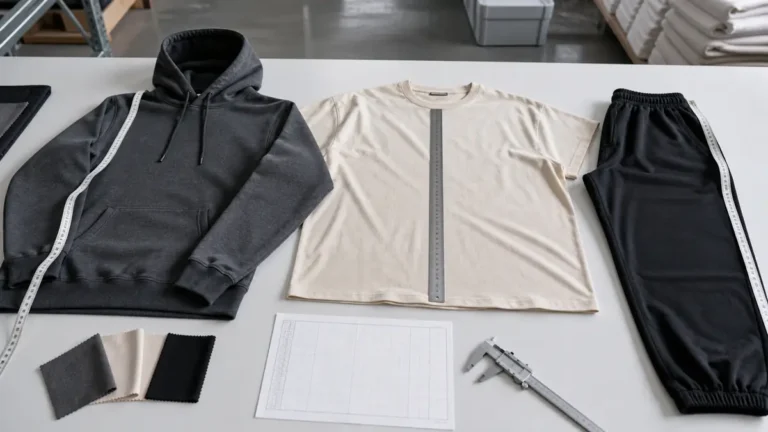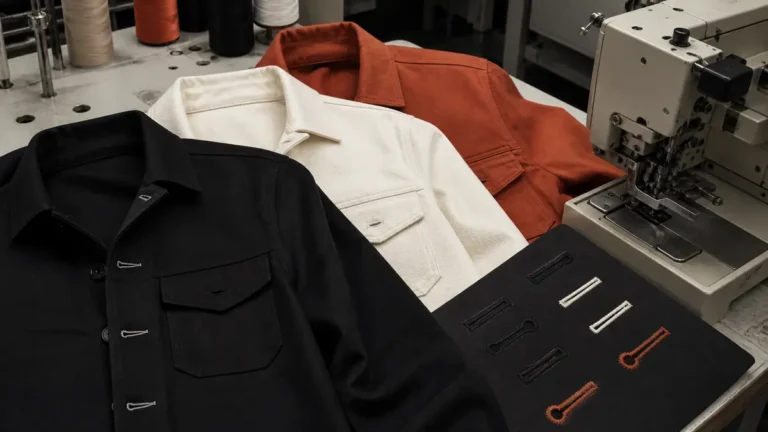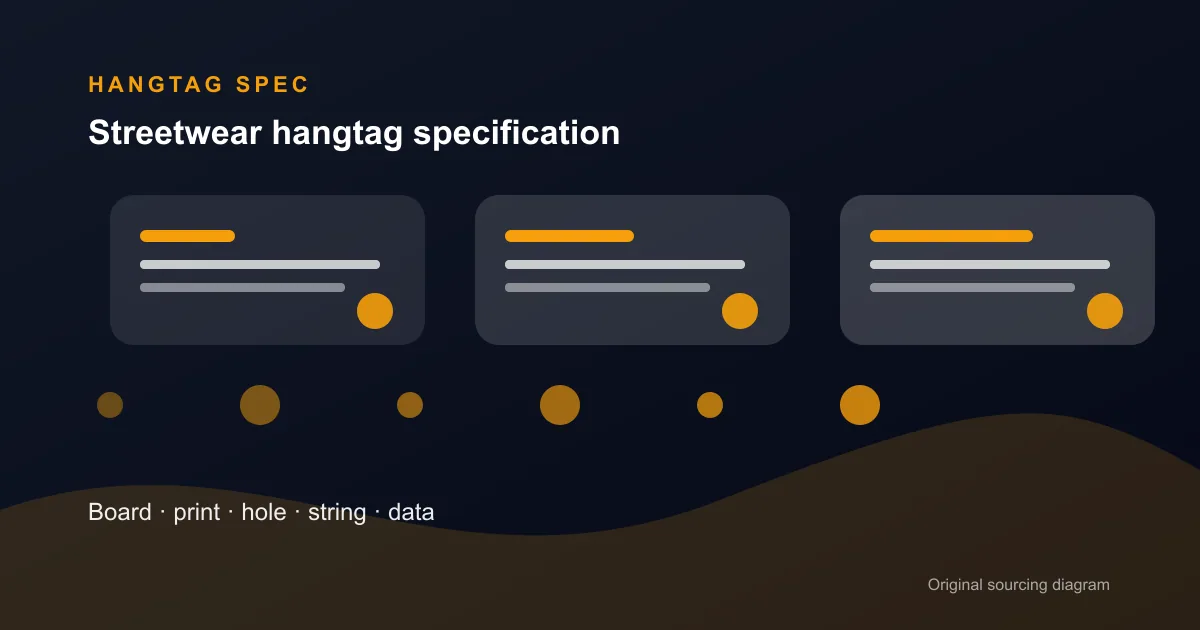
Streetwear Hangtag Specification Guide
Quick Answer: A streetwear hangtag specification should define the tag’s purpose, finished size, material, thickness, print sides, colour references, finish, hole and attachment, fixed and variable data, barcode requirements, proof route, tolerance, pack-out and approval revision. Test a physical tag on the actual garment and scan any barcode before bulk attachment.
A streetwear hangtag specification converts a small branding object into a controlled production component. A render can show the logo and colours, but it does not prove board stiffness, edge quality, hole position, string length, barcode performance or how the tag sits on an oversized T-shirt or hoodie after packing.
This dedicated guide narrows the trim-control stage within the broader private-label streetwear packaging guide. Buyers can also review custom menswear products before deciding whether one tag format can serve several garment categories.
What is a streetwear hangtag specification?
It is the approved technical and data brief used to quote, proof, print, attach and inspect a removable garment tag. It controls the physical tag and the information printed on each variant. A specification is different from the graphic artwork: the artwork may not state board grade, hole diameter, cord construction or carton packing.
Start by defining the job. A brand-story tag, retail price ticket and warehouse barcode carrier have different priorities. If one tag must perform all three, build a clear information hierarchy before choosing its dimensions.
The streetwear hangtag specification should name which of those jobs is primary and which are optional.
Which fields belong in the specification?
| Specification area | Required decision | Approval evidence | Typical risk |
|---|---|---|---|
| Purpose and scope | Garments, channels and markets served | Component matrix | One tag forced onto incompatible products |
| Construction | Size, shape, material, thickness and grain | Physical blank or proof | Warping, cracking or weak edges |
| Sides, colours, process, coating and finish | Colour and finish sample | Uncontrolled appearance or unreadable copy | |
| Attachment | Hole, reinforcement, string and garment location | Attached garment sample | Damage, tangling or reversed orientation |
| Variable data | Style, colour, size, SKU, price and code | Variant proof set | Data does not match the garment |
| Pack-out | Bundle, protection, count and carton label | Master pack | Mixed revisions or scuffed tags |
How should size, material and finish be selected?
Choose finished dimensions after the content and garment are known. A large heavy tag may overwhelm a lightweight tee, while a narrow tag can compress a barcode or multilingual copy. State dimensions in millimetres, orientation, corner radius or die line, and the safe area for critical text.
Name the paper, board or alternative material with a supplier reference and measurable grade when available. “Premium card” is not a usable specification. If environmental claims are planned, the brand must retain suitable evidence and approve the exact wording rather than inferring a claim from colour or texture.
Update the streetwear hangtag specification when the board, finish, die line or attachment supplier changes.
For print, record process, number of colours, front and back coverage, spot or process colour targets, lamination, varnish, foil, embossing, debossing or other finish. Ensure that a coating does not reduce barcode contrast or cause glare in the intended scan environment.
What should the artwork file contain?
Provide a print-ready file with the cut line, bleed, safe area, hole location, colour definitions, font handling and front/back orientation. Keep technical guides on non-printing layers when supported. Export a proof that shows finished dimensions and identifies the revision.
Separate fixed design from variable data. The brand logo, story and website may remain constant, while style, colour, size, SKU, price and barcode change by variant. Use a controlled table as the data source and require the proof to show the human-readable values beside any machine-readable code.
How should barcode data be controlled?
Obtain identifiers from the brand’s authorised numbering system and define the required symbology and destination use. Do not let a designer invent a code or reuse one identifier across variants when the retailer or inventory system expects unique items. Match the encoded number, human-readable number, SKU, style, colour and size.
The GS1 General Specifications resource explains that identification keys, data carriers, check digits and symbol placement belong to one system. The brand should confirm the exact standard and retailer requirements for its route. Scan the digital proof only as a preliminary check; the physical production proof must also be scanned after printing and finishing.
How should the hole and attachment be specified?
State hole diameter, centre position from the finished edges, reinforcement or eyelet, string or cord material, colour, length, knot or seal and orientation. Identify the garment attachment point and whether the fastener may pierce fabric, pass through a seam label or use another approved route.
Test the complete assembly on the final garment. The attachment should not pull a lightweight knit, mark a coated jacket, snag brushed fleece or sit across the main decoration. During packing, confirm that the tag faces the intended direction and is protected from abrasion.
Which proof stages reduce hangtag errors?
- Content proof: approve wording, hierarchy, legal review status and variant fields.
- Digital print proof: check layout, dimensions, die line, bleed, colours and hole position.
- Physical white sample: handle the material, edges, thickness and attachment.
- Printed proof: inspect colour, registration, finish, legibility and barcode.
- Garment sample: review scale, orientation, comfort and pack appearance.
- Bulk first piece: verify the current revision before the full run continues.
Record approved, rejected and conditionally accepted features separately. A colour approval does not automatically approve variable data, and a barcode scan does not approve the visual finish.
Each proof should cite the current streetwear hangtag specification revision and responsible approver.
What belongs in the bulk quality checklist?
- Correct artwork and data revision by style-colour-size variant
- Finished dimensions, shape and corner quality
- Material identity, thickness and surface consistency
- Print registration, colour, density and small-text legibility
- Finish coverage without scratches, bubbles or unintended glare
- Hole position, reinforcement and attachment security
- Barcode scan and human-readable value reconciliation
- Correct garment attachment point and orientation
- Bundle count, protection and carton identification
Set tolerances and sampling according to the program rather than copying generic limits. The buyer and supplier should agree which deviations are critical, which can be reworked and who authorises an exception.
How does a hangtag interact with required garment labels?
A removable hangtag should not be assumed to replace permanent care information or other required garment labelling. For U.S. products, FTC guidance explains circumstances in which care information must also appear outside packaging or on a hangtag when the attached care label cannot be seen at sale, but the underlying care-label obligations remain.
Destination requirements vary. The brand or importer should confirm which information belongs on permanent labels, which may appear on removable tags and which claims need substantiation. Keep the legal-data approval separate from the printer’s technical approval.
Frequently asked questions
What size should a streetwear hangtag be?
There is no universal best size. Base it on content, garment scale, barcode space, attachment and pack-out. Approve a physical mockup on each relevant product category.
Can one hangtag work for tees, hoodies and jackets?
Possibly, but test proportion, weight and attachment on all three. Different products may need another size, cord length, hole reinforcement or data layout.
Should the price be pre-printed?
That depends on the sales channel and update frequency. A controlled variable field or separate price sticker may reduce obsolete stock, but the brand should define the workflow before printing.
Can a QR code replace product information?
Do not assume so. Decide what users need without a device and what the destination market requires on the product. Test the destination URL, code contrast and long-term ownership.
How is a barcode approved?
Reconcile the identifier and human-readable data, verify the correct standard, scan the physical proof and retest after final coating or finishing in the intended environment.
When should the hangtag be reordered?
Use inventory triggers linked to the current artwork revision and active SKU set. Quarantine obsolete variants so an old tag cannot enter a new garment order.
Conclusion: approve the tag as a physical data carrier
A reliable streetwear hangtag specification controls purpose, construction, appearance, data, scanning, attachment and pack-out. The final evidence is a physical, correctly attached and data-verified proof—not a screen render alone. Send the garment range, tag artwork, variant table, barcode source, target market and pack route through the Aimer Custom Lab contact page to confirm order-specific sampling and production options.