Streetwear Garment Wash Shade Control Guide
Garment washing creates the faded, broken-in character associated with many streetwear collections, but uncontrolled variation can make one delivery look like several unrelated colors. A practical streetwear garment wash shade control system combines an approved visual standard, instrumental color data where appropriate, consistent lighting, lot segregation, recipe and load records, panel compatibility and a clear shade-sorting rule.
Quick answer: how should streetwear garment wash shade control work?
Control garment-wash shade by sealing an approved standard, defining the wash state and lighting, measuring color difference with a consistent method, sorting bulk into documented shade bands and preventing mixed panels or sets. Review whole-garment appearance as well as instrument readings, because seams, ribs, thread, prints and different fabric directions may respond differently.
What is garment-wash shade variation?
Shade variation is a visible or measured difference in lightness, chroma or hue between the approved standard and production garments, or between garments within the same order. In washed streetwear, some variation may be intentional. The requirement is not always perfect uniformity; it is controlled variation that supports the design and can be packed consistently.
ISO 105-J03 provides a method for calculating color difference between specimens measured under the same conditions using a CMC-based value. AATCC EP9 gives principles for visual assessment of textile color differences. These methods support repeatability, but the commercial tolerance must be set for the actual style and wash effect.
Why does streetwear garment wash shade control become difficult?
Variation can begin before washing. Fabric rolls may differ in dye lot, weight, absorbency, residual finish or relaxation. Cutting panels from different rolls can create one garment with mismatched parts. During washing, load weight, liquor ratio, chemical dosing, temperature, time, mechanical action, drainage, neutralization, drying and machine condition can all influence the result.
Pre-wash causes
- Mixed fabric dye lots or unapproved roll substitution.
- Different panel directions or nap orientation.
- Inconsistent print, pigment or spray application.
- Rib, pocketing, thread or labels with different color response.
Process causes
- Load quantity or garment-to-liquor relationship changes.
- Recipe dosing, sequence, pH, time or temperature drifts.
- Machines deliver different mechanical action.
- Drying temperature, duration or moisture endpoint varies.
- Wet garments wait unevenly before the next process.
What should a streetwear garment wash shade control standard contain?
Use a physical garment from the approved process, not only a digital color. Record style, fabric lot, color, wash recipe revision, machine, load, date and finishing condition. Store the standard to limit contamination, abrasion and light exposure. When possible, retain a master, working standard and boundary examples.
| Standard element | What to record | Purpose |
|---|---|---|
| Physical master | Approved garment or panel in final dry state | Represents intended visual character |
| Instrument data | Measurement geometry, illuminant, observer and color-difference formula | Makes readings comparable |
| Visual conditions | Light source, booth condition, background and viewing angle | Reduces inconsistent judgment |
| Process record | Recipe revision, load, machine and drying route | Supports reproduction and investigation |
| Boundary samples | Approved light, standard and dark examples | Defines the commercial shade band |
How should streetwear garment wash shade control be assessed visually?
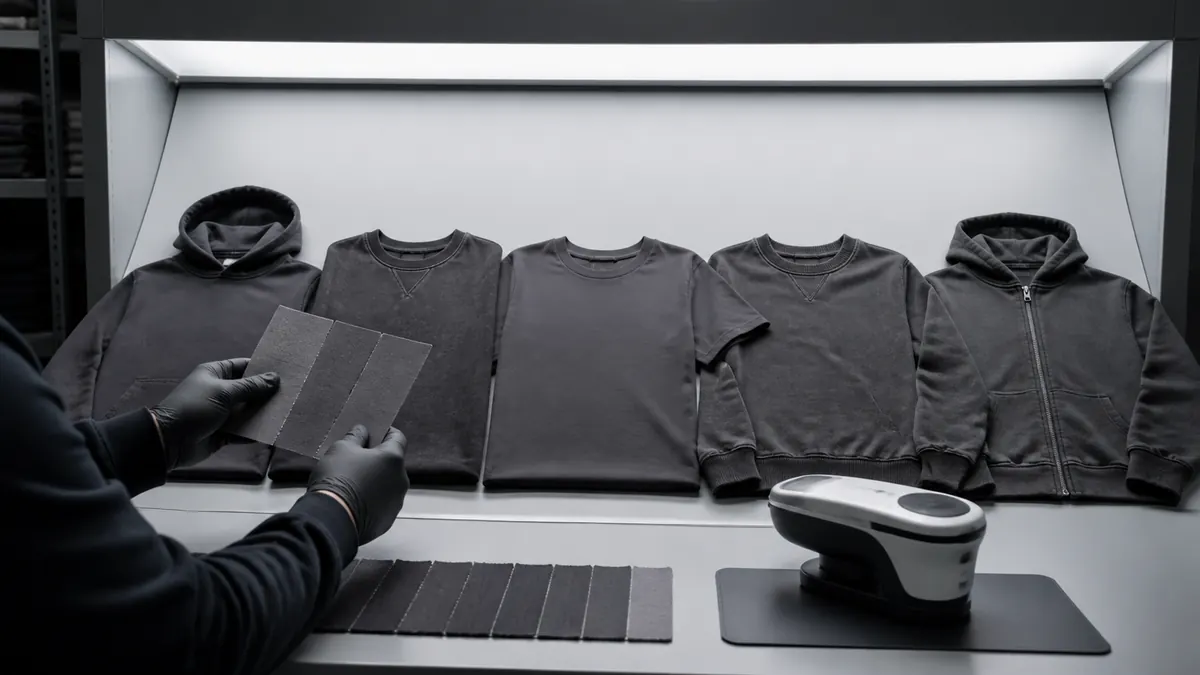
Compare clean, conditioned and fully dried specimens under the specified light source. Use a neutral surrounding field and consistent orientation. AATCC EP9 aims to standardize visual comparison of textile color difference, which helps prevent assessors from changing method between lots.
Inspect the complete garment before narrowing to a measurement area. Check front-to-back match, sleeve-to-body match, rib and shell relationship, pocket and hood panels, seam abrasion, streaking, crease marks, edge damage and localized chemical effects. Rotate or reposition specimens when texture changes the apparent shade.
How should streetwear garment wash shade control use color data?
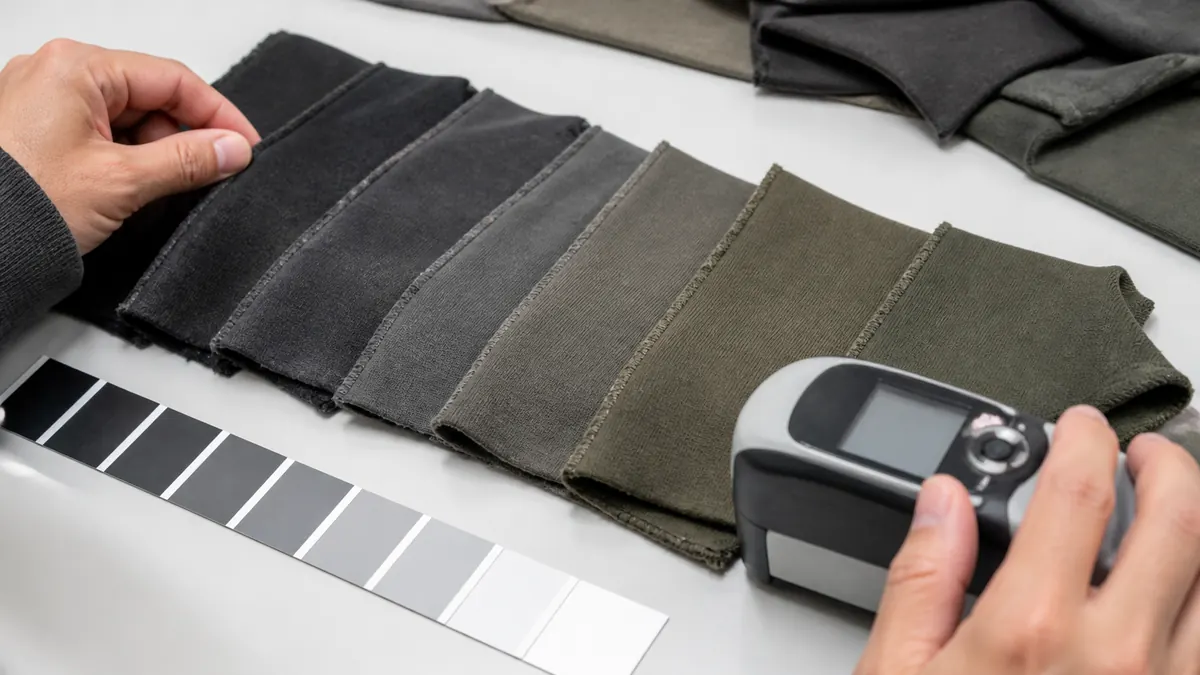
Instrument readings support objective communication, but they should not replace product judgment. Use the same instrument configuration, aperture, backing, specimen layers, measurement locations and color-difference formula. Washed surfaces can be textured and nonuniform, so take multiple readings at defined areas and review the spread.
ISO 105-J03 explains that color difference can be quantified between specimens measured under the same conditions and that the maximum tolerance depends on the end-use requirement. Datacolor likewise describes pass/fail tolerances, shade sorting and clustering as tools for managing variation. Buyers should set the tolerance from approved production evidence rather than inventing a universal value.
What is shade sorting?
Shade sorting groups acceptable garments into visually consistent bands, for example lighter, standard and darker approved groups. It does not convert a failed color into an acceptable one. First reject pieces outside the approved boundaries; then pack acceptable pieces so a retail order, set or size run does not contain an obvious jump.
- Condition and dry garments to the defined state.
- Remove pieces with stains, streaks, severe creases or local damage.
- Compare each garment with the master and boundary samples.
- Use consistent instrumental measurements when specified.
- Assign the garment to an approved shade band.
- Keep matching panels and coordinated sets together.
- Label cartons or internal records with the shade band.
- Audit packed assortments before shipment.
How can mixed-panel garments be prevented?
Control begins in the cutting room. Shade and lot identification must remain attached to bundles through sewing. Do not combine body, sleeve, hood or pocket panels from incompatible rolls merely because the unfinished fabric looks similar. After sewing, maintain bundle identity through washing and finishing.
Ribs and interlinings may respond differently from shell fabric. Review the streetwear fusible interlining guide when wash temperature, chemicals or mechanical action could change support layers. Hardware should also be approved in the final wash route using the streetwear snap button specification guide.
How should streetwear garment wash shade control manage lots?
Record every variable needed to reconstruct the lot: garment quantity and dry weight, water or liquor parameters, chemical identification and dosing, sequence, pH where relevant, time, temperature, machine, mechanical settings, rinsing, neutralization, extraction, drying and operator. If one machine consistently produces another shade, do not mix its output until the process is aligned.
Use a controlled pilot or first bulk load and obtain approval before processing the whole order. The first load should be large enough to represent production conditions; a tiny development washer may not reproduce bulk mechanical action.
What should happen when a shade fails?
Quarantine the affected lot and identify whether the issue is uniform color shift, internal variation or localized defects. Compare fabric lots, recipe records, machine, load and drying data. Reprocessing may change strength, hand feel, dimensions, print appearance and trims, so do not authorize it on color alone. Trial and retest the complete product.
AATCC TM61 provides an accelerated laundering method for colorfastness, while standard detergents and controlled procedures help reduce test variability. Colorfastness testing and production wash-shade approval answer different questions; include both when the product requires them.
Streetwear garment wash shade control checklist
- Master, working and boundary samples are identified and protected.
- Fabric lots remain segregated from cutting through washing.
- Wash recipe, machine, load and drying route are recorded.
- Visual booth conditions and instrumental settings are fixed.
- Whole-garment and panel-to-panel appearance are checked.
- Acceptable shade bands and packing rules are written.
- Thread, rib, print, labels and hardware are reviewed after washing.
- Reprocessing requires a controlled trial and full quality review.
Frequently asked questions
Is some shade variation acceptable in washed streetwear?
It may be, when the approved design includes controlled variation. The permitted range must be defined with physical boundary samples.
Can a digital Pantone reference replace a washed garment standard?
No. It can support color communication, but it does not reproduce texture, abrasion, seams and garment-wash character.
Is one color reading enough?
Usually not for nonuniform washed surfaces. Use defined locations and multiple readings, then review the whole garment visually.
What is the difference between shade sorting and reprocessing?
Shade sorting groups acceptable garments. Reprocessing changes the product and must be validated for all affected properties.
Why should cartons record shade bands?
It helps prevent visibly different acceptable bands from being mixed in one retail assortment or coordinated set.
Where can color-difference calculation be verified?
ISO 105-J03 describes calculation of textile color differences measured under consistent conditions.
Conclusion
Reliable streetwear garment wash shade control begins with lot discipline and a production-equivalent master, then combines repeatable visual assessment, appropriate instrument data, process records and shade-aware packing. To develop a washed streetwear sample or review a bulk shade-control plan, contact Aimer Custom Lab with your fabric, wash concept and target appearance.