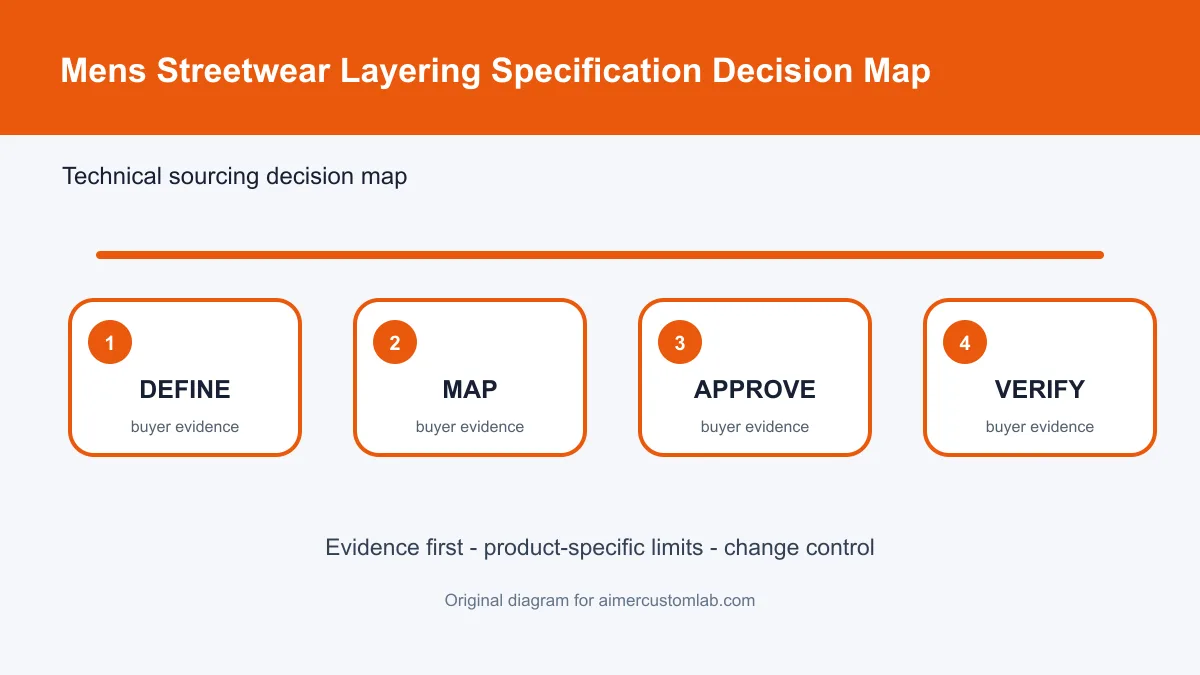
Mens Streetwear Layering Specification Guide
Independent garment approvals can create a T-shirt that is too long under a cropped jacket, a hoodie that crowds an overshirt or sleeves that bind when layers are combined. For OEM, ODM, wholesale, teamwear and private-label buyers, mens streetwear layering specification is a product-control decision, not a marketing label. This guide makes no unsupported claim about price, MOQ, capacity, lead time, certification, licensing or factory qualification; those facts require confirmation for the exact order.
Quick Answer
A mens streetwear layering specification defines which T-shirt, crewneck, hoodie, overshirt or jacket sits above or below another garment, then controls ease, length, shoulder, sleeve, neckline, opening, fabric bulk and mobility. Buyers should approve representative combinations on the intended size set, because individually acceptable garments can bind, bunch or hide the planned silhouette when worn together.
What is mens streetwear layering specification?
A mens streetwear layering specification is the controlled relationship among garment order, silhouette, ease distribution, material bulk, openings and intended wearer movement.
What controls a mens streetwear layering specification?
Direct answer: Compare the variables that can change both the visible outcome and the sourcing decision. The matrix below converts a subjective discussion into named inputs, evidence and common failure risks.
| Decision point | What to define | Why it matters | Common mistake |
|---|---|---|---|
| Layer order | Identity, revision and owner | Supports repeatable buyer approval | Leaving the decision to an undefined label |
| Target body | Named value, relationship and recorded condition | Supports repeatable buyer approval | Leaving the decision to an undefined label |
| Ease distribution | Named value, relationship and recorded condition | Supports repeatable buyer approval | Leaving the decision to an undefined label |
| Material bulk | Named value, relationship and recorded condition | Supports repeatable buyer approval | Leaving the decision to an undefined label |
| Mobility zone | Named value, relationship and recorded condition | Supports repeatable buyer approval | Leaving the decision to an undefined label |
How should buyers build the approval workflow?
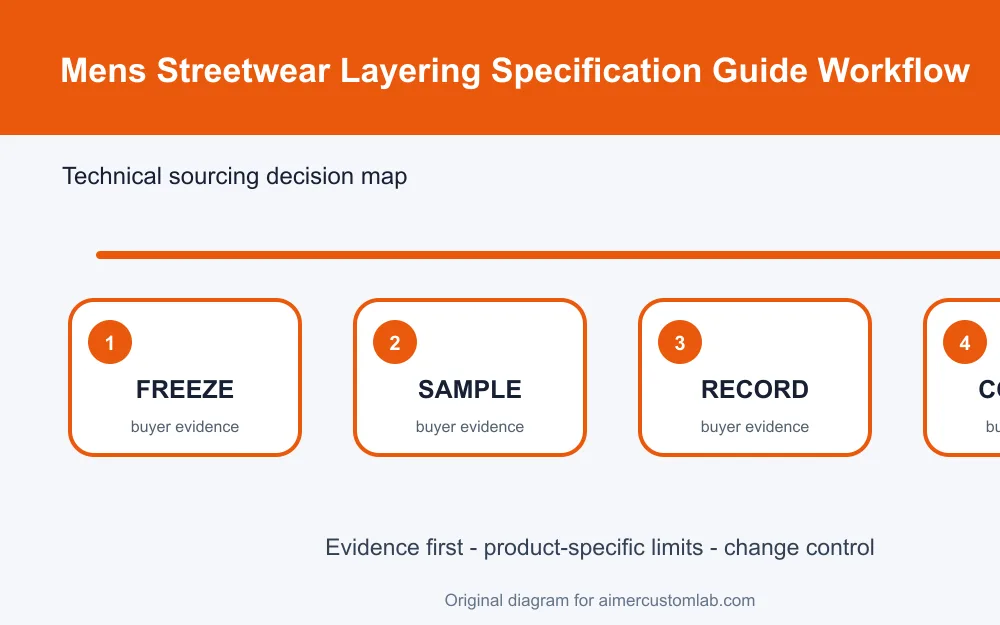
Direct answer: Freeze the question and inputs, use production-representative garments and components, record the method and intermediate behavior, inspect the finished product, and connect approval to a controlled revision.
- Define the intended layer combinations and wearer scenario.
- Name the body and garment landmarks used for comparison.
- Allocate ease through chest, shoulder, armhole, sleeve and hem.
- Measure fabric thickness, recovery and finished-seam bulk.
- Review front, side, back and movement on representative sizes.
- Freeze compatible revisions and define reapproval triggers.
How should common failures be diagnosed?
Hood bunches under jacket collar: what should be checked first?
Direct answer: Compare hood volume, neckline opening, collar height, fabric bulk and seam placement. Preserve the original symptom, product identity and settings before correction. Change one controlled variable at a time and repeat the same inspection, because a cosmetic adjustment without a traceable cause cannot support reliable bulk production.
T-shirt extends beyond intended outer layer: what should be checked first?
Direct answer: Control body length relationships by size instead of relying on fit labels. Preserve the original symptom, product identity and settings before correction. Change one controlled variable at a time and repeat the same inspection, because a cosmetic adjustment without a traceable cause cannot support reliable bulk production.
Sleeves bind during movement: what should be checked first?
Direct answer: Review layered armhole, bicep, cuff, fabric stretch and shoulder ease. Preserve the original symptom, product identity and settings before correction. Change one controlled variable at a time and repeat the same inspection, because a cosmetic adjustment without a traceable cause cannot support reliable bulk production.
What belongs in the purchase specification?
Direct answer: The specification must let another qualified person reproduce the approved product without guessing. For mens streetwear layering specification, include the following controlled fields and link each field to the relevant sample or record.
- layer order
- target body
- ease distribution
- material bulk
- mobility zone
- sample quantity and size coverage
- measurement and viewing conditions
- approval owner and revision
- change and retest triggers
How should sampling cover size and production risk?
Direct answer: Choose samples by variation and consequence, not convenience. Include justified small, middle and large sizes, risk colors, construction geometries, material lots, placements or wearer configurations that can change the decision. State whether each result covers only one specimen, a controlled family or a defined production lot.
How should bulk inspection and change control work?
Direct answer: Convert the approved target into measurable checkpoints, inspection timing, sample selection, defect language, disposition and escalation. Preserve the sealed sample or approved visual standard and train inspectors on the same landmarks and terminology used during development.
What evidence should accompany the approval?
Direct answer: Retain product and specimen identities, source files, revisions, conditions, raw observations, measurements, photographs, individual results, failure modes, corrective actions, owner, date, disposition and approved sample. Summary statements without raw evidence do not establish the approved construction.
What are the evidence boundaries?
ISO 8559-1 clothing body measurement definitions provides authority context, while the peer pages show buyer-facing product and decision structures. None supplies a universal product limit or proves either target site’s price, MOQ, capacity, certification or delivery. Order-specific values require buyer-approved evidence.
Results apply to the specimens, files, methods and conditions evaluated. They do not automatically cover every size, color, lot, factory line, climate, wearer, competition, care behavior or destination. Confirm current external rules and intellectual-property permissions with the responsible authority for the exact market and use.
Which related products can this guide support?
- Review custom hoodie sets with branding and packaging when applying this control to a specific sourcing brief.
- Review custom zip hoodie sets for private labels when applying this control to a specific sourcing brief.
- Review custom oversized private-label T-shirts when applying this control to a specific sourcing brief.
These descriptive internal links show relevant product categories only. They do not assert a fixed construction, price, MOQ, capacity, certification or delivery time. Send the actual specification for order-specific confirmation.
Buyer checklist
Use this checklist to keep mens streetwear layering specification aligned from development through final inspection.
- Identity frozen
- Entities named
- Method defined
- Conditions recorded
- Sample coverage justified
- Result classified
- Boundary stated
- Retest triggers listed
Which sources informed this guide?
The following current peer and authority pages informed the information architecture, entity definitions and decision boundaries. Their wording was not copied, and commercial or product claims were not transferred to this supplier.
Research-to-page evidence map
This table shows how qualified high-traffic or fast-growth peer learning changed the public article and where the result is visible.
| Research finding | Specific application | Visible evidence |
|---|---|---|
| The high-traffic peer exposes clear buyer-facing categories, filters and product decision paths. | SEO: organized mens streetwear layering specification around a buyer decision matrix and explicit failure risks. | What controls a mens streetwear layering specification? |
| The fast-growth peer connects category explanation with product choices and visible next actions. | AEO: placed a direct 40-70 word answer before detail and followed it with a controlled approval route. | Quick Answer |
| Peer content names product entities, use cases and constraints instead of treating every garment as one generic choice. | GEO: defined the core entity, named conditions and limits, cited current sources, and separated verified facts from order-specific decisions. | What are the evidence boundaries? |
Which morning peer learning did we apply?
This table connects the previous afternoon action contract to visible SEO, AEO and GEO changes in this article.
| Dimension | Prior action | Finding | Specific application | Public evidence marker |
|---|---|---|---|---|
| SEO | pm-aimercustomlab-1a387bd7a2ea | Fashion Nova keeps broad menswear category intent connected to visible garment routes and product discovery. | Applied the prior action through a search-oriented decision matrix for mens streetwear layering specification. | What controls a mens streetwear layering specification? |
| AEO | pm-aimercustomlab-52eb9af9525d | Closure London exposes product type, size, color, collection and style as a facet matrix that buyers can translate into specification fields. | Applied the prior action with a 40-70 word direct answer before the detailed mens streetwear layering specification workflow. | Quick Answer |
| GEO | pm-aimercustomlab-055f6d8d53ed | Fashion Nova keeps broad menswear category intent connected to visible garment routes and product discovery. | Applied the prior action by defining related entities, scenarios, limitations and decision evidence for mens streetwear layering specification. | What are the evidence boundaries? |
What did a recent-growth peer teach us?
This additional learning is independent of the high-traffic gate. It uses a previously unanalyzed peer with numeric 28-92 day growth evidence. We applied the structure or verifiable fact only, without copying wording or transferring commercial claims.
| Dimension | Finding | Specific application | Public evidence marker |
|---|---|---|---|
| AEO | Closure London gives a concise category orientation and visible choices for hoodies, joggers, tracksuits, outerwear and T-shirts. | AEO: organized the guide around layer order, target body, ease distribution and a public buyer decision marker. | Quick Answer |
Frequently asked questions
Can one approval cover every mens streetwear layering specification?
Answer: No. Approval covers only the represented product, components, method, revision and recorded conditions.
Should a descriptive label replace measurements?
Answer: No. Use labels for orientation and controlled measurements or attributes for reproducible decisions.
Why record relationships between components?
Answer: A change to one material, colour, size or process can affect another part of the garment system.
What happens after a component or file changes?
Answer: Review the impact and repeat the affected evidence before bulk release.
Who defines the acceptance rule?
Answer: The buyer and qualified technical parties must define it for the exact product, market and use.
Conclusion: what should a buyer do next?
mens streetwear layering specification should finish as a documented, product-specific approval rather than a generic promise. Keep the controlled files, measured target, representative sample, method, raw observations, photographs, corrective action and change triggers together. That record makes repeat orders faster and reduces disputes caused by incomplete specifications.
Inquiry CTA: Send your tech pack, intended market and use, size range, pattern or garment reference, material and component details, artwork, care route, packaging route and requested evidence. Ask the team to confirm feasibility, sample details, MOQ, lead time, capacity and available supporting records for the exact order.