Streetwear PDP Fibre Disclosure Guide
Quick Answer: Streetwear PDP fibre disclosure is the fibre-composition information shown on an e-commerce product detail page before purchase. Buyers should map it to the correct style, colour and material version, show distinct textile components where required, use market-approved fibre names and languages, and reconcile the online statement with the sewn label, packaging and commercial documents.
A brand may approve an accurate sewn label and publish an outdated product page. This often happens when a colourway changes fabric, a jacket lining is omitted online or marketing copy replaces precise composition with terms such as “premium blend.” Streetwear PDP fibre disclosure makes pre-purchase content part of the technical release, not a separate marketing task.
What is streetwear PDP fibre disclosure?
Streetwear PDP fibre disclosure is the visible online presentation of textile fibre composition for the exact orderable garment or variant. The controlled record includes URL or page template, style and variant ID, shell and other required components, authorised fibre names, percentages, language, visibility location, evidence source, sewn-label artwork, effective date and content owner.
EU Regulation 1007/2011 Article 16 requires composition information to be clearly visible before an electronic purchase within its scope. FTC rules and guidance govern U.S. textile labels and written advertising when fibre claims are made. The correct PDP content therefore depends on where and how the garment is sold.
Why should buyers control streetwear PDP fibre disclosure before production?
Pre-purchase visibility prevents the accurate physical label from being hidden until after the customer commits to the order. EU Article 16 connects fibre descriptions to catalogues, trade literature, packaging, labels and electronic purchases. The current Your Europe guidance emphasises clear, legible composition and official languages. FTC guidance warns that fibre claims in labels and advertising must be truthful and uses precise generic fibre names and percentages.
This article does not prescribe a universal page position, accordion design or wording order. It asks the responsible market reviewer to verify visibility, language and content against the actual storefront and applicable law.
Which fields belong in the buyer decision?
Compare product identity, composition accuracy, component clarity, visibility and cross-channel consistency. The table separates evidence, interpretation and the action that follows.
| PDP control | Buyer question | Evidence |
|---|---|---|
| Variant identity | Does the statement belong to this style and colour? | SKU/GTIN or variant master and effective dates |
| Composition | Are fibre names and percentages supported? | BOM, supplier evidence and approved statement |
| Components | Are shell, lining or other sections separated where required? | Component map and market review |
| Visibility | Can the customer see the information before purchase? | Desktop/mobile screenshots and click path |
| Language | Is the required market language used? | Locale matrix and reviewer sign-off |
| Consistency | Do PDP, sewn label, packaging and feed agree? | Cross-channel reconciliation record |
Do not allow a default variant’s composition to populate every colour automatically unless the material is genuinely identical. The PDP should disclose differences at the orderable-variant level.
Which current sources define the evidence boundary?
Use the official market rule, current business guidance and the same evidence master that controls the physical label. EU Article 16 states that fibre descriptions should be visible to the consumer before purchase, including electronic sales. Your Europe summarises composition, language and information-separation expectations. FTC’s Textile Fiber Rule states that covered U.S. products disclose generic fibre names and percentages by weight together with other required identity information, while related advertising guidance requires truthful claims.
Consult EU Regulation 1007/2011, the updated Your Europe textile-label page, the FTC Textile Fiber Rule and FTC cotton labelling and advertising guidance.
What should the sourcing brief contain?
- Destination market and storefront locale.
- Orderable style, colour and size/variant IDs.
- Approved fibre statement by component.
- Source BOM and evidence versions.
- Sewn-label and packaging artwork references.
- Desktop and mobile disclosure location.
- Marketplace feed or catalogue mapping.
- Translation owner and language approval.
- Effective date and content rollback path.
- Change triggers for material or variant updates.
How should the streetwear PDP fibre disclosure workflow run?
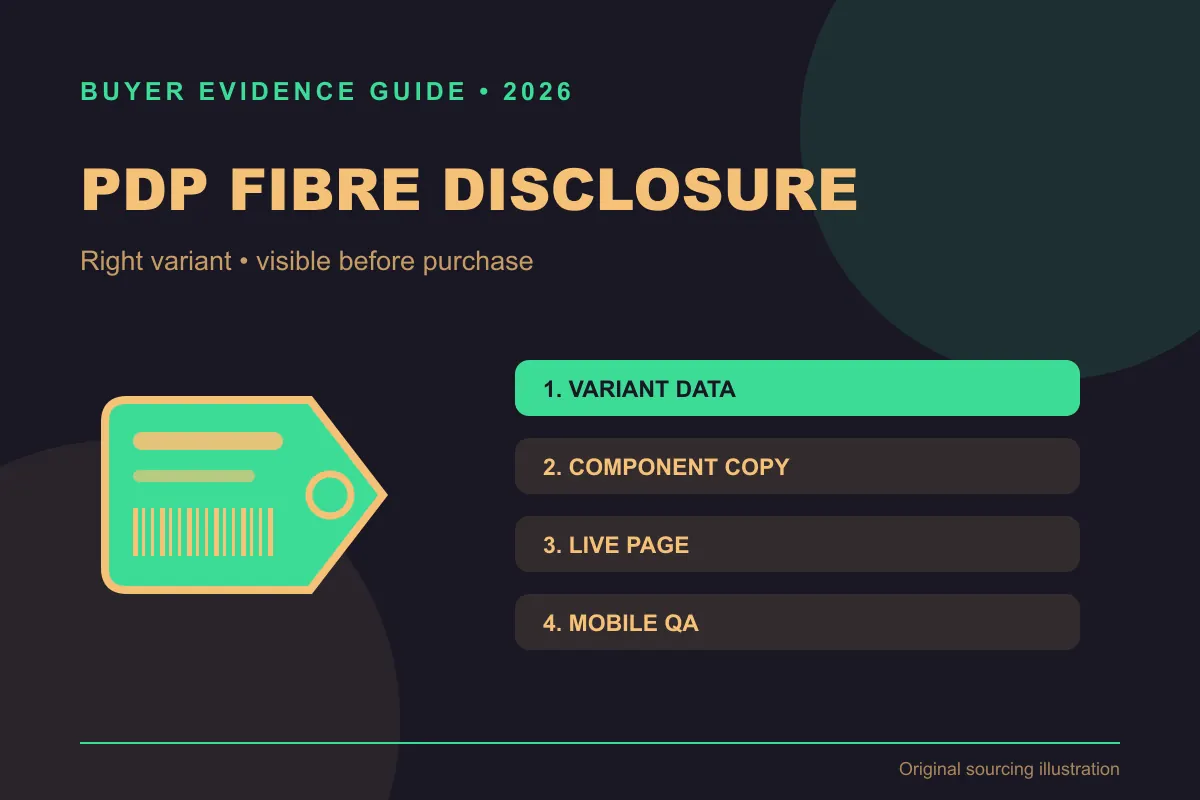
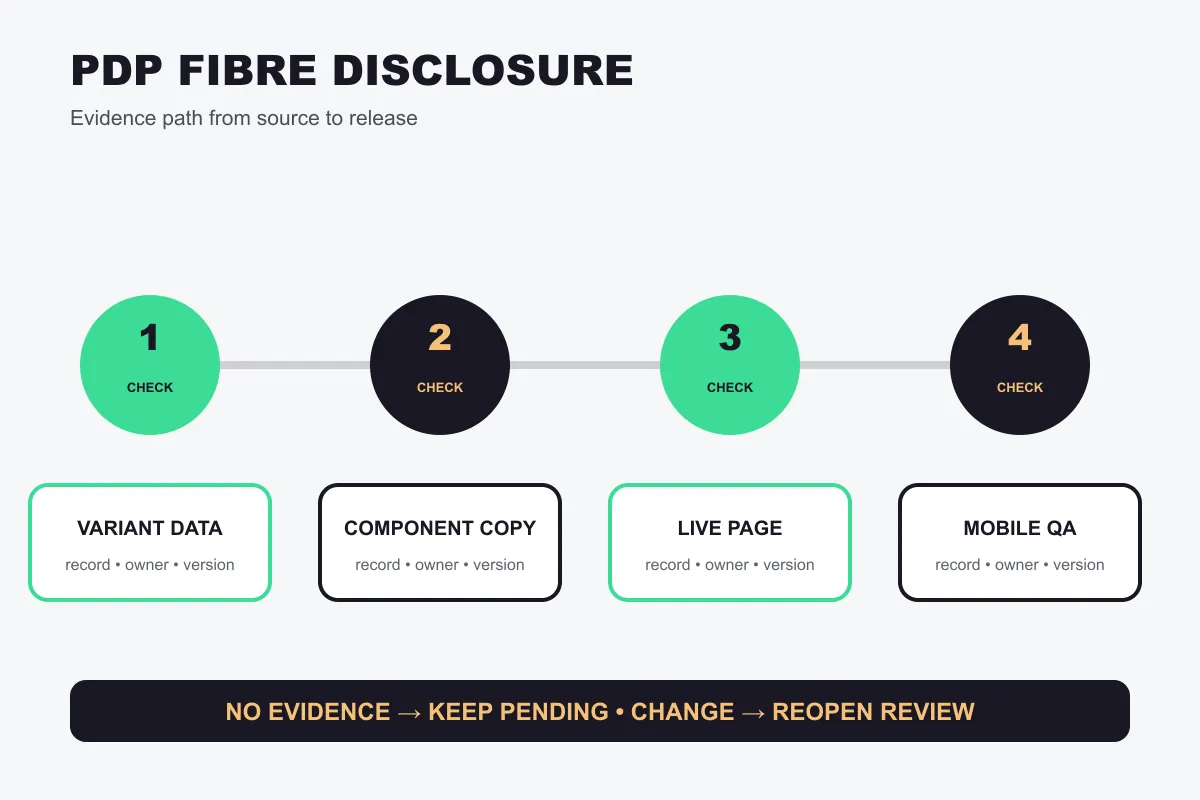
Start from the approved product record, publish composition at the correct variant level, test visibility and reconcile every channel. Each step should create a dated record linked to the style, variant, version, reviewer and decision.
- Name the market, storefront and orderable variant structure.
- Freeze the approved component-level composition statement.
- Map each colour or material version to the correct content record.
- Translate only after the source wording is approved.
- Place composition where the buyer can access it before purchase.
- Test desktop, mobile, quick-view and marketplace-feed outputs.
- Compare the live PDP with the sewn label and packaging proof.
- Capture screenshots, URL, timestamp and variant state.
- Assign corrections and prevent bulk publication of an unverified default.
- Reopen after material, supplier, component, language, template or market changes.
A CMS preview is not the same as a live pre-purchase check. Verify the public URL and actual variant switcher; if the site personalises content by region, record the locale tested.
How should a brand read the findings?
A complete PDP approval needs accurate data, correct variant mapping and visible public presentation. A correct fibre sentence in a hidden CMS field does not satisfy the buyer-facing purpose. A visible sentence for the wrong colourway is also a failure. Screenshots should show the selected variant and the composition section together.
| Finding | Meaning | Buyer action |
|---|---|---|
| Correct statement is visible for every tested variant | PDP supports the reviewed scope | Approve and retain evidence |
| Content is accurate but appears only after purchase | Pre-purchase visibility is not demonstrated | Change placement or interaction |
| One colour uses different material but default text remains | Variant mapping is wrong | Hold affected variant and correct data |
| Label changes but PDP does not | Channels are out of sync | Update master record and republish |
Do not treat a screenshot as permanent compliance evidence. Page templates, feeds, localisation and variant logic can change; periodic and change-triggered checks are needed.
What failure modes should be prevented?
The largest risk is accurate composition stored in the business while inaccurate or invisible content reaches the buyer.
- Publishing marketing terms without precise composition.
- Showing one default composition for all colourways.
- Omitting lining or sectional information.
- Using an untranslated source in a required locale.
- Testing only the CMS preview.
- Letting marketplace feeds diverge.
- Failing to timestamp screenshots.
- Updating the label without the PDP.
A controlled streetwear PDP fibre disclosure workflow treats online content as a product specification output tied to a real variant and evidence state.
What belongs in the release checklist?
Approval evidence should prove what the customer saw, for which variant, market and time.
- Market and locale identified.
- Variant mapping verified.
- Fibre names and percentages supported.
- Required components separated.
- Desktop and mobile checked.
- Information visible before purchase.
- Live public URL captured.
- Label, packaging and feed reconciled.
- Screenshots timestamped.
- Change control active.
If the storefront cannot show variant-specific content reliably, report the limitation and correct the system before launching material-divergent variants.
How were research findings applied to this guide?
The source facts below were converted into an original procurement control. No competitor copy, commercial claim, protected artwork or product image was reused.
| Research finding | Specific change | Visible evidence |
|---|---|---|
| EU Article 16 expressly includes electronic purchase | Live pre-purchase visibility became a release gate | Definition, workflow steps five to eight |
| Your Europe emphasises clarity and official languages | A locale matrix and mobile/desktop check were added | Comparison table and checklist |
| FTC requires truthful fibre identification and percentages for covered products | Marketing names are separated from supported composition | Authority section and risk list |
| Yesterday’s learning requested an e-commerce composition row | Variant-level PDP evidence now anchors the article | Quick Answer and decision table |
Answer-first paragraphs improve AEO. Variant entities, public evidence, market limitations and authoritative citations make the content more useful for GEO retrieval and summarisation.
Frequently asked questions about streetwear PDP fibre disclosure
Must fibre content be visible before an EU online purchase?
Within the regulation’s scope, Article 16 requires consumer-visible information before purchase. Confirm the actual market, product and current legal interpretation.
Can every colour share one composition statement?
Only when the composition is genuinely the same. Map material-divergent colourways separately.
Is an accordion acceptable?
The interaction must still provide clear pre-purchase access. Ask the responsible market reviewer to approve the real desktop and mobile presentation.
Should the PDP repeat care instructions?
Control care separately. Composition and care may both be useful online, but they rely on different evidence.
What triggers a new PDP check?
Any relevant product or page change. Materials, suppliers, components, translations, feeds, templates and variant logic can alter the result.
Conclusion: make composition visible before the click to buy
Streetwear PDP fibre disclosure is reliable when variant identity, component composition, approved language, public visibility and physical labels share one controlled source. Live desktop and mobile evidence then proves the buyer saw the right information without relying on a hidden CMS field.
Connect this record to the streetwear care label evidence guide, review manufacturing options on the capabilities page, and define the garment scope through the streetwear product range. Contact the sourcing team with the target market, product version and required evidence so the available options can be confirmed for your project.