Multi-Component Streetwear Fibre Label Guide
Quick Answer: A multi-component streetwear fibre label identifies the fibre composition of distinct textile parts such as shell, lining, rib, filling or separate panels when the destination market requires sectional disclosure. Buyers should map every component to the BOM and test evidence, use authorised fibre names and percentages, separate care information, and obtain market review before approving labels or product-page copy.
A jacket described simply as “cotton blend” may contain a woven shell, polyester lining, rib cuffs and textile filling. A hoodie can combine body fleece, rib, pocketing and embroidery backing. A multi-component streetwear fibre label prevents one whole-garment statement from hiding different textile sections. It also gives private-label buyers a controlled source for sewn labels, hangtags, packaging and e-commerce content.
What is multi-component streetwear fibre label?
A multi-component streetwear fibre label is a composition statement that names distinct textile components and states the fibres applicable to each required section. The working file should connect each label line to a component ID, location, supplier, material specification, declared percentage, supporting test or declaration, market rule, language and artwork version. It is different from the care instruction, country-of-origin statement and business identity fields, even when they share one physical label.
EU Regulation 1007/2011 and FTC guidance use different legal frameworks. The EU regulation addresses multi-component products and visibility in the market; FTC guidance gives U.S. examples such as shell, lining and interlining disclosures. Buyers must select the destination-market rule instead of blending examples into a universal label.
Why should buyers control multi-component streetwear fibre label before production?
Component mapping reduces the risk that accurate fabric data becomes inaccurate finished-garment wording. EU Article 11 states that a textile product with two or more textile components of different fibre content should disclose each component, subject to stated conditions and exceptions. FTC guidance likewise shows sectional disclosure examples. These structures are especially relevant to lined jackets, padded garments, mixed-panel hoodies and products with substantial rib or separate textile sections.
The existence of a BOM row does not prove a legal disclosure requirement or percentage. Minor components, ornamentation and exceptions depend on the applicable law. Unknown data should remain pending for the responsible market reviewer.
Which fields belong in the buyer decision?
Review each textile section, its evidence, its legal treatment and the exact words shown to the buyer. The table separates evidence, interpretation and the action that follows.
| Component field | Buyer question | Controlled evidence |
|---|---|---|
| Shell/body | What main textile surrounds or forms the garment? | BOM, material specification and composition support |
| Lining/interlining | Is it textile, distinct and subject to disclosure? | Construction map and market-rule decision |
| Rib/panels/pocketing | Does a separate section need its own line? | Weight/area context and reviewer rationale |
| Filling/padding | Is the textile portion disclosed under the target rule? | Material identity and applicable guidance |
| Trim/ornamentation | Is it exempt, excluded or required? | Documented exception analysis |
| Final wording | Do labels, packaging and product pages agree? | Approved master statement and artwork revision |
Do not estimate fibre percentages from garment weight or copy a supplier nickname into the consumer label. Use the legally authorised fibre names and verified values for the destination market.
Which current sources define the evidence boundary?
Use the destination-market regulation, official business guidance and validated material evidence as separate layers. EU Regulation 1007/2011 Article 11 covers multi-component textile products, Article 14 addresses durable, legible, visible and accessible labelling, and Article 16 addresses consumer-visible composition information including electronic purchase. The current Your Europe page summarises these duties and notes that composition should be separate from care information. FTC’s textile guidance provides U.S. sectional examples and identifies fibre content, origin and responsible-business information as core label elements.
Review EU Regulation 1007/2011, the current Your Europe textile-label guidance and the FTC textile and wool labelling guide. Obtain qualified market advice for the actual product.
What should the sourcing brief contain?
- Destination countries and sales channel.
- Garment component diagram.
- BOM component IDs and supplier materials.
- Shell, lining, interlining, rib, pocketing, filling and textile trim review.
- Verified fibre names and percentages by component.
- Evidence source, date, lot or version.
- Applicable exceptions and reviewer rationale.
- Required consumer languages.
- Composition, care, origin and identity fields kept distinct.
- Master statement and artwork approval owner.
How should the multi-component streetwear fibre label workflow run?
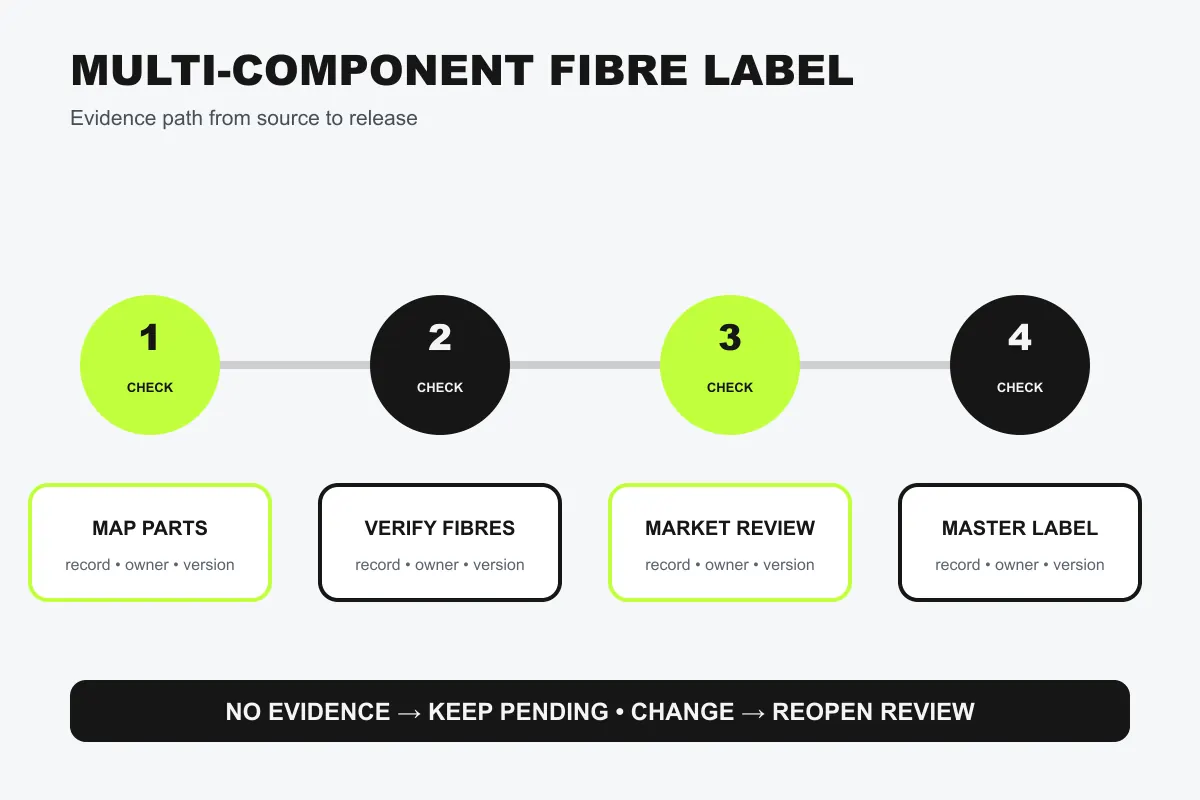
Map the garment physically, connect every textile section to evidence, apply the target-market rule and then release one controlled wording source. Each step should create a dated record linked to the style, variant, version, reviewer and decision.
- Name every destination market and channel before drafting the label.
- Mark the shell, lining, rib, pocketing, panels, filling and other textile components on a garment diagram.
- Link each component to the approved BOM and supplier material reference.
- Verify fibre names and percentages through appropriate evidence.
- Review whether each component is required, exempt or separately disclosed in the target market.
- Draft market- and language-specific statements without mixing care instructions into composition.
- Reconcile the sewn label, hangtag, packaging, catalogue and product page.
- Approve the artwork against a representative finished garment.
- Retain the decision, evidence and artwork versions.
- Reopen after material, component, supplier, market or claim changes.
If component weight, legal classification or evidence is missing, do not guess. Hold the affected wording and ask the market-responsible party or qualified adviser.
How should a brand read the findings?
The label statement is reliable only when every line can be traced to a real component and current evidence. A correct shell statement does not correct an omitted lining. A supplier declaration for fabric roll A may not support substituted rib B. One EU-language layout may not serve every Member State where the product is offered.
| Finding | Meaning | Buyer action |
|---|---|---|
| All required components and evidence align | Wording is supportable for the reviewed scope | Approve market-specific artwork |
| Component exists but percentage is unverified | Statement would be speculative | Hold and obtain evidence |
| Sewn label and PDP disagree | Consumer information is inconsistent | Correct the master source and all outputs |
| Material supplier changes | Earlier evidence may be stale | Revalidate affected component |
This workflow does not determine legal compliance by itself. Authorities, importers, distributors and brand owners retain responsibilities under the applicable market rules.
What failure modes should be prevented?
The biggest failure is treating “fabric composition” as one field when the finished garment contains several textile sections.
- Copying the shell content to the whole garment.
- Omitting a required main lining.
- Using supplier trade names instead of authorised fibre names.
- Mixing EU and U.S. examples into one universal rule.
- Letting care text obscure composition.
- Leaving product-page wording out of the approval.
- Guessing percentages.
- Failing to update after substitution.
A multi-component streetwear fibre label keeps the physical garment, BOM, evidence, market rule and consumer wording connected.
What belongs in the release checklist?
Another reviewer should be able to point to each garment component and the evidence behind its label line.
- Market scope named.
- Component map complete.
- BOM versions linked.
- Fibre names and percentages supported.
- Exceptions documented.
- Languages reviewed.
- Care and composition separated.
- Sewn label, packaging and PDP reconciled.
- Finished garment checked.
- Changes trigger reapproval.
Use conditional status for unresolved components. A visible “pending evidence” field protects accuracy better than a polished but unsupported label mock-up.
How were research findings applied to this guide?
The source facts below were converted into an original procurement control. No competitor copy, commercial claim, protected artwork or product image was reused.
| Research finding | Specific change | Visible evidence |
|---|---|---|
| EU Article 11 addresses products with different textile components | The article begins with a physical component map | Definition, table and workflow step two |
| Your Europe separates composition from other information such as care | Composition and care are controlled as distinct fields | Scope, step six and checklist |
| FTC guidance gives shell, lining and interlining examples | Sectional rows were added for U.S. review | Comparison table and FAQ |
| Yesterday’s learning called for shell/lining/rib/trim mapping | Those components now gate label release | Quick Answer and brief |
The 40–70 word direct answer and question headings support AEO. Named authorities, market boundaries and traceable component evidence support GEO while preserving uncertainty.
Frequently asked questions about multi-component streetwear fibre label
Does every small trim need a separate fibre line?
Not automatically. Apply the destination-market exceptions and document the rationale instead of assuming inclusion or exclusion.
Can one overall percentage cover shell and lining?
Only if the applicable rule and product facts support it. Different components often require separate disclosure.
Should care symbols be part of the composition statement?
Keep the information distinct. They may share a label, but their evidence and rules answer different questions.
Can a supplier declaration support the label?
It can be part of the evidence. Verify scope, material version, issuer and market requirements before relying on it.
When should the component map be updated?
After any material or construction change. Supplier substitutions, added lining, revised rib and new markets can all affect wording.
Conclusion: label the garment that actually exists
A multi-component streetwear fibre label is defensible when the shell, lining, rib, filling and other relevant sections are physically mapped, evidence-backed and reviewed for the destination market. One controlled master statement then keeps labels, packaging and product pages aligned without guessing facts.
Connect this record to the streetwear care label evidence guide, review manufacturing options on the capabilities page, and define the garment scope through the streetwear product range. Contact the sourcing team with the target market, product version and required evidence so the available options can be confirmed for your project.