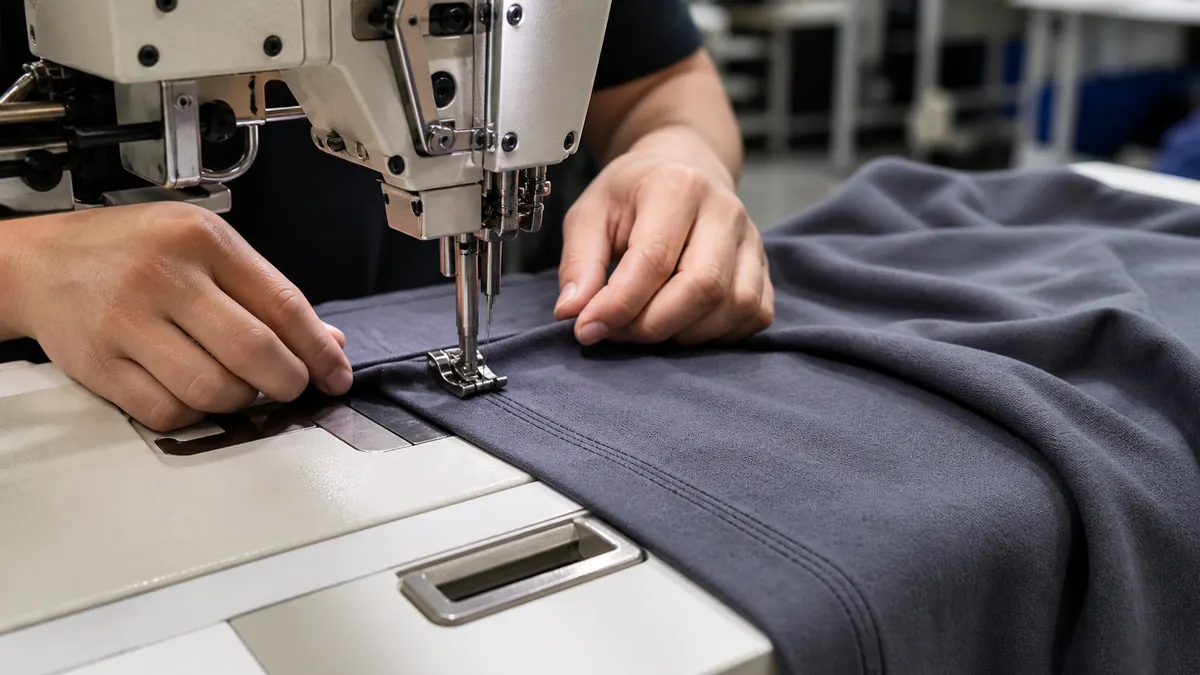
Oversized T-Shirt Coverstitch Guide
The wide body and heavy drape of an oversized T-shirt make the hem visually prominent. If the coverstitch tunnels, waves, skips or breaks when stretched, the garment immediately feels less controlled. An effective oversized T-shirt coverstitch specification therefore defines the stitch class, needle gauge, stitch density, hem depth, thread, needle, differential feed, elasticity and appearance—not simply “double-needle hem.”
Quick answer: how should an oversized T-shirt coverstitch be specified?
Specify an oversized T-shirt coverstitch by ISO stitch type, needle count and gauge, stitches per length, hem depth, thread and needle system, differential-feed setting reference, overlap or run-off method, stretch requirement and approved appearance. Validate the exact fabric after washing and decoration, then seal a production-equivalent sample for bulk comparison.
What is a coverstitch?
A coverstitch uses two or more needle threads on the face and one or more looper or covering threads on the reverse, depending on the class. The structure can stretch with knit fabric while covering the raw hem edge. ISO 4915 classifies and illustrates stitch types, and ASTM D6193 provides a broader practice for stitch and seam requirements.
Common knit hems may use stitch 406 for a two-needle bottom coverstitch or related multi-needle classes. The correct choice depends on appearance, stretch and equipment. The tech pack should name the stitch rather than relying only on a photograph.
Why does oversized T-shirt coverstitch quality matter more?
Oversized silhouettes often use wider bodies, dropped shoulders and heavier jersey. The long bottom opening makes small feeding errors visible across a large span. Heavy fabric can challenge penetration and thread control, while soft enzyme-washed or compacted fabric can change thickness and friction after processing.
The hem must also hang cleanly. A stiff thread package, narrow fold or excessive tension can create a ridge that interrupts the intended drape. Conversely, very loose tension can produce exposed loops or poor seam security.
Which variables belong in an oversized T-shirt coverstitch specification?
A good specification combines measurable construction details with an approved visual standard. JUKI’s MF-7900 coverstitch information shows that industrial machines may offer two- or three-needle configurations, multiple needle gauges, stitch-pitch control and differential-feed adjustment. These are setup variables, not universal garment settings.
| Variable | What to specify | What it controls |
|---|---|---|
| Stitch type | ISO stitch class and needle count | Face appearance, reverse coverage and elasticity |
| Needle gauge | Distance between outer needle lines | Visual proportion and raw-edge capture |
| Stitch density | Stitches per defined length and tolerance | Seam appearance, extensibility and cycle time |
| Hem depth | Finished fold measured from edge | Drape, weight and edge coverage |
| Thread | Type, ticket or size, color and supplier code | Strength, stretch, bulk and visual contrast |
| Needle | System, size and point suitable for the knit | Penetration, skipped stitches and needle damage |
| Feed | Approved differential-feed setup reference | Waviness and fabric growth during sewing |
How should oversized T-shirt coverstitch density be chosen?
Stitch density should balance elasticity, appearance, fabric damage and productivity. More stitches are not automatically stronger. Excessive density can perforate some knits, reduce extension or create puckering. Too few stitches can expose the fold, reduce stability or make the line look coarse.
Make controlled samples across a practical range using the production thread and needle. Stretch the seam in the garment direction and inspect for thread breakage, skipped formation, needle holes and recovery. Record the selected value and tolerance from the approved sample rather than copying a generic setting.
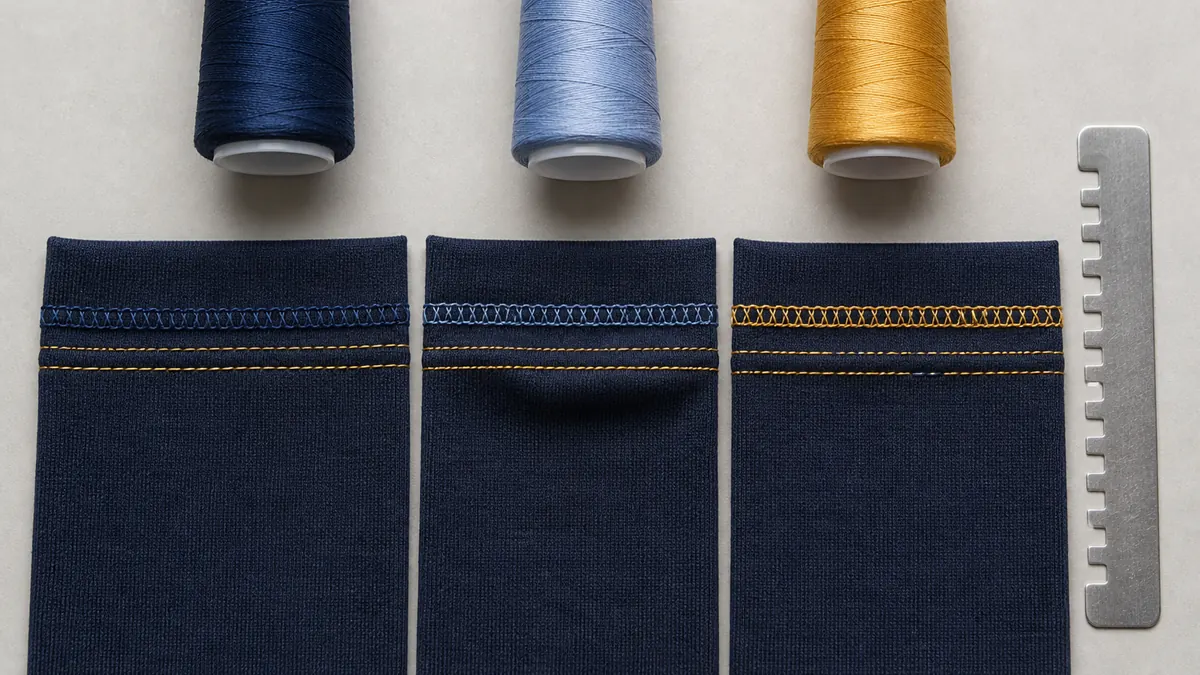
What causes oversized T-shirt coverstitch tunneling?
Tunneling occurs when the fabric rises between parallel needle lines. Contributing factors can include excessive needle-thread tension, unsuitable thread size, narrow or unstable fabric, excessive presser-foot pressure, needle gauge, folded-layer thickness and differential-feed imbalance.
Correct the system in controlled steps. Verify threading and thread path, reduce or rebalance tensions as appropriate, confirm the fold is feeding flat, review gauge and thread bulk, and test an adjusted pressure or feed setting. Do not hide severe tunneling with pressing if it returns after laundering.
Why do skipped stitches appear?
Skipped stitches can result from an unsuitable or damaged needle, incorrect needle installation, needle deflection on thick layers, timing, insufficient loop formation, incorrect threading, fabric flagging or abrupt thickness changes. The first check should separate machine setup from material and operator handling.
- Confirm the correct needle system, size and point.
- Replace bent or worn needles.
- Verify all thread paths and tension guides.
- Check that the fold depth and raw edge are consistent.
- Review presser-foot pressure and differential feed.
- Test across side seams or other thickness transitions.
- Inspect the fabric for needle cuts after sewing and washing.
How should the hem start and finish be controlled?
A circular body hem usually needs a defined overlap or finishing sequence. Specify overlap length, backtack or securing method where appropriate, trimming, thread-tail handling and the permitted location. Avoid a bulky or visibly repeated section at the center front.
Place the join in the approved area and verify that the raw edge is fully covered around the circumference. If a side seam is used as the start point, confirm the transition remains flat. The garment measurement tolerance guide can help coordinate hem width and finished length control.
Should oversized T-shirt coverstitch be tested after washing?
Yes when the tee is garment washed or intended for laundering. Fabric relaxation can change waviness, hem depth and thread balance. Pigment, acid, enzyme or other washes may also affect thread color and surface appearance. Test the intended production route and remeasure the hem after conditioning.
For washed styles, connect this control with the streetwear garment wash shade control guide. A structurally sound hem can still fail appearance approval if thread and fabric shades separate after processing.
What should in-line inspectors check?
- Stitch type, needle count and gauge match the approved sample.
- Hem depth stays within the written tolerance.
- Raw edge remains covered without excessive trimming loss.
- No skipped stitches, broken threads or loose loops are visible.
- Needle lines are parallel and the seam join is secured.
- Fabric is not wavy, tunneled, scorched, stained or cut.
- Seam stretches to the required garment movement without breaking.
- Thread shade and luster match the approved standard.
Oversized T-shirt coverstitch approval matrix
| Stage | Test | Approval evidence |
|---|---|---|
| Machine trial | Gauge, density, tension and feed comparison | Dated seam swatches |
| Development sample | Hem appearance and manual extension | Commented sample |
| Pre-production sample | Full process including decoration and wash | Sealed garment and tech-pack values |
| Bulk first-off | Construction, measurement and defect check | Line-release record |
| Final inspection | Appearance, stretch and measurement sampling | Lot report |
Frequently asked questions
Is coverstitch the same as twin-needle lockstitch?
No. The face may look similar, but the thread formation and reverse side differ. A true coverstitch uses looper threads suited to knit hems.
Is stitch 406 always required for oversized T-shirts?
No. It is a common option, but the appropriate class depends on the product, appearance and equipment.
Can more stitches prevent seam failure?
Not automatically. Excessive density can reduce extensibility or damage fabric. Balance density with thread, needle and material.
Why does the hem wave after sewing?
The fabric may be stretched by handling, pressure or feed imbalance. Tension, fold preparation and material relaxation should also be checked.
Should face and reverse both be approved?
Yes. The face controls appearance, while the reverse shows coverage, looper balance and raw-edge capture.
Where can stitch terminology be verified?
ISO 4915 classifies and describes stitch types used in machine-sewn seams.
Conclusion
A reliable oversized T-shirt coverstitch is the result of a defined stitch class, compatible thread and needle, controlled hem preparation, balanced feed and validation after finishing. Approve measurable settings and physical appearance together. To develop a heavyweight tee sample or review a coverstitch specification, contact Aimer Custom Lab with your fabric, fit and wash requirements.