Streetwear Seam Slippage Test: Buyer Guide
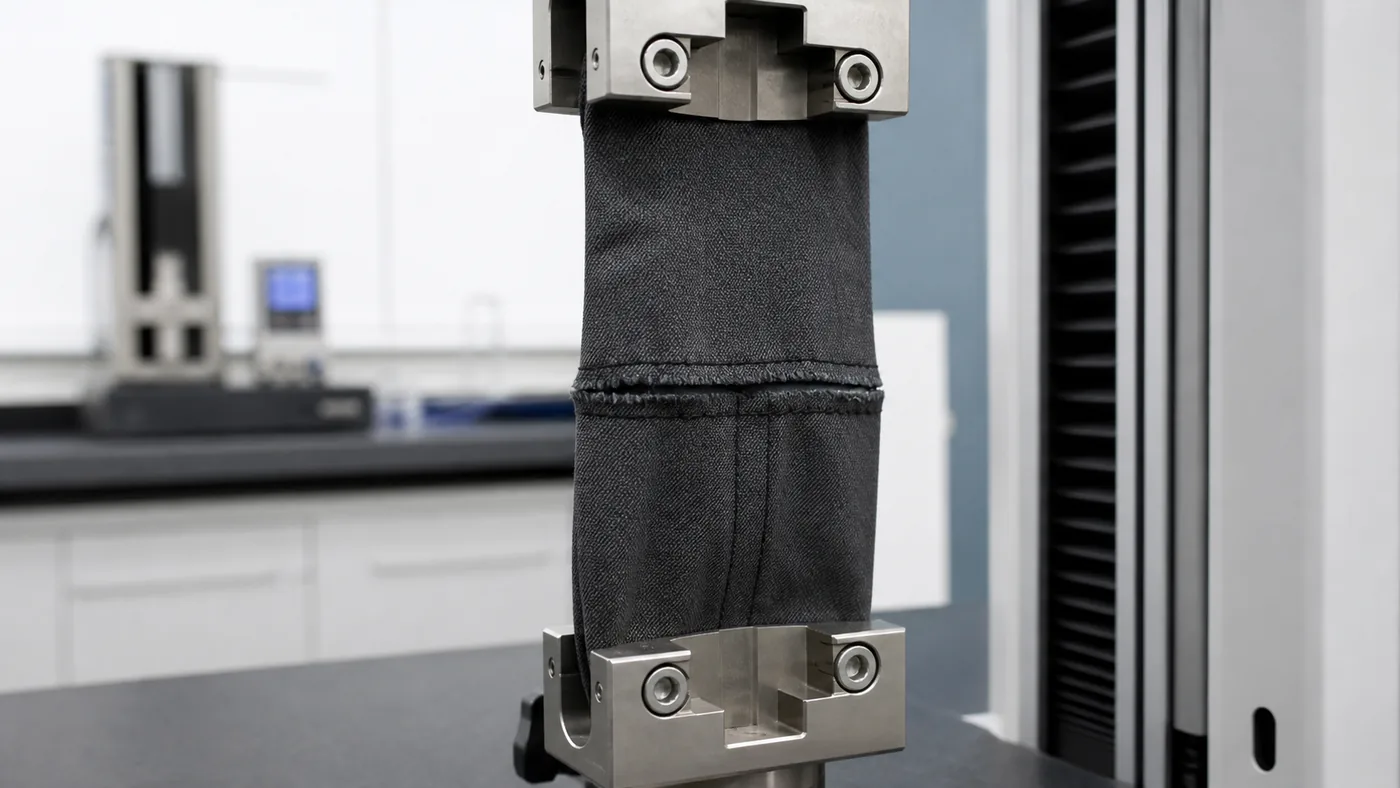
A streetwear seam slippage test examines whether yarns in a woven fabric move away from a sewn seam under load and create an unacceptable opening. This failure is different from thread breaking and different from fabric tearing. It can appear at a jacket armhole, pocket corner, trouser seat, side seam, or overshirt shoulder even when the stitches themselves remain intact.
Quick Answer: Match the method to the woven apparel construction, specify seam type, stitch density, thread, seam allowance, specimen direction, applied load, and measurement rule, then distinguish yarn slippage from seam rupture. Test production-representative fabric and seams after relevant finishing or washing. Knits usually require different stretch and seam-performance evaluations.
What a Streetwear Seam Slippage Test Reveals
Woven yarns are held by interlacing and friction. Under force perpendicular to a seam, the yarn system can shift, leaving a visible gap next to the stitches. Looser constructions, slippery filament yarns, low cover, certain finishes, short seam allowances, or unsuitable stitch settings can raise risk. The result belongs to the fabric-and-seam assembly, not to thread alone.
Streetwear products can create demanding localized loads through oversized silhouettes, heavy pockets, linings, metal trims, layered panels, and repeated sitting or arm movement. A fabric that is acceptable in a simple shirt may behave differently in a loaded cargo pocket or jacket back. Map high-stress areas before defining test specimens.
Streetwear Seam Slippage Test Standards and Scope
ISO 13936-2 describes a fixed-load method for resistance of yarns to slippage at a seam in woven fabrics. ASTM D1683/D1683M measures failure in sewn seams of woven apparel fabrics and can address seam strength, slippage, or integrity. ASTM D4034/D4034M concerns woven upholstery fabrics, showing why scope must be checked before borrowing a method. Use the apparel method agreed by buyer, supplier, and laboratory.
| Control | Details to lock | Why it changes results |
|---|---|---|
| Fabric | Code, lot, finish, direction | Yarn mobility is construction-specific |
| Seam | Type, allowance, stitch density | Assembly geometry affects load |
| Thread and needle | Ticket, fiber, needle size/point | Can damage or restrain yarns |
| Load | Specified force or extension procedure | Opening depends on applied stress |
| Measurement | Gap definition and reading method | Prevents subjective reporting |
| Care state | Before/after wash or finish | Relaxation and friction can change |
Separate Slippage, Thread Break, and Fabric Tear
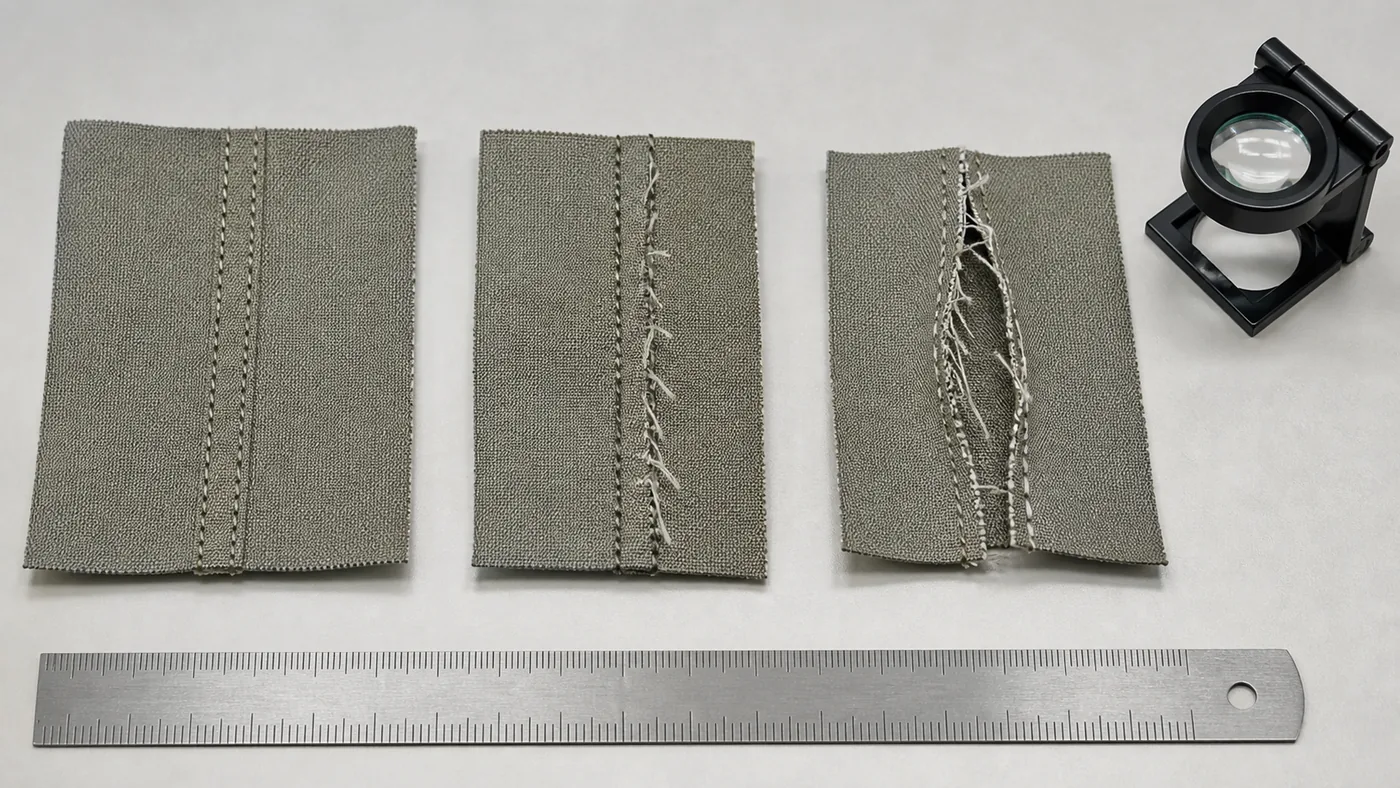
Yarn slippage appears as displacement beside the seam. Thread break occurs when sewing thread fails. Fabric tear is rupture away from or through the seam. A test report should state the observed failure mode and where it began. Calling every opening “weak stitching” can send development in the wrong direction.
If thread breaks first, a stronger thread or different seam may change the outcome, but needle damage and fabric strength must also be reviewed. If yarns slip while the thread remains intact, investigate fabric cover, seam allowance, stitch density, seam orientation, and reinforcement. If the base fabric tears, review tensile or tear performance and stress concentration.
Streetwear Seam Slippage Test Development Plan
- Identify high-load garment zones and the fabric direction at each seam.
- Choose the correct apparel standard and reporting unit.
- Sew specimens with production machine, needle, thread, and settings.
- Condition specimens and record any wash or finish treatment.
- Apply load perpendicular to the seam as required.
- Measure the opening and document the failure mode.
- Repeat across multiple specimens and relevant directions.
- Confirm improvements on a wearable size-set sample.
Use the result with the site’s cut-and-sew manufacturing capabilities and the streetwear clothing sampling process. Pattern geometry, seam construction, fabric choice, finishing, and bulk inspection should follow the same approved specification.
How Fabric Construction Changes Risk
Low yarn density can leave fewer interlacings to resist movement. Smooth continuous filaments may slip more easily than hairier yarns. Satin-like structures, open weaves, and certain coatings or softeners can reduce resistance. Heavy fabric is not automatically safe; a dense-looking surface can still have mobile yarns depending on structure and finish.
Test both warp and weft directions when the garment uses seams in both orientations. A result from one direction should not be generalized to the other. When a pattern is rotated to improve marker efficiency, confirm that critical seams have not moved into the weaker orientation.
Improve a Failing Streetwear Seam Slippage Test
Possible actions include selecting a tighter construction, changing yarn or finish, increasing seam allowance, modifying stitch density, changing seam type, adding suitable reinforcement, or redistributing load through the pattern. Each action has tradeoffs in hand feel, appearance, cost, bulk, flexibility, and production time.
Do not simply increase stitch density without checking needle perforation and puckering. Too many penetrations can weaken some fabrics. A reinforcement tape may help one area but create stiffness or visible ridges. Develop one controlled change at a time, repeat the same method, and approve the solution on the actual garment.
Streetwear Seam Slippage Test Report Checklist
- Standard, edition, laboratory, equipment, and date.
- Fabric code, lot, declared construction, color, and finish.
- Specimen direction and tested garment zone.
- Seam type, allowance, stitches per length, thread, and needle.
- Conditioning, laundering, and finishing state.
- Individual measurements and agreed summary.
- Failure mode, photographs, and deviations.
- Traceability to sample and bulk order.
Translate Streetwear Seam Slippage Test Data to Bulk QC
After development approval, create a sealed seam standard showing the fabric direction, allowance, stitch density, thread, needle, pressing, and reinforcement. Give production and inspection teams the same reference. During line checks, examine high-load seams for yarn distortion, skipped stitches, needle damage, puckering, and allowance consistency rather than waiting for final inspection.
Incoming fabric must remain traceable by roll and lot. If cover, width, hand, finish, or shade differs, confirm the effect before cutting. Periodic streetwear seam slippage test verification should follow the buyer’s risk plan, especially after supplier or finishing changes. The goal is to keep the approved assembly stable across production, not to collect an isolated laboratory certificate.
Buyer Mistakes to Avoid
- Using a knit seam-strength result for a woven slippage question.
- Submitting an unsewn fabric when the method requires an assembly.
- Leaving seam construction out of the specification.
- Testing only one direction.
- Confusing a thread break with yarn movement.
- Changing bulk stitch settings after approval.
FAQ
Is seam slippage the same as seam strength?
No. Seam strength concerns force at failure, while slippage focuses on yarn movement and opening at a seam. A method may report related behavior, but the failure mode must be identified.
Does this test apply to hoodies and T-shirts?
Most hoodies and tees are knitted, so woven seam-slippage methods may not fit. Use methods appropriate to the actual knit and seam performance question.
Can a wider seam allowance help?
It can improve some assemblies, but fabric construction, seam type, stitch density, direction, and reinforcement also matter. Verify by testing.
Should washed garments be tested?
Yes when laundering or garment finishing can alter yarn friction, relaxation, shrinkage, or seam geometry.
When is retesting needed?
Retest after changes to fabric, finish, supplier, seam type, stitch density, thread, needle, pattern orientation, wash, or reinforcement.
Conclusion: Specify the Assembly, Not Just the Fabric
A useful streetwear seam slippage test recreates the production seam, controls direction and load, measures the opening, and records the true failure mode. Send the tech pack, fabric construction, seam details, finish, quantity, and required method through the inquiry form so risk can be reviewed before bulk cutting.