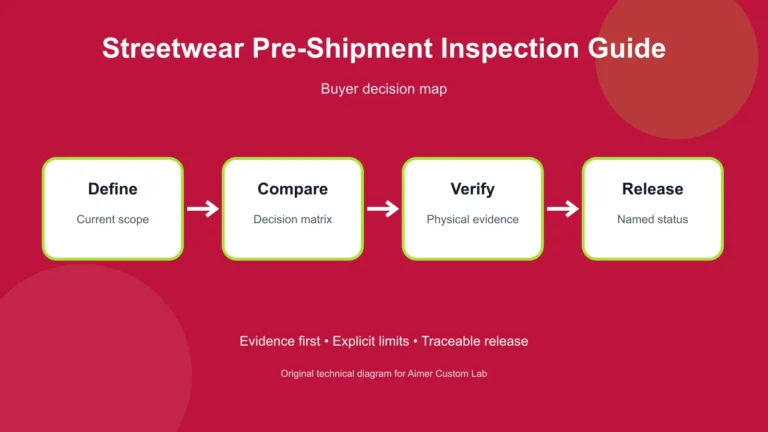
Streetwear Needle Detection Guide for Buyers
A single broken sewing-needle fragment can turn a routine apparel order into a product-safety incident. Streetwear needle detection is valuable because it adds a piece-level control near the end of production, but the machine result is credible only when the factory can show how needles are issued, recovered, challenged, rejected, and documented.
This guide helps private-label buyers ask the right questions without claiming that one detector setting fits every garment. It covers clean T-shirts and hoodies as well as styles with zippers, snaps, eyelets, or other metal trims that can affect the method.
Quick Answer
Streetwear needle detection is a final safety control for ferrous needle fragments, not a substitute for broken-needle prevention and line accountability. Buyers should define product compatibility, detector sensitivity, test-piece challenge checks, reject isolation, reinspection, record retention, and exceptions for metal trims before approving the shipment plan.
What is streetwear needle detection?
Streetwear needle detection is the controlled inspection of finished garments with equipment designed to identify ferrous metal contamination at an agreed sensitivity. The system includes prevention, calibrated challenge pieces, pass and reject handling, incident records, product compatibility rules, and buyer-approved exceptions.
What belongs in a complete streetwear needle detection system?
The comparison below is a buyer decision matrix. It converts a broad quality question into inspectable evidence and makes trade-offs visible before bulk production.
| Control element | Buyer question | Evidence to review | Failure risk |
|---|---|---|---|
| Needle issuance and return | Are needles controlled by person, machine, and time? | Issue log and authorized replacement record | Missing fragments cannot be traced |
| Broken-needle response | Is work stopped, isolated, searched, and released by authority? | Incident form with recovered parts and affected bundle | Contaminated units continue downstream |
| Detector challenge | Is sensitivity checked with agreed test pieces at defined intervals? | Challenge log before, during, and after production | Machine drift or incorrect setup goes unnoticed |
| Reject handling | Are alarms isolated, investigated, and rechecked under a documented route? | Reject cage or quarantine log and disposition | Rejected unit returns to the good flow |
| Metal-trim exception | How are zippers, snaps, or eyelets handled without weakening safety? | Product-specific method and buyer approval | False alarms or an unjustified sensitivity reduction |
For streetwear needle detection, use this matrix during sample review and copy the agreed evidence into the purchase specification. That keeps the decision connected to the actual product rather than a generic factory promise.
Why is prevention as important as the detector?
Detection occurs after many sewing operations, so prevention reduces both risk and investigation scope. Controlled needle storage, limited replacement authority, complete fragment recovery, work stoppage, bundle isolation, and line clearance create a traceable response. Without those steps, the factory may know that a needle broke but not which garments were exposed.
The detector is the final verification layer. It should not be used to justify weak broken-needle discipline. Ask who can release isolated goods and how the factory proves that all affected pieces were rechecked.
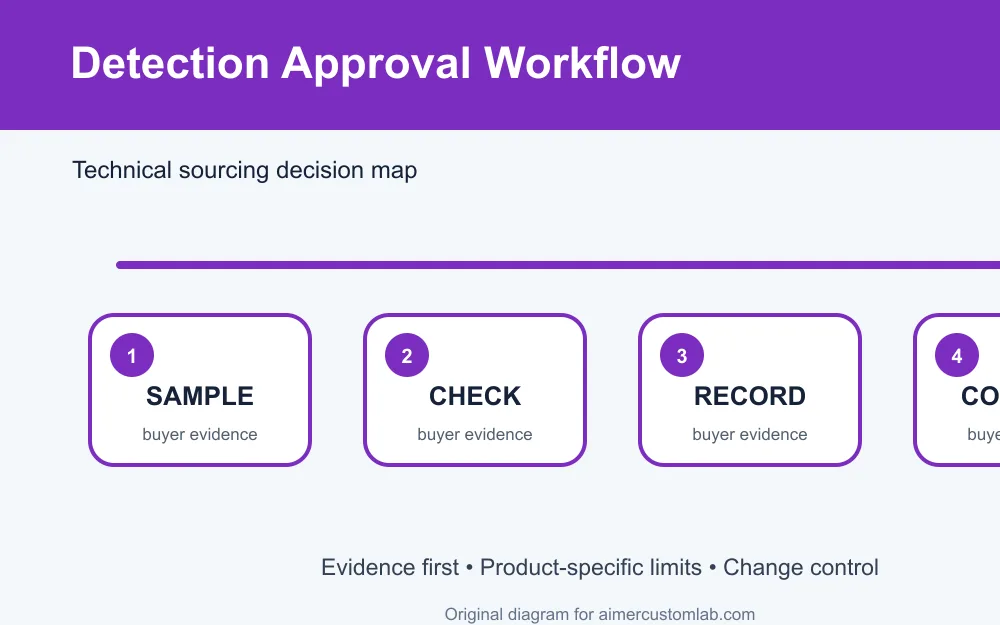
How should a buyer approve the detection process?
- Classify the style by risk and list all intended metal components, packaging materials, hangtags, and accessories before production.
- Agree the detector type, aperture, conveyor condition, product orientation, and challenge pieces with the supplier or qualified inspection provider.
- Run challenge checks at the agreed positions and intervals, including before start, during production, after stoppage, and at completion as applicable.
- Define the one-way flow from unchecked to checked goods and use clear physical separation so passed cartons cannot mix with pending units.
- Specify alarm, isolation, investigation, reinspection, and disposition steps; do not allow an operator to simply pass the same item repeatedly.
- Review a representative completed log and exception route before authorizing shipment.
How do metal trims change the plan?
A zipper, snap, eyelet, rivet, or metal cord end may trigger equipment designed to find ferrous contamination. Lowering sensitivity until the garment passes can create a blind spot. Instead, identify the trim material during development and ask the detector or inspection specialist to define a compatible route. Options may include component control, sectional inspection before attachment, specialized detection, or another buyer-approved method.
Document the reason, method, and limits of any exception. A product with metal trim should not silently inherit the process for a plain cotton T-shirt.
What records make the result auditable?
A useful record names the order, style, color, size range, line, date, machine or detector identity, operator, agreed sensitivity, challenge-piece identity, challenge times and results, quantity checked, alarms, isolated units, investigations, rechecks, disposition, and reviewer. The record should reconcile with packed quantity rather than exist as an unrelated certificate.
Photographs can support equipment and segregation evidence, but they do not replace logs. If a third-party inspection is involved, confirm the scope: sample-based general inspection and piece-by-piece needle detection are different controls.
What are the standards and evidence boundaries?
CPSC guidance notes that children’s apparel with sharp points or edges may be treated as hazardous even where a particular small-parts rule does not apply. That does not create a universal detector setting for all streetwear. Product age group, market, trim construction, customer requirements, and detector capability must be evaluated for the actual order.
This guide does not claim a specific sensitivity, legal requirement, or retailer protocol. Ask the buyer, compliance adviser, inspection provider, and equipment specialist to confirm the applicable requirement and record it before production.
Which related products can this guide support?
- Review custom oversized streetwear T-shirts when matching this control to a production configuration.
- Review custom zip hoodie sets when matching this control to a production configuration.
Product construction, materials, quantities, lead times, test scope, and packaging must be confirmed for the actual inquiry. The linked pages show relevant product categories; they do not replace a signed specification.
Buyer checklist
Use this checklist to keep streetwear needle detection consistent from development through final inspection.
- Needle issue log controlled
- Broken-needle route documented
- All metal trims declared
- Detector and aperture identified
- Challenge pieces traceable
- Unchecked and checked goods separated
- Reject disposition recorded
- Packed quantity reconciled
Standards and evidence boundaries
Use the following sources as current research inputs and confirm the applicable edition, buyer protocol, and market requirement before testing or production. No source below proves a supplier-specific certification, capacity, price, MOQ, or lead time.
- CPSC guide to U.S. apparel and household textiles
- HQTS garment metal-detection overview
- Printify trending hoodies guide
- Custom Ink custom-apparel guide
Research-to-page evidence map
This map records how source research changed the public guide without copying source language.
| Research finding | Specific application | Visible evidence |
|---|---|---|
| Uses trend-led use cases and question headings to connect product choices to outcomes. | Connected detection choices to plain, zip, and metal-trim product use cases. | How do metal trims change the plan? |
| Uses key decisions, steps, comparison cues, and confidence-building review language. | Added a five-part decision table and a six-step approval route. | What belongs in a complete streetwear needle detection system? |
| Highlights sharp-point and sharp-edge risk in children’s textile articles. | Added a scope boundary for age group, market, and product-specific compliance. | What are the standards and evidence boundaries? |
Frequently asked questions
Does needle detection replace a broken-needle policy?
No. Prevention, incident containment, fragment recovery, and final detection are complementary controls.
Can garments with zippers pass the same process as T-shirts?
Not automatically. Metal components can trigger the equipment and require a product-specific approved route.
Should rejected garments be passed through again immediately?
No. Isolate and investigate them under the agreed procedure before any controlled reinspection.
Is a general inspection certificate enough?
Not unless its scope clearly includes the required piece-level detection method, challenge checks, quantities, and results.
What should trigger reapproval?
Changes to detector, sensitivity, aperture, trim, packaging, line layout, factory, or buyer requirement should trigger review.
Conclusion: how should a buyer move forward?
streetwear needle detection works best as a documented approval decision linked to the actual fabric, component, construction, route, and end use. Keep the signed sample, method, raw observations, corrective actions, and change controls together so bulk inspection can compare like with like.
Inquiry CTA: Send your tech pack, target market, quantity range, material or component specification, artwork, size range, packaging route, and requested test method. Ask the team to confirm feasibility, sampling details, MOQ, lead time, and evidence for your specific order rather than relying on general figures.