Hoodie Embroidery Digitizing Approval Guide
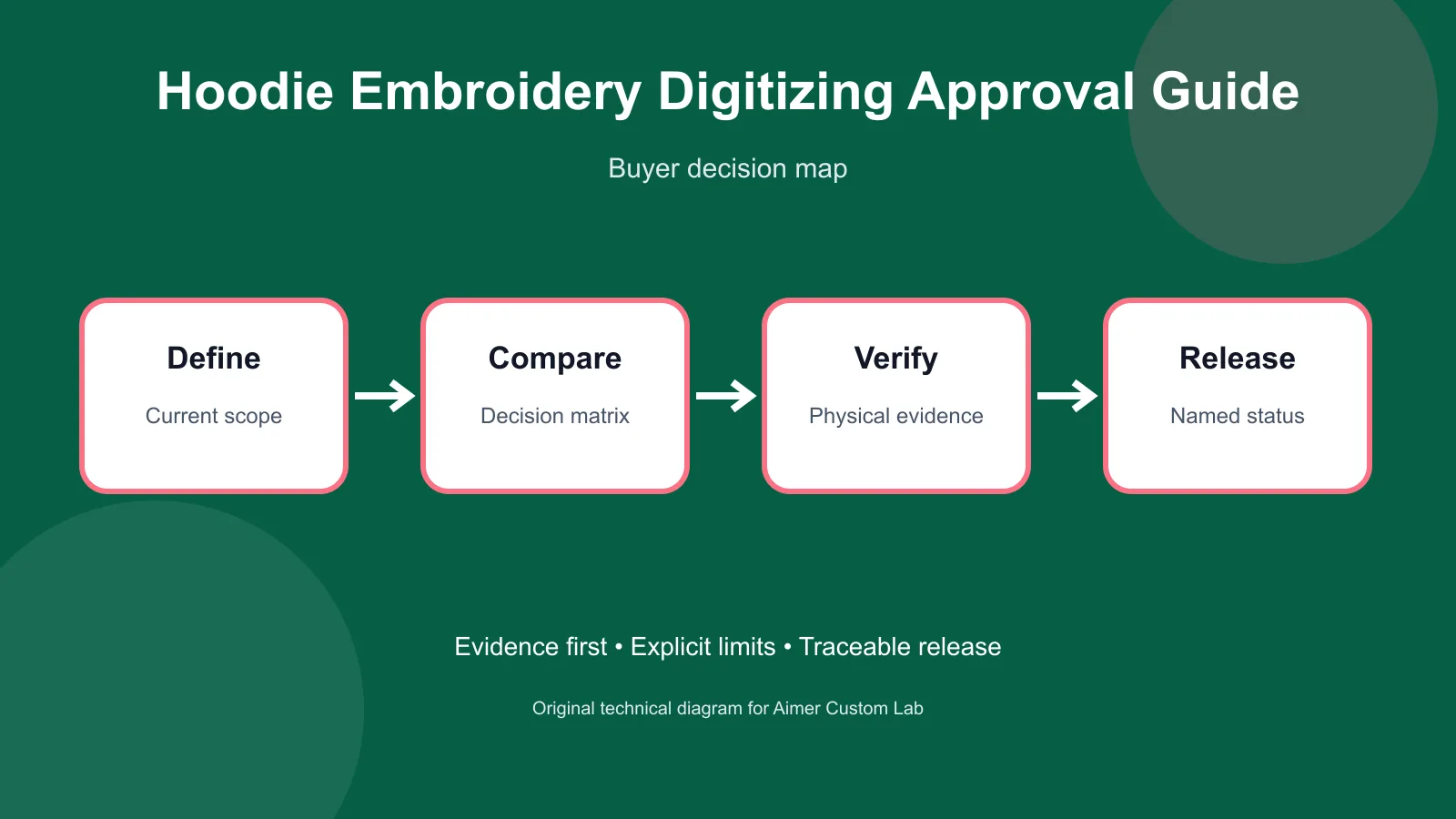
Quick Answer: Hoodie embroidery digitizing should translate approved artwork into stitch types, direction, sequence, density, underlay and compensation for a defined fabric, size and placement. Approve a physical stitch-out on representative hoodie material, record thread and stabilisation choices, and issue a new revision whenever the artwork or production setup changes.
Embroidery software does not simply print a logo with thread. The digitizer chooses stitch types, directions, sequence, density and support for a particular fabric and size. A file that sews well on a firm cap may pucker or lose detail on brushed fleece, and reducing the same file can make text close up. Approval therefore needs a physical stitch-out on representative material.
The control must stay linked to the current purchase order and approved revision. A clean-looking result is not sufficient when the represented product, size coverage or decision authority is unclear. Unknown values remain unknown; unavailable evidence is a coverage gap, not a pass.

What is hoodie embroidery digitizing?
Hoodie Embroidery Digitizing Approval is the controlled conversion of approved artwork into machine-readable stitch instructions for a specific hoodie fabric, placement, size and embroidery setup. It supports a sourcing decision only when the represented order, method, revision and evidence boundary are explicit.
Key entities include source artwork, embroidery size, stitch file, stitch type, stitch direction, stitch density, underlay, pull compensation, thread colour, needle path, trims, stabiliser, hooping, placement anchor, fabric face, stitch-out, revision and approval status. Keeping these entities connected prevents an attractive image, isolated measurement or generic status from replacing the actual evidence needed for release.
Why does hoodie embroidery digitizing matter to private-label buyers?
It converts a subjective or fragmented check into a repeatable decision that can be reviewed by design, production, quality and receiving teams. The value is not the number of fields recorded; it is the ability to connect a current instruction to the physical goods and the final disposition.
Streetwear programs often combine multiple silhouettes, decoration methods, colours, sizes and packaging versions. The process should therefore identify what is represented, what remains outside coverage, which exceptions can be corrected and who can authorise the next step.
Which buyer decisions belong in the hoodie embroidery digitizing plan?
Translate the order into named decisions before asking an operator or inspector to act. The following matrix keeps convenience, visual similarity and obsolete files from becoming hidden acceptance rules.
| Decision | Evidence question | Required output |
|---|---|---|
| Artwork simplification | Which lines, gaps and text can survive at the intended size? | Stitchable visual hierarchy |
| Stitch architecture | Which stitch types, directions, underlay and sequence build the design? | Controlled digitizing plan |
| Fabric support | What stabiliser, hooping and compensation suit the hoodie material? | Substrate-specific setup |
| Colour and placement | Which thread references and garment anchors control appearance? | Thread and position specification |
| Physical approval | Which stitch-out represents production and what changes reopen review? | Dated approved sample and revision |
Commercial priorities can change timing or review depth, but they should not rewrite technical evidence. If a condition changes the represented product, document the approval and repeat the affected check against the updated revision.
Which source records define the evidence boundary?
Use current authoritative guidance for terminology, method and reporting context, then apply the buyer-approved specification to the actual order. The research sources used for this guide are listed below and linked again in the application record.
Custom Ink Image Resolution and Embroidery Requirements, Printful Embroidered vs Printed Clothing, UberPrints Uploaded Image Requirements.
How should a buyer run the hoodie embroidery digitizing workflow?
Freeze inputs, perform a repeatable check, control exceptions and issue a named release decision. Record the responsible person, represented order, revision and dated outcome at every stage.
- Freeze the source artwork, intended embroidery dimensions, hoodie fabric and placement.
- Identify text, fine lines, enclosed spaces and gradients that may require simplification.
- Select stitch types and directions that preserve the intended visual hierarchy.
- Define underlay, density and pull compensation for the representative material.
- Plan the colour sequence, trims and path to reduce distortion and unnecessary movement.
- Specify thread references, stabiliser, needle, hooping and placement anchors.
- Run a stitch-out on the intended fabric or the closest controlled construction available.
- Review shape, text, registration, puckering, thread coverage, reverse appearance and placement.
- Revise one variable at a time and issue a new digitizing revision after each change.
- Approve the physical result, archive the stitch file and forbid unrecorded resizing in production.
A changed input reopens the affected decision. Do not allow an earlier sample, inspection or label to remain the release basis when the physical product or instruction has changed.
What evidence should be retained?
The evidence package should allow another reviewer to understand exactly what was checked, what was not checked and why the final decision was made. Photographs support identity and findings, but they do not replace quantity, measurements, revision or method.
| Evidence block | Minimum identity | Buyer verification |
|---|---|---|
| Source package | artwork revision, size and visual reference | What image is being interpreted? |
| Digitizing record | stitch file, settings and revision | Can the approved program be identified? |
| Material setup | hoodie fabric, stabiliser, hooping and thread | Does the test represent production? |
| Stitch-out review | front, reverse, dimensions and defect notes | What was physically observed? |
| Approval status | approver, date, limits and reopened changes | Is release tied to one configuration? |
How should results and exceptions be interpreted?
Interpret a result only inside the recorded scope and conditions. A local pass does not erase an uncovered size, changed input, unavailable document or unresolved exception.
| Finding | Meaning | Action |
|---|---|---|
| Within the approved boundary | The sampled condition meets the recorded basis | Retain evidence and continue the defined workflow |
| Outside the boundary | The represented units require disposition | Segregate, investigate and record authority |
| Required evidence unavailable | Coverage is incomplete | Pause the affected judgment and request the missing record |
| Goods changed after checking | Earlier evidence may no longer represent the lot | Repeat affected checks before release |
Which failure modes should the buyer prevent?
The most serious failure is a complete-looking record that represents the wrong product, revision or population.
- Treating automatic conversion as finished digitizing.
- Reducing a large stitch file without re-digitizing for the new size.
- Adding density to hide a problem caused by poor underlay or fabric support.
- Approving thread colours only from a screen preview.
- Testing on stable woven fabric when production uses soft hoodie fleece.
- Ignoring the reverse side, stabiliser visibility or wearer comfort.
- Moving the logo after hooping and placement approval.
- Using an unlabeled stitch file that cannot be matched to the approved stitch-out.
These failures are controlled through defined inputs, representative selection, explicit unknowns, revision discipline and named decision authority. More fields do not compensate for the wrong evidence boundary.
What belongs in the pre-release checklist?
Use a short checklist only after the detailed method and acceptance basis are agreed.
- Source artwork and embroidery size frozen
- Fine detail and text assessed
- Stitch types and directions defined
- Underlay and density reviewed
- Pull compensation documented
- Thread and stabiliser specified
- Placement anchors recorded
- Representative stitch-out completed
- Front and reverse appearance approved
- Stitch revision archived
How did high-traffic and fast-growth peer learning improve this guide?
Peer learning was applied to information architecture, direct answers, internal-link context and entity clarity only. Competitor wording, branded artwork, prices, claims and product designs were not copied.
| Dimension | Research finding | Specific application | Public evidence marker |
|---|---|---|---|
| SEO | customink.com: Custom Ink separates embroidery file requirements from digital and screen-print requirements, clarifying method-specific intent and common mistakes. | Aligned the title, search intent, decision table and descriptive internal links around hoodie embroidery digitizing. | ACL-DIGITIZE-SEO intent and decision matrix |
| AEO | uberprints.com: UberPrints explains file types and preparation as short definitions followed by concrete actions, a useful answer-first pattern. | Added a 40-70 word Quick Answer, question headings, direct first sentences, numbered steps and five practical FAQs. | ACL-DIGITIZE-AEO answer-first workflow |
| GEO | qualified peer pages: Qualified peer pages connect vector source, physical size, thread outcome, fabric and placement, while the guide adds the missing stitch-out and revision entities. | Defined source artwork, embroidery size, stitch file, stitch type, stitch direction, stitch density, underlay, pull compensation, thread colour, needle path, trims, stabiliser, hooping, placement anchor, fabric face, stitch-out, revision and approval status; linked claims to authorities and stated evidence limits. | ACL-DIGITIZE-GEO entity and evidence boundary |
The high-traffic signal came from current July 2026 session evidence for Custom Ink. The fast-growth signal came from UberPrints’ latest three-month growth evidence. These traffic signals qualify the peers; they do not prove that every page element caused growth.
How were authority findings applied?
| Research source | Applied finding | Visible evidence |
|---|---|---|
| Custom Ink Image Resolution and Embroidery Requirements | Used terminology and record structure without treating the source as supplier certification or a universal pass rule. | definition and decision table |
| Printful Embroidered vs Printed Clothing | Applied inspection and traceability boundaries while keeping acceptance order-specific. | workflow and evidence table |
| UberPrints Uploaded Image Requirements | Applied textile and shipment evidence context and required explicit limits. | interpretation and FAQs |
The answer-first boundary supports AEO. Stable entities, source links, decision conditions and explicit unknowns support GEO without promising inclusion in any AI-generated answer.
Frequently asked questions about hoodie embroidery digitizing
Is an embroidery file just a converted vector logo?
No. Vector artwork can be a useful source, but embroidery digitizing adds stitch types, sequence, density, underlay, compensation and machine instructions for a defined material and size.
Can one digitized file be resized for every hoodie placement?
Not safely by assumption. Significant size changes can alter stitch density, text clarity and structural support, so the file may need to be re-digitized and stitched out again.
Why does fleece need a representative stitch-out?
Soft or lofty surfaces can change thread support, edge definition and puckering behaviour. A physical stitch-out shows interactions that a screen simulation cannot confirm.
What should buyers inspect on the reverse side?
Check stabiliser, thread management, bulk, loose ends and any condition that could affect appearance, durability or wearer comfort..
What changes require a new embroidery approval?
Changes to size, artwork, fabric, placement, thread, stabiliser, stitch logic or machine setup should reopen the affected review and revision record..
Conclusion: release only what the evidence represents
Hoodie Embroidery Digitizing Approval is the controlled conversion of approved artwork into machine-readable stitch instructions for a specific hoodie fabric, placement, size and embroidery setup. A reliable process connects current inputs, representative physical evidence, exception control and named authority. The decision should make the next sourcing, production or shipment step easier without overstating what was checked.
Continue with streetwear embroidery capabilities, private-label hoodie options, request a controlled embroidery sample. Share the represented style, intended market, active specification and required evidence so project-specific options can be confirmed rather than assumed.