Streetwear Supplier Declaration Validity Guide
Quick Answer: Streetwear supplier declaration validity depends on traceable scope, not a signature alone. A buyer should match the declaration to the legal entity, factory, material or chemical code, component, colour, lot or time window, destination market, requirement version and supporting evidence. Relevant changes to formulation, supplier, site, process or regulation should trigger review or retesting.
Private-label teams often receive a statement saying a fabric, ink or trim “complies,” but the document may not identify the ordered style, current requirement or production source. Streetwear supplier declaration validity turns that paperwork into a controlled decision. It ranks declarations alongside material records and test reports without pretending that every document is equivalent.
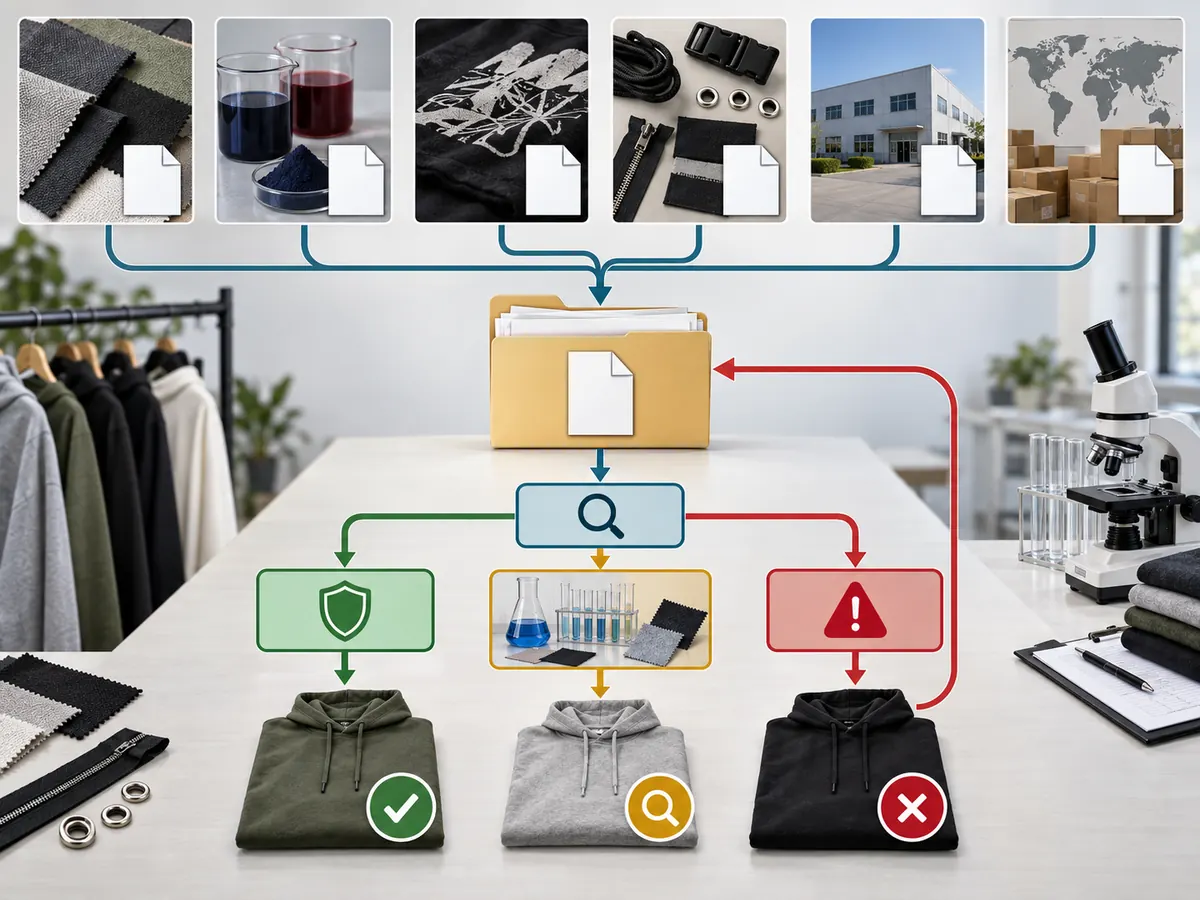
What does streetwear supplier declaration validity mean?
Supplier-declaration validity is the degree to which a signed statement is current, authentic, appropriately scoped and traceably connected to the product decision. A valid declaration identifies who issued it, what product or formulation it covers, which requirement and version it addresses, the applicable market or customer, its effective period and the evidence or controls behind the statement.
A declaration is not the same as an accredited laboratory report, certification, safety data sheet, chemical inventory or purchase record. Each document answers a different question. A declaration can support accountability and formulation control, but it cannot be extended beyond its stated scope.
A useful streetwear supplier declaration validity record therefore identifies the product, component or garment zone, test or evidence route, version, condition, date and decision owner. A marketing phrase without those fields cannot support a repeatable sourcing decision.
Why does streetwear supplier declaration validity matter to buyers?
It matters because an apparently current PDF may cover a different material, chemical formulation, factory or previous requirement version. Streetwear supply chains can involve the cut-and-sew factory, fabric mill, dyehouse, printer, embroidery unit, trim vendor and packaging supplier. The brand should know which party controls each statement and whether subcontractors are included.
Validity does not mean permanence. A correct declaration can become stale after a formula, site, supplier, process, market rule or customer RSL changes. The buyer should define review dates and event-based triggers instead of assuming one document covers every future order.
Start with the intended wearer, destination market, product construction and claim. Then select evidence proportionate to the decision. This sequence prevents a convenient report for an unrelated fabric, component or supplier from being used as proof for the actual order.
Which components should the streetwear supplier declaration validity cover?
Map each declaration to the component and supplier that controls the relevant information, then identify supporting records. The following map converts the research into a practical sampling or document plan.
| Declaration field | Validity question | Evidence to cross-check |
|---|---|---|
| Issuer and legal entity | Is the responsible company identifiable and authorized? | Approved supplier record and contact path |
| Factory or subcontractor | Does the production site match the order? | Purchase order, audit or production record |
| Material or formulation code | Is the exact fabric, ink, finish or trim covered? | BOM, chemical inventory and supplier data |
| Requirement and version | Which law, RSL or MRSL is addressed? | Current controlled copy and change log |
| Lot, colour or time scope | Does it represent current production? | Batch record, test report and retained sample |
| Signature and date | Who approved it and when? | Document-control and authorization record |
A company-wide statement without product or formulation detail may be useful background but weak release evidence. Request precise coverage instead of editing the declaration yourself. If confidentiality limits formulation disclosure, agree a controlled confirmation route with the supplier, laboratory or designated reviewer.
Which standards or authorities support streetwear supplier declaration validity?
OECD due-diligence guidance and ZDHC document-control practices support ongoing, risk-based verification rather than one-time document collection. ZDHC guidance expects facilities to maintain current requirements, chemical inventories, supplier declarations, certifications, test reports, traceability and corrective-action records. ISO auditing guidance for externally provided products and services emphasizes current approved-provider information and verification of supplied outputs.
Use the OECD garment and footwear due-diligence hub and its 2026 due-diligence essentials. ZDHC details document and process control and current chemical-purchasing records. The ISO Auditing Practices Group provides guidance on external providers.
What should the buyer put in the technical brief?
- Supplier legal name, production site and authorized signatory.
- Product, material, formulation, colour and component scope.
- Destination markets and customer program.
- Requirement name, version and effective date.
- Lot, purchase order or defined validity period.
- Supporting report, certification, inventory or process-control reference.
- Subcontractor and upstream-supplier coverage.
- Review date, change notification and retesting triggers.
How should a streetwear supplier declaration validity workflow run?
Verify identity and scope first, then compare the document with the order, current requirement and supporting evidence. The steps below keep the evidence tied to the real order.
- List the declaration needed for each material, chemical, trim and supplier decision.
- Confirm the issuer’s legal entity, production site and authority to sign.
- Match the product, component, colour and formulation codes to the frozen BOM.
- Check the destination market, customer requirement and version against controlled copies.
- Verify lot, date and validity period against the purchase and production records.
- Cross-check laboratory reports, chemical inventory, certification or process records as appropriate.
- Classify the declaration as accepted, clarification required, expired or not applicable.
- Reopen the review after a relevant supplier, site, formulation, process or requirement change.
Each gate needs a named owner and a visible status. “Approved” should mean the evidence was reviewed against a stated criterion. It should not merely mean that a PDF or declaration exists. A relevant change returns the affected component to review.
How should streetwear supplier declaration validity evidence be interpreted?
Rank a declaration by specificity, currency, traceability and supporting controls—not by how confident the wording sounds. A precise statement for the exact formulation and current order is stronger than an undated company-wide promise. An analytical report may provide compound-specific evidence but still require scope matching. A certification may cover listed products or facilities only. Keep each evidence type inside its real boundary.
| Finding | What it means | Buyer action |
|---|---|---|
| Exact entity, site, code, version and current lot match | Declaration is traceable to the order | Accept with supporting records |
| Requirement version or validity period unclear | Currency is not demonstrated | Request clarification before release |
| Generic company statement only | Product and formulation scope are weak | Seek component-specific evidence |
| Relevant supplier or formulation changed | Earlier declaration may be stale | Hold affected scope and reassess |
Do not alter supplier declarations, backdate signatures or infer coverage. If a field is confidential or unavailable, record the limitation and choose a proportionate alternative such as direct laboratory confirmation, controlled certification scope or additional testing.
How were current research findings applied?
This guide turns primary-source scope and limitations into a buyer workflow instead of copying laboratory or regulatory wording.
| Research finding | Specific change in this guide | Verification point |
|---|---|---|
| OECD frames due diligence as ongoing and risk based | The workflow includes periodic and event-triggered review | Ordered steps and boundary text |
| ZDHC calls for current RSL/MRSL, inventories, declarations, reports and traceability | The guide cross-checks multiple evidence types instead of relying on one PDF | Map and checklist |
| ZDHC chemical purchasing keeps formulation and batch information current | Formulation, lot and change fields are mandatory | Technical brief |
| ISO auditing guidance verifies external providers and keeps approved records current | Issuer, site and approval status are separate validity gates | Decision table |
The sources support definitions, scope and limitations. Recommendations are identified as procurement practice and do not claim that one voluntary method or framework is mandatory everywhere. That separation improves answer clarity for AEO, provides quotable context for GEO and keeps the page useful to a human buyer.
What mistakes weaken a streetwear supplier declaration validity decision?
The biggest error is treating the existence of a document as proof that it matches the purchase order.
- Accepting an undated declaration with no validity period.
- Ignoring the legal entity or production site.
- Matching a family name instead of the exact material or formulation code.
- Using an obsolete RSL or regulatory version.
- Assuming one fabric report covers prints, trims and packaging.
- Keeping no upstream or subcontractor coverage.
- Failing to reopen the decision after change.
These mistakes separate evidence from the exact sourcing decision. A disciplined streetwear supplier declaration validity reconnects the sample, method or document, product scope, conditions, decision rule and responsible approver.
What belongs in the streetwear supplier declaration validity approval checklist?
A reviewer should be able to trace the statement from signature to the exact order and evidence set.
- Issuer, site and signatory verified.
- Exact component and code matched.
- Current requirement and version confirmed.
- Market, lot and time scope recorded.
- Supporting evidence cross-checked.
- Gaps classified and owned.
- Change and retesting rules active.
Keep the checklist with the tech pack, test request or purchase file. Mark unknown fields as pending and assign an owner. Conditional wording is more accurate than an unsupported promise about compliance, comfort, durability or performance.
Frequently asked questions about streetwear supplier declaration validity
Is a signed supplier declaration enough for approval?
Not by itself. It must match the entity, site, product scope, current requirement, production period and supporting controls.
How long is a declaration valid?
There is no universal period. Use the stated validity, program rules, review schedule and change triggers for the specific document.
Can one declaration cover every component?
Only if the scope clearly proves that. Fabrics, inks, trims, packaging and subcontracted processes often have different owners and evidence.
What should trigger a fresh review?
Any relevant change. Supplier, site, formulation, process, material code, market rule, customer RSL or production lot can affect validity.
What if the supplier will not disclose a confidential formula?
Use a controlled alternative. Agree an appropriate declaration scope, third-party confirmation, certification review or targeted test without demanding unnecessary trade secrets.
Conclusion: validate scope, not confidence
Streetwear supplier declaration validity comes from a current and traceable match between issuer, site, component, code, requirement, market and production. A controlled review makes supplier paperwork useful while preserving the separate roles of declarations, laboratory reports and certifications.
Connect declarations to the streetwear sampling process and record exact approved components in the trim card approval guide. Contact the sourcing team with the product construction, destination markets and evidence requirement so the available facts can be confirmed for your specific project.