Total Fluorine vs Targeted PFAS Testing
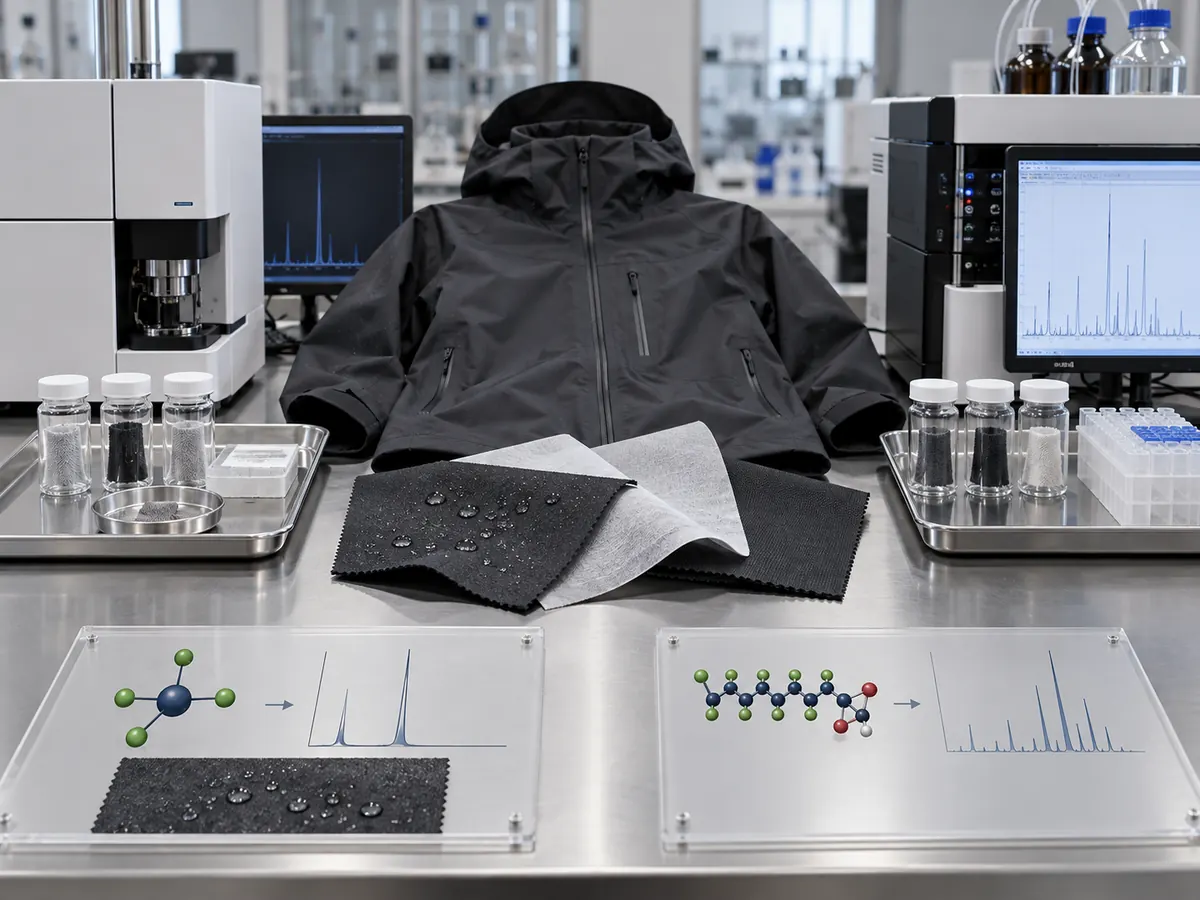
Quick Answer: Total fluorine vs targeted PFAS testing answers two different questions. Total fluorine is a broad screening measurement for overall fluorine, while targeted analysis looks for named PFAS compounds. A screen can flag a need for investigation but does not identify a compound; a targeted non-detect does not prove that every possible PFAS or fluorinated substance is absent.
Streetwear outerwear may combine water-repellent finishes, membranes, coated fabrics, printed graphics, seam tapes and treated trims. Buyers often ask whether total fluorine vs targeted PFAS testing is the better route, but the answer depends on the claim and decision. The strongest evidence plan uses screening and targeted methods for clearly defined purposes rather than treating either as universal proof.
What does total fluorine vs targeted PFAS testing mean?
Total fluorine screening measures overall fluorine in a sample, while targeted PFAS analysis measures a defined list of named per- and polyfluoroalkyl substances. A total-fluorine result may include fluorine from sources that are not the targeted PFAS list. A targeted method can quantify specified compounds but cannot represent substances outside its analyte scope.
Extractable organic fluorine, total organic fluorine and total fluorine are not automatically interchangeable terms or methods. The laboratory report must name the measurement, sample preparation, unit and reporting limit. A buyer should not convert one result into another without technical confirmation.
A useful total fluorine vs targeted PFAS testing record therefore identifies the product, component or garment zone, test or evidence route, version, condition, date and decision owner. A marketing phrase without those fields cannot support a repeatable sourcing decision.
Why does total fluorine vs targeted PFAS testing matter to buyers?
It matters because a brand may need both a broad formulation screen and a compound-specific compliance check. A total-fluorine screen can help investigate whether an unknown coating or finish contains fluorinated chemistry. Targeted analysis can address named compounds in a market rule or customer specification. The program should state whether it controls intentional use, a legal threshold, a supplier claim or an internal sourcing preference.
PFAS regulation is changing by jurisdiction and application. ECHA’s universal restriction proposal remains under scientific evaluation, so its existence must not be presented as a final universal textile ban. Current legal and contractual requirements should be confirmed for each destination market.
Start with the intended wearer, destination market, product construction and claim. Then select evidence proportionate to the decision. This sequence prevents a convenient report for an unrelated fabric, component or supplier from being used as proof for the actual order.
Which standards or authorities support total fluorine vs targeted PFAS testing?
Use current regulatory sources and program-specific criteria to define the claim before selecting screening and targeted methods. ECHA describes the status of European PFAS restriction work. OEKO-TEX distinguishes total-fluorine screening from targeted PFAS criteria in its current product requirements and moved from EOF to total fluorine for its intentional-use policy in 2024. Those program choices are informative but not universal legal requirements.
Review the ECHA PFAS overview, the OEKO-TEX 2024 regulation update and the current OEKO-TEX STANDARD 100 document. Confirm current market rules and methods with qualified specialists.
What should the buyer put in the technical brief?
- Product, component and destination-market scope.
- Claim type: intentional use, restricted named compounds, customer specification or internal policy.
- Finish, membrane, print, film and trim supplier codes.
- Screening measurement name, preparation, unit and reporting limit.
- Targeted analyte list, method, unit and reporting limits.
- Component separation or composite rationale.
- Supplier formulation declaration and change notification.
- Decision path for screen and targeted findings.
Which components should the total fluorine vs targeted PFAS testing cover?
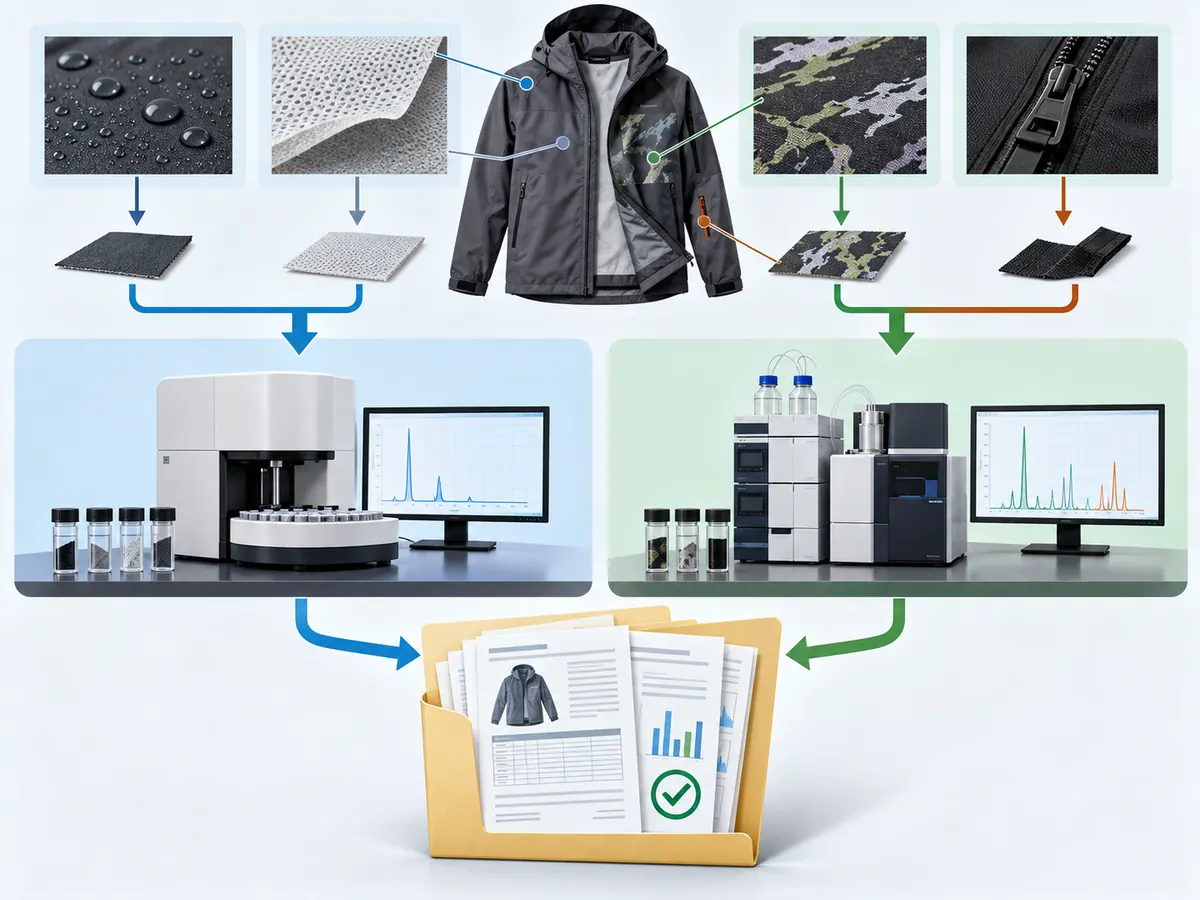
Prioritize components where repellency, membranes, coatings, films or treated surfaces create a plausible fluorine question. The following map converts the research into a practical sampling or document plan.
| Component or evidence route | Question answered | Key limitation |
|---|---|---|
| Water-repellent shell | Is fluorine broadly detected or are named PFAS present? | Finish and supplier must match bulk |
| Membrane or coating | Does the polymer layer drive the result? | May need separate sampling from face fabric |
| Print, film or seam tape | Could a small treated component be missed? | Composite dilution can hide a source |
| Total fluorine screen | How much total fluorine is measured? | Does not identify a specific compound |
| Targeted PFAS panel | Are listed analytes detected and quantified? | Does not cover every PFAS or fluorinated substance |
A finished jacket may need multiple samples because a low-area component can disappear inside a composite. Record component mass, area and grouping. If the intent is to support an “intentionally added PFAS” policy, combine supplier formulation controls with analytical evidence rather than asking one test to prove supplier intent.
How should a total fluorine vs targeted PFAS testing workflow run?
Start with the claim, map plausible fluorinated components and assign a decision to each evidence route. The steps below keep the evidence tied to the real order.
- Define the market, customer policy and exact wording the evidence must support.
- Freeze the bill of materials, finish recipes, membrane, coatings, prints and trims.
- Collect supplier declarations for exact formulations and distinguish intentional-use statements from test reports.
- Use a broad fluorine screen when the question is whether fluorine is present at a meaningful level.
- Use a targeted panel when named PFAS and applicable limits define the decision.
- Sample high-risk components separately and record reporting limits and units.
- Investigate discordant results instead of forcing a pass/fail interpretation.
- Retest after finish, membrane, chemical supplier, print, trim or regulatory change.
Each gate needs a named owner and a visible status. “Approved” should mean the evidence was reviewed against a stated criterion. It should not merely mean that a PDF or declaration exists. A relevant change returns the affected component to review.
How should total fluorine vs targeted PFAS testing evidence be interpreted?
Read broad and targeted findings together, but never treat them as equivalent. A fluorine signal with targeted non-detects can indicate fluorinated material outside the target list, method differences, background or another source; it requires investigation. Targeted detections identify named compounds within the method scope. Low or non-detect total fluorine should still be read against the reporting limit and product policy.
| Finding | What it means | Buyer action |
|---|---|---|
| Low screen and targeted non-detects at suitable limits | Evidence supports the stated narrow scope | Review declarations and approve conditionally |
| Elevated screen; targeted panel non-detect | Unidentified fluorine or method mismatch may remain | Investigate formulation and expand analysis |
| Targeted PFAS detected above applicable requirement | Named compound conflicts with the decision rule | Hold affected component |
| Supplier finish changed after testing | Earlier evidence may not represent bulk | Reassess and retest |
Do not advertise “PFAS-free” as absolute absence unless the claim definition and evidence support it. Prefer precise language describing intentional-use controls, named analytes, thresholds, product components and the date or lot covered.
What mistakes weaken a total fluorine vs targeted PFAS testing decision?
The most common error is asking one test to answer a question outside its analytical scope.
- Calling total fluorine a list of identified PFAS.
- Treating targeted non-detects as proof that every PFAS is absent.
- Using ECHA’s proposal as if it were a final universal rule.
- Testing only shell fabric while ignoring membrane, coating or seam tape.
- Combining small components without dilution review.
- Hiding method, units or reporting limits.
- Using an old finish report after a chemical-supplier change.
These mistakes separate evidence from the exact sourcing decision. A disciplined total fluorine vs targeted PFAS testing reconnects the sample, method or document, product scope, conditions, decision rule and responsible approver.
How were current research findings applied?
This guide turns primary-source scope and limitations into a buyer workflow instead of copying laboratory or regulatory wording.
| Research finding | Specific change in this guide | Verification point |
|---|---|---|
| ECHA’s broad restriction remains a proposal under evaluation | The guide avoids presenting it as a final universal ban | Regulatory boundary visible near relevance |
| OEKO-TEX moved from EOF to total fluorine for an intentional-use policy | The article explains that program-specific screening choice without universalizing it | Authority section |
| Current criteria distinguish total fluorine and targeted PFAS | A comparison table separates the questions and limitations | Visible component/evidence table |
| Non-detect depends on analyte list and reporting limit | Interpretation and FAQ reject absolute-absence claims | Decision table and FAQ |
The sources support definitions, scope and limitations. Recommendations are identified as procurement practice and do not claim that one voluntary method or framework is mandatory everywhere. That separation improves answer clarity for AEO, provides quotable context for GEO and keeps the page useful to a human buyer.
What belongs in the total fluorine vs targeted PFAS testing approval checklist?
The approval file should show why each test was selected and what it cannot prove.
- Claim and destination market defined.
- PFAS-related component map completed.
- Supplier formulation evidence tied to exact codes.
- Screening and targeted methods named separately.
- Units, limits and analyte lists reviewed.
- Discordant-result investigation path assigned.
- Change notification and retesting triggers written.
Keep the checklist with the tech pack, test request or purchase file. Mark unknown fields as pending and assign an owner. Conditional wording is more accurate than an unsupported promise about compliance, comfort, durability or performance.
Frequently asked questions about total fluorine vs targeted PFAS testing
Does total fluorine identify a specific PFAS?
No. It is a broad fluorine measurement and does not name the source compound.
Do targeted non-detects prove that no PFAS is present?
No. They apply to the listed analytes and reporting limits, not every possible PFAS or fluorinated substance.
Should a brand use both approaches?
Sometimes. Use a broad screen and targeted analysis when they answer separate, documented sourcing questions.
Can one shell-fabric sample cover a jacket?
Not always. Membranes, coatings, prints, seam tapes and trims may need separate representation.
When should evidence be refreshed?
After relevant change. A new finish recipe, membrane, supplier, component, market or customer rule can make prior evidence stale.
Conclusion: match the method to the claim
Total fluorine vs targeted PFAS testing is not a contest with one universal winner. Screening and compound-specific analysis answer different questions. Buyers get stronger decisions by defining the claim, mapping components, preserving reporting limits and investigating results that do not align.
Start with the PFAS-free streetwear claims guide and apply separate performance checks from the hydrostatic pressure guide. Contact the sourcing team with the product construction, destination markets and evidence requirement so the available facts can be confirmed for your specific project.