Oversized T-Shirt Neck-Drop Grading Guide
Oversized T-shirt neck-drop grading controls how the front and back neckline depths change across a size range. It influences head clearance, collar shape, shoulder balance and the visual proportion of a relaxed silhouette. Buyers should specify measurement landmarks and size-specific rules instead of asking a factory to enlarge every neckline by one global percentage.
Quick Answer: Build oversized T-shirt neck-drop grading from a fitted base pattern, define front drop, back drop and neck width at exact seam-line landmarks, assign grade rules by size range, and review the complete neckline with shoulder, collar and head-opening measurements. Approve smallest, base and largest sizes on production-intent fabric before bulk.
What is oversized T-shirt neck-drop grading?
Neck drop is the vertical distance used to describe neckline depth at center front or center back from a defined reference. Grading is the systematic change of a pattern and its measurements from one size to another. Oversized T-shirt neck-drop grading therefore means controlling how neckline depth and its connected curve evolve across the size range while preserving the intended style.
Textile School’s overview of pattern grading explains that grading increases or decreases pattern pieces while maintaining fit, balance and proportion. It also treats front and back neck drop, neck width, shoulder and body length as related grade locations. The key buyer lesson is that the neckline cannot be graded in isolation.
Why is oversized T-shirt neck-drop grading different?
An oversized tee often has a wider body, dropped shoulder and longer or broader sleeve. Those changes alter the visual scale around the neck even when the neckline measurement stays constant. If the neck grows too much, larger sizes may appear loose or expose the shoulder. If it grows too little, smaller and larger sizes can have inconsistent head clearance or collar tension.
“Oversized” does not mean uniformly scaled. Chest width may have a bold grade while neck width and drop change only modestly. The correct relationship depends on the target customer, neckline shape, rib behavior and fit intent. Establish grade rules from the brand’s approved base size and wearer data rather than copying a generic retail chart.
| Point of measure | Definition to control | Connected decision | Common risk |
|---|---|---|---|
| Front neck drop | Reference point to center-front seam line | Style depth and head opening | Too deep, too high or measured over rib |
| Back neck drop | Center-back depth from agreed reference | Collar position and balance | Back gaping or neckline shift |
| Neck width | Side-neck to side-neck landmark | Curve length and shoulder width | Exposed shoulder or tight opening |
| Neck seam length | Front plus back seam-line length | Collar length and stretch ratio | Wavy or constricted rib |
| Shoulder slope | Vertical and horizontal shoulder relationship | How the neck sits on body | Front rise, back gap or drag lines |
How should oversized T-shirt neck-drop grading be measured?
Define whether the measurement starts at high-point shoulder, side-neck point or another controlled landmark. Define whether it ends at the neckline seam line or finished collar edge. Note whether the rib is included. A technical measurement guide describes front drop as a relationship between neck width, side-neck point and center front; this illustrates why a sketch is more reliable than a short label.
Measure the garment flat without pulling the neckline. Align center front and center back correctly and remove wrinkles without stretching. If the design is asymmetric, add a separate construction sketch rather than forcing the shape into a standard center-front definition. Use the same landmark in pattern, sample and bulk inspection.
How should oversized T-shirt neck-drop grading be specified?
- Base size and intended fit description.
- Front drop, back drop, neck width and finished opening POM sketches.
- Whether values are taken at seam line or finished edge.
- Grade increment for every adjacent size or size group.
- Shoulder width, drop shoulder and slope relationships.
- Neckline seam length and collar dimensions.
- Fabric and rib stretch, recovery and shrinkage references.
- Tolerances separated from grade increments.
- Smallest, base and largest size approval requirements.
A tolerance is not permission to replace the grade rule. If the intended front drop increases between sizes, write the target for every size. Do not give only a base value plus a tolerance and expect production to infer the range.
How are oversized T-shirt neck-drop grading rules created?
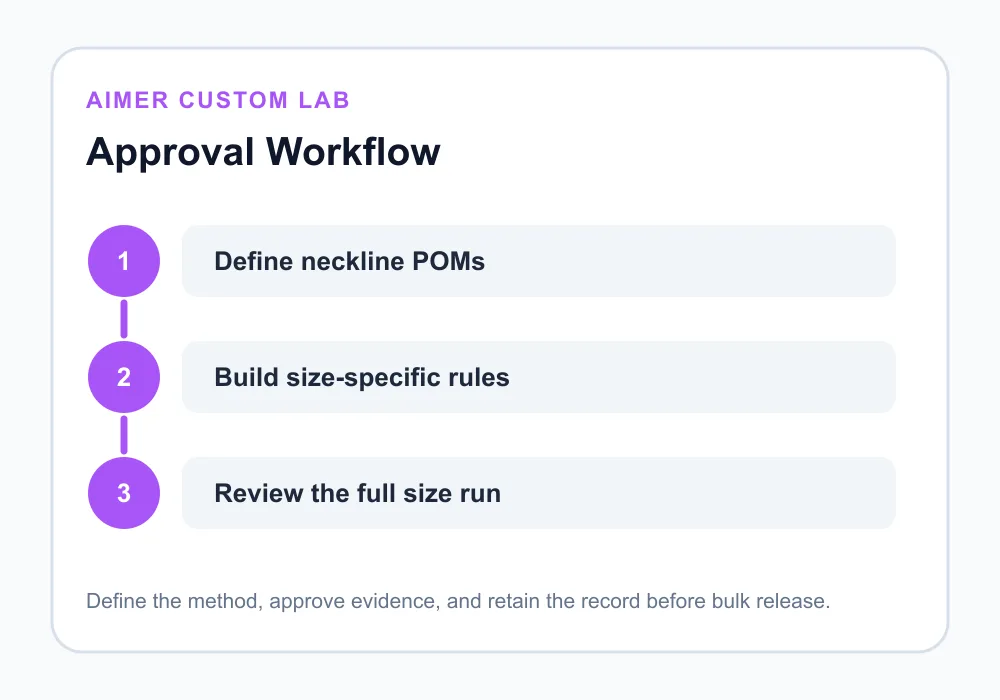
- Fit the base size: Approve the body, shoulder and neckline together on representative wearers.
- Set the size architecture: Define alpha sizes, body data, intended ease and any break points in the range.
- Assign pattern movements: Grade neck width and depth with shoulder and center-front control points.
- Reblend curves: Maintain smooth neckline geometry and right-angle relationships at center lines where required.
- Walk connected seams: Check shoulder seams and total neckline seam length after grading.
- Recalculate the collar: Use the production rib and approved relationship rather than copying one collar length across sizes.
- Audit the spec: Compare graded pattern measurements with the finished measurement chart.
- Fit key sizes: Review smallest, base and largest sizes, then refine rules where the size range changes proportion.
Should oversized T-shirt neck-drop grading follow chest width?
Not necessarily. Pattern grading reflects proportional change rather than uniform scaling. A research paper on basic collar-contour grading treats neck width and front and back drop as distinct relationships to body-size change. Its specific equations apply to its study context, not every streetwear block, but the principle is useful: control each neckline dimension deliberately.
Oversized tees often need restrained neckline growth so the style remains stable in large sizes. Smaller sizes may also need a separate rule to preserve head clearance. Use wearer data, sample evidence and brand intent to set increments. Conditional rules are more honest than a universal number.
How does the collar affect neck-drop grading?
The body neckline creates a seam length; the collar must fit that length with the intended tension and finished height. Rib composition, knit density, width, recovery and shrinkage affect the required collar pattern. If the neckline is graded but the collar is not recalculated, one size may ripple while another feels tight.
Review the T-shirt back neck tape guide when tape is added, because tape length and application can influence back-neck stability. Pair the neckline work with the drop-shoulder measurement guide so width, slope and neck landmarks remain coordinated.
What should size-run fitting check for oversized T-shirt neck-drop grading?
Check head entry without overstretching the collar, front depth, back contact, side-neck position and left-right symmetry. Observe whether the neckline moves when the wearer raises the arms, turns the head or bends forward. Look for a front neckline that climbs, a back neck that gaps, shoulder drag or a collar that rolls.
Photograph each approved size from the same distance and posture, but retain physical measurements and comments. A visual image alone cannot confirm seam-line geometry. Record actual POMs, wearer profile, fabric lot and wash status so the team understands what changed.
How should neck-drop grading be checked after laundering?
Body fabric and rib may shrink differently. Measure front drop, back drop, width and seam length before and after the agreed care cycle. Inspect collar waviness, twisting, center-front symmetry and tape distortion. If a neckline changes, determine whether the cause is pattern grading, material shrinkage, sewing feed or pressing before editing the grade table.
What should bulk quality control inspect?
- Correct size-specific front and back drop targets.
- Measurement landmark consistency.
- Left-right shoulder and neckline symmetry.
- Collar seam position and even distribution.
- Back-neck tape length and smoothness where used.
- Head opening, recovery and post-care appearance.
- Size labels matched to the correct graded pattern.
- Actual measurements by size and lot.
Use the approved pattern and size chart as the control source. If operators measure from the finished collar while the spec is written to the seam line, apparent discrepancies will persist. Train inspection teams with a POM diagram and one measured reference garment.
Frequently asked questions
Is neck drop measured over the collar rib?
Only if the specification defines it that way. State whether the landmark is the seam line or finished edge and provide a sketch.
Can one neck-drop increment be used for every size?
Sometimes, but not automatically. Wide size ranges may need break points based on body data, fit intent and sample evidence.
Why does the back neck gap in larger sizes?
Possible causes include excessive width or drop, shoulder balance, collar ratio, rib recovery, sewing feed or shrinkage difference.
Should oversized tees have a larger neck opening?
Not by definition. Neckline proportion is a style choice that must still provide head clearance and stable wear.
Are tolerances and grade rules the same?
No. A grade rule is the intended difference between sizes; a tolerance is the allowed production variation around each target.
Which sizes should be sampled?
At minimum, review the agreed key sizes, usually including smallest, base and largest sizes where fit risk is greatest.
Conclusion: approve oversized T-shirt neck-drop grading as a system
Oversized T-shirt neck-drop grading should coordinate front depth, back depth, width, shoulder geometry, collar seam length and rib behavior. Clear POMs and size-specific values make the decision measurable; size-run and care testing prove the result. Contact Aimer Custom Lab with the base pattern, target size range, fabric and fit references so a development and sampling plan can be confirmed.