
T-Shirt Fabric Spirality Testing Guide
T-shirt fabric spirality is the rotational distortion that can make side seams travel toward the front or back after laundering. It is especially relevant to circular-knitted jersey because the wale direction can be inherently nonvertical. Buyers should evaluate the fabric and finished garment after an agreed care cycle, using a documented test method and approved limit instead of relying on a fresh, unwashed sample.
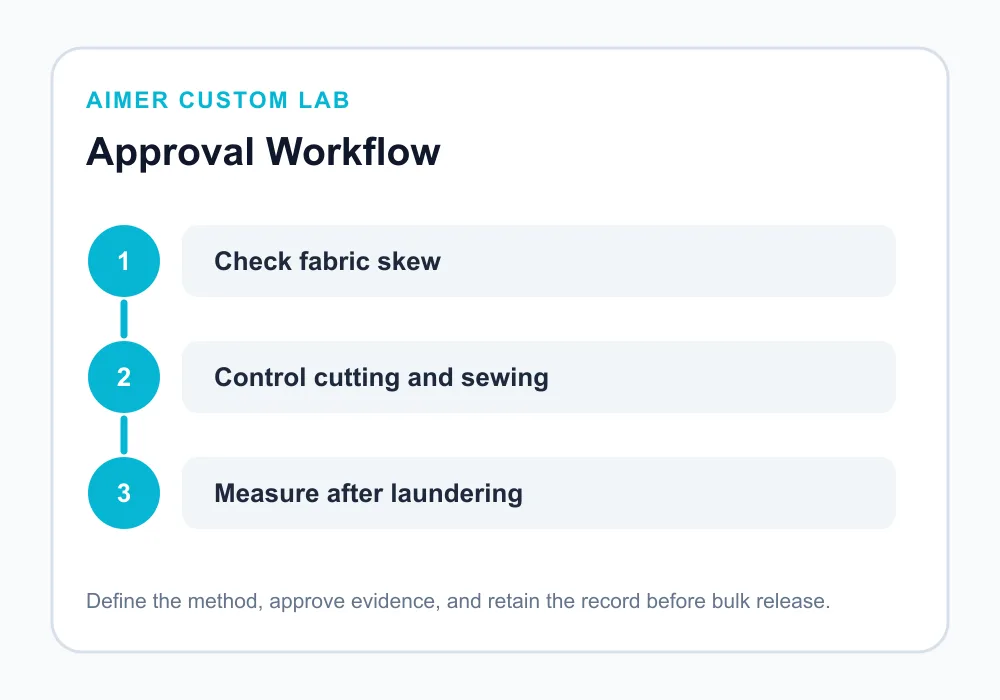
Quick Answer: Control T-shirt fabric spirality by defining the knit and finishing requirements, checking fabric skew before cutting, cutting panels on the approved grain, sewing without distortion, and measuring seam twist after the agreed laundering cycles. Approve both material and finished-garment results before bulk production and keep the test method consistent.
What is T-shirt fabric spirality?
T-shirt fabric spirality is the tendency of a garment or knit structure to rotate away from its intended vertical alignment. On a finished T-shirt, the most visible sign is a side seam that twists toward the front or back. The hem can also look uneven, graphics can appear off-center and the body may hang asymmetrically.
Spirality is related to skew, torque and seam twist, but specifications should define the exact property and method being measured. ISO 16322-3:2021 specifies procedures for measuring spirality or torque in woven and knitted garments after domestic laundering and notes that circular-knitted fabrics can have inherent nonvertical wale alignment.
Why does T-shirt fabric spirality appear after washing?
Single-jersey construction can retain torsional forces from yarn and circular knitting. Relaxation during washing allows those forces to express themselves. Yarn twist, machine settings, fabric diameter, finishing route and compaction all influence the result. Cutting panels off grain or sewing with unequal feed can add construction distortion that resembles material spirality.
Shrinkage also changes the way the garment hangs. If length and width shrink unevenly, a small pre-existing skew may become more visible. The correct investigation therefore separates raw or finished fabric condition, cutting alignment, sewing control and after-care change.
| Possible source | Typical clue | Control point | Buyer evidence |
|---|---|---|---|
| Yarn or knit torque | Consistent rotation across garments | Fabric construction and finishing | Fabric and garment wash-test reports |
| Fabric skew before cutting | Wales or edges are not square | Incoming fabric inspection | Roll map and measured skew |
| Off-grain cutting | Twist varies by panel or marker position | Relaxation and cutting alignment | Cut-panel audit |
| Uneven sewing feed | Local roping or seam distortion | Machine feed and operator method | In-line seam comparison |
How should T-shirt fabric spirality be tested?
Use a recognized or mutually agreed method and keep it identical between sample, pre-production and bulk checks. AATCC’s TM179 description covers skew change in woven and knitted fabrics after home laundering, while AATCC TM207 addresses seam twist in garments. The exact standard edition, specimen preparation, laundering cycles and calculation should be written in the quality plan.
- Identify the specimen: Record style, size, fabric lot, color, panel direction and production stage.
- Condition and mark: Prepare reference points according to the selected method before laundering.
- Use the agreed care cycle: Keep water, detergent, drying and number of cycles consistent.
- Relax the garment: Condition it as required before measurement; do not pull seams into position.
- Measure and calculate: Use the formula and reporting units from the chosen method.
- Record direction: Note whether rotation is toward the front or back and whether it is symmetrical.
- Compare with the limit: Apply the tolerance agreed for that product, fabric and test method.
- Retain samples: Keep photographs and physical approvals for bulk comparison.
What should the tech pack specify?
- Fabric composition, knit structure, yarn specification and finished weight.
- Approved color and finishing route.
- Relaxation requirements before spreading and cutting.
- Panel grain direction and key alignment references.
- Side-seam construction, stitch type and differential-feed control.
- Care-label instruction used for the test.
- Named spirality or seam-twist test method and edition.
- Number of cycles, drying method and mutually agreed limit.
- Sample code, fabric lot and approval date.
Do not copy a tolerance from an unrelated T-shirt. A lightweight promotional jersey, a dense oversized streetwear tee and a garment-washed style may require different commercial decisions. Ask the supplier to confirm what can be achieved in the selected construction before placing the order.
How can cutting reduce seam twist risk?
Fabric should be relaxed according to the agreed process before spreading. The cutting team should check that the fabric is not being forced square while tensioned, because it may return to its natural condition later. Panel grainlines must follow the approved marker, and pieces from distorted roll areas should be isolated.
Cut-panel inspection can distinguish a fabric issue from a sewing issue. Lay front and back panels against a stable reference and check whether the grain, hem and side edges align. Record roll and ply information so repeated defects can be traced rather than mixed into the full order.
How can sewing affect apparent spirality?
Even accurately cut panels can twist if one ply is stretched or fed faster during side-seam assembly. Differential feed, presser-foot pressure, operator handling and stitch settings must suit the fabric. A side seam that ropes immediately after sewing points toward construction control; a seam that rotates mainly after laundering may involve fabric relaxation as well.
Compare an unsewn fabric specimen, a cut-panel set and a finished garment from the same lot. This evidence-based sequence prevents unnecessary pattern changes. Use the side-seam versus tubular T-shirt guide when choosing construction, and retain all changes within the streetwear sampling process.
How should T-shirt fabric spirality be inspected in bulk?
Sample more than one carton and more than one part of the production run. Include different fabric rolls and sizes where possible. Measure under the same conditioned state and after the same laundering sequence used for approval. A random fresh garment can look acceptable even when the after-care result is unstable.
- Confirm fabric roll, dye lot, color and garment size.
- Check flat symmetry before washing.
- Photograph side seams and center references.
- Complete the specified care cycles.
- Measure seam twist or spirality with the documented method.
- Compare direction and magnitude with the approved sample.
- Quarantine any repeated lot-specific deviation.
- Record corrective action before shipment release.
Frequently asked questions
Is spirality the same as shrinkage?
No. Shrinkage is dimensional change; spirality is rotational distortion. Both can occur together and should be reported separately.
Why is seam twist more common in single jersey?
Yarn and circular-knitting torque can create inherent nonvertical wale alignment that becomes visible when the fabric relaxes during laundering.
Can steaming remove T-shirt fabric spirality?
Steaming may temporarily improve appearance, but it does not prove after-care stability. Approval should be based on the agreed laundering test.
Does a tubular T-shirt eliminate spirality?
No. It removes sewn side seams, but the knitted tube itself can still rotate. Assess the finished body using the appropriate method.
What is an acceptable spirality percentage?
There is no universal value for every product. Buyer and supplier should agree a limit tied to the exact method, fabric and end use.
When should spirality testing occur?
Test development fabric, the pre-production sample and representative bulk garments so material changes are caught before shipment.
Conclusion: test after care, not only at the sewing line
Reliable T-shirt fabric spirality control connects yarn and knit selection, finishing, relaxed cutting, balanced sewing and standardized after-laundering measurement. Define the method and commercial limit, trace results to fabric lots and compare bulk with the approved sample. Send Aimer Custom Lab your fabric target, care method, size range and testing requirement so the development team can confirm the appropriate sampling and quality-control plan before quotation.