French Terry vs Fleece Hoodie Fabric Guide
Quick answer: In a French terry vs fleece hoodie comparison, French terry normally shows uncut loops on the reverse and offers moderate warmth with a more open hand. Brushed fleece has a raised, soft reverse that traps more air and feels warmer. Buyers should compare composition, knit structure, GSM, brushing, shrinkage, pilling, colour and finished-garment performance rather than choosing by fabric name alone.
Streetwear brands often request “heavyweight cotton fleece” or “premium French terry” as if those phrases define one material. They do not. Suppliers may use regional terminology, blends and finishing methods differently. Two fabrics at the same nominal GSM can produce different bulk, drape, surface character and warmth.
A useful French terry vs fleece hoodie review therefore compares physical samples and controlled data, not names alone.
This guide provides a practical French terry vs fleece hoodie sourcing framework for private-label buyers. It connects fabric selection with the hood construction, rib specification and complete sample approval process.
What is French terry fabric?
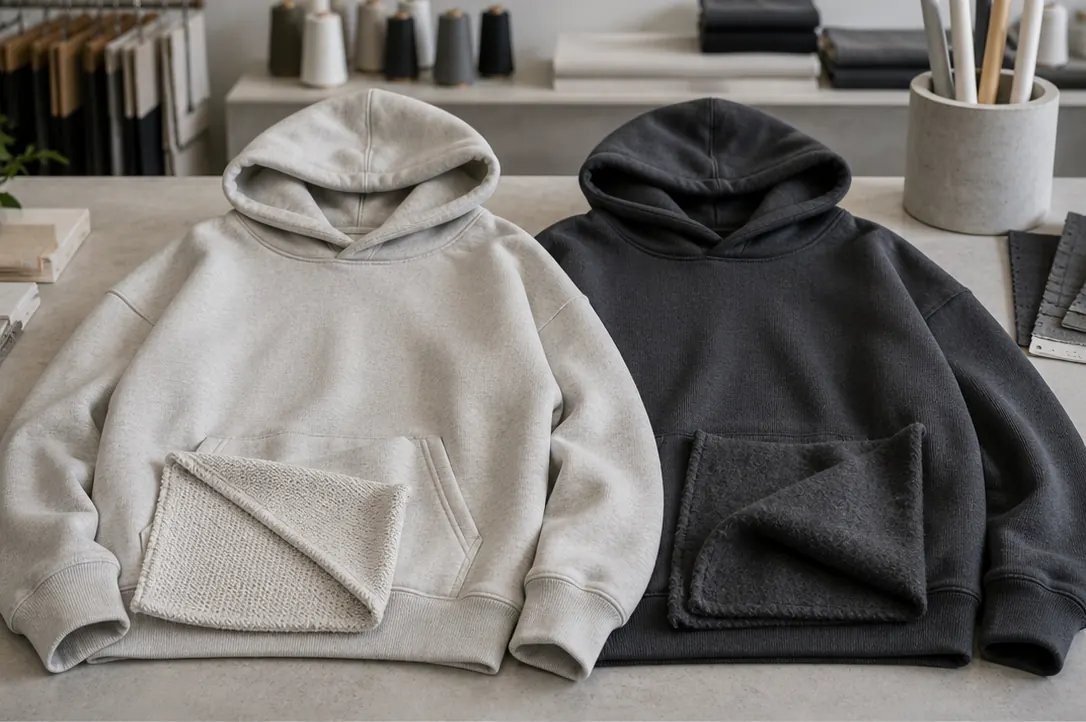
French terry is a knitted fabric with a comparatively smooth face and visible loops on the reverse. The loopback structure can absorb moisture and provide body without the full raised surface of brushed fleece. Fibre composition, yarn size, loop length, density, finishing and weight all influence the result.
The Nooteboom French terry guide describes it as a comfortable structure for relaxed garments and moderate warmth. That general description is useful, but a sourcing specification still needs the exact mill reference and testable properties.
What is brushed sweatshirt fleece?
Brushed fleece for hoodies generally begins as a knit structure whose reverse is mechanically raised to create a soft pile. Brushing changes surface area, loft and insulation. It can also influence lint, pilling, shrinkage and the way the garment handles during cutting and sewing.
“Fleece” is a broad commercial term. Ask whether the fabric is cotton-rich, polyester-rich or blended; whether it is two-end or three-end; how heavily it is brushed; and whether the supplied swatch represents the final dyed and finished bulk fabric.
French terry vs fleece hoodie comparison
| Decision factor | French terry | Brushed fleece |
|---|---|---|
| Reverse surface | Visible uncut loops | Raised, soft pile |
| Typical thermal feel | Moderate warmth and more open hand | Warmer, loftier interior |
| Visual structure | Loopback texture inside | Plush brushed texture inside |
| Seasonal use | Layering and transitional ranges | Cold-weather or comfort-focused ranges |
| Development risk | Loop snag, shrinkage and skew require review | Pilling, lint, matting and shrinkage require review |
| Decoration planning | Smooth face may support several methods | Face and loft still need decoration testing |
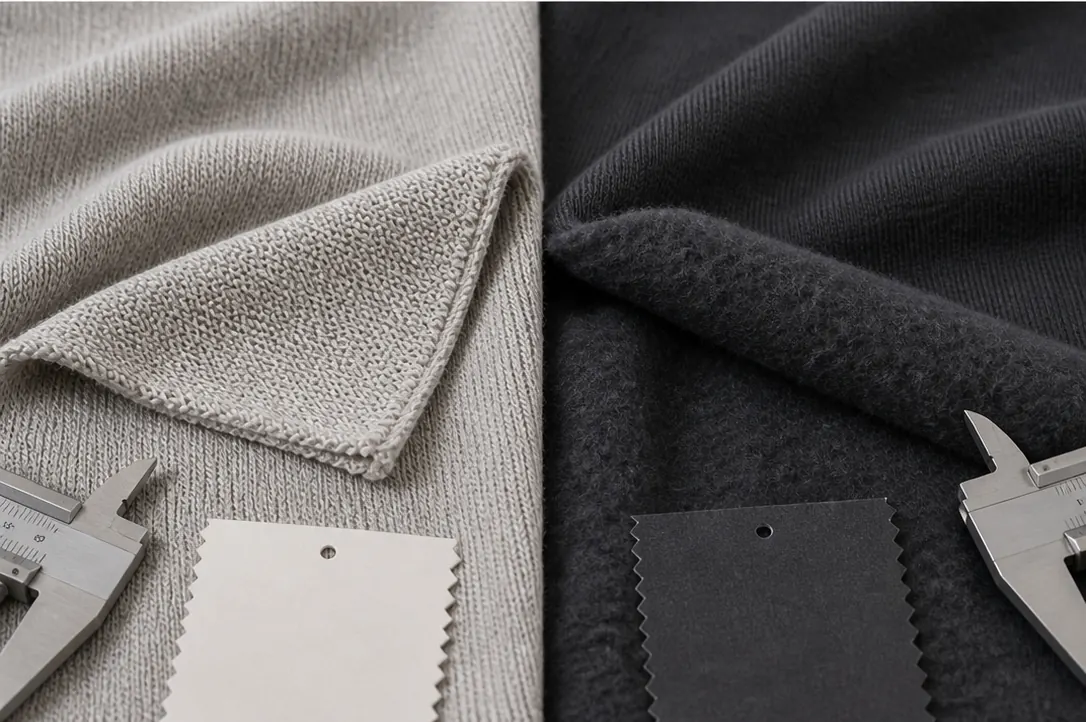
These are tendencies, not guarantees. A dense heavyweight French terry can feel warmer than a lightweight fleece, and finishing can change both fabrics substantially.
Use the French terry vs fleece hoodie comparison as a decision framework, then verify the chosen mill reference in the final garment.
Does GSM settle a French terry vs fleece hoodie decision?
GSM means grams per square metre and describes mass per area. It does not directly define thickness, warmth, fibre quality, stretch, recovery, softness or durability. A compact knit and a lofty brushed fabric can share a GSM yet feel unrelated.
Use GSM as one controlled data point. Record the agreed test method, sample condition and tolerance. Compare thickness, stretch, recovery, drape and finished-garment weight alongside it. The final hoodie must also work with rib, hood layers, pocket and decoration.
How do composition and yarn affect the decision?
Cotton-rich options
Cotton-rich fabrics can offer a familiar natural hand and surface for streetwear, but fibre length, yarn system, dyeing and finishing influence pilling and stability. Do not approve only the fibre percentage.
Cotton-polyester blends
Blends can support strength, recovery, drying behaviour or cost targets, depending on construction. They can also change colour response, print compatibility and hand feel. Confirm the exact blend and whether different yarns appear on face and back.
Elastane or stretch components
Stretch fibres may be used for recovery or fit, but the amount, placement and heat sensitivity matter. Test the actual fabric with sewing and finishing rather than inferring performance from content alone.
How does brushing change fleece?
Brushing lifts fibres on the reverse to create softness and loft. The intensity and number of passes can change appearance and performance. Excessive or inconsistent brushing may create loose fibre, uneven shade, matting or pilling. Light brushing produces a different result from a dense plush back.
Fersan Tekstil’s French terry fabric page distinguishes loopback and brushed variants, illustrating why “French terry” and “fleece-backed” can overlap in supplier terminology. Request a physical swatch and define the reverse finish explicitly.
Which French terry vs fleece hoodie fabric supports structure?
Structure depends on more than weight. Knit density, thickness, recovery, finishing and pattern all influence whether a hoodie stands away from the body or collapses softly. A double-layer hood in heavy fleece may become bulky; a loopback fabric with sufficient body may create a cleaner hood without as much loft.
Evaluate the complete sample with pocket, rib, hood and seams. A flat swatch cannot show how the finished garment balances across the shoulders or how the hem rib controls the body.
What should a French terry vs fleece hoodie test cover?
- Composition and construction verification appropriate to the order
- Fabric weight using the agreed method
- Thickness, width and usable width
- Stretch and recovery in relevant directions
- Dimensional change after the proposed care cycle
- Spirality or skew where relevant
- Pilling and surface appearance
- Colourfastness appropriate to end use and colourway
- Brushed-fibre shedding or matting
- Decoration adhesion, penetration and appearance
The selected methods and acceptance limits should reflect destination requirements, claims and customer specifications. Do not cite a certificate for a different fabric lot as proof for the current order.
How should decoration be sampled?
Screen printing, heat transfer and embroidery interact with the face yarn, surface finish, stretch and heat response. A smooth face can help, but “smooth” is not a measurable approval by itself. Apply the actual artwork at production scale and position.
After decoration, wash the garment and inspect cracking, edge lift, dye migration, puckering, show-through, needle damage and hand feel. Embroidery also needs suitable backing and density. Confirm the final method through samples rather than assuming one setting suits both French terry and fleece.
How should a fabric approval package be built?
- Identify the mill or supplier reference: Assign a controlled code to each candidate.
- Record construction and composition: Include face, back and yarn details where available.
- Measure physical properties: Use the agreed conditioning and methods.
- Create lab dips or colour samples: Approve colour on the actual construction.
- Sew a complete hoodie: Use intended rib, thread, hood and pocket construction.
- Apply real decoration: Test the artwork, process and size planned for production.
- Launder and remeasure: Review dimensions, surface, colour and decoration.
- Seal the final standard: Keep a signed swatch and garment with revision records.
Common fabric-selection mistakes
Buying only by GSM
The same number can describe compact or lofty structures with different drape and warmth. Approve construction, surface and garment behaviour.
Calling every loopback fabric fleece
Terminology varies. Photograph the face and reverse, describe whether loops are visible or brushed, and attach the exact approved swatch.
Approving an undyed handloom only
Dyeing, washing and finishing may change shrinkage, shade, hand and width. Final approval should reflect the intended bulk process.
Ignoring rib compatibility
Body fabric and rib must work together in weight, stretch, recovery and colour. A good body fabric can still produce a poor hoodie when rib tension is wrong.
French terry vs fleece buyer checklist
This French terry vs fleece hoodie checklist should accompany the signed swatch and finished sample.
- Fabric name supported by face and reverse description
- Composition, construction, GSM and finish documented
- Final dyed colour and wash approved
- Stretch, recovery and shrinkage reviewed
- Pilling, lint and surface change checked
- Hood, pocket and rib tested on the full garment
- Decoration sampled and laundered
- Signed swatch and production reference retained
Frequently asked questions
Is French terry cooler than fleece?
It often feels less insulating because the reverse remains looped rather than fully brushed, but weight, density, fibre and finish can reverse that expectation. Compare actual samples.
Is fleece always heavier?
No. GSM and thickness vary widely in both categories. A fabric name does not determine weight.
Which is better for heavyweight streetwear?
Either can work. Choose according to desired structure, interior texture, season, wash, decoration and garment balance.
Can French terry be brushed?
Supplier terminology varies, and some loopback structures are brushed to create a fleece-like reverse. Describe and approve the physical surface instead of relying on the name.
Which fabric pills less?
Pilling depends on fibre, yarn, knit, brushing, finishing and use. Request relevant test results and inspect washed samples.
Should the hood use the same fabric as the body?
It may, but a double layer can become bulky. A compatible lining can be considered if its shrinkage, stretch, colour and seam behaviour are approved.
Conclusion
A useful French terry vs fleece hoodie decision compares verified structures, not marketing names. Control the exact fabric reference, test the finished garment and retain a signed production standard that the supplier can reproduce.
Sourcing a private-label hoodie? Contact Aimer Custom Lab with your target hand feel, GSM range, composition, wash, size plan and artwork. Confirm fabric availability, sampling, MOQ and production timing for the specific development.