Streetwear Garment Wash Guide for Better Finishes
Streetwear garment wash development changes color, hand feel, surface character, shrinkage, and the final measurements of tees, hoodies, and tracksuit pieces. A wash name such as “vintage” or “enzyme” is only a direction, not a production specification. Private-label buyers need an approved fabric, dye route, wash recipe reference, measurement method, and sealed sample before bulk production. This guide explains the critical choices and controls.
Quick Answer
For a repeatable streetwear garment wash, define the desired look with physical references, select a fabric and construction compatible with the process, run a sample on the actual garment, measure shrinkage before and after conditioning, test colorfastness and component behavior, and approve a written standard that includes acceptable variation. Repeat approval if fabric, dye lot, trim, print, or wash route changes.
Why Streetwear Garment Wash Changes the Product
Garment washing happens after a product has been cut and sewn, so every component experiences the process together. Fabric relaxes, yarns move, seams pucker, rib contracts, thread responds, prints age, and metal or plastic trims can mark the surface. This creates the lived-in character valued in streetwear, but it also creates risk when the pattern and materials were developed only for an unwashed garment.
The wash can make two garments from the same nominal size fit differently if load, time, temperature, chemistry, mechanical action, drying, or conditioning varies. Good development therefore treats wash as an engineering input as well as an aesthetic finish.
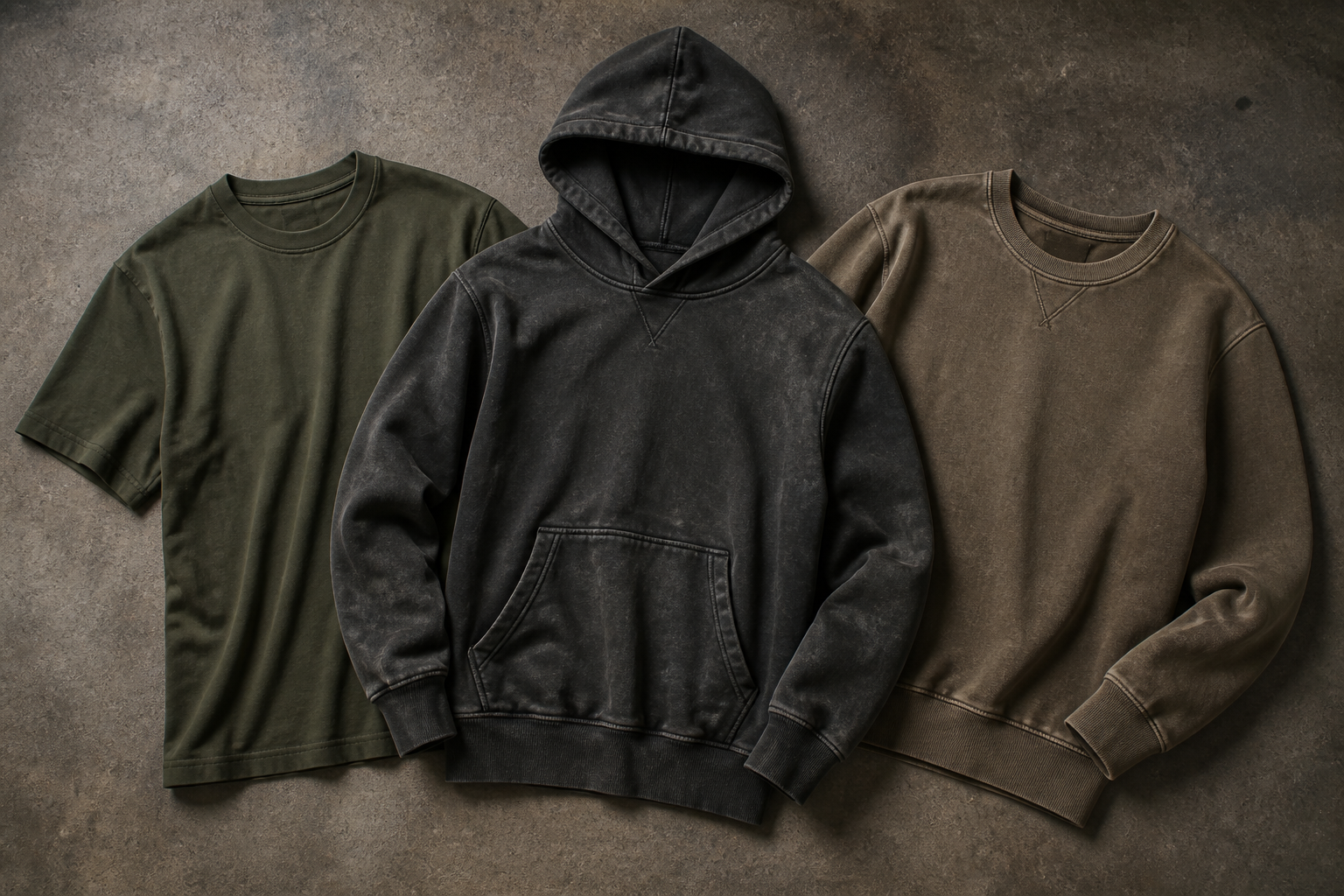
Streetwear Garment Wash: Common Finish Directions
| Direction | Typical visual or hand effect | Key buyer risk |
|---|---|---|
| Rinse or soft wash | Cleaner hand and removal of process residues | Unexpected relaxation shrinkage |
| Enzyme wash | Softer surface and reduced fuzz on suitable cotton-rich fabrics | Overprocessing can weaken fabric or change shade |
| Garment dye | Color applied after sewing with natural variation at seams | Trim, thread, labels, and panels may take color differently |
| Pigment-dye effect | Washed, aged surface with characteristic highs and lows | Rubbing transfer and shade variation require control |
| Stone or abrasive effect | Pronounced worn character | Damage at seams, prints, edges, and hardware |
| Acid or high-contrast effect | Strong irregular visual pattern | High piece-to-piece variation and difficult repeatability |
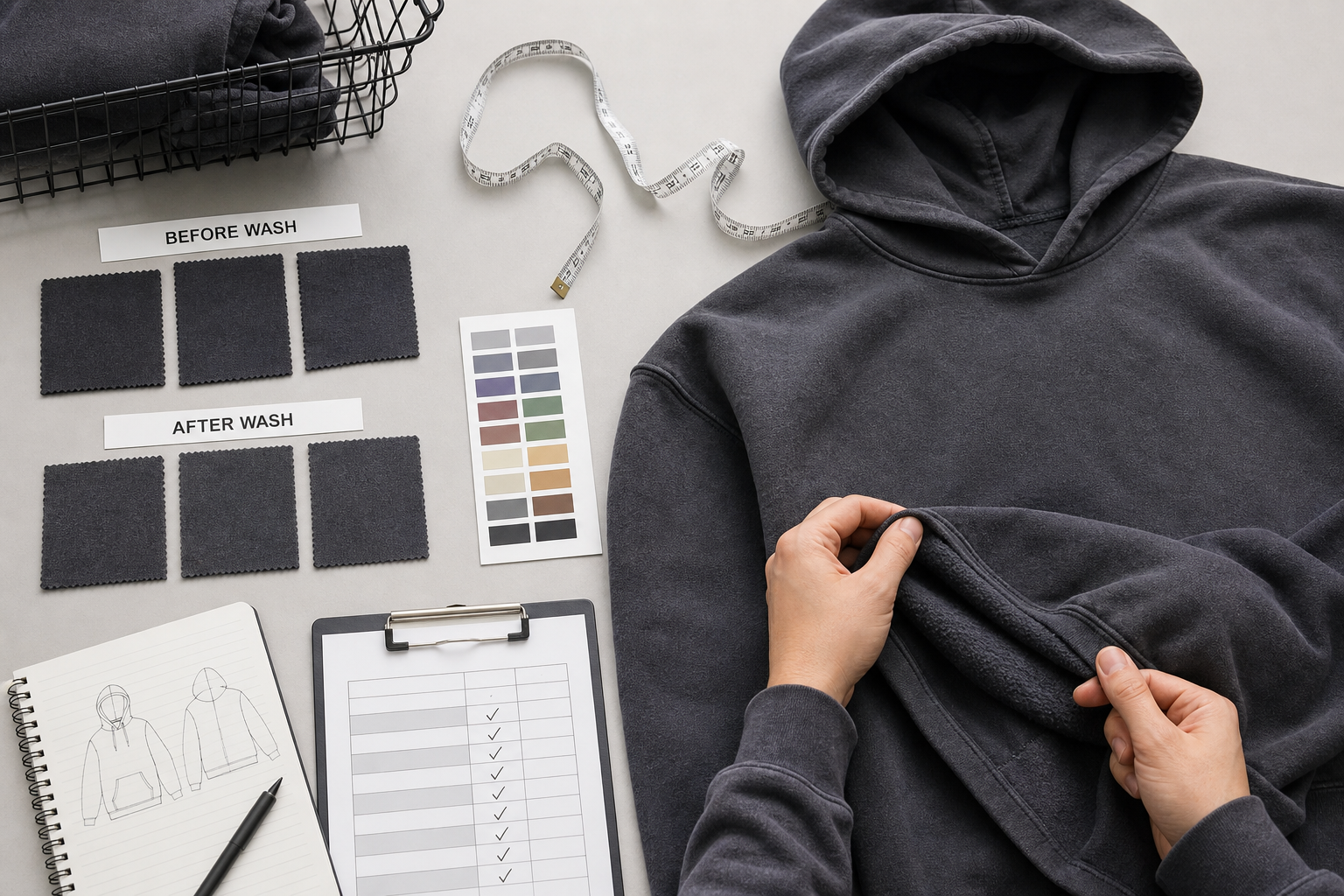
Wash approval should compare color, surface, measurements, seams, print, labels, and trims on the complete garment.
Streetwear Garment Wash and Fabric Selection
Fiber content is the starting point. Cotton, polyester, blends, elastane, and different yarn systems react differently to dye and mechanical action. Fabric weight in GSM helps describe mass but does not predict every wash result. Knit structure, yarn twist, compacting, finishing, and surface brushing also influence shrinkage and appearance.
Approve the exact fabric reference, not only a generic description such as “heavy cotton.” If the style uses rib cuffs, hood lining, mesh, pocket bags, or contrast panels, include them in the trial. A washed black body and rib can appear mismatched even when both were ordered as black.
Streetwear Garment Wash and Pattern Allowance
The finished measurement chart should describe the garment after the approved wash and conditioning method. Before cutting, the pattern maker needs expected length and width change by fabric direction. A single shrinkage percentage may be insufficient because body length, chest width, sleeve length, rib, and seam areas can change differently.
Run a pilot sample and record measurements before wash, after wash, after drying, and after conditioning. Adjust the pattern from actual data. Recheck more than one size because oversized grading, heavy pockets, and different panel shapes can affect relaxation. The goal is not to make the pre-wash sample match the final spec; it is to make the finished garment match.
Streetwear Garment Wash Color Approval
Use physical standards
Screen images are useful for direction but cannot define a washed surface accurately. Approve a sealed garment, cut swatch, or wash blanket from the intended route. Record the fabric lot and sample date. For intentionally irregular finishes, approve a range showing the lightest and darkest acceptable results.
Review color under consistent light
Compare samples in a repeatable viewing environment. Check the front, back, seams, rib, pocket edges, hood, and areas under labels. Look for unwanted streaks, pressure marks, contamination, and sudden contrast rather than only averaging the overall shade.
Test transfer and care behavior
Deep pigment and garment-dyed colors can transfer by rubbing or washing. Specify relevant colorfastness testing for the material, color, intended use, care label, and sales market. CottonWorks publishes educational material on cotton dyeing and colorfastness; a qualified laboratory should perform any required formal test.
Streetwear Garment Wash with Printing and Embroidery
Decide whether decoration is applied before or after the garment wash. Printing before wash can create an aged appearance but exposes the print to chemistry, heat, and abrasion. Printing after wash can improve graphic consistency but requires the finished garment to be flat and stable enough for registration. Embroidery thread, backing, foam, patches, and adhesives also need process compatibility.
Approve the sequence in the tech pack. Review cracking, peeling, color change, staining, puckering, thread damage, and adhesive failure. When artwork sits across a seam or pocket, check whether wash distortion changes alignment.
Streetwear Garment Wash and Trim Compatibility
- Zippers should operate smoothly and show no damaging corrosion, chipping, or staining.
- Snaps, eyelets, rivets, and drawcord tips should remain secure and free from sharp edges.
- Labels must remain legible and must not bleed onto the garment.
- Drawcords and elastics should retain acceptable length and recovery.
- Thread color should coordinate after wash and seams should remain strong.
- Interfacing and fused areas should not bubble, delaminate, or create hard patches.
- Packaging should not begin until garments are fully dry, conditioned, and free from loose residues.
Streetwear Garment Wash Sample Approval Workflow
- Define the target: use clear physical references and state the desired hand, contrast, and aging level.
- Confirm materials: list fabric, rib, thread, labels, trims, print, and embroidery.
- Make a lab or pilot trial: process the actual garment construction.
- Condition and measure: follow one timing and measurement method.
- Review appearance: approve a master and, when needed, an acceptable range.
- Run performance checks: select colorfastness, dimensional stability, seam, and trim tests appropriate to the product.
- Approve a size set: verify the final measurements and proportions across key sizes.
- Lock the route: record version, load conditions, and all approved exceptions.
- Inspect bulk: compare early, middle, and late production plus multiple cartons.
Streetwear Garment Wash Bulk Quality Control
Bulk wash control should monitor load composition and process consistency. Mixing styles, colors, fabric lots, or very different garment weights can change mechanical action and shade. The factory should identify lots so a problem can be traced. First-off approval is essential before the entire order is processed.
Inspect color range, hand, measurements, twisting, seam puckering, holes, edge damage, print, embroidery, trims, odor, and cleanliness. Randomly measure garments after the agreed conditioning time. If intentional variation is part of the design, separate acceptable character from defects using visual limit samples.
Common Streetwear Garment Wash Failures
Unexpected shrinkage
The fabric was not tested through the final route or the pattern allowance used generic assumptions. Correct with actual pre- and post-wash data and reconfirm graded sizes.
Uneven or stained color
Overloading, poor circulation, incompatible trims, loose dye, contaminated equipment, or inconsistent drying can create marks. Identify the process cause instead of hiding the garment in a darker shade.
Damage at seams and edges
Abrasion concentrates at pocket corners, cuffs, hems, and raised seams. Review construction strength and reduce process severity if the aesthetic gain does not justify the durability loss.
Frequently Asked Questions
Is enzyme wash the same as garment dye?
No. Enzyme treatment modifies suitable fibers or surface character, while garment dye applies color after sewing. A style may use both, but they are different process decisions.
Can every hoodie receive a vintage wash?
No single process suits every fiber, print, zipper, label, and construction. Compatibility must be tested on the complete sample.
How much variation is normal?
It depends on the intended effect and process capability. Approve physical upper and lower visual limits rather than relying on vague language such as “slight variation.”
When should measurements be taken?
Use a defined point after washing, drying, and conditioning. Measuring hot or damp garments can produce misleading results.
What should buyers send for sampling?
Provide the style tech pack, target finish references, fabric and color direction, decoration files, finished measurements, care expectations, destination market, and required tests.
Conclusion: Approve the Wash as a Production System
A successful streetwear garment wash connects material, pattern, construction, color, decoration, trim, drying, conditioning, and inspection. Physical standards and written measurement data make the desired vintage character repeatable without pretending every piece will be visually identical.
Review our streetwear manufacturing capabilities and custom oversized T-shirt development. For an order-specific wash trial, contact us with your garment and finish references. For technical background, see CottonWorks finishing education.