Streetwear First Article Inspection Guide

Quick Answer: Streetwear first article inspection verifies the first completed unit produced with intended bulk materials, patterns, machinery, artwork and packing instructions before output continues. Compare it with the approved specification and reference sample, record measured results and defects, then release, correct or hold the process through named authority rather than verbal acceptance.
A first article is useful because it tests whether released information survives translation into real production. A correct sample made earlier by a specialist does not prove that the bulk line, actual fabric lot, decoration equipment and packing team are aligned.
The inspection should focus on repeatability, not on finding one attractive piece. The unit must be traceable to the materials, settings and operators that will continue the order so approved results can be reproduced and rejected conditions can be corrected at source.
What is streetwear first article inspection?
Streetwear first article inspection is a documented comparison of an early production unit and its manufacturing conditions against the approved product and process requirements. It is useful only when the represented order, revision and evidence boundary are explicit.
Key entities include first article ID, style, colour, size, order revision, pattern version, material lot, machine or process setting, artwork file, measurement point, tolerance, workmanship defect, label, packing state, corrective action and release status. These entities should remain connected across the specification, physical goods and final record so a later reviewer can understand exactly what was checked.
Why does streetwear first article inspection matter before release?
It catches systematic risk before many units inherit the same wrong pattern, seam, artwork position, trim or label. It also creates a release record that separates evidence-based approval from a casual “looks fine” judgment.
The control should be proportional to the order risk and agreed buyer requirements. It must not manufacture missing information: an unread value is unknown, an unavailable record is a coverage gap, and a pending decision is not a pass.
Which buyer decisions belong in the control?
Translate the order into named decisions before asking an operator or inspector to act. A decision table prevents visual similarity, convenience or old files from replacing the current approved basis.
| Decision | Evidence question | Output |
|---|---|---|
| Identity | Does the unit match the PO, style, colour, size and active revision? | Traceable article |
| Materials | Are body, rib, lining, trims and decoration inputs from intended bulk lots? | Representative construction |
| Measurements | Are required points measured by the stated method and within tolerance? | Reproducible fit result |
| Workmanship | Do seams, symmetry, pressing and finishing meet the approved standard? | Defect record |
| Decoration and labels | Are artwork, placement, colour and information correct? | Released branding and compliance details |
| Process release | Which settings or instructions must be retained before continuation? | Controlled bulk restart |
Commercial discussions may influence priorities, but they should not rewrite technical evidence. Any condition that changes the represented product or shipment needs documented approval and an updated revision.
Which standards and source records set the evidence boundary?
Use current authoritative guidance to define method, terminology and reporting boundaries. Review SGS product inspection, SGS textiles and clothing, SGS pre-shipment inspection.
These sources support method selection and evidence design. They do not certify either website, establish one universal pass value, or replace the buyer-approved specification, route, market requirement or test plan for the actual order.
How should buyers run the streetwear first article inspection workflow?
Freeze the inputs, execute a reproducible check, control exceptions and issue a named release decision. Identify the order, represented style, revision, responsible person and dated outcome at every step.
- Freeze the order and product references used for comparison.
- Choose a first article made with intended bulk inputs and normal process conditions.
- Record article, line, date, operator, material lot and equipment identity.
- Verify style, colour, size and component completeness.
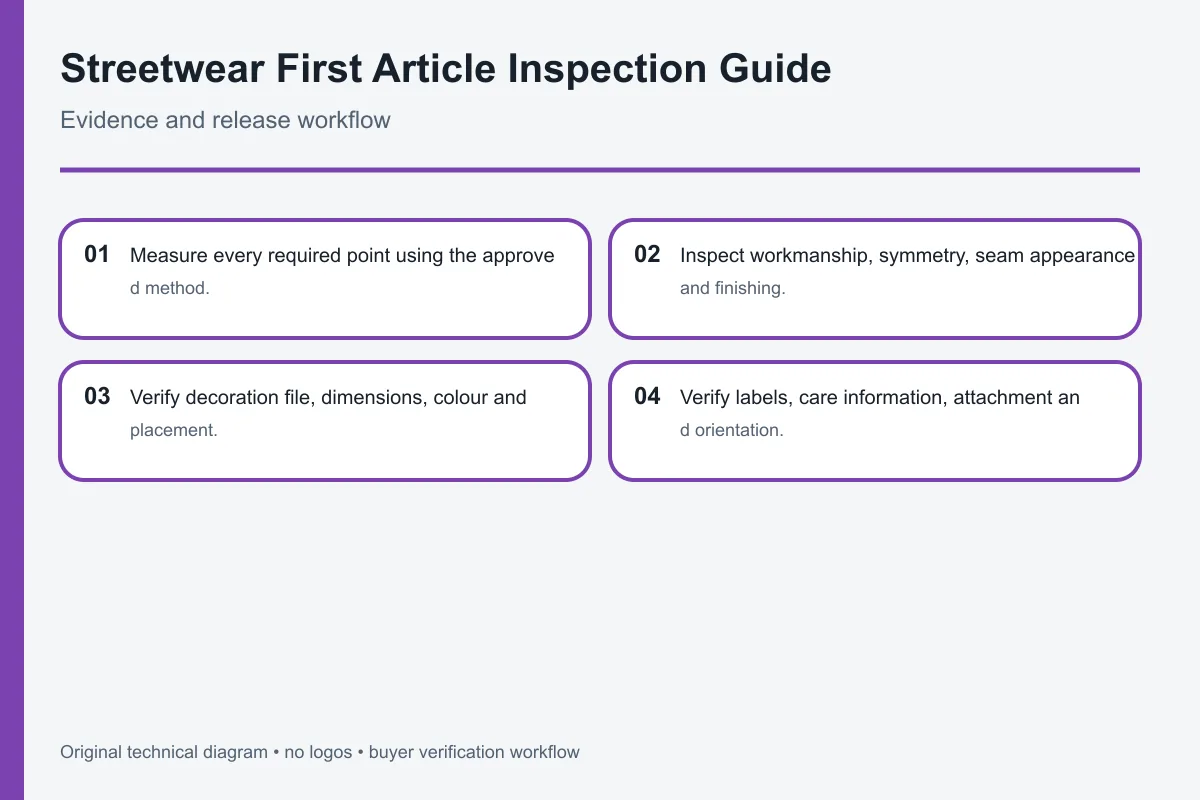
- Measure every required point using the approved method.
- Inspect workmanship, symmetry, seam appearance and finishing.
- Verify decoration file, dimensions, colour and placement.
- Verify labels, care information, attachment and orientation.
- Apply any required functional or handling check without inventing a universal test.
- Record result, defects, correction, recheck evidence and signed release status.
When an input changes, review the affected steps rather than assuming the earlier result still applies. Keep superseded records so the reason for a new decision remains traceable.
What evidence should be retained?
The evidence package should connect the approved instruction to the physical product or shipment and the final decision. Evidence should be readable, dated and explicit about any area that was not available.
| Evidence block | Minimum identity | Buyer verification |
|---|---|---|
| Reference pack | PO, tech pack, approved sample and active comments | Is there one comparison basis? |
| Article trace | unit ID, size, line, lot, equipment and time | Can the result be reproduced? |
| Measurement record | method, actual values, tolerance and result | Are fit decisions numerical? |
| Visual record | front, back, detail and defect images | Do images identify the same article? |
| Release record | decision, conditions, owner and recheck | Was continuation authorized? |
Use photographs as supporting evidence, not as a replacement for identity, measurements, quantities or method. The record should allow another reviewer to distinguish observation from assumption.
How should results and exceptions be interpreted?
Interpret the result only inside the recorded scope and conditions. A local pass does not erase an uncovered order line, changed input or unresolved exception.
| Finding | Meaning | Required action |
|---|---|---|
| Conforming and representative | The process can continue under recorded conditions | Release and retain settings |
| Conforming but nonrepresentative | The unit does not prove normal bulk repeatability | Repeat with intended material or line conditions |
| Systematic defect | Continued output would repeat the issue | Hold, correct root condition and reinspect |
| Isolated damage | The individual unit failed but process risk is uncertain | Segregate and investigate before deciding scope |
Correction should preserve traceability to the original finding. If correction changes the represented item or pack, define the recheck before release instead of relying on an undocumented visual review.
What failure modes should the buyer prevent?
The main risk is a clean-looking record that does not represent the actual order.
- Selecting a specially repaired showpiece.
- Inspecting before all operations are complete.
- Using sample-room material instead of the bulk lot.
- Recording only pass or fail without actual measurements.
- Changing a machine setting without recording it.
- Ignoring labels or packing because garment appearance passed.
- Releasing production before corrective recheck.
- Treating a first article as a substitute for in-line and final inspection.
These failures are prevented through revision control, representative selection, explicit unknowns and named release authority—not by adding unsupported claims or arbitrary numbers.
What belongs in the pre-release checklist?
Use a short checklist only after the detailed method and acceptance basis are agreed.
- Active PO and revision are present.
- Article uses intended bulk materials.
- Unit and process are traceable.
- Measurements use the approved method.
- Workmanship and symmetry are checked.
- Decoration and placement are verified.
- Labels and packing are inspected.
- Defects have clear locations and severity.
- Correction has an owner.
- Release status and conditions are signed.
If one required item cannot be verified, mark it pending or unavailable and pause the affected judgment. Do not convert the gap to zero or quietly remove it from the checklist.
How did high-traffic and fast-growth peer learning improve this guide?
Peer learning was used only for information architecture and buyer usability. No competitor wording, branded artwork, commercial claim or product design was copied.
| Dimension | Peer-page finding | Specific application | Public evidence marker |
|---|---|---|---|
| SEO | Represent groups return inspection around explicit questions, item condition and a numbered handling path. | Built a procurement decision matrix and descriptive cluster links for streetwear first article inspection. | ACL-FAI-SEO buyer decision matrix |
| AEO | mnml states the returned-item inspection outcome and eligibility conditions immediately before supporting detail. | Placed a direct 40–70 word answer before the detailed workflow and answered every question heading first. | ACL-FAI-AEO answer-first workflow |
| GEO | The peer pages name observable condition entities such as tags, original packaging, wear, damage, alteration and packing-list identity. | Defined first article ID, style, colour, size, order revision, pattern version, material lot, machine or process setting, artwork file, measurement point, tolerance, workmanship defect, label, packing state, corrective action and release status and tied judgments to authoritative sources and stated limits. | ACL-FAI-GEO entity and evidence boundary |
The structure brings clear product-page decision patterns into a technical sourcing guide while preserving original language, independent evidence and the procurement context.
How were authority findings applied?
| Research source | Original application | Visible evidence |
|---|---|---|
| SGS product inspection | Applied inspection planning and conformity evidence without treating the source as supplier certification or a universal pass rule. | definition and decision table |
| SGS textiles and clothing | Applied textile and apparel testing context without treating the source as supplier certification or a universal pass rule. | workflow and evidence table |
| SGS pre-shipment inspection | Applied final verification boundaries and reporting without treating the source as supplier certification or a universal pass rule. | interpretation and FAQ boundary |
The answer-first boundary supports AEO. Stable entities, source links, decision conditions and explicit unknowns support GEO without promising inclusion in any AI answer.
Frequently asked questions about streetwear first article inspection
Is first article inspection the same as final inspection?
No. It verifies an early representative unit and process before continued output; final inspection evaluates the completed shipment under its defined plan.
Which size should be inspected?
Use the size or sizes defined by the buyer and risk plan. A single size may not represent grading, artwork or construction differences across the range.
Can production continue while results are pending?
Only when the buyer-approved control plan explicitly permits a limited conditional release and defines the boundary. Otherwise hold the affected operation.
Should destructive tests be performed on the first article?
Use only tests required by the applicable specification and sampling plan, with a replacement and traceability plan where the tested unit cannot ship.
Does approval guarantee the whole order?
No. It confirms the represented unit and recorded conditions; in-line and final controls remain necessary.
Conclusion: release only what the evidence represents
Streetwear first article inspection is a documented comparison of an early production unit and its manufacturing conditions against the approved product and process requirements. A robust process connects current inputs, representative physical evidence, exception control and named authority. The result should make the next receiving, production or shipment decision easier without overstating what was checked.
Continue with streetwear capabilities, custom hoodie set, contact the sourcing team. Share the style, intended market, active specification and required evidence so project-specific options can be confirmed rather than assumed.