Streetwear Fabric Bow and Skew Test Guide
Quick Answer — streetwear fabric bow and skew test: Relax and condition production-intent fabric, select the correct method, and measure bow or skew at distributed roll locations using the relevant yarn, course, stripe or printed reference. Record individual and maximum results, map affected zones, and assess cutting yield and finished-garment balance. Treat post-wash T-shirt spirality as a related but separate observation.
A streetwear fabric bow and skew test checks whether yarns, courses, stripes, checks or printed references stay square to the fabric edges. Bow curves across the width; skew shifts on an angle. The distortion can make a striped overshirt look uneven, rotate hoodie panels, move pocket placements or create asymmetry that becomes more obvious after cutting and laundering.
This buyer guide connects the result with the streetwear product range and private-label manufacturing capabilities. It does not invent a universal pass value, certification, production capacity, minimum order or lead time. The brand, supplier and appointed laboratory should agree order-specific methods and acceptance rules before testing.
What is streetwear fabric bow and skew test?
ASTM D3882-08(2020) describes bow and skew measurements for woven and knitted fabrics and printed geometric designs.
ASTM D3882-08(2020) describes bow and skew measurements for woven and knitted fabrics and printed geometric designs. Bow is a curved displacement across the width; skew is angular displacement. ISO 13015:2013 covers skew and bow in woven fabrics. Buyers must select a method that fits the construction and identify the exact reference being measured.
The applicable authority for this article is ASTM D3882-08(2020). A standard describes a controlled method; it does not automatically create a commercial tolerance for every product. Record the exact edition, procedure, specimen state and any deviation so another reviewer can interpret the result.
Why does this issue matter for buyers?
The issue can alter appearance, consistency, durability or the validity of the approved sample.
Streetwear amplifies geometry through oversized panels, drop shoulders, visible topstitching, chest pockets, checks, stripes and large prints. Fabric may be stressed during knitting or weaving, dyeing, stentering, compacting, coating, printing and winding. If distortion changes across the roll, marker compensation can waste fabric and still produce inconsistent garments.
Risk should be ranked by visibility, product function, material sensitivity, order size and cost of late correction. A buyer can then test the variables most likely to change instead of collecting generic reports that do not identify the style. Development evidence should be connected to the purchase order, approved bill of materials and sealed reference.
Which controls should be fixed before testing?
Freeze the sample identity, method, setup, reporting fields and decision owner before results are produced.
| Control | What to record | Buyer purpose |
|---|---|---|
| Construction | Woven, knit, stripe, check or print | Selects the reference |
| Relaxation | Time, support and conditioning | Removes temporary tension |
| Location map | Width and roll-length coordinates | Shows variation |
| Result | Individual, maximum and direction | Supports cutting decision |
| Garment evidence | Pocket, hem, side seam and print alignment | Confirms product impact |
How should buyers run a streetwear fabric bow and skew test workflow?
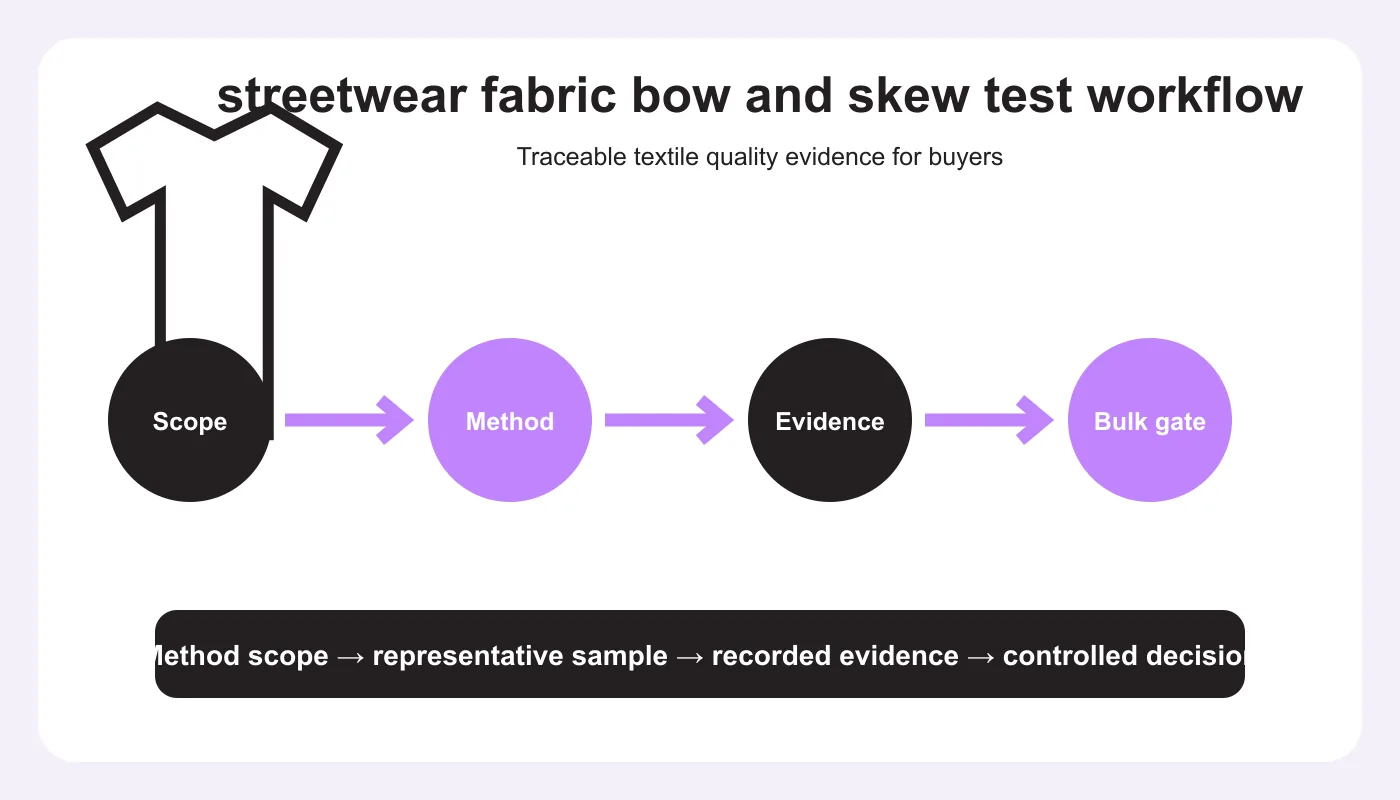
Use staged gates from development through representative bulk confirmation.
1. Identify alignment-critical design elements
Start with the approved product brief and record the exact sample, revision and responsible reviewer. For this stage of the streetwear fabric bow and skew test workflow, use production-intent materials rather than a convenient substitute. Photograph the setup, retain individual observations, and link any correction to the next approval gate. This prevents an isolated laboratory or line result from losing its purchasing context.
2. Condition representative roll sections
Start with the approved product brief and record the exact sample, revision and responsible reviewer. For this stage of the streetwear fabric bow and skew test workflow, use production-intent materials rather than a convenient substitute. Photograph the setup, retain individual observations, and link any correction to the next approval gate. This prevents an isolated laboratory or line result from losing its purchasing context.
3. Mark fabric edges and reference lines
Start with the approved product brief and record the exact sample, revision and responsible reviewer. For this stage of the streetwear fabric bow and skew test workflow, use production-intent materials rather than a convenient substitute. Photograph the setup, retain individual observations, and link any correction to the next approval gate. This prevents an isolated laboratory or line result from losing its purchasing context.
4. Measure bow and skew separately
Start with the approved product brief and record the exact sample, revision and responsible reviewer. For this stage of the streetwear fabric bow and skew test workflow, use production-intent materials rather than a convenient substitute. Photograph the setup, retain individual observations, and link any correction to the next approval gate. This prevents an isolated laboratory or line result from losing its purchasing context.
5. Overlay the result on the marker plan
Start with the approved product brief and record the exact sample, revision and responsible reviewer. For this stage of the streetwear fabric bow and skew test workflow, use production-intent materials rather than a convenient substitute. Photograph the setup, retain individual observations, and link any correction to the next approval gate. This prevents an isolated laboratory or line result from losing its purchasing context.
6. Approve a finished size set
Start with the approved product brief and record the exact sample, revision and responsible reviewer. For this stage of the streetwear fabric bow and skew test workflow, use production-intent materials rather than a convenient substitute. Photograph the setup, retain individual observations, and link any correction to the next approval gate. This prevents an isolated laboratory or line result from losing its purchasing context.
How should results be interpreted without overclaiming?
Interpret the result only within the method, specimen and product question that were documented.
Keep individual readings or observations, not only a rounded average or a coloured “pass” cell. Review location patterns, replicate spread, test uncertainty where supplied and deviations from the approved procedure. A borderline value should trigger clarification or repeat testing under the same conditions, not a changed method selected after the result is known.
Laboratory evidence and garment approval answer different questions. A controlled method supports comparison, while the finished streetwear garment confirms construction, fit, appearance and intended care. Neither should silently replace the other. If a marketing claim is planned, the responsible brand must ensure that its wording matches the actual evidence and destination-market requirements.
Which mistakes can make the evidence misleading?
| Risk | Why it matters | Control |
|---|---|---|
| Edge omission | Distortion may be strongest near selvedges | Map full usable width |
| Tension during measurement | Stretch can straighten a distorted line | Relax and support specimen |
| Generic tolerance | A check shirt and solid fleece have different risk | Set product-specific criteria |
| Post-wash confusion | Spirality includes garment and laundering effects | Document the measured state |
streetwear fabric bow and skew test buyer checklist
- Record construction, width, colour, lot and finish.
- Name the method and reference line.
- Relax and condition specimens consistently.
- Measure several width and length positions.
- Report bow and skew separately.
- Map results to marker and pocket placement.
- Confirm representative sizes after care.
- Retest after mill or finishing changes.
How should a corrective action be documented?
State the observation, affected lot, requirement, suspected cause, containment action, process change and verification gate.
A vague request to “improve quality” is difficult to audit. Ask the supplier to identify what changed and how recurrence will be prevented. Keep the original evidence, root-cause review, corrected sample and retest result under one revision. If the material, component supplier, colour, finish, equipment route or construction changes, reopen the relevant approval rather than assuming the old report still applies.
Bulk sampling should be proportional to risk. Use the buyer-approved inspection level or laboratory plan, map samples to lots and locations, and preserve traceability through cutting and sewing. If the evidence cannot be linked to the actual production lot, it should not be used as proof for that order.
What belongs in the final approval record?
A complete record makes the decision reproducible. Keep the product code, colour, material or component lot, supplier reference, sample stage, test method, report number, date and named reviewer together. Add photographs made under controlled conditions, the sealed reference and the exact disposition. Record whether the evidence supports development, pre-production or bulk release; these gates are related but not interchangeable.
When several sites or suppliers are involved, use consistent terminology and revision numbers. The same focus keyword should describe the same technical entity throughout the brief, report and corrective action. That clarity helps a laboratory answer the intended question, helps a factory isolate affected work and helps a later buyer understand why the order was approved. It also creates concise, verifiable information that search engines and answer systems can interpret without relying on unsupported promotional claims.
Frequently asked questions
Do solid fabrics need bow and skew testing?
They may when structural lines affect cutting, seam balance or large prints, although the risk is easier to see in stripes and checks.
Can the marker be rotated to fix skew?
Sometimes limited adjustment helps, but it can reduce yield and cannot correct distortion that changes within the roll.
Is bow and skew a fabric or garment test?
The standard measurement is made on fabric references; garment inspection then confirms how the distortion affects the style.
Why inspect multiple roll locations?
Finishing and winding tension can vary across width and length, so one cutting may not represent the roll.
When should approval be reopened?
After changes in mill, construction, width, finishing, printing route or when bulk alignment differs from the sealed reference.
Conclusion: turn the test into a purchasing decision
A streetwear fabric bow and skew test makes alignment measurable before distorted cloth reaches the cutting table. Link the roll map to marker planning, size-set review and post-care appearance. Share stripes, checks, artwork and pocket tolerances with Aimer Custom Lab so the most important alignment zones can be controlled before bulk cutting.
For an order-specific plan, use the Aimer Custom Lab enquiry page and provide the product, material, colour, sample stage, intended market and evidence already available. Final requirements should be confirmed before bulk release.