Streetwear Fabric GSM Test: Buyer Guide
A streetwear fabric GSM test gives buyers a repeatable way to confirm whether the cloth used for a sample or bulk order matches the approved specification. GSM means grams per square metre. It measures mass per unit area, not softness, warmth, durability, or quality by itself. For oversized T-shirts, hoodies, sweatpants, tracksuits, and jackets, the result is useful only when the specimen, conditioning, cutting, weighing, calculation, and tolerance are all documented.
Quick answer: condition representative specimens, cut a known area with a calibrated cutter or accurately measured template, weigh each specimen on a suitable balance, convert the mass to g/m², and compare the average and individual results with the approved fabric specification. Record lot, colour, garment panel, test environment, specimen size, equipment, results, and any retest. Use the same written method for sample approval and bulk inspection.
Why a Streetwear Fabric GSM Test Matters
Fabric weight influences silhouette, drape, perceived substance, layering behaviour, and production handling. An oversized tee may lose its intended fall if the actual fabric is materially lighter than the approved sample. A fleece hoodie can feel different when the face, loop or brushed back, and finishing route change. However, a heavier number is not automatically better. Fibre content, yarn, knit construction, finishing, compactness, brushing, and moisture regain all affect performance.
For private-label sourcing, GSM is best treated as one controlled characteristic in a broader specification. It should sit beside composition, construction, width, shade, shrinkage, pilling, colourfastness, appearance, and approved hand feel. Buyers can align the test plan with the streetwear clothing sampling process and confirm available controls on the capabilities page.
Streetwear Fabric GSM Test: Method and Equipment
A recognised reference is ASTM D3776/D3776M, Standard Test Methods for Mass Per Unit Area (Weight) of Fabric. The standard provides procedures; it does not create one universal pass limit for every streetwear product. The purchase specification must define the agreed method and acceptance rule.
1. Define the Material and Sampling Point
State whether the test applies to incoming roll goods, cut panels, finished garments, or all three. Record the fabric supplier reference, colour, dye lot, finish, roll or batch, and garment style. Avoid cutting only from a convenient edge or one garment. A representative plan should cover the variation the buyer wants to control.
2. Condition the Specimens
Textile mass changes with moisture. Specimens should reach equilibrium in the agreed standard atmosphere before weighing. The report should record the temperature, relative humidity, and conditioning time or the referenced standard. Testing a damp piece beside a dry warehouse sample can create an apparent difference that is not a manufacturing difference.
3. Cut a Known Area
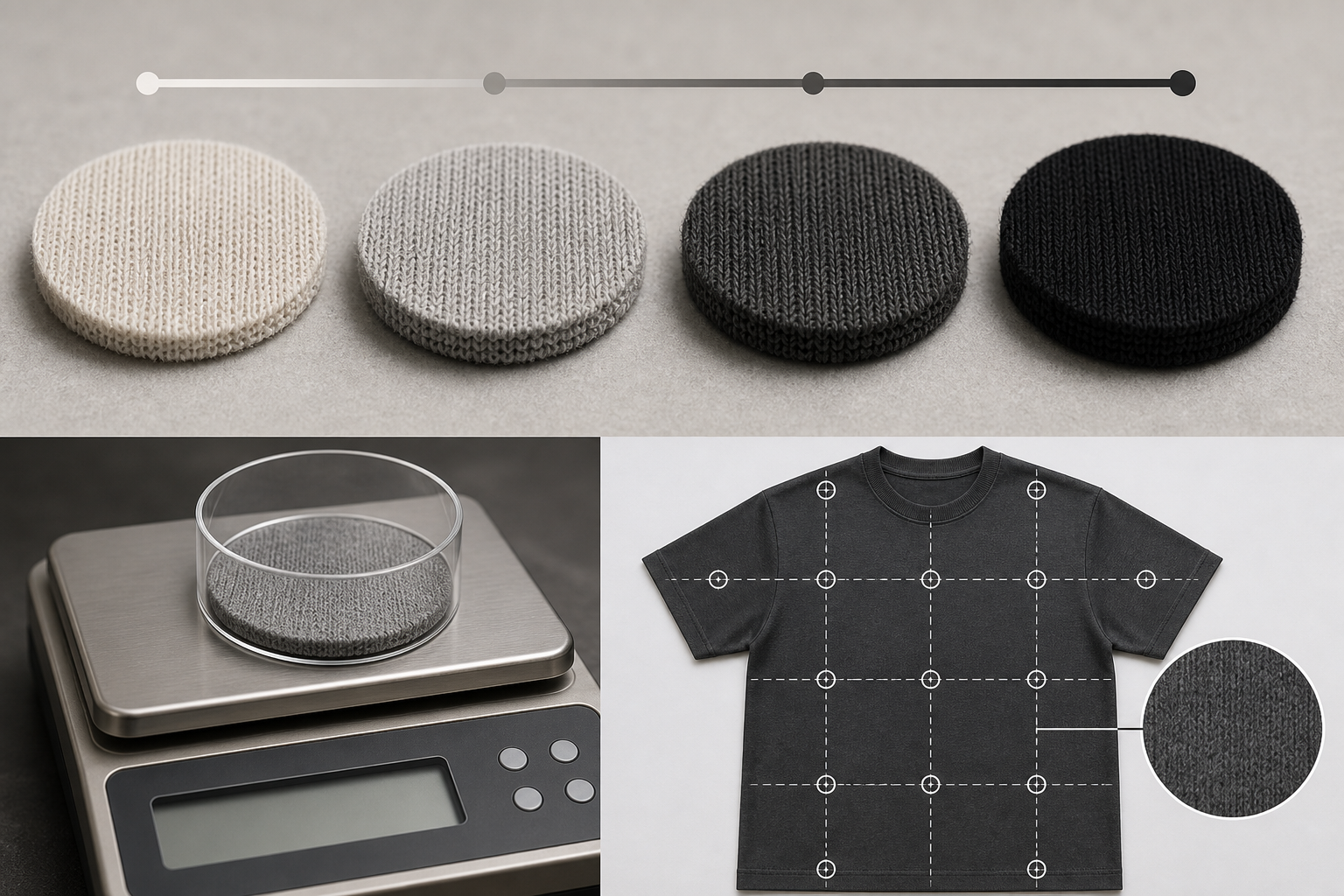
A circular GSM cutter is convenient because its area is fixed, but it must be sharp, clean, and verified. A measured square or rectangle can also work when the method allows it. Avoid seams, ribs, pockets, prints, labels, embroidery, brushed debris, or distorted edges unless those features are intentionally part of the test. Cut multiple specimens from different locations.
4. Weigh and Calculate
Use a balance with suitable resolution for the specimen size. Tare the container or paper if one is used. Calculate each result rather than reporting only an average. For a specimen with area A in square metres and mass M in grams, GSM equals M divided by A. A 100 cm² specimen is 0.01 m², so its mass is multiplied by 100. Do not apply the multiplier for one cutter to a specimen of another area.
Streetwear Fabric GSM Test Comparison Table
| Control point | Good practice | Common mistake | Buyer evidence |
|---|---|---|---|
| Sampling | Multiple representative locations and lots | One easy-to-reach swatch | Lot, colour, roll or garment ID |
| Conditioning | Agreed atmosphere and sufficient time | Weighing immediately after washing or unpacking | Temperature, humidity, duration |
| Area | Verified cutter or measured template | Wrong area multiplier | Cutter size and calibration record |
| Balance | Suitable resolution and clean weighing surface | Unstable or un-tared balance | Equipment ID and check status |
| Reporting | Individual values, average, range, and disposition | Average only | Signed test sheet and retest history |
| Acceptance | Written target and tolerance tied to the approved sample | Assuming heavier always passes | Specification revision and approval |
How to Build a Streetwear Fabric GSM Test Approval Rule
Start with the fabric specification and the approved development sample. Define the nominal GSM, tolerance, test stage, specimen count, averaging rule, and response when one result is outside the limit. If different colours or finishes are expected to behave differently, specify whether each colour is assessed separately. The rule should be agreed before bulk production, not invented after a dispute.
A useful approval plan distinguishes between an isolated result and a systematic shift. For example, the buyer may require an additional set of specimens when one value is unusual, while a lot average outside the agreed range may trigger review before cutting. The exact limits must come from the confirmed order specification; they should not be copied from another brand.
GSM Is Not a Complete Quality Claim
Two fabrics with the same GSM can feel and perform differently. A compact jersey and an open, brushed knit may share a number but have different thickness, stretch, recovery, air permeability, abrasion behaviour, and drape. Buyers should combine GSM with visual approval, hand-feel comparison, dimensional stability, and relevant performance tests.
Check Finished Garments as Well as Roll Goods
Finishing, washing, steaming, and relaxation can change mass per unit area. If the bulk garment includes a wash or special finish, the control plan should state whether testing occurs before finishing, after finishing, or at both stages. A result from raw greige fabric cannot automatically represent the final garment.
Streetwear Fabric GSM Test Checklist
- Confirm the nominal GSM and tolerance in the purchase specification.
- Identify the exact fabric, colour, lot, roll, style, and sample stage.
- Use representative specimens from more than one location.
- Condition specimens in the agreed textile atmosphere.
- Verify cutter area, blade condition, balance resolution, and tare.
- Avoid seams and decorations unless the method specifically includes them.
- Calculate and retain every individual result.
- Report average, minimum, maximum, and range.
- Link the result to the approved sample and specification revision.
- Define retest, hold, review, or acceptance actions in advance.
Using the Streetwear Fabric GSM Test in Sampling and Bulk
During development, compare several fabric options rather than approving from a marketing label alone. Record the GSM of the selected material and attach it to the sample approval. At pre-production, confirm that the booked fabric matches the approved reference. During bulk production, test across lots or colours according to risk, order size, and the buyer’s inspection plan.
Keep reports connected to material swatches, photographs, purchase references, and corrective actions. This makes a later review faster and helps separate a fabric-weight problem from a pattern, shrinkage, or finishing issue. Relevant products and construction categories can be reviewed on the products page.
Common Mistakes to Avoid
- Calling a fabric premium only because its GSM is high.
- Testing unconditioned wet or freshly unpacked specimens.
- Using the wrong conversion factor for the cut area.
- Mixing results from ribs, body jersey, fleece, and lining.
- Ignoring lot and colour differences.
- Reporting only one specimen or only the average.
- Comparing raw fabric with washed garments without noting the stage.
- Changing the method between sample and bulk testing.
Frequently Asked Questions
What does GSM mean in streetwear fabric?
GSM means grams per square metre. It expresses fabric mass per unit area. It is a specification value, not a complete score for quality, warmth, or durability.
How many specimens should be tested?
The number depends on the referenced method, lot structure, risk, and buyer plan. Multiple representative specimens are more informative than one convenient cut. State the count before testing.
Can a buyer compare GSM from finished garments and roll fabric?
Only with care. Finishing, washing, moisture, relaxation, and garment construction can affect the result. Record the stage and compare like with like.
Does higher GSM always mean a better hoodie?
No. Yarn, knit structure, fibre, finishing, recovery, shrinkage, pilling, and workmanship all matter. The right GSM is the one that supports the intended product and approved specification.
What should happen if one result is outside tolerance?
Follow the agreed retest and disposition rule. Review additional representative specimens, equipment, calculation, conditioning, and lot identity before deciding whether to hold or approve material.
Conclusion: Make Fabric Weight Traceable
A reliable streetwear fabric GSM test connects a clear specification with controlled sampling, conditioning, cutting, weighing, calculation, and documented acceptance. It helps private-label teams protect silhouette and consistency without treating one number as a substitute for total fabric quality.
To discuss the appropriate fabric, testing stage, and approval documents for your project, contact Aimer Custom Lab with your garment type, target hand feel, colours, finishes, and available specification. Final tolerances and production terms should be confirmed for the specific order.