Streetwear Hoodie Zipper Guide for Brand Buyers
Streetwear hoodie zipper selection affects appearance, opening performance, sewing difficulty, pocket alignment, wash behavior, and the perceived quality of a private-label zip-up hoodie. A zipper cannot be chosen from color alone. Brand buyers should define the chain type, size, slider, tape, length, end construction, and garment finishing process before sampling. This guide turns those decisions into a practical approval workflow.
Quick Answer
For a dependable streetwear hoodie zipper, select the chain and gauge for the fabric weight and visual direction, approve the exact finished length, stabilize the front opening before sewing, test slider movement and left-right alignment, and repeat the test after the intended garment wash. Keep one sealed sample and one zipper specification as the bulk reference.
Why Streetwear Hoodie Zipper Construction Matters
A zip hoodie places the closure on the most visible line of the garment. Even a small length difference can distort the hem, neckline, print placement, or pocket alignment. Heavy brushed fleece needs enough zipper structure to remain stable, while lightweight French terry can ripple if the chain and sewing method are too rigid. Oversized proportions add another variable because a longer body creates a longer zipper and more opportunity for waviness.
Zipper terminology should be explicit. The chain includes interlocking elements, the slider opens and closes them, the pull tab is the part held by the wearer, tape is sewn into the garment, and top and bottom stops control travel. A separating zipper opens completely at the bottom and is common for full-zip hoodies. A closed-end zipper stays joined and is more common for pockets or half-zip designs.
Streetwear Hoodie Zipper: Main Types
| Type | Look and behavior | Best questions for buyers |
|---|---|---|
| Coil | Flexible, low-profile chain with a clean casual appearance | Will it support the fabric weight and intended wash? |
| Molded plastic | Individual teeth create a bold, modern line | Is the tooth scale right for the garment and colorway? |
| Metal | Distinct weight and heritage visual | How will metal finish, weight, and wash treatment affect the garment? |
| Reverse coil | Chain is hidden for a minimal front surface | Does the slider operate smoothly with the chosen facing construction? |
| Water-resistant style | Coated appearance suited to technical directions | Is water resistance actually required, and has the whole seam system been tested? |
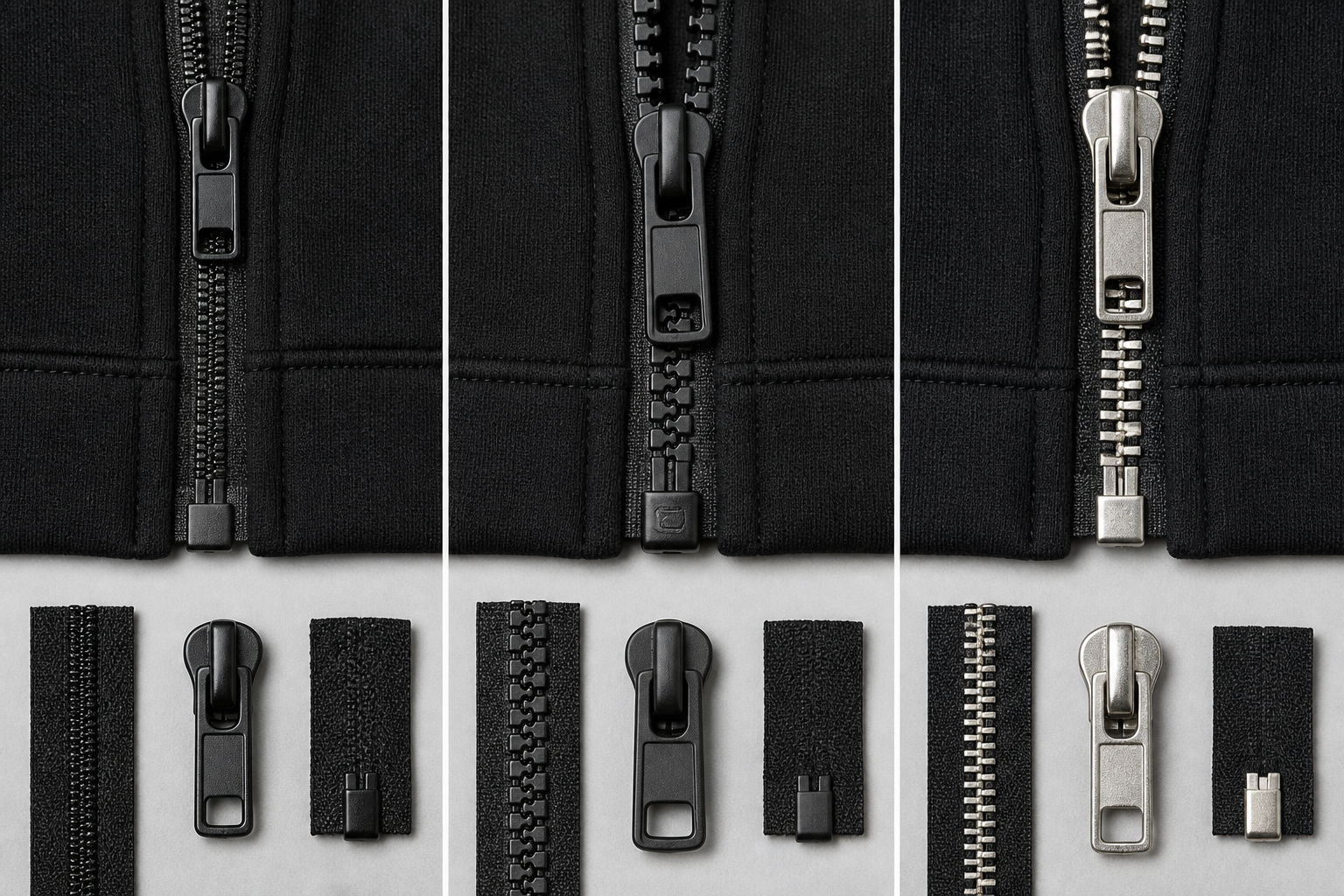
Coil, molded, metal, and reverse constructions create different visual weight and sewing behavior.
Streetwear Hoodie Zipper Size and Gauge
Zipper size generally describes the approximate chain width when closed, but naming conventions can vary by product line. Do not approve only a number in a message. Ask for the exact manufacturer or supplier reference and a physical sample. A larger chain can suit heavyweight or rugged streetwear, while a smaller chain can support a minimal look. The garment fabric, interfacing, body length, pocket design, and target customer use all matter.
Check whether the slider, bottom box, pin, stops, and pull are compatible with the chosen chain. Mixing visually similar components can cause premature failure. For custom pulls, approve dimensions, weight, edge smoothness, finish, logo orientation, and attachment security.
Streetwear Hoodie Zipper Length and Pattern Balance
The zipper length should be tied to the approved garment pattern, not a generic hoodie measurement. Define whether length is measured from the top stop to the bottom stop or by total component length. The finished front opening must match the zipper without stretching either side. If the zipper is forced into a shorter opening, the front can wave. If the opening is stretched to fit a longer zipper, the hem and neckline can distort.
Approve top-stop position under the hood or collar seam and bottom-stop clearance above the hem. Confirm that the slider does not press into the wearer’s neck when fully closed. For two-way separating zippers, test both sliders in the full size range and explain the operating sequence in the sample review.
Streetwear Hoodie Zipper Sewing Specification
Stabilize the opening
Knit fabrics can grow during handling. A suitable stay tape, fusible support, facing, or controlled sewing method may be needed. The support must be compatible with the fabric and intended wash so it does not create bubbling, stiffness, or visible adhesive marks.
Control symmetry
Mark matching points at the neckline, chest graphics, pocket openings, and hem. Baste or secure both zipper sides from the same reference. After closing the zipper, horizontal seams and pocket edges should meet at the approved tolerance. Topstitching should remain parallel to the chain.
Protect the wearer
A zipper guard or facing can prevent the chain from touching skin and can create a clean inside finish. At the top, a chin guard or folded tape end may improve comfort. Review bulk and stiffness because an oversized hoodie should still drape naturally.
Streetwear Hoodie Zipper and Garment Washing
Garment wash can change the hoodie fabric, zipper tape, metal finish, slider movement, and surrounding seam appearance. If the style is enzyme washed, pigment dyed, stone washed, or otherwise finished after sewing, the zipper must be approved through the same route. Metal parts can mark fabric, coated pulls can chip, and cotton-rich tape may change differently from polyester-rich fabric.
Close the zipper as specified during washing trials and follow the supplier’s recommended protective method. After drying and conditioning, check shrinkage, front-edge waviness, color transfer, finish change, tooth damage, bottom-box function, and pull security. A pre-wash approval is not enough for a washed garment.
Streetwear Hoodie Zipper Sample Checklist
- Chain type, size, color, finish, and supplier reference are recorded.
- Separating or closed-end construction matches the design.
- Finished zipper length and measurement method are defined.
- Slider direction, pull shape, logo orientation, and bottom hardware are approved.
- Left and right neckline, pocket, print, and hem points align when closed.
- The front opening lies flat without obvious rippling or twisting.
- Slider runs smoothly through repeated open-close cycles.
- Top and bottom stops are secure and comfortable.
- Wash sample shows acceptable color, shape, and operating performance.
- All graded sizes use approved length rules and placement points.
Streetwear Hoodie Zipper Quality Control
Bulk control should begin before the zipper is sewn. Check incoming quantity, reference, length, shade, visible defects, and slider operation. During sewing, monitor opening length, stabilization, stitch distance, and alignment. A first-piece check should close the hoodie and compare neckline, pockets, graphics, and hem across the center front.
Final inspection should include appearance, measurements, repeated operation, pull security, sharp-edge review, and the intended care test. Sample units from different cartons and sizes. Record defects by type so the cause can be corrected rather than hidden by final sorting.
Common Streetwear Hoodie Zipper Failures
Wavy center front
This often results from mismatched opening and zipper length, stretched knit edges, insufficient stabilization, or uneven feed during sewing. Correct the pattern and process rather than pressing the problem flat temporarily.
Misaligned pockets and hem
Without matched notches and a closed-garment checkpoint, each side can be sewn correctly in isolation but look wrong together. Add balance marks to the pattern and inspection sheet.
Slider jams near seams
Bulky seam allowances, loose threads, incompatible components, or distorted chain alignment can obstruct the slider. Test the fully constructed and washed garment, not only the loose zipper.
Frequently Asked Questions
Is a metal zipper always higher quality?
No. Quality depends on component compatibility, correct selection, sewing, and testing. Coil, molded, and metal zippers can all perform well when matched to the product.
What zipper works for a heavyweight hoodie?
The answer depends on fabric structure, body length, desired visual weight, wash, and cost target. Review physical options on the actual sample rather than choosing by fabric GSM alone.
Can the zipper match a custom garment color?
Tape and components may be available in standard or custom colors, but minimums and tolerances vary. Approve a physical trim card or sample beside the washed garment fabric.
Should zipper tests happen before or after washing?
Both. Pre-wash checks find component and sewing issues; post-wash checks show whether the full garment process changes appearance or operation.
What should a tech pack include?
Include chain type and size, supplier reference, color, finish, length method, separating direction, slider and pull details, stitch construction, facing or guard, placement measurements, and test requirements.
Conclusion: Approve the Complete Closure System
A streetwear hoodie zipper succeeds when the chain, hardware, pattern, knit stabilization, sewing, wash, and bulk inspection work as one system. Approve the exact component on the intended garment rather than treating the zipper as a last-minute accessory.
Explore our private-label streetwear capabilities and custom streetwear development. To review a zip-hoodie project, contact us with your tech pack and wash requirements. For component terminology and selection guidance, see YKK’s zipper guide for wearables.