Hoodie Fabric Weight and Fleece Construction Guide
Hoodie fabric weight and fleece construction are often compressed into one marketing phrase such as heavy fleece. That phrase cannot reveal conditioning, test option, composition, knit density, yarn, face, brushing, shrinkage, pilling, stretch, or heat. Two fabrics with similar reported mass can feel and perform differently, so the buying decision needs both numeric and structural evidence. For OEM, ODM, wholesale, teamwear, and private-label teams, hoodie fabric weight and fleece construction is therefore a controlled buying decision rather than a marketing label. This guide avoids unsupported claims about certification, price, MOQ, capacity, or lead time; those facts must be confirmed for the exact order.
Quick Answer
Hoodie fabric weight and fleece construction must be specified separately. Fabric weight states mass per unit area under a defined method, while fleece construction describes the knit, yarn, face, and looped or brushed interior. Buyers should compare conditioned test data, composition, structure, finish, shrinkage, pilling, print surface, warmth, and end use.
What is hoodie fabric weight and fleece construction?
Fabric weight is mass per unit area, commonly reported in grams per square metre or ounces per square yard. Fleece is a construction and finishing family, not one fiber. It may use cotton, polyester, or blends; interiors may be looped, brushed, or otherwise raised; faces may be cotton-rich for printing or engineered for different performance.
What should buyers compare in a hoodie fabric matrix?
Direct answer: Compare variables that can change both the technical outcome and the purchase decision. The matrix below exposes where a simple choice depends on material, pattern, process, or user evidence.
| Decision point | What to define | Why it matters | Common mistake |
|---|---|---|---|
| Mass per unit area | Method, option, conditioning, units, specimens, and result range | Makes reported weight interpretable and comparable | Comparing supplier numbers with unknown methods |
| Fiber and yarn system | Composition, yarn type, blend distribution, and face construction | Influences hand feel, print, care, drying, and durability | Assuming fleece identifies the fiber |
| Interior construction | French terry loop, brushed fleece, pile, or other raised finish | Changes warmth, bulk, lint, and seasonal use | Calling every loop-backed knit brushed fleece |
| Surface and decoration | Face yarn, smoothness, stretch, color, and print or embroidery trial | Artwork quality depends on the actual surface | Approving decoration on a substitute swatch |
| End-use evidence | Climate, layering, silhouette, movement, care, shrinkage, and pilling | Connects material facts to a buyer decision | Selecting the highest weight as automatically premium |
How should the approval workflow be built?
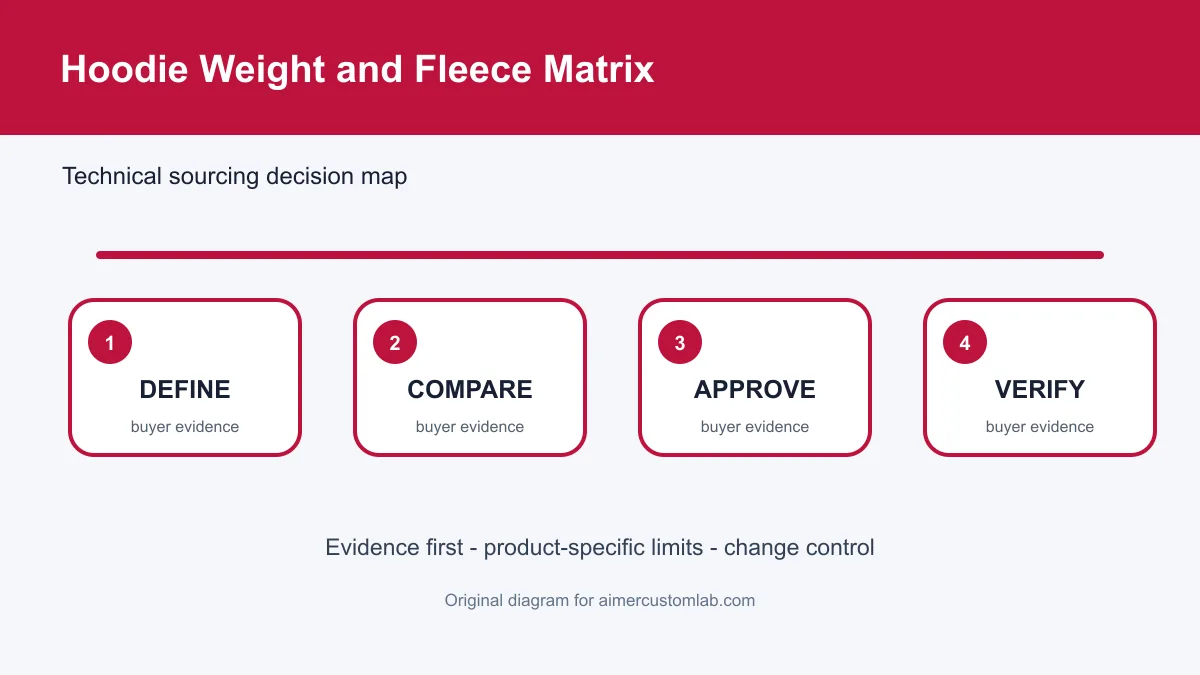
Direct answer: Freeze the question and inputs, use production-representative garments, record the method and intermediate behavior, and inspect the complete product before release.
- Define the customer, climate, season, layering, silhouette, decoration, care route, and expected hand feel before selecting a weight band.
- Request fabric identity, composition, knit description, yarn details, face, interior finish, color, supplier, and lot.
- Measure mass per unit area using an agreed current method, option, conditioning, specimen plan, and units; retain raw specimen results.
- Build decorated garment samples and assess drape, opacity, warmth, bulk, seam behavior, print or embroidery surface, and wearer movement.
- Run the agreed care route and evaluate dimensional change, skew, twist, pilling, shedding, color, face, interior, rib, and decoration.
- Approve the exact fabric and garment evidence, define acceptable variation, and require review after supplier, lot, finish, brushing, dye, or construction changes.
How should common failures be diagnosed?
Reported GSM does not match received fabric: what should be checked first?
Direct answer: Check conditioning, specimen area, selvage inclusion, units, rounding, moisture, lot identity, and method option. Record the original symptom before correction, change one variable at a time, and repeat the same check. That creates a traceable cause-and-effect record rather than a cosmetic adjustment that cannot be reproduced in bulk.
Heavy fabric still feels thin: what should be checked first?
Direct answer: Inspect knit density, yarn, compactness, brushing, finish, and garment construction rather than weight alone. Record the original symptom before correction, change one variable at a time, and repeat the same check. That creates a traceable cause-and-effect record rather than a cosmetic adjustment that cannot be reproduced in bulk.
Fleece sheds or pills: what should be checked first?
Direct answer: Separate loose fibers, brushing residue, fiber blend, abrasion, laundering, and finish before choosing a correction. Record the original symptom before correction, change one variable at a time, and repeat the same check. That creates a traceable cause-and-effect record rather than a cosmetic adjustment that cannot be reproduced in bulk.
Decoration surface looks uneven: what should be checked first?
Direct answer: Review face yarn, nap direction, pretreatment, stabilizer, pressure, thread, ink, and the actual decoration process. Record the original symptom before correction, change one variable at a time, and repeat the same check. That creates a traceable cause-and-effect record rather than a cosmetic adjustment that cannot be reproduced in bulk.
What belongs in the purchase specification?
Direct answer: The specification must let another qualified team reproduce the approved product and evidence without guessing. For hoodie fabric weight and fleece construction, agree these fields before bulk release:
- fabric supplier, article, lot and approved color
- fiber composition and yarn information
- knit construction, face and interior finish
- mass-per-area method, option, conditioning and accepted range
- width, stretch, recovery and dimensional stability
- pilling, shedding, color and care evidence
- decoration compatibility on finished garments
- retained swatch, sample identity and change triggers
How should sampling and change control work?
Direct answer: Select samples by risk, variation, and the decision the evidence must support. Include justified sizes, colors, material lots, decoration areas, production lines, wearer profiles, or pack configurations. State whether a sample represents only itself, a controlled family, or a defined production lot.
Reapprove when material source, composition, construction, pattern, grading, stitch, artwork, decoration, finish, care route, packaging, destination market, or intended use changes in a way that can affect the result. Connect every revision to the affected orders before substitution.
What evidence should accompany the approval?
Direct answer: Retain product and specimen identities, the controlled method, conditions, raw observations, measurements, photographs, individual results, failure modes, corrective actions, owner, date, disposition, and approved sample. A short pass message cannot show whether the right product, condition, or endpoint was used.
What are the practical limits of the evidence?
ASTM D3776/D3776M covers measurement of fabric mass per unit area and offers different options for full pieces, full-width samples, small swatches, and narrow fabrics. A small-swatches result applies to the sample and not necessarily the whole lot. The method measures weight; it does not classify warmth, quality, fleece structure, premium positioning, or fitness for one streetwear program.
Results describe the specimens, users, methods, and conditions evaluated. They do not automatically cover every size, color, lot, factory line, climate, care behavior, or destination. Link approval to stated boundaries and add surveillance or retesting when risk and change justify it.
Which related products can this guide support?
- Review custom hoodie sets with branding and packaging when applying this control to a production configuration.
- Review custom zip hoodie sets for private labels when applying this control to a production configuration.
- Review custom oversized private-label T-shirts when applying this control to a production configuration.
These descriptive internal links show relevant product categories. They are not claims about a fixed construction, price, MOQ, capacity, certification, or delivery time. Send the actual specification for order-specific confirmation.
Buyer checklist
Use this checklist to keep hoodie fabric weight and fleece construction consistent from development through final inspection.
- Use case and climate defined
- Fleece construction named
- Fiber and yarn identity recorded
- Weight method and units stated
- Raw specimens retained
- Decorated garment sampled
- Care and surface risks checked
- Lot and finish changes controlled
What are the standards and evidence boundaries?
The first source below supplies the core technical method, definition, or compliance boundary. The two qualified high-traffic or fast-growth peer pages informed information architecture, answer-first design, and buyer decision framing. Their wording was not copied. Confirm the current edition, destination market, buyer protocol, and laboratory scope for the exact product.
- ASTM D3776/D3776M fabric mass per unit area
- Printify hoodie route and fabric guide
- Custom Ink custom hoodies guide
- Printful hoodie materials guide
Research-to-page evidence map
The table records how current research changed this public article and where the applied result is visible.
| Research finding | Specific application | Visible evidence |
|---|---|---|
| Introduces fabric weight inside a route-based hoodie decision and keeps the next steps practical. | SEO: organized hoodie fabric weight and fleece construction around a decision table and buyer-risk questions. | What should buyers compare in a hoodie fabric matrix? |
| Makes style, fabric weight, decoration, and use case scannable with comparison tables and FAQs. | AEO: placed a 40–70 word direct answer before detail and added a six-step approval route. | Quick Answer |
| The technical source defines a controlled term, method, or compliance boundary and makes limitations explicit. | GEO: defined entities, named conditions, linked the authority, and separated verified facts from buyer-specific decisions. | What are the standards and evidence boundaries? |
Frequently asked questions
Does higher GSM always mean a warmer hoodie?
Answer: No. Weight contributes to bulk, but fiber, knit, brushing, air space, fit, lining, and moisture also affect thermal experience.
Is French terry a fleece?
Answer: French terry usually has visible interior loops and may be discussed beside fleece, but it is not the same as a heavily brushed raised interior. Name the actual construction.
Can supplier GSM be accepted without testing?
Answer: Use supplier data as an input, but verify when weight is a controlled requirement and record the method, conditioning, sample, and result.
Why can two 350 GSM fabrics feel different?
Answer: Yarn, knit density, face, brushing, finish, composition, stretch, moisture, and construction can differ even when mass is similar.
What should trigger fabric reapproval?
Answer: Changes in mill, lot, yarn, composition, knit, brushing, dye, finish, width, or test result can affect the approved garment.
Conclusion: what should a buyer do next?
hoodie fabric weight and fleece construction should finish as a documented, product-specific approval rather than a generic promise. Keep the signed sample, controlled files, method, conditions, raw observations, photographs, corrective action, and change triggers together. That record makes bulk decisions faster and reduces disputes caused by incomplete specifications.
Inquiry CTA: Send your tech pack, intended market and use, size range, material and component references, artwork, care route, packaging route, and requested evidence. Ask the team to confirm feasibility, sample details, MOQ, lead time, capacity, and available supporting records for the exact order.