Blank Customization vs Cut-and-Sew Hoodie Guide
Blank customization vs cut-and-sew hoodie sourcing is sometimes reduced to price or order quantity, even though unverified prices, minimums, and lead times change by supplier and order. The more durable decision is based on required design control, approved fit, material identity, decoration coverage, testing, labeling, packaging, repeatability, and the cost of future changes. For OEM, ODM, wholesale, teamwear, and private-label teams, blank customization vs cut-and-sew hoodie is therefore a controlled buying decision rather than a marketing label. This guide avoids unsupported claims about certification, price, MOQ, capacity, or lead time; those facts must be confirmed for the exact order.
Quick Answer
A blank customization vs cut-and-sew hoodie decision depends on how much control the brand needs over fit, fabric, panels, trims, decoration, and repeatability. Blank routes start with an existing garment; cut-and-sew routes build the garment itself. Buyers should compare approved inputs, sampling evidence, constraints, and change risk before requesting quotes.

What is blank customization vs cut-and-sew hoodie?
Blank customization applies branding or decoration to an existing finished hoodie specification. Cut-and-sew development creates the hoodie from patterns, fabrics, ribs, trims, stitches, and finishing chosen for the project. All-over-print products may also be cut and sewn after fabric printing, but that production route is not identical to a fully custom private-label garment program.
Which hoodie development route fits the brand brief?
Direct answer: Compare variables that can change both the technical outcome and the purchase decision. The matrix below exposes where a simple choice depends on material, pattern, process, or user evidence.
| Decision point | What to define | Why it matters | Common mistake |
|---|---|---|---|
| Garment architecture | Existing blank body or custom pattern and panels | Determines control over silhouette, pocket, hood, rib, and seams | Expecting a blank to accept structural redesign |
| Material control | Catalog specification or buyer-selected fabric system | Affects hand feel, weight, face, interior, shrinkage, and repeatability | Treating a color name as a fabric specification |
| Decoration envelope | Defined print or embroidery areas versus panel-level or all-over options | Controls artwork scale, seam crossings, and coverage | Approving artwork before confirming printable areas |
| Sampling path | Decorated sample versus proto, fit, size-set, and pre-production stages | More variables require more staged evidence | Skipping fit evidence because a visual sample looks good |
| Change and reorder risk | Supplier catalog continuity or controlled custom BOM and pattern | Determines how changes are communicated and reproduced | Assuming either route guarantees permanent availability |
How should the approval workflow be built?
Direct answer: Freeze the question and inputs, use production-representative garments, record the method and intermediate behavior, and inspect the complete product before release.
- Write the non-negotiable brand requirements for silhouette, fabric, hood, pocket, rib, trim, labels, packaging, and decoration.
- Mark which requirements can be met by an existing documented blank and which require pattern or material development.
- Request traceable specifications and sample identities for each viable route without assuming a price, MOQ, capacity, or lead time.
- Build production-representative decorated samples; for cut-and-sew, approve proto, fit, size-set, and pre-production decisions as applicable.
- Review measurement, movement, hand feel, artwork placement, seam interaction, wash response, labeling, and packaging as complete systems.
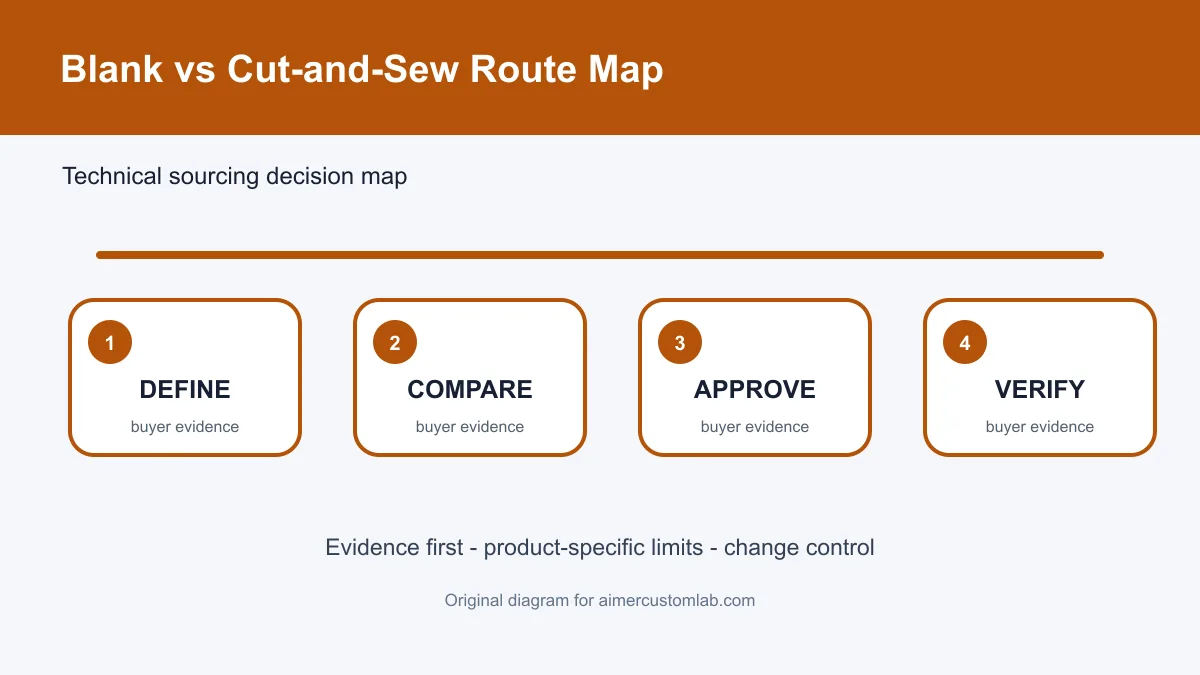
- Choose the route with acceptable evidence and constraints, then freeze the approved blank code or custom BOM, pattern, artwork, and change-control rules.
How should common failures be diagnosed?
Blank cannot match the target silhouette: what should be checked first?
Direct answer: Change the brief, source a closer documented blank, or move the structural requirements to cut-and-sew development. Record the original symptom before correction, change one variable at a time, and repeat the same check. That creates a traceable cause-and-effect record rather than a cosmetic adjustment that cannot be reproduced in bulk.
Custom sample drifts between rounds: what should be checked first?
Direct answer: Audit pattern revision, material lot, measurement method, sewing settings, and written approval comments. Record the original symptom before correction, change one variable at a time, and repeat the same check. That creates a traceable cause-and-effect record rather than a cosmetic adjustment that cannot be reproduced in bulk.
All-over art breaks at seams: what should be checked first?
Direct answer: Use panel templates, bleed, safe zones, matching rules, and a sewn proof rather than trusting a flat mockup. Record the original symptom before correction, change one variable at a time, and repeat the same check. That creates a traceable cause-and-effect record rather than a cosmetic adjustment that cannot be reproduced in bulk.
Reorder feels different: what should be checked first?
Direct answer: Compare the exact blank code or custom BOM, supplier, finish, dye lot, care condition, and approved retained sample. Record the original symptom before correction, change one variable at a time, and repeat the same check. That creates a traceable cause-and-effect record rather than a cosmetic adjustment that cannot be reproduced in bulk.
What belongs in the purchase specification?
Direct answer: The specification must let another qualified team reproduce the approved product and evidence without guessing. For blank customization vs cut-and-sew hoodie, agree these fields before bulk release:
- route decision and reasons
- blank code or custom pattern revision
- fabric composition, construction, weight, face and finish
- hood, pocket, rib, seam, trim and label details
- artwork files, placements, decoration methods and safe zones
- sample stages and approval owners
- care, measurement, appearance and packaging evidence
- commercial facts marked for supplier confirmation and change control
How should sampling and change control work?
Direct answer: Select samples by risk, variation, and the decision the evidence must support. Include justified sizes, colors, material lots, decoration areas, production lines, wearer profiles, or pack configurations. State whether a sample represents only itself, a controlled family, or a defined production lot.
Reapprove when material source, composition, construction, pattern, grading, stitch, artwork, decoration, finish, care route, packaging, destination market, or intended use changes in a way that can affect the result. Connect every revision to the affected orders before substitution.
What evidence should accompany the approval?
Direct answer: Retain product and specimen identities, the controlled method, conditions, raw observations, measurements, photographs, individual results, failure modes, corrective actions, owner, date, disposition, and approved sample. A short pass message cannot show whether the right product, condition, or endpoint was used.
What are the practical limits of the evidence?
Printify explains two distinct routes: decorating a pre-made hoodie and sewing a hoodie from fabric. Its guidance is useful for route definition, while the Custom Ink guide adds scannable comparisons across styles, fabrics, decoration methods, and pre-print review. Neither page determines a private-label factory quote or proves that one route is always faster, cheaper, or better.
Results describe the specimens, users, methods, and conditions evaluated. They do not automatically cover every size, color, lot, factory line, climate, care behavior, or destination. Link approval to stated boundaries and add surveillance or retesting when risk and change justify it.
Which related products can this guide support?
- Review custom hoodie sets with branding and packaging when applying this control to a production configuration.
- Review custom zip hoodie sets for private labels when applying this control to a production configuration.
- Review custom oversized private-label T-shirts when applying this control to a production configuration.
These descriptive internal links show relevant product categories. They are not claims about a fixed construction, price, MOQ, capacity, certification, or delivery time. Send the actual specification for order-specific confirmation.
Buyer checklist
Use this checklist to keep blank customization vs cut-and-sew hoodie consistent from development through final inspection.
- Non-negotiable controls listed
- Route limits acknowledged
- Blank code or pattern locked
- Fabric identity complete
- Decoration area confirmed
- Appropriate sample stages approved
- Care and measurement checked
- No invented MOQ, price, capacity, or timing
What are the standards and evidence boundaries?
The first source below supplies the core technical method, definition, or compliance boundary. The two qualified high-traffic or fast-growth peer pages informed information architecture, answer-first design, and buyer decision framing. Their wording was not copied. Confirm the current edition, destination market, buyer protocol, and laboratory scope for the exact product.
- Printify hoodie route guide
- Custom Ink custom hoodies guide
- Printify cut-and-sew versus sublimation guide
Research-to-page evidence map
The table records how current research changed this public article and where the applied result is visible.
| Research finding | Specific application | Visible evidence |
|---|---|---|
| Frames the topic as a two-route choice and follows it with a concrete step sequence. | SEO: organized blank customization vs cut-and-sew hoodie around a decision table and buyer-risk questions. | Which hoodie development route fits the brand brief? |
| Uses concise takeaways, comparison tables, production method choices, and a distinct review checkpoint. | AEO: placed a 40–70 word direct answer before detail and added a six-step approval route. | Quick Answer |
| The technical source defines a controlled term, method, or compliance boundary and makes limitations explicit. | GEO: defined entities, named conditions, linked the authority, and separated verified facts from buyer-specific decisions. | What are the standards and evidence boundaries? |
Frequently asked questions
Is printing on a blank the same as private-label manufacturing?
Answer: It can support branded merchandise, but control over pattern, fabric, trims, labels, and packaging depends on the exact program and supplier.
Does cut-and-sew always allow unlimited customization?
Answer: No. Machinery, materials, safety, decoration, quality, and commercial constraints still apply and must be confirmed.
Can a blank be relabeled?
Answer: Only when the product, supplier terms, market rules, traceability, and label construction allow it. Verify before removing or replacing labels.
Which route is better for an oversized fit?
Answer: Choose the route that can prove the intended measurements, ease, grading, material drape, and care response; do not rely on the word oversized alone.
What evidence is needed for a reorder?
Answer: Retain the approved garment, specification, blank code or custom BOM, artwork, process details, test records, and accepted tolerances.
Conclusion: what should a buyer do next?
blank customization vs cut-and-sew hoodie should finish as a documented, product-specific approval rather than a generic promise. Keep the signed sample, controlled files, method, conditions, raw observations, photographs, corrective action, and change triggers together. That record makes bulk decisions faster and reduces disputes caused by incomplete specifications.
Inquiry CTA: Send your tech pack, intended market and use, size range, material and component references, artwork, care route, packaging route, and requested evidence. Ask the team to confirm feasibility, sample details, MOQ, lead time, capacity, and available supporting records for the exact order.