PVC Screen Print Phthalate Test Guide
Quick Answer: A PVC screen print phthalate test should target the actual printed polymer layer, not only the cotton garment beneath it. Buyers should freeze the ink or transfer formulation, destination market, named phthalates, sampling boundary, method, reporting unit and detection limit. ISO 14389 can support textile phthalate analysis, but the applicable legal or customer limit must be confirmed separately.
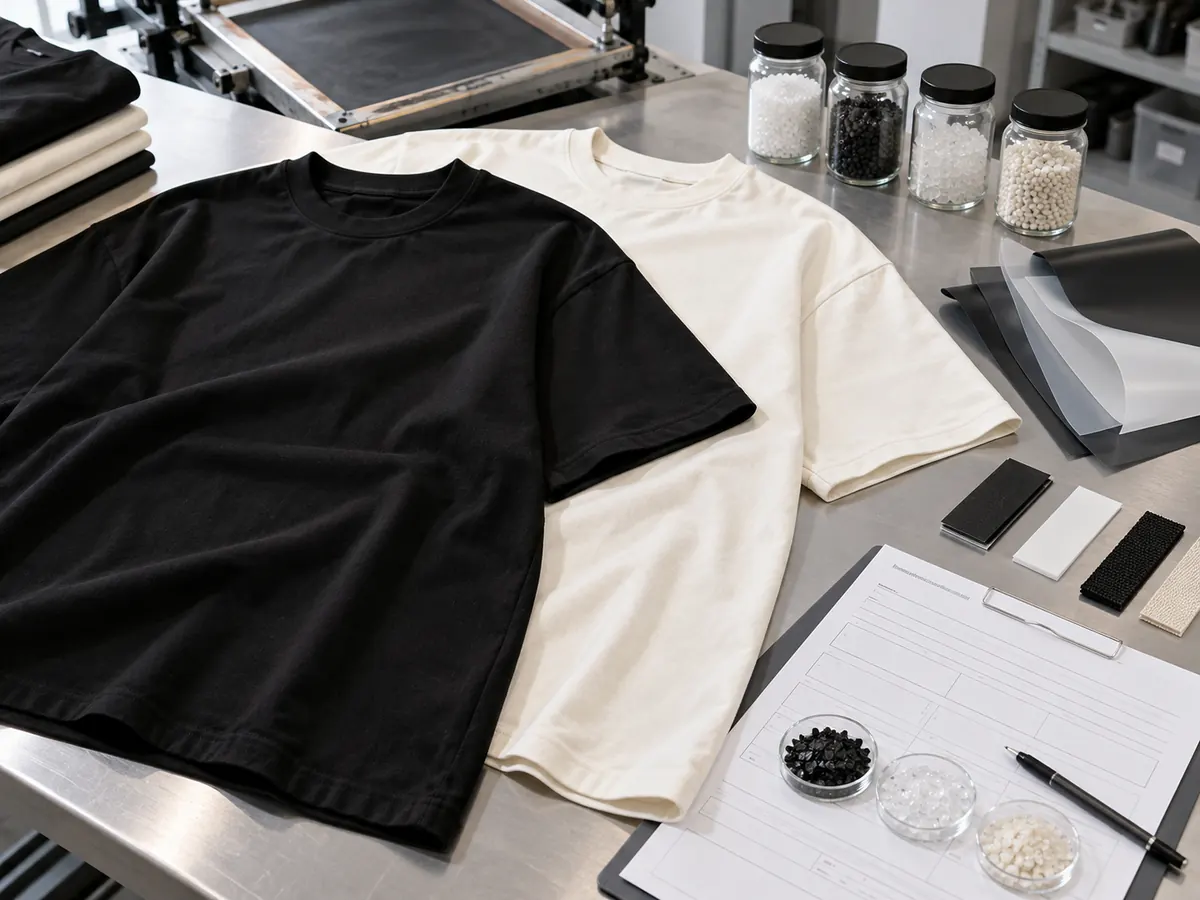
Bold plastisol-style graphics can occupy a large area of an oversized T-shirt or hoodie, yet the most convenient laboratory specimen is often the unprinted body fabric. A PVC screen print phthalate test corrects that mismatch by following the polymer-rich decoration. It also separates chemical evidence from print durability, handfeel, adhesion and cracking, which require different evaluations.
What does PVC screen print phthalate test mean?
A PVC screen print phthalate analysis is a targeted measurement of specified phthalate compounds in the identified print or related plasticized component. Phthalates have been used as plasticizers in some flexible polymer formulations. Their relevance depends on the actual ink, film, adhesive or trim chemistry; the presence of a screen print alone does not prove that a restricted phthalate is present.
The analysis is not a generic “chemical safety test” and does not automatically cover every regulated phthalate or market. It must be separated from heavy-metal, organotin, azo colorant, formaldehyde, PFAS and durability checks. “PVC-free” and “phthalate-free” also describe different questions.
A useful PVC screen print phthalate test record therefore identifies the product, component or garment zone, test or evidence route, version, condition, date and decision owner. A marketing phrase without those fields cannot support a repeatable sourcing decision.
Which components should the PVC screen print phthalate test cover?
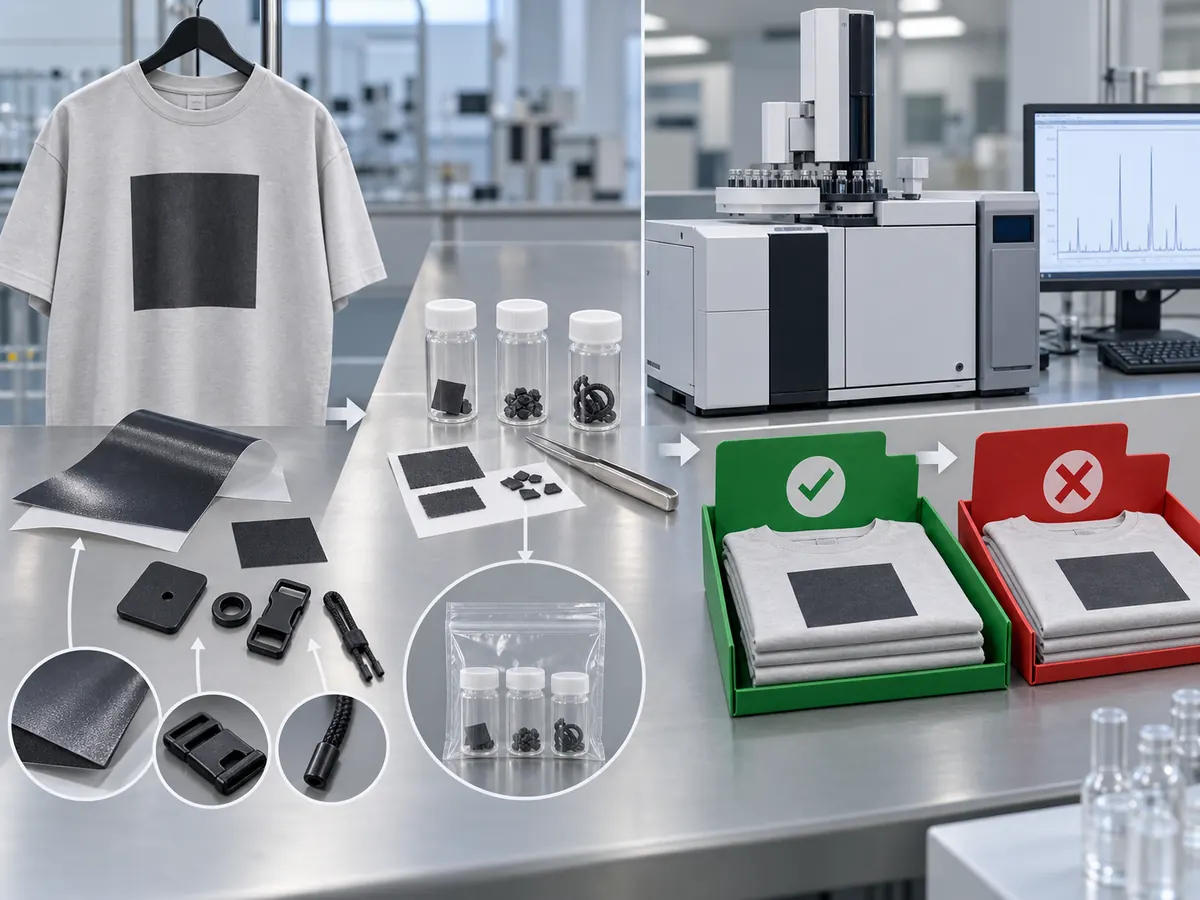
Prioritize polymer-rich layers and keep chemically distinct print materials separate when the method and sample mass allow. The following map converts the research into a practical sampling or document plan.
| Component | Risk question | Sampling action |
|---|---|---|
| Printed top colour | Does this formulation contain relevant plasticizers? | Collect representative cured print material |
| Underbase | Is it a different ink or formulation? | Separate or document the laboratory composite |
| Transfer film or adhesive | Is the decoration partly a film system? | Identify and test the relevant layer |
| Cotton body fabric | Does it serve only as the substrate? | Retain as reference; do not use as a print proxy |
| Packaging or flexible patch | Is it a separate polymer supplier? | Evaluate under its own market and component scope |
Laboratories may need a minimum mass of isolated print. Agree a cutting or scraping plan before sampling. If layers must be composited, document the proportions and dilution limitation. Never claim the result represents untested colours, suppliers or polymer components without a justified grouping rationale.
Why does PVC screen print phthalate test matter to buyers?
It matters because the print supplier may control a formulation that the cut-and-sew factory does not own. A streetwear brand needs evidence tied to the specific ink system, colour, underbase, curing route and production lot. A report for the cotton blank or an unrelated print colour cannot automatically support a large high-density graphic on the ordered style.
Legal restrictions vary by substance, product use, market and date. Some ECHA Annex XVII entries use limits expressed as a percentage by weight of plasticised material, but that is not a universal limit for every garment or jurisdiction. Confirm the exact rule and test scope with qualified advisers and laboratories.
Start with the intended wearer, destination market, product construction and claim. Then select evidence proportionate to the decision. This sequence prevents a convenient report for an unrelated fabric, component or supplier from being used as proof for the actual order.
Which standards or authorities support PVC screen print phthalate test?
ISO 14389:2022 provides a method for determining certain phthalates in textiles, while ECHA restrictions define legal conditions for particular substances and uses. The standard method and the legal requirement perform different jobs: the method explains analysis, while the market rule defines which substance, scope and limit apply. A customer RSL can add separate contractual requirements.
Consult the official ISO 14389:2022 page, the ECHA Annex XVII phthalates restriction text and ECHA’s phthalates topic overview. Confirm the current destination-market requirement before setting the acceptance rule.
What should the buyer put in the technical brief?
- Destination markets and current legal or customer requirement.
- Style, artwork, print colour, ink, underbase, additive and supplier codes.
- PVC, non-PVC and phthalate claim wording to be evaluated separately.
- Named analytes, method, unit and reporting limit.
- Sampling boundary and required mass for each print layer.
- Development, approval or bulk-lot identity.
- Change-notification and retesting rule.
How should a PVC screen print phthalate test workflow run?
Freeze the decoration chemistry and market scope before isolating representative print material for analysis. The steps below keep the evidence tied to the real order.
- List destination markets and the exact restricted-phthalate requirements that apply.
- Freeze the artwork, colour separations, ink system, underbase, additives and curing route.
- Map polymer-rich prints, films, adhesives, patches and packaging components.
- Collect supplier declarations and formulation evidence linked to exact codes.
- Agree named analytes, method, units, reporting limits and sampling with the laboratory.
- Test representative cured production material and retain a traceable control sample.
- Review numerical results—not only a generic pass label—against the correct requirement.
- Hold, investigate and retest after relevant formulation, supplier, colour or process change.
Each gate needs a named owner and a visible status. “Approved” should mean the evidence was reviewed against a stated criterion. It should not merely mean that a PDF or declaration exists. A relevant change returns the affected component to review.
How should PVC screen print phthalate test evidence be interpreted?
Interpret each result by analyte, unit, reporting limit, component, method and market rule. “Not detected” means below the stated reporting limit for the named analyte. It does not prove absolute zero, cover compounds not requested or validate a different print formulation. A total for a defined group must not be confused with each individual compound unless the requirement says so.
| Finding | What it means | Buyer action |
|---|---|---|
| Exact cured print, correct analytes and current requirement | Evidence matches the intended decision | Eligible for approval |
| Only blank fabric tested | Print chemistry is not represented | Resample the decoration |
| Non-detect but reporting limit exceeds requirement | Evidence cannot demonstrate conformity | Request a suitable method or limit |
| Ink, colour or supplier changed after testing | Earlier scope may be stale | Hold affected production and reassess |
Do not turn a component result into an absolute product-wide claim. If “phthalate-free” is used, define the analytes, threshold, component and evidence scope. If the evidence supports only a specific print, use narrow wording and maintain lot traceability.
How were current research findings applied?
This guide turns primary-source scope and limitations into a buyer workflow instead of copying laboratory or regulatory wording.
| Research finding | Specific change in this guide | Verification point |
|---|---|---|
| ISO 14389 addresses specified phthalates in textiles | The lab brief requires named analytes and method scope | Authority and checklist fields |
| ECHA conditions vary by substance and use | Market scope comes before any limit or claim | First workflow gate |
| Legal limits may refer to plasticised material | The component map targets the print rather than cotton substrate | Sampling table |
| Non-detect depends on the reporting limit | Interpretation rejects absolute-zero claims | Decision table and FAQ |
The sources support definitions, scope and limitations. Recommendations are identified as procurement practice and do not claim that one voluntary method or framework is mandatory everywhere. That separation improves answer clarity for AEO, provides quotable context for GEO and keeps the page useful to a human buyer.
What belongs in the PVC screen print phthalate test approval checklist?
The approval file should connect the numerical report to the exact cured decoration.
- Market and customer scope current.
- Ink, colour and underbase codes frozen.
- Polymer-component map complete.
- Sampling photos and mass recorded.
- Analytes, unit and reporting limit reviewed.
- Supplier declaration and test report cross-checked.
- Claim boundary and retesting triggers written.
Keep the checklist with the tech pack, test request or purchase file. Mark unknown fields as pending and assign an owner. Conditional wording is more accurate than an unsupported promise about compliance, comfort, durability or performance.
What mistakes weaken a PVC screen print phthalate test decision?
Programs fail when they test the easiest substrate or treat supplier marketing as analytical proof.
- Testing only the cotton body.
- Using a report for a different ink colour or supplier.
- Confusing PVC-free with phthalate-free.
- Requesting a generic panel without named analytes.
- Ignoring the reporting limit and unit.
- Compositing layers without documenting dilution.
- Keeping no change-control trigger after bulk formulation updates.
These mistakes separate evidence from the exact sourcing decision. A disciplined PVC screen print phthalate test reconnects the sample, method or document, product scope, conditions, decision rule and responsible approver.
Frequently asked questions about PVC screen print phthalate test
Is every PVC screen print made with restricted phthalates?
No. Actual chemistry depends on the formulation, so use supplier evidence and product-specific analysis rather than assumption.
Can a cotton-fabric report cover the print?
No. The polymer-rich decoration is a separate component and must be represented in the sample plan.
Does PVC-free mean phthalate-free?
Not automatically. They are different claims and need evidence tailored to each statement.
What does not detected mean?
It means below a stated reporting limit. It is not proof of absolute absence and does not cover unrequested analytes.
When should the print be retested?
After relevant change. A new ink, pigment, additive, underbase, supplier, curing route or market requirement can change the evidence scope.
Conclusion: follow the chemistry into the print
A defensible PVC screen print phthalate test targets the actual decoration, names the analytes and reporting limit, and applies the correct market rule. It produces narrower and more useful evidence than testing only the garment blank or relying on a generic declaration.
Use the broader streetwear phthalate guide and the separate print wash-durability guide to keep chemical and physical evidence distinct. Contact the sourcing team with the product construction, destination markets and evidence requirement so the available facts can be confirmed for your specific project.