Streetwear Fibre Composition Verification Guide
Quick Answer: Streetwear fibre composition verification confirms which fibres are present, measures relevant blend percentages, and supports accurate destination-market labels. Map the body, rib, lining and other textile components separately; select the correct ISO 1833 method for the claimed mixture; reconcile laboratory results with supplier records before printing bulk labels.

Composition claims influence purchasing, care, performance expectations and legal labelling. A robust streetwear fibre composition verification process separates three decisions: identifying which fibres are present, measuring their proportions with an appropriate method, and translating the verified result into a destination-market label. A supplier composition sheet is a useful starting point, but it is not automatically evidence for the finished garment.
What is streetwear fibre composition verification?
Fibre composition verification is the documented confirmation of fibre identity and percentage for the components that require disclosure. It can combine microscopy, solubility or chemical separation, and quantitative calculation. The correct route depends on the claimed blend, construction and applicable labelling rule.
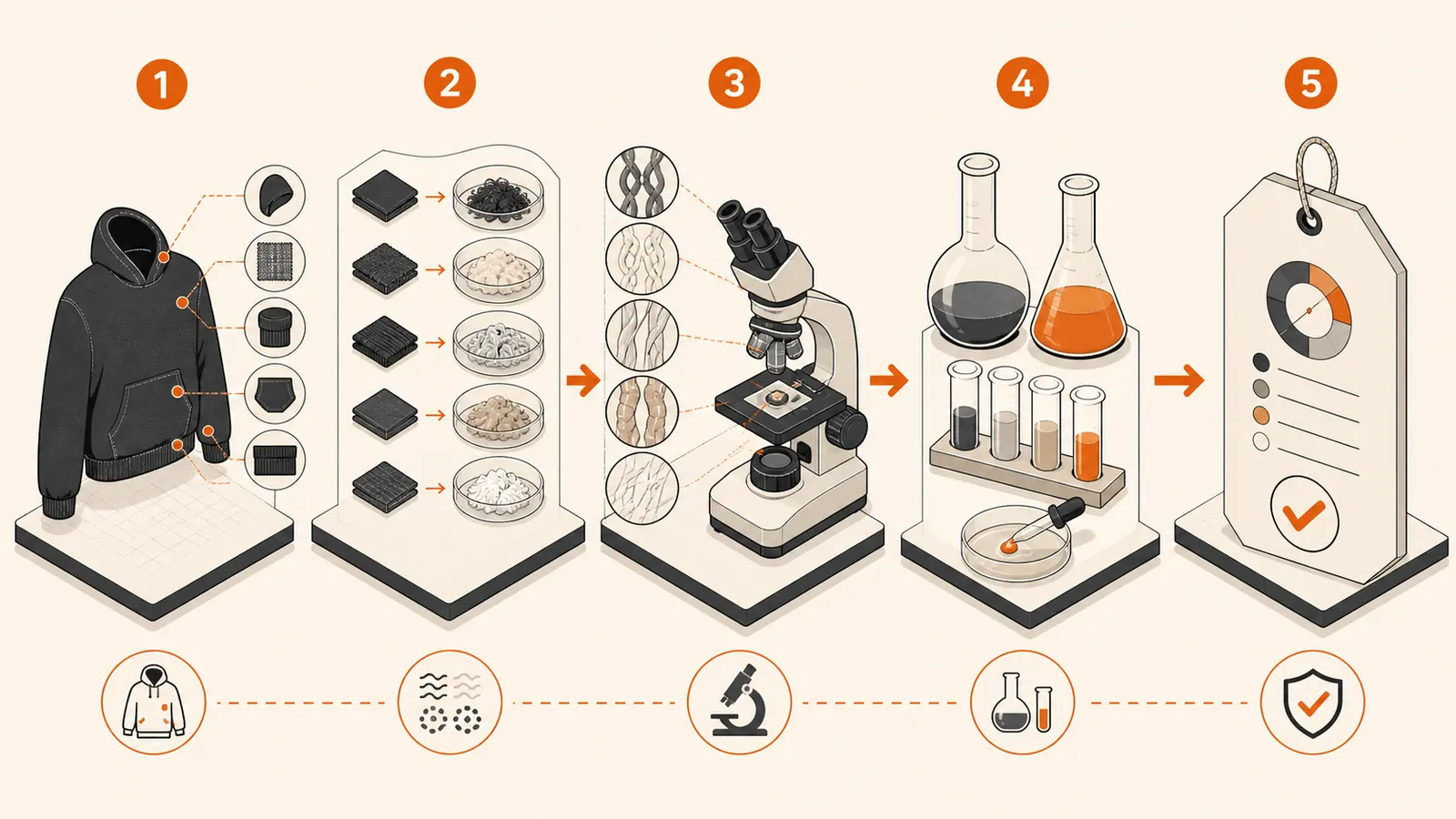
A hoodie can include a cotton-polyester body, elastane rib, polyester sewing thread, fusible backing, pocket lining and labels. Regulations can treat components and exclusions differently, so the laboratory sample plan and the legal labelling decision should not be reduced to one unqualified percentage.
Why is supplier paperwork not enough for streetwear fibre composition verification?
Mill declarations support traceability, but errors can enter through yarn substitution, recycled or blended feedstock, fabric mixing, trim changes and copying data from an earlier style. Testing a representative finished-product sample provides an independent check. The buyer should reconcile any difference before printing permanent care and fibre labels.
A streetwear fibre composition verification also protects product consistency. If a bulk lot differs materially from the approved sample, the issue can affect handfeel, shrinkage, dye behavior, durability, care instructions and consumer disclosure. Early verification is usually easier than relabelling packed goods.
Which components should be mapped?
| Garment area | Typical composition question | Verification action |
|---|---|---|
| Main body | Single fibre or blended knit? | Quantify the declared blend using the method suited to those fibres |
| Rib cuffs and waistband | Does elastane or another fibre create stretch? | Test separately when construction or labelling rules require it |
| Lining or pocketing | Is it a different textile component? | Identify and assess separate disclosure obligations |
| Embroidery, backing and thread | Are these decorative or functional components? | Document scope and applicable exclusions before combining results |
| Labels and small trims | Are they excluded from fibre calculations? | Confirm with the destination-market rule, not assumption |
Which standards and rules should buyers check?
ISO 1833-1:2020 sets general principles for quantitative chemical analysis of textile fibre mixtures. It works with mixture-specific parts of the ISO 1833 series; the correct part depends on the fibres present. A laboratory should not choose a chemistry blindly from the desired label claim.
For the United States, the FTC Textile Fiber Rule covers fibre-content disclosure and related requirements. In the European Union, Regulation (EU) No 1007/2011 addresses textile fibre names and related labelling. Requirements and guidance can change, so confirm the current rule for every sales market with a qualified adviser.
How should a streetwear fibre composition verification be run?
- Collect declarations. Obtain yarn, fabric and trim composition documents tied to current supplier codes.
- Map components. Photograph the garment and mark body, rib, lining, pocketing, backing and other textile areas.
- Choose the analytical route. Tell the lab the claimed fibres and ask it to confirm the suitable qualitative and quantitative methods.
- Test representative samples. Link specimens to style, color, lot and production stage; keep a sealed control sample.
- Reconcile the result. Compare lab findings with purchase records and investigate meaningful differences.
- Approve label artwork. Apply the current destination-market rules only after the technical evidence is resolved.
How should streetwear fibre composition verification results be interpreted?
Analytical results can involve moisture conventions, agreed allowances, method limitations and uncertainty. The number on a laboratory report is not necessarily copied directly to a label without applying the relevant rule. Ask the lab to state the method, component tested, pre-treatment, calculation basis and any limitations.
Do not invent a universal tolerance. Different jurisdictions and product situations may handle tolerances, decorative components and impurities differently. The buyer should use the applicable regulation and professional advice. When a result conflicts with the declaration, hold label approval until the fibre identity, calculation and component scope are understood.
Evidence hierarchy for label approval
| Evidence | What it supports | Limitation |
|---|---|---|
| Supplier declaration | Material traceability and claimed specification | Not an independent finished-product measurement |
| Qualitative identification | Which fibre types appear to be present | May not determine accurate proportions |
| Quantitative mixture analysis | Proportions for the tested component and method | Must match the actual fibre combination and calculation basis |
| Legal label review | Names, order, wording and component treatment for a market | Depends on current jurisdiction-specific requirements |
What errors cause fibre-label failures?
- Testing only the main fabric while the label describes the whole garment ambiguously.
- Using a generic mill report that is not linked to the production lot.
- Requesting only fibre identification when quantitative blend verification is needed.
- Choosing the wrong chemical-analysis method for the declared blend.
- Ignoring rib, lining or pocket components that may need separate treatment.
- Printing labels before resolving differences between laboratory and supplier data.
- Applying one market’s fibre names or tolerance assumptions globally.
Buyer checklist before bulk label printing
- Current fabric and component codes match the approved bill of materials.
- Finished-garment component map is attached to the laboratory request.
- Claimed fibres, method, units and calculation basis are stated on the report.
- Result differences have a documented technical investigation.
- Label wording has been checked against each destination market.
- Any later material substitution triggers label and testing review.
Place composition verification inside the streetwear clothing sampling process, before permanent label production. The related streetwear fiber content label guide can help connect test evidence to a broader artwork-review workflow.
Frequently asked questions
Is fibre identification the same as blend-percentage testing?
No. Identification determines which fibre types are present; quantitative analysis estimates their proportions using a method suitable for that specific mixture.
Can one report cover body fabric and rib?
Only when the report’s sample scope and the applicable rule justify that treatment. Different constructions should normally be mapped and evaluated explicitly.
When should composition be checked?
Verify at development when labels are planned, then use risk-based bulk checks and retest after yarn, fabric, trim supplier or construction changes.
What if the lab result differs from the mill declaration?
Hold label approval, confirm sample identity and method, review uncertainty and allowances, trace the material lot, and resolve the difference with the supplier and laboratory.
Does a verified composition prove recycled content?
No. Conventional fibre composition analysis identifies fibre types and proportions; recycled-content claims usually need separate chain-of-custody and claim evidence.
How can composition data support future sourcing?
Keep verified results in a material library with the fabric code, mill, yarn source, dye lot, garment styles and approved label wording. When the same material is proposed again, the buyer can compare current declarations with the earlier evidence and decide whether a new check is needed. This record also helps teams investigate shrinkage, handfeel or color differences without treating composition as an isolated compliance task.
Conclusion: verify the garment before approving the label
A defensible streetwear fibre composition verification links supplier records, component mapping, an appropriate analytical method and current market rules. It turns a label from a copied claim into traceable product information. Contact Aimer Custom Lab with the intended markets, bill of materials and label draft to confirm what can be supported for a specific streetwear order.