Streetwear Nickel Release Test Guide
Streetwear nickel release test planning helps brands control metal buttons, rivets, zipper parts, eyelets, buckles and decorative plates that can contact skin. A supplier statement that a trim is “nickel free” is not a complete specification. The buyer needs a component map, contact assessment, exact finish code, applicable market rule, test method, report identity and substitution control.
Quick Answer: How should a streetwear nickel release test be specified?
A streetwear nickel release test should identify each metal trim, its exact material and finish, whether it has direct and prolonged skin contact, the destination market and the applicable restriction. For EU-bound products, review REACH Annex XVII entry 27, use the appropriate EN 1811 release method and coating-wear preparation where applicable, then link every report to the production component and supplier lot.
Decision rule: assess release from the finished, worn component—not only the alloy name. Coatings, plating thickness, wear, sweat exposure and component geometry affect the evidence.
What is nickel release?
Nickel release is the migration of nickel from an article under a defined test condition. It differs from total nickel content. A metal part can contain nickel yet release it below a specified limit, while a plated component can perform initially but release more after the coating wears. Therefore, composition screening and release testing answer different questions.
Nickel can cause allergic contact dermatitis in sensitized people. The restriction is based on use and contact, not a broad claim that every metal item must contain zero nickel. A sourcing team should avoid both extremes: ignoring skin contact and demanding an undefined “nickel-free certificate” that cannot be traced to the trim.
Which streetwear components require review?
| Component | Possible contact | Control question |
|---|---|---|
| Jeans button or snap | Waist and abdominal skin | Is the back or cap exposed during wear? |
| Rivet | Pocket or inside garment | Does the post or back contact skin? |
| Zipper slider and puller | Neck, chest, fly or pocket | Which surfaces are touched repeatedly? |
| Eyelet and drawcord end | Neck, hood or waist | Can movement create prolonged contact? |
| Buckle or adjuster | Waist, cuff or strap | Is fabric consistently between metal and skin? |
| Decorative plate | Varies by placement | Is the rear face covered and durable? |
What does EU REACH Annex XVII entry 27 cover?
The European Chemicals Agency interpretation document for REACH restriction entry 27 lists articles intended to come into direct and prolonged contact with skin, including certain garment rivet buttons, tighteners, rivets, zippers and metal marks. It establishes migration limits and addresses coated articles.
Use the current consolidated legal text and qualified compliance advice for the intended market. Product design, contact duration and the exposed part matter. This guide supports sourcing decisions and does not replace a legal determination.
Which methods support a nickel release assessment?
EN 1811 is widely used as a reference method for release of nickel from articles intended for direct and prolonged skin contact. Where a non-nickel coating provides the release barrier, EN 12472 describes a wear and corrosion simulation used before release testing. Ask the laboratory which current versions and sample preparation apply to the component.
Screening methods can support risk management but may not replace the required quantitative method. Record whether the report is a screening result, a release result, or a post-wear release result. Do not summarize all three as “passed nickel test.”
How should a streetwear nickel release test be planned step by step?
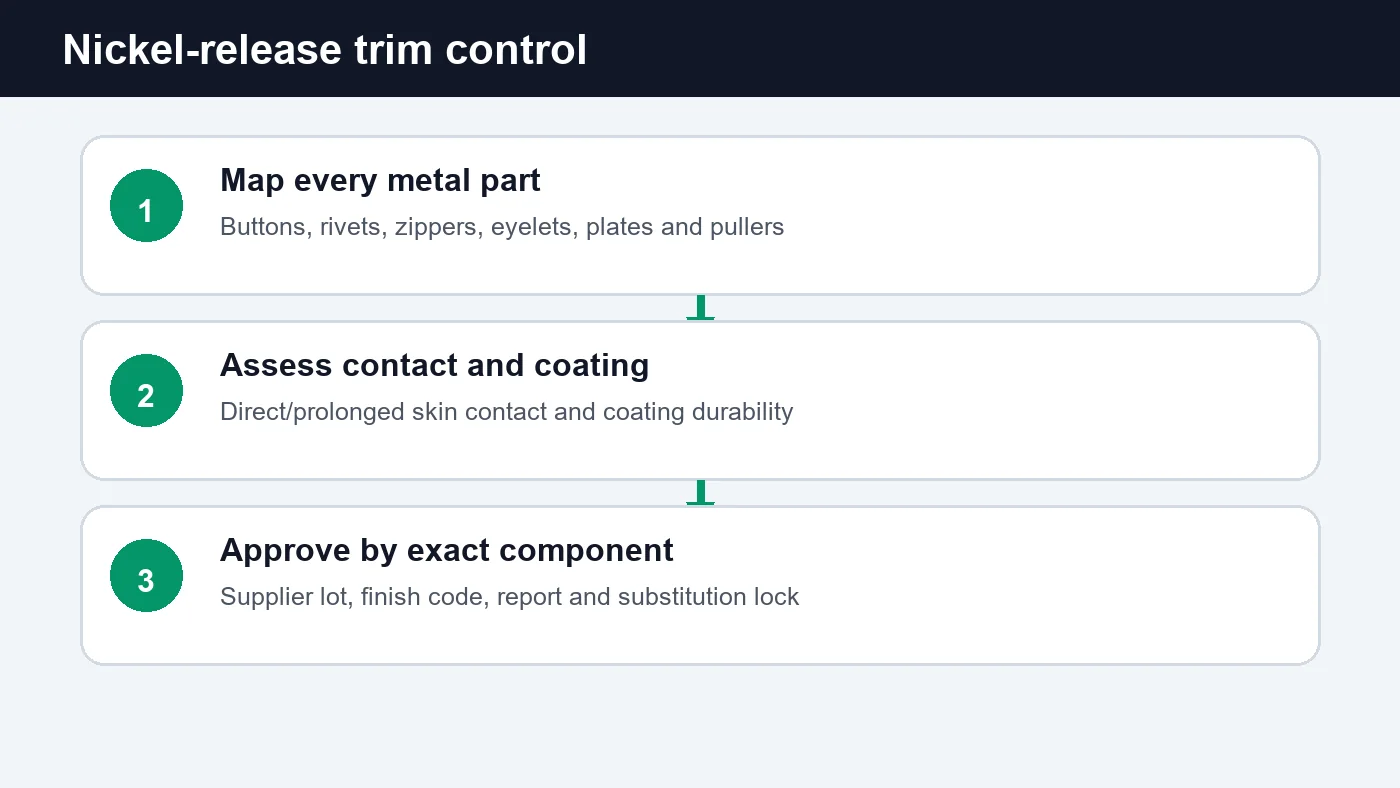
- Create a trim map. Photograph and number every exposed metal part on the garment.
- Assess skin contact. Identify direct, prolonged and repeated contact in realistic sizes and wear positions.
- Freeze the component identity. Record supplier, base material, plating, color, coating, dimensions and mold.
- Select the compliance route. Confirm the market restriction and current test method with the responsible party.
- Prepare the exact component. Test the finished trim or appropriate assembly, not an unrelated metal plaque.
- Simulate wear when required. Apply the relevant coating-wear preparation before release testing.
- Link the report to bulk. Keep photographs, lot data, purchase orders and approved samples.
What information belongs on the laboratory request?
- Style, component number, garment placement and intended wearer.
- Destination countries and applicable restriction.
- Base material, plating layers, coating, color and supplier code.
- Contact assessment and surfaces selected for exposure.
- Test method, current version and wear simulation where relevant.
- Required units, uncertainty, result format and photographs.
- Sample stage, supplier lot and approval owner.
If several components share a finish, do not automatically combine them. Geometry, surface area, edge wear, forming and post-plating assembly can affect release. Agree with the laboratory which components can be grouped and document that rationale.
How should coatings and plating be controlled?
A coating can reduce initial release but must remain effective during normal use. Specify the plating stack or coating system, thickness or process control, pretreatment, curing and appearance standard where this information is available. Require supplier notification before any chemistry, plating line or sub-supplier change.
Garment washing, enzyme treatment, abrasion and pressing may damage a decorative surface. Test production-intent components after the relevant garment process. Inspect exposed base metal, color shift, blistering, sharp edges and corrosion as separate quality properties; a nickel release report does not prove general coating durability.
How does bulk quality control protect the approved result?
- Use an approved trim card with component numbers and finish codes.
- Match bulk cartons and bags to the named supplier and purchase order.
- Inspect color, geometry, back construction and protective layers.
- Prevent mixing visually similar trims from unapproved lots.
- Retain components from each lot for investigation and retesting.
- Document corrective action when plating or component identity changes.
Connect the trim card with the manufacturing capability and quality-control plan. The factory can protect identity and traceability, while the brand or importer remains responsible for the market-specific compliance decision.
What common mistakes create compliance gaps?
- Requesting total nickel only: content does not equal release.
- Testing the wrong surface: the skin-contacting portion must match the assessment.
- Ignoring coating wear: an initial barrier may not remain effective.
- Using one report for every finish: color and plating routes can differ.
- Approving by appearance: identical-looking trims may come from different suppliers.
- Making a broad “nickel-free” claim: use wording supported by the actual method and scope.
Streetwear nickel release test frequently asked questions
Is nickel content the same as nickel release?
No. Content identifies material composition; release measures migration under a controlled condition. Market restrictions may focus on release from skin-contact articles.
Does every zipper require the same assessment?
No. Consider placement, contact, component surfaces, material and finish. A neck zipper puller can present a different scenario from a covered pocket slider.
Why is coating-wear simulation important?
A coating may control initial release but wear during use. Where applicable, the specified wear preparation evaluates the barrier before release testing.
Can one trim report cover all colors?
Only when the component identity and finish route are demonstrated to be equivalent and the compliance party accepts the grouping.
Should garment-washed metal trims be tested after washing?
The plan should represent the finished product and applicable method. Identify garment processing to the laboratory and compliance owner.
Conclusion: control the exact metal part
A reliable streetwear nickel release test program starts with a garment trim map and ends with exact component traceability. Assess real skin contact, distinguish content from release, review coating wear and lock supplier substitutions. Browse relevant streetwear products and contact Aimer Custom Lab with the trim card, destination market, garment wash and size range for project-specific confirmation.
A streetwear nickel release test record should connect each approved metal trim to its supplier lot, finish, wear simulation and bulk release decision.