Hoodie Seam Stretch Compatibility Guide
A soft hoodie can feel comfortable in the body yet fail where rib joins a sleeve, a hood meets a neckline or a pocket edge crosses stretch. A seam that is too rigid may pop; a seam with excessive reserve may grin, wave or grow. Brushed backs and thick intersections can also disturb feeding and loop formation. Buyers need location-specific construction evidence before bulk. For OEM, ODM, wholesale, teamwear and private-label buyers, hoodie seam stretch compatibility is a product-control decision, not a marketing label. This guide makes no unsupported claim about price, MOQ, capacity, lead time, certification, licensing or factory qualification; those facts require confirmation for the exact order.
Quick Answer
Hoodie seam stretch compatibility means the completed seam can follow the shell or rib movement required at its location without thread break, skipped stitches, seam opening, fabric damage, permanent growth, puckering, or discomfort. Approve the exact fabric direction, thread, needle, stitch class, seam allowance, density, differential feed, loading route, recovery time, and post-care result for representative sizes.
What is hoodie seam stretch compatibility?
Hoodie seam stretch compatibility is the functional match between the extension and recovery of a sewn assembly and the movement demanded by the garment location. It is not one fabric number. Shell fleece, rib, binding, pocket, hood and zipper areas may combine materials with different stretch, thickness and recovery, while thread and stitch geometry supply or restrict extensibility.
How should buyers compare hoodie seam stretch compatibility?
Direct answer: Compare the variables that can change both the visible outcome and the sourcing decision. The matrix below converts a subjective discussion into named inputs, evidence and common failure risks.
| Decision point | What to define | Why it matters | Common mistake |
|---|---|---|---|
| Location and motion | Neckline, cuff, hem, hood, pocket or armhole; direction and required movement | Demand differs across the hoodie | Using one generic pull test |
| Material pair | Shell, rib, lining, tape or pocket layer; stretch, recovery and thickness | Mixed materials control the assembly | Testing the shell alone |
| Thread and needle | Thread construction, size, elongation; needle point and size | Loop reserve and material damage affect failure | Selecting only by availability |
| Stitch and seam | Class, allowance, density, differential feed and coverage | Geometry determines extensibility and appearance | Copying settings across thicknesses |
| Approval route | Load or extension, cycles, recovery, care, comfort and visual criteria | A defined route turns feel into evidence | Stretching by hand without records |
How should buyers build the approval workflow?
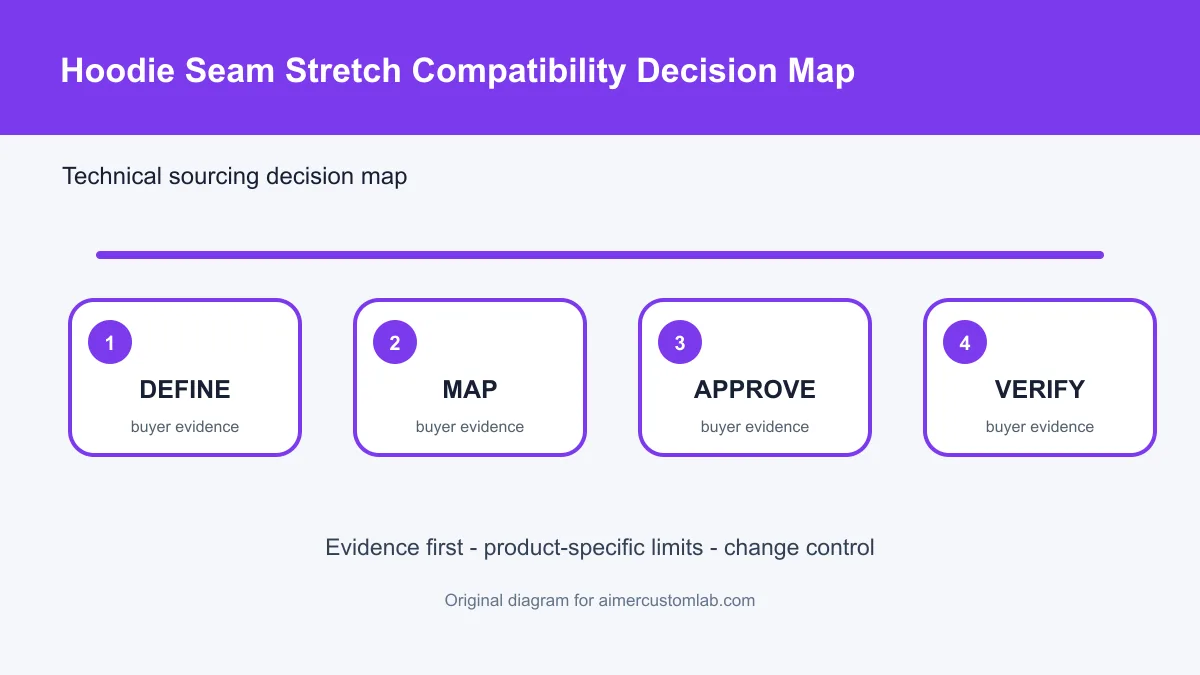
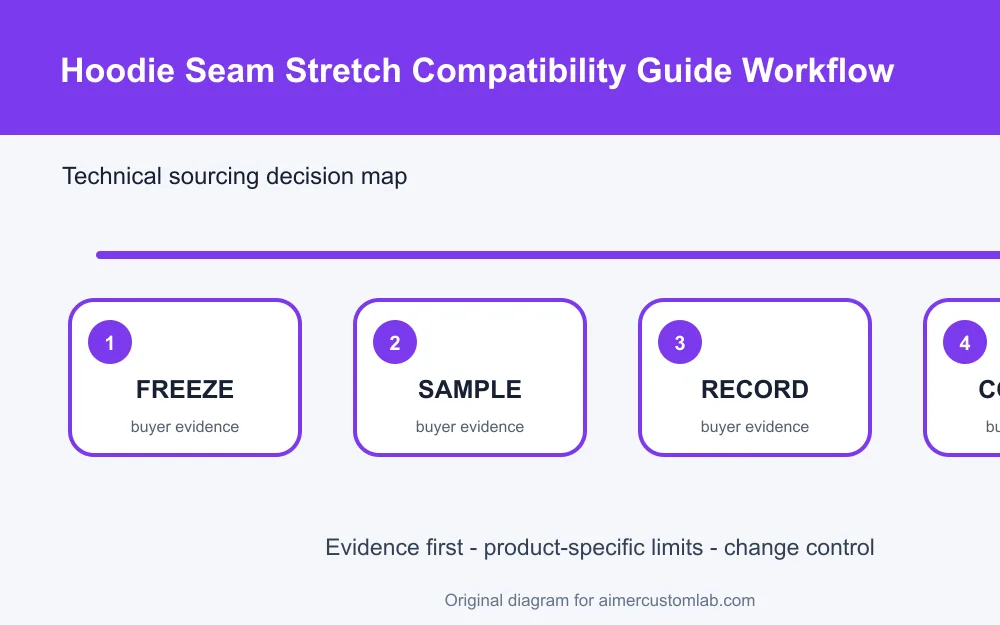
Direct answer: Freeze the question and inputs, use production-representative garments and components, record the method and intermediate behavior, inspect the finished product, and connect approval to a controlled revision.
- Map each hoodie seam by wearer movement, material combination, stretch direction, visual risk and skin contact.
- Freeze shell, rib, lining, tape, thread, needle, stitch, seam allowance, density, feed and pressing variables.
- Condition production-representative assemblies and measure their initial dimensions and appearance before loading.
- Apply the defined extension or movement cycles in the real direction while recording force, opening, skipped stitches, thread behavior and fabric damage.
- Release and measure recovery after the specified rest; inspect grinning, waviness, puckering, growth, bulk and wearer comfort.
- Repeat the evaluation after the intended care route and across justified sizes or thickness intersections.
- Lock the approved recipe by location, retain raw data and samples, and list changes that require a new compatibility check.
How should common failures be diagnosed?
The cuff seam breaks during dressing: what should be checked first?
Direct answer: Compare rib extension demand with thread elongation, stitch reserve, density, seam direction and needle damage. Preserve the original symptom, product identity and settings before correction. Change one controlled variable at a time and repeat the same inspection, because a cosmetic adjustment without a traceable cause cannot support reliable bulk production.
The hood neckline waves: what should be checked first?
Direct answer: Review differential feed, layer stretch, stabilizer, seam allowance, pressing and recovery rather than trimming the wave away. Preserve the original symptom, product identity and settings before correction. Change one controlled variable at a time and repeat the same inspection, because a cosmetic adjustment without a traceable cause cannot support reliable bulk production.
The pocket edge opens under use: what should be checked first?
Direct answer: Test the exact pocket-body assembly and reinforcement ends in the loading direction, including comfort and visual criteria. Preserve the original symptom, product identity and settings before correction. Change one controlled variable at a time and repeat the same inspection, because a cosmetic adjustment without a traceable cause cannot support reliable bulk production.
What belongs in the purchase specification?
Direct answer: The specification must let another qualified person reproduce the approved product without guessing. For hoodie seam stretch compatibility, include the following controlled fields and link each field to the relevant sample or record.
- seam location, movement and stretch direction
- shell, rib, lining, tape and pocket identities
- thread, needle, stitch class and seam type
- allowance, density, feed, tension and pressure
- specimen orientation, conditioning and care state
- load or extension, cycles and recovery period
- break, opening, damage, growth, appearance and comfort criteria
- approved recipe, samples, results and change triggers
How should sampling cover size and production risk?
Direct answer: Choose samples by variation and consequence, not convenience. Include justified small, middle and large sizes, risk colors, construction geometries, material lots, placements or wearer configurations that can change the decision. State whether each result covers only one specimen, a controlled family or a defined production lot.
How should bulk inspection and change control work?
Direct answer: Convert the approved target into measurable checkpoints, inspection timing, sample selection, defect language, disposition and escalation. Preserve the sealed sample or approved visual standard and train inspectors on the same landmarks and terminology used during development.
What evidence should accompany the approval?
Direct answer: Retain product and specimen identities, source files, revisions, conditions, raw observations, measurements, photographs, individual results, failure modes, corrective actions, owner, date, disposition and approved sample. Summary statements without raw evidence do not establish the approved construction.
What are the evidence boundaries?
Coats explains thread elongation as a seam-performance variable and its seam guidance connects construction with softness and security. Groz-Beckert explains that needle selection and sewing conditions can damage materials. These sources support the mechanism and control points but do not set one universal hoodie extension, force, cycle count or pass limit. The order specification must define the intended use and test basis.
Results apply to the specimens, files, methods and conditions evaluated. They do not automatically cover every size, color, lot, factory line, climate, wearer, competition, care behavior or destination. Confirm current external rules and intellectual-property permissions with the responsible authority for the exact market and use.
Which related products can this guide support?
- Review custom hoodie sets with branding and packaging when applying this control to a specific sourcing brief.
- Review custom zip hoodie sets for private labels when applying this control to a specific sourcing brief.
- Review custom oversized private-label T-shirts when applying this control to a specific sourcing brief.
These descriptive internal links show relevant product categories only. They do not assert a fixed construction, price, MOQ, capacity, certification or delivery time. Send the actual specification for order-specific confirmation.
Buyer checklist
Use this checklist to keep hoodie seam stretch compatibility aligned from development through final inspection.
- Seams mapped by motion
- Material pairs frozen
- Thread elongation considered
- Needle and stitch recorded
- Direction and load defined
- Recovery and care measured
- Comfort and appearance checked
- Location-specific recipes retained
Which sources informed this guide?
The following current peer and authority pages informed the information architecture, entity definitions and decision boundaries. Their wording was not copied, and commercial or product claims were not transferred to this supplier.
- Coats thread elongation technical guide
- Coats Soft and Secure Seams technical bulletin
- Groz-Beckert sewing damage guide
Research-to-page evidence map
This table shows how qualified high-traffic or fast-growth peer learning changed the public article and where the result is visible.
| Research finding | Specific application | Visible evidence |
|---|---|---|
| Connects hoodie material choices to use, feel and decoration instead of treating every hoodie as equivalent. | SEO: organized hoodie seam stretch compatibility around a buyer decision matrix and explicit failure risks. | How should buyers compare hoodie seam stretch compatibility? |
| Uses clear menswear categories and garment-led presentation, supporting a buyer-first answer and comparison route. | AEO: placed a direct 40-70 word answer before detail and followed it with a controlled approval route. | Quick Answer |
| Peer content names product entities, use cases and constraints instead of treating every garment as one generic choice. | GEO: defined the core entity, named conditions and limits, cited current sources, and separated verified facts from order-specific decisions. | What are the evidence boundaries? |
Frequently asked questions
Can fabric stretch data predict seam stretch?
Answer: Not by itself. Thread, stitch reserve, allowance, feed, damage and material combinations change the completed assembly.
Should rib joins use the body-seam recipe?
Answer: Only if evidence supports it; rib-to-shell joins often have different extension, thickness and feeding behavior.
Is thread break the only failure?
Answer: No. Seam opening, fabric damage, permanent growth, waviness, puckering, grinning and discomfort also matter.
How should representative sizes be chosen?
Answer: Select sizes and intersections where geometry, extension demand or layer thickness can materially change the result.
When must compatibility be rechecked?
Answer: Recheck fabric, finish, rib, lining, thread, needle, stitch, density, feed, pattern, grade or care changes.
Conclusion: what should a buyer do next?
hoodie seam stretch compatibility should finish as a documented, product-specific approval rather than a generic promise. Keep the controlled files, measured target, representative sample, method, raw observations, photographs, corrective action and change triggers together. That record makes repeat orders faster and reduces disputes caused by incomplete specifications.
Inquiry CTA: Send your tech pack, intended market and use, size range, pattern or garment reference, material and component details, artwork, care route, packaging route and requested evidence. Ask the team to confirm feasibility, sample details, MOQ, lead time, capacity and available supporting records for the exact order.