Hoodie Zipper Slider Lock Test Guide
A zip hoodie can pass visual inspection while the slider slowly drops during wear or fails to hold when the garment is moved. The hoodie zipper slider lock test turns that complaint into a defined component check, but only if the buyer distinguishes slider-lock holding from other zipper properties.
This guide provides a sourcing framework for full-zip hoodies, tracksuits, and jackets. It explains how to write the test request, prepare representative samples, review installation effects, and avoid inventing a universal force limit.
Quick Answer
A hoodie zipper slider lock test checks whether a locking slider resists unintended movement under an agreed load and orientation. Buyers should first confirm the zipper and slider type, then define the applicable method, specimen conditioning, sample plan, acceptance value, failure mode, and bulk traceability with the zipper supplier or laboratory.
What is hoodie zipper slider lock test?
A hoodie zipper slider lock test evaluates the holding function of a locking slider rather than the overall chain strength. It is one part of zipper qualification. Chain strength, stop strength, puller attachment, opening force, dimensional compatibility, laundering, and garment installation may require separate checks.
Which zipper property answers which buyer question?
The comparison below is a buyer decision matrix. It converts a broad quality question into inspectable evidence and makes trade-offs visible before bulk production.
| Property | Buyer question | Typical evidence | Not proven by this check |
|---|---|---|---|
| Slider-lock holding | Will the locked slider resist unintended movement? | Method, orientation, load result, failure mode | Chain strength or puller strength |
| Opening and closing force | Does the slider move smoothly along the chain? | Peak force in opening and closing directions | Lock holding under load |
| Chain and element strength | Will the teeth or coil resist lateral separation? | Specified chain-strength test result | Stop or puller durability |
| Stop and puller strength | Will end stops and the pull attachment remain secure? | Component-specific strength results | Long-term laundering appearance |
| Garment installation review | Does sewing, facing, and alignment allow normal use? | Approved hoodie sample and wear simulation | Standalone component laboratory values |
For hoodie zipper slider lock test, use this matrix during sample review and copy the agreed evidence into the purchase specification. That keeps the decision connected to the actual product rather than a generic factory promise.
Why does slider type matter before testing?
Not every slider uses the same lock mechanism. Auto-lock, semi-auto-lock, pin-lock, and non-locking constructions behave differently, and some products are intended to move freely rather than hold under load. The buyer should identify the supplier reference, material, finish, puller, chain size, and intended slider function before choosing a method.
A mismatch between slider and chain can create poor movement or unreliable holding even if the individual parts appear acceptable. Retain the complete approved zipper assembly, not only a color swatch or puller sample.
How should buyers plan a slider-lock approval test?
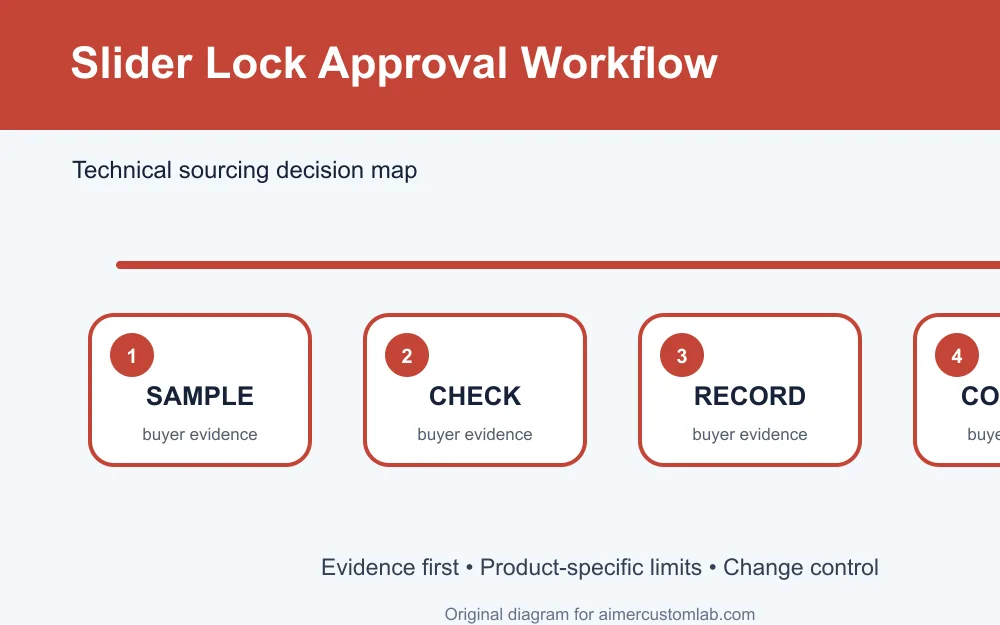
- Confirm the zipper application, slider-lock type, chain reference, puller, stops, tape, length, and garment use with the component supplier.
- Select the applicable standard or buyer method and record specimen conditioning, test orientation, loading rate or duration, and reporting units.
- Draw representative samples from the approved component lot and identify each specimen so failures can be traced.
- Test slider-lock holding separately from chain, stop, pull-off, twist, and opening-force properties required by the risk assessment.
- Review the installed zipper on a hoodie for alignment, facing interference, seam distortion, pocket load, and normal body movement.
- Approve the result with component certificates, raw readings, failure modes, photographs, and a sealed garment sample.
How can garment construction affect zipper performance?
Uneven front lengths, stretched tape, incorrect seam allowance, bulky seam intersections, or a facing caught near the chain can increase operating force and place asymmetric load on the slider. Decoration that crosses too close to the zipper may also distort the front. A component that passes in a laboratory can still perform poorly after installation.
Inspect the hoodie closed on a flat surface and on a wearer or form. Check hem alignment, pocket balance, neck opening, slider travel, fabric caught in the chain, and whether the slider remains at several practical positions. Record any installation correction separately from a component failure.
What should the bulk control plan include?
Lock the approved zipper bill of materials and supplier reference. Require notification before changing slider body, locking part, puller, chain, tape, finish, coating, stop, or subcontractor. Incoming inspection should confirm identity and appearance; periodic testing should follow the buyer’s agreed frequency and lot definition.
Inline checks should cover zipper alignment, smooth travel, stop security, and fabric clearance. Final checks can include operation and hold behavior on a defined sample. Laboratory values, sample size, and acceptance criteria must be agreed rather than inferred from this guide.
What are the standards and evidence boundaries?
ASTM D2061 includes a method for holding strength of a slider lock as well as other zipper-strength properties. ASTM D2062 addresses operating characteristics such as opening and closing force. These standards show why one test cannot represent the entire zipper system.
This article does not prescribe a universal force, sample size, or pass limit. Hoodie fabric weight, zipper size, slider design, end use, buyer protocol, and market expectations all affect the decision. Confirm the current method and threshold with the component supplier or qualified laboratory.
Which related products can this guide support?
- Review custom zip hoodie and tracksuit sets when matching this control to a production configuration.
- Review custom streetwear puffer bomber jackets when matching this control to a production configuration.
Product construction, materials, quantities, lead times, test scope, and packaging must be confirmed for the actual inquiry. The linked pages show relevant product categories; they do not replace a signed specification.
Buyer checklist
Use this checklist to keep hoodie zipper slider lock test consistent from development through final inspection.
- Slider and chain references locked
- Locking function declared
- Method and conditioning agreed
- Raw readings and failure mode retained
- Installation alignment reviewed
- Operating force checked separately
- Bulk change control defined
- Sealed component and hoodie samples kept
Standards and evidence boundaries
Use the following sources as current research inputs and confirm the applicable edition, buyer protocol, and market requirement before testing or production. No source below proves a supplier-specific certification, capacity, price, MOQ, or lead time.
- ASTM D2061 zipper strength test methods
- ASTM D2062 opening and closing method preview
- Printify trending hoodies guide
- Custom Ink hoodie guide
Research-to-page evidence map
This map records how source research changed the public guide without copying source language.
| Research finding | Specific application | Visible evidence |
|---|---|---|
| Differentiates zip and pullover hoodie use and design constraints. | Made full-zip construction and slider function explicit before testing. | Why does slider type matter before testing? |
| Uses a comparison table, process steps, and garment-specific print notes. | Added a property decision table and installation review workflow. | Which zipper property answers which buyer question? |
| Separates slider-lock holding from other zipper strength properties. | Created explicit scope boundaries and separate evidence rows. | What are the standards and evidence boundaries? |
Frequently asked questions
Is slider-lock strength the same as zipper strength?
No. It addresses one locking function. Chain, stops, puller, operating force, and installation need separate consideration.
Can a non-locking slider fail a lock test?
A non-locking slider has a different intended function. Confirm component type before applying a lock-holding requirement.
Why does the zipper work before sewing but bind in the hoodie?
Tape stretch, misalignment, seam bulk, facing interference, or fabric caught near the chain can change operation.
Should every color be tested?
Finishes and lots can affect components. Define representative coverage and change control with the supplier and buyer.
What evidence should accompany approval?
Keep the method, conditioning, specimen IDs, raw values, failure modes, component references, photos, and sealed sample.
Conclusion: how should a buyer move forward?
hoodie zipper slider lock test works best as a documented approval decision linked to the actual fabric, component, construction, route, and end use. Keep the signed sample, method, raw observations, corrective actions, and change controls together so bulk inspection can compare like with like.
Inquiry CTA: Send your tech pack, target market, quantity range, material or component specification, artwork, size range, packaging route, and requested test method. Ask the team to confirm feasibility, sampling details, MOQ, lead time, and evidence for your specific order rather than relying on general figures.